The Smooth Idle Trap: Why Your Beetle Can Sound Perfect at the Light but Fail on the Santiago Canyon Hills
📌 Key Takeaways
A smooth idle doesn't prove a vintage VW engine is healthy—it only shows the engine can run at its lowest demand.
- Hills Expose Hidden Problems: A Beetle that sounds perfect at rest may struggle on climbs because load reveals weak cylinder sealing that idle hides.
- Timing Can Mask Trouble: Advanced ignition timing makes tired engines feel peppier at idle, but the trick fails when the engine has to work hard uphill.
- Get the Numbers: Compression and leakdown tests give you objective data—healthy engines show 110–135 PSI with cylinders within 10% of each other.
- Use the Must-Do Framework: Sort findings into "fix before buying," "budget for soon," or "just monitor" so you know exactly what you're getting into.
- Trust Your Senses Under Load: Flattening pull, hollow exhaust sounds, and hot fuel smells on a grade tell you more than any driveway demo.
Objective testing turns hope into confidence before you buy.
Classic VW shoppers in Orange County will learn how to spot engine problems sellers can't hide, preparing them for the diagnostic details that follow.
~ ~ ~ ~ ~ ~ ~ ~ ~ ~ ~ ~ ~ ~ ~ ~ ~ ~
That rhythmic air-cooled thrum at the seller's curb feels reassuring. Steady. Settled. The engine sounds happy just sitting there. Then you head east toward Santiago Canyon, the road tilts upward, and something changes.
The pull flattens. A whiff of hot, unburned fuel drifts through the vent. The engine that sounded so confident at idle now struggles to translate RPMs into forward momentum. This is the smooth idle trap—and it catches vintage VW buyers more often than you might expect.
Think of compression and leakdown testing as your engine's blood pressure and lung capacity check. A smooth idle is like a resting heart rate: useful, but it does not tell you what happens when the body is asked to perform. The real truth about a classic Beetle's mechanical health shows up under load, not at a stoplight. Understanding that difference is the first step toward buying with confidence instead of hope.
The Myth: A Smooth Idle Means the Engine Is Fine
A pleasant idle is reassuring, but it is incomplete evidence. An air-cooled VW can sound perfectly settled at rest and still carry internal problems that only reveal themselves when the engine is actually working.
The confusion makes sense. A rough idle is obviously bad, so a smooth one must be good—right? Not necessarily. Idle quality tells you whether the engine can maintain combustion at its lowest demand. It does not tell you whether the cylinders are sealing properly, whether the rings are worn, or whether the valves are holding pressure the way they should.
This is where many first-time vintage VW buyers get caught. The car starts easily. It settles down. It does not shake the whole cabin. The seller smiles. Everyone relaxes. But plenty of Beetles with tired internals will idle like champions. The problems hide until you ask the engine to do something harder than just sitting there. A seller's driveway demo, no matter how smooth it sounds, is not a mechanical verdict. It is one data point among many—and not the most important one.
What Idle Can Hide When Timing Is Doing Too Much Work
Here is the mechanism that creates the trap: ignition timing can mask internal sealing issues until the engine is strained.
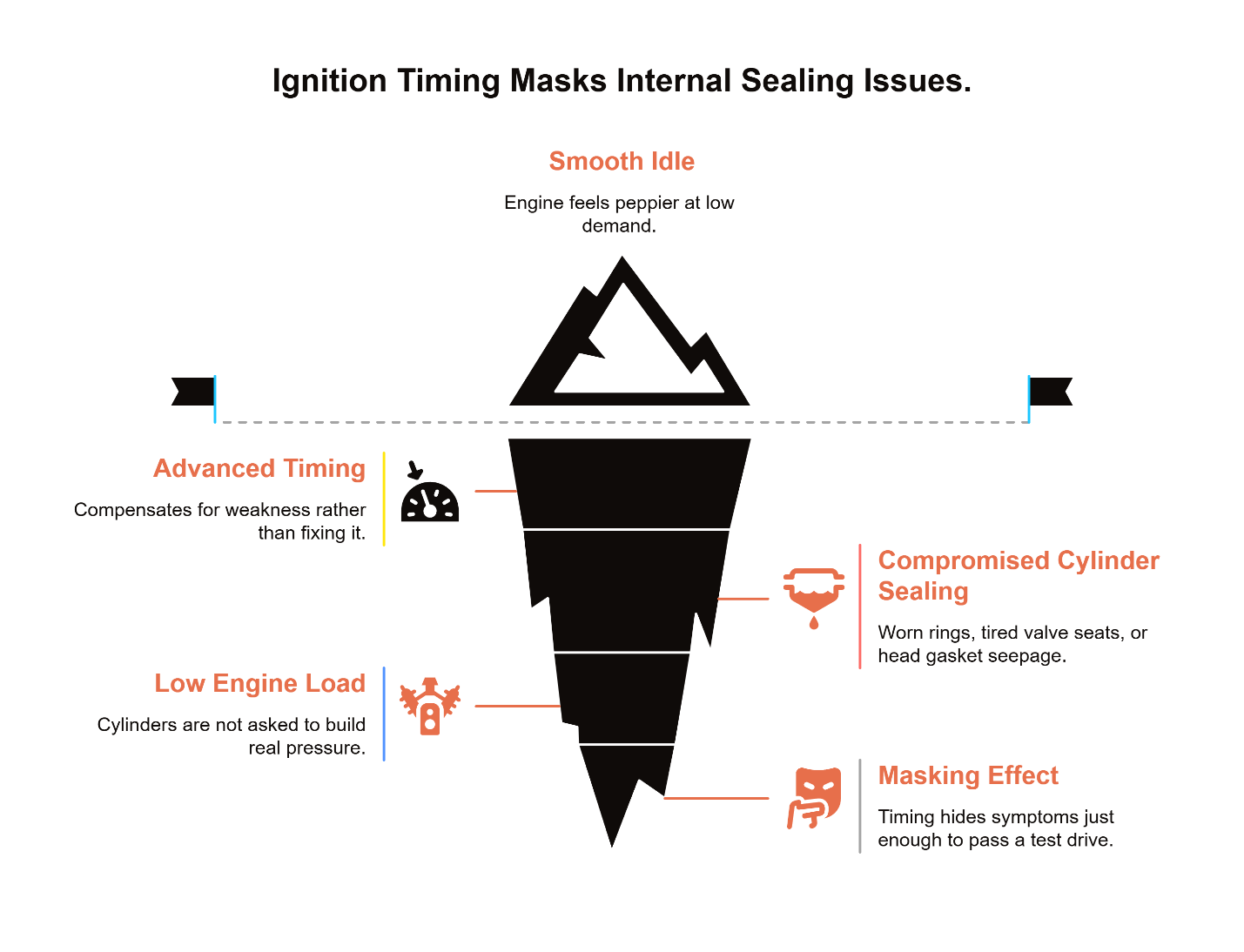
On an air-cooled VW, advancing the timing makes the engine feel peppier at low demand. It can smooth out a rough idle and give the impression of a healthy, responsive motor. That does not mean timing is a trick. It means timing can temporarily flatter the situation. The adjustment compensates for weakness rather than fixing it. When cylinder sealing is compromised—worn rings, tired valve seats, or head gasket seepage—advancing the timing can hide the symptoms just enough to pass a casual test drive.
The masking effect works because idle places almost no load on the engine. Combustion happens, but the cylinders are not being asked to build real pressure against resistance. Once the engine has to pull weight up a grade, the timing trick stops working. The weak sealing that was invisible at idle becomes obvious under load.
This is why proper diagnostics separate symptoms from causes on air-cooled engines. A smooth idle is a symptom of adequate low-load combustion. It is not proof of mechanical integrity.
Why the Santiago Canyon Climb Exposes the Truth
Orange County driving includes enough flat roads that a weak engine can hide for a while. But Santiago Canyon changes the equation. The grade is steady, the load is real, and an air-cooled engine has to work.
This is where the smooth idle trap collapses. On the climb, a healthy vintage VW pulls steadily. The exhaust note stays consistent. The throttle response feels proportional to your input. A weak engine tells a different story: the pull flattens earlier than it should, the exhaust develops a hollow puffing quality, and you catch that unmistakable smell of hot, unburned fuel—the scent of an engine running rich because it cannot build enough cylinder pressure to burn efficiently.
These sensory cues matter. They are the real-world proof test that a driveway demo cannot replicate. If you are evaluating a vintage VW in Orange County, a hill-load test is not optional. It is the moment when the engine has to show you what it actually has. Your senses can tell a specialist a great deal about what is happening inside—but only if you give the engine a reason to reveal it.
Compression and Leakdown: The Numbers That Matter More Than the Idle
If the hill-climb test raises questions, compression and leakdown testing provide the objective answers. These are analog verification tools that cut through subjective impressions and timing tricks.
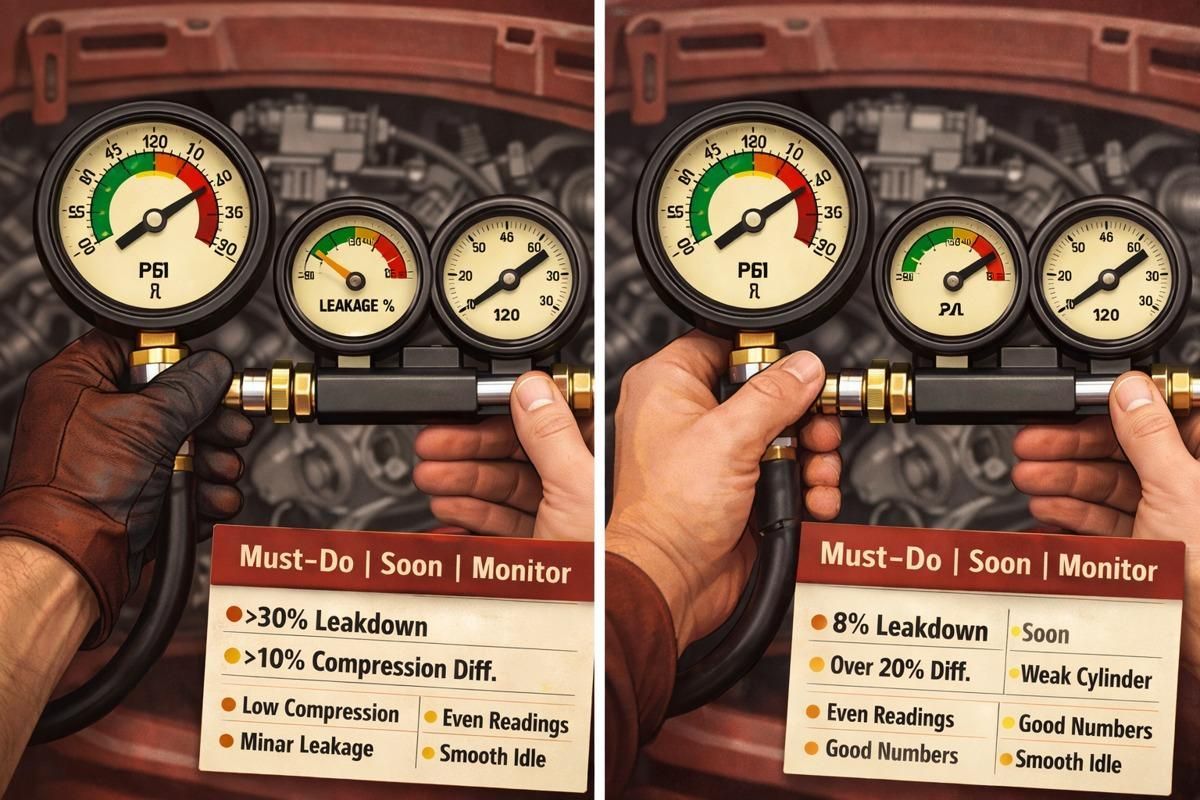
A compression test measures how much pressure each cylinder builds during the compression stroke. Healthy, stock vintage VW engines generally show estimated readings of 110–135 PSI, though modified or freshly rebuilt motors may run higher, but the single most important factor is consistency across all four cylinders. A spread of more than 10% between the highest and lowest cylinder is more concerning than any individual number. One cylinder at 140 PSI and another at 110 PSI tells you something is wrong—even if 110 sounds acceptable in isolation.
A leakdown test goes further. It measures how quickly pressurized air escapes from each cylinder, revealing where the sealing is failing: rings, valves, or head gasket. Leakdown under 10% is strong. Over 20% means work is needed. The test also tells you where the air is going, which helps prioritize what kind of repair the engine actually needs.
Together, these numbers become your primary negotiation tool. A buyer who walks in with compression and leakdown data has leverage. A buyer who relies on idle impressions alone is guessing. For a deeper dive into interpreting these benchmarks, see our guide on what compression and leakdown numbers mean for buyers.
A Buyer's Decision Framework: Must-Do, Soon, or Monitor
Numbers and sensory observations only help if you can translate them into a decision. Here is a simple framework that converts inspection findings into actionable categories:
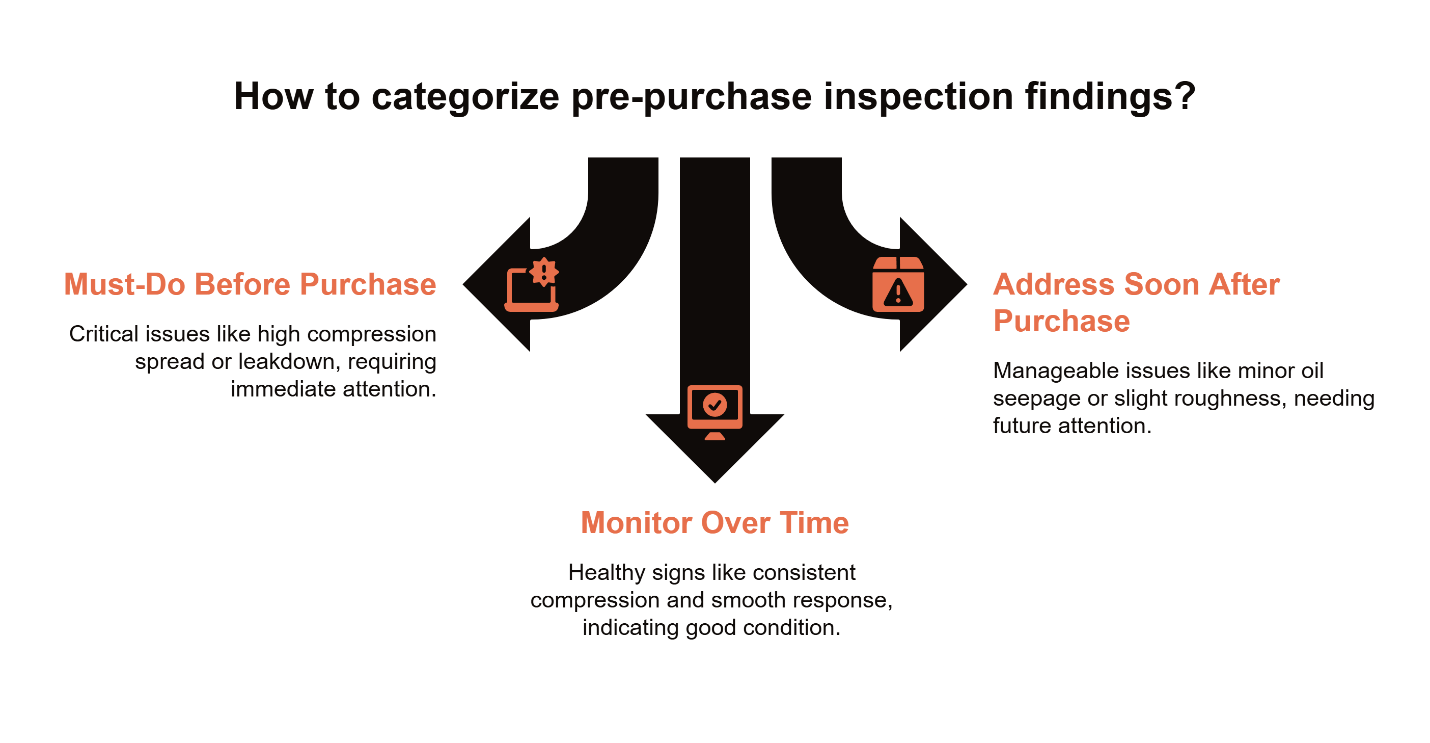
Must-Do Before Purchase: Any cylinder showing more than 10% compression spread from the others. Leakdown exceeding 20% on any cylinder. Obvious exhaust smoke, fuel smell under load, or audible blow-by. These findings mean the engine needs work before it is reliable—and you should negotiate accordingly or walk away.
Address Soon After Purchase: Leakdown between 10% and 20%. Minor oil seepage that is stable, not worsening. Slight roughness under load that does not indicate catastrophic wear. These issues are manageable but should factor into your budget and timeline.
Monitor Over Time: Consistent compression within 10% across cylinders. Leakdown under 10%. Smooth, proportional response under load. Stable oil consumption. These are healthy signs. Keep records, maintain the engine properly, and enjoy the car.
This framework works for any pre-purchase inspection—not just engine evaluation. The same logic applies to brakes, steering, and tires as well. The goal is to replace vague worry with a clear, prioritized action list.
When a Smooth Idle Still Deserves a Professional Inspection
A smooth idle is not meaningless. It is one piece of evidence that the engine is running. The mistake is treating it as the whole story.
Even when a Beetle sounds settled and the hill-climb test feels encouraging, professional verification matters. A compression and leakdown test takes less than an hour and gives you objective data that no test drive can provide. It is not about distrust or paranoia—it is about knowing what you are buying before you commit.
A calm pre-purchase inspection can do more than confirm compression and leakdown. It can help document repair history, preserve originality, and separate "buy it" from "buy someone else's problem."
Orange Independent Auto Repair has been helping vintage VW owners in Orange County since 1971. Our approach to classic car maintenance is built on honest diagnostics, transparent communication, and education. If you are evaluating a purchase, we can run the tests, explain the results, and help you understand what the numbers mean for your specific situation. No pressure, no upsell—just the information you need to make a confident decision. You can learn more about our full range of services or reach out directly.
The Difference Between Hope and Confidence
The Beetle that sounded perfect at the seller's curb might be perfect. Or it might be a timing-masked engine waiting to reveal itself on the first real climb. You cannot know from idle alone.
A smooth idle is a baseline, not a bill of health. The real buying decision should rest on cylinder consistency, leakdown interpretation, and what the engine does when it has to work. Those are the metrics that separate a good purchase from an expensive lesson.
If you are shopping for a vintage VW in Orange, Tustin, Anaheim, Yorba Linda, or Villa Park, take the canyon test. Listen for what changes. Then get the numbers that tell you the rest of the story. A short conversation or inspection with Orange Independent Auto Repair can help you evaluate a vintage VW with more clarity and less risk. That is how you move from hoping the engine is healthy to knowing it is.
Our Editorial Process
Our expert team uses AI tools to help organize and structure our initial drafts. Every piece is then extensively rewritten, fact-checked, and enriched with first-hand insights and experiences by expert humans on our Insights Team to ensure accuracy and clarity.
About the Orange Independent Auto Repair Insights Team
The Orange Independent Auto Repair Insights Team is our dedicated engine for synthesizing complex topics into clear, helpful guides. While our content is thoroughly reviewed for clarity and accuracy, it is for informational purposes and should not replace professional advice.