
Carb Sync or Timing? How Proper Diagnostics Separate Symptoms from Causes on Air-Cooled VWs
📌 Key Takeaways
Measure ignition timing and carb sync in sequence—not simultaneously—to identify the real problem without wasting money on unnecessary parts.
- Baseline Before Adjustments: Confirm compression, valve clearance, and vacuum integrity first—tuning around hidden mechanical issues just masks deeper problems.
- Ignition Comes Second: Verify spark consistency and timing behavior across all cylinders before touching carburetor settings, since weak spark mimics fuel delivery failures.
- Balance After Spark: Carburetor synchronization only reveals true cylinder contribution once you've confirmed the ignition system delivers stable, even spark.
- Document Every Finding: Photo-backed compression numbers, timing readings, and mixture screw positions create proof that prevents repeat diagnostics and protects your budget.
- Symptoms Overlap Constantly: Lumpy idle, hesitation, and popping can indicate either timing or carb issues—pattern observation (cold/hot, idle/load, sudden/gradual) separates guesses from answers.
Sequence beats guesswork—measure one variable at a time.
Classic VW and Porsche owners seeking reliable weekend drivability will gain diagnostic clarity here, preparing them for the detailed mechanical explanations that follow.
Your classic air-cooled VW starts hesitating on the freeway on-ramp. The idle feels lumpy at stoplights. You're wondering: is it the carbs or the timing?
Here's the reality. Those symptoms could point to either system—or both at once. The engine doesn't care about convenient categories. What it needs is a methodical sequence that measures one variable at a time, so you're not chasing ghosts or replacing parts that aren't broken.
Think of it like a luthier tuning a vintage instrument: you don't chase one "off" string until you've confirmed the whole instrument is stable and in tune together.
Quick answer: carbs or timing?
If your classic air-cooled VW suddenly idles rough, pops, or feels flat, it might be carb sync, timing, or both. The fastest way to know is a sequence: confirm baseline engine health, verify ignition integrity and timing behavior, then evaluate fuel delivery and balance. Measuring in order separates symptoms from the real cause.
Don't change two variables at once. That's where confusion—and unnecessary expense—starts.
Why classic air-cooled VWs make this confusing
Classic air-cooled Volkswagens are wonderfully honest by modern standards—mechanically simple, which is part of their charm. That simplicity also means small changes can produce big symptoms.
A rough idle might stem from uneven fuel delivery between cylinders. Or it could be spark arriving a few degrees too early under load, causing the engine to fight itself. Sometimes it's both systems nudging each other out of balance.
The problem isn't the car. It's the approach. Seat-of-the-pants guesses rarely work when two systems interact this closely. Sequence beats guesswork.
What ignition timing changes (in plain terms)
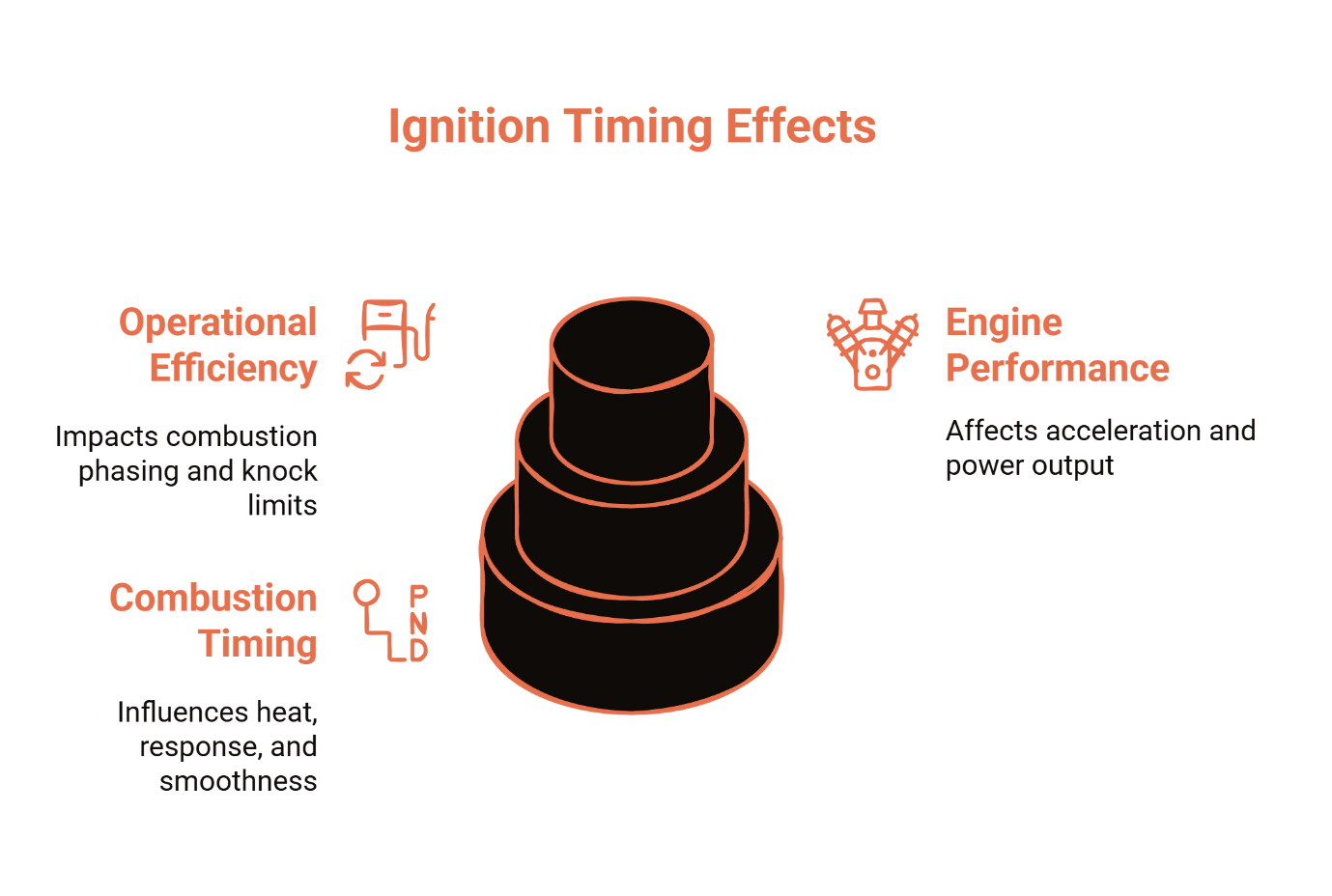
Ignition timing controls when the spark plug fires relative to the piston's position in the cylinder. On a classic air-cooled engine, spark typically occurs a set number of degrees before the piston reaches the top of its stroke—what's called "before top dead center" or BTDC.
When timing is set correctly, the fuel-air mixture ignites at the right moment to push the piston down smoothly. If timing is too advanced (spark happens too early), the mixture ignites while the piston is still traveling upward. This creates a knock or ping and can feel like hesitation under load. If timing is too retarded (spark happens too late), the engine loses power and may overheat because combustion continues into the exhaust stroke.
You'll feel timing issues most clearly during acceleration or climbing hills. The engine may respond sluggishly, or you might hear a metallic rattle that shouldn't be there. At idle, incorrect timing can contribute to uneven running, but it's rarely the only culprit at low RPM.
Modern engine research continues to treat spark timing as a major control variable because it directly affects combustion phasing, efficiency, and knock limits across operating conditions.
The key point: timing affects when combustion happens, which influences heat, response, and smoothness across the entire RPM range.
What carb sync changes (in plain terms)
Carburetor synchronization addresses a different question: are all cylinders contributing evenly?
On a dual-carb setup, each carburetor feeds two cylinders. If one carb is delivering slightly more fuel or air than the other, those two cylinders will produce more power than their counterparts. The result is an unbalanced idle—shaky, lumpy, and inconsistent.
Think of it like a four-person rowing crew where two rowers are pulling harder than the others. The boat moves forward, but it wobbles. A classic air-cooled engine with poor carb sync does the same thing: it runs, but the power pulses feel uneven.
Carb sync issues show up most clearly at idle and during steady cruise speeds. Acceleration might mask the imbalance temporarily because all cylinders are working harder. But when you settle into a steady 55 mph, that wobble comes back.
The key point: carb sync affects cylinder-to-cylinder balance, which influences idle quality and consistent power delivery.
Symptom overlap: the two-minute reality check
This is where it gets tricky. Many symptoms can point to either system—or both.
When it shows up:
- Cold start only → more likely fuel delivery or choke function
- Fully warm, especially under load → more likely timing or mixture
- At idle only → often carb sync, but timing can contribute
- Steady cruise with occasional hesitation → could be either system
What it feels or sounds like:
- Lumpy, uneven idle → carb sync is a prime suspect
- Popping through the carbs on deceleration → often timing-related, but can indicate lean mixture
- Flat spots during acceleration → timing, mixture richness, or both
- Metallic rattle under load → typically timing too advanced
What changed recently:
- Long storage period → fuel system issues are common (varnish, stale fuel)
- Recent carburetor work → sync may have drifted
- Recent distributor work → timing baseline may have shifted
- Sudden symptom with no recent work → look for a mechanical failure (vacuum leak, worn component)
The pattern matters more than any single symptom. Don't jump to conclusions based on one data point.
The diagnostic-first sequence that separates symptoms from causes
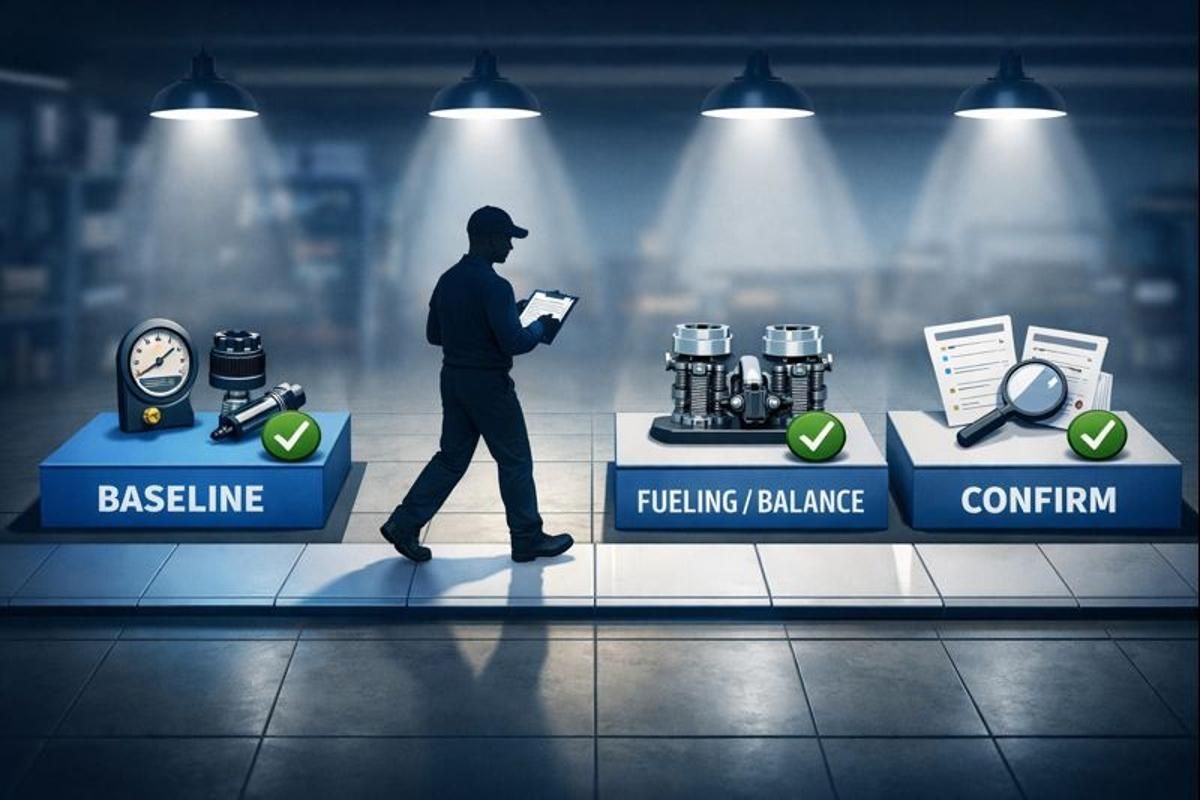
The sequence follows four clear phases: Baseline → Ignition → Fueling/Balance → Confirm. Each phase reduces variables before moving forward.
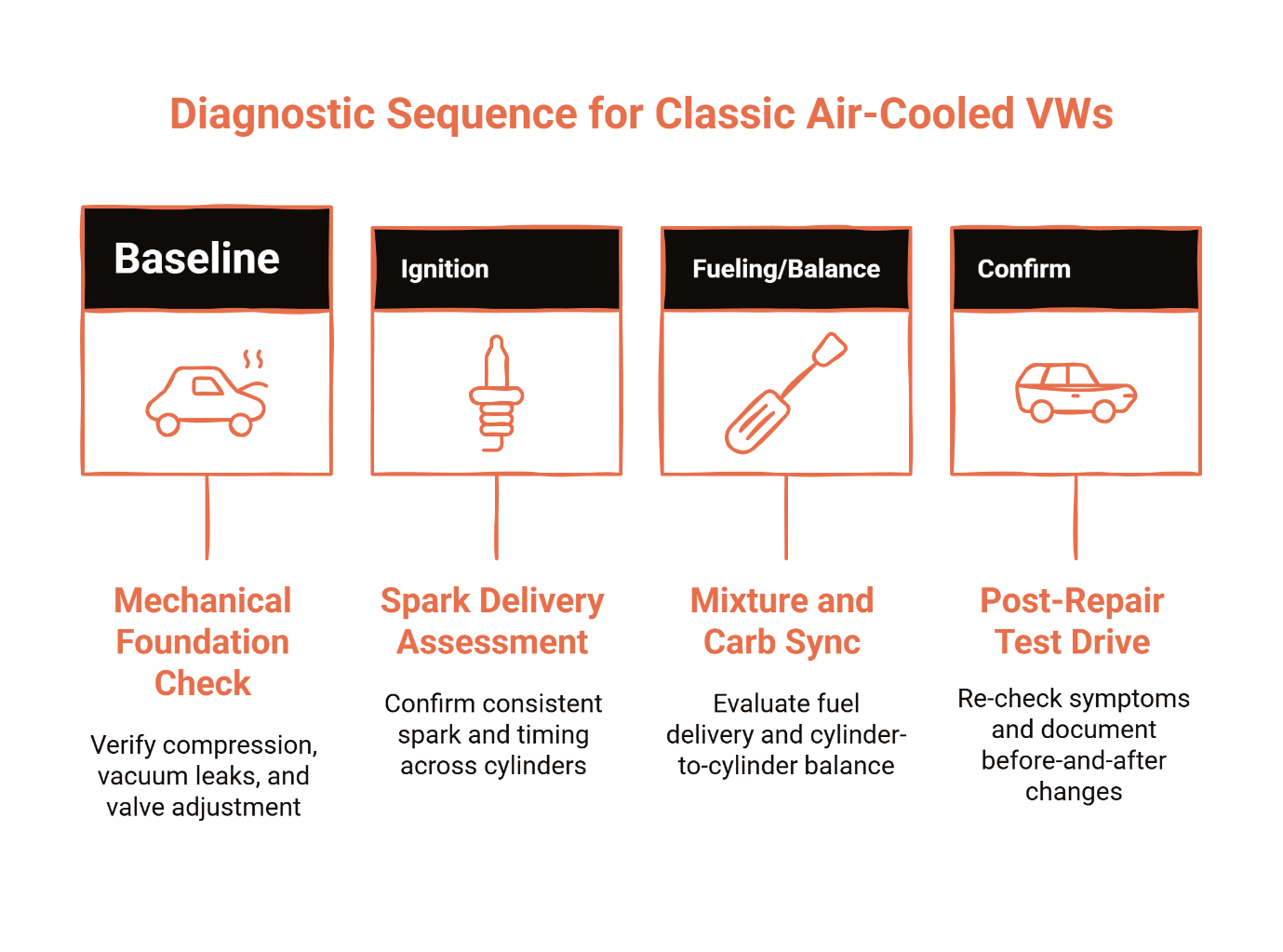
Here's the sequence that prevents guessing:
1. Baseline first: Confirm the engine has a stable foundation
Good compression, no major vacuum leaks, valves adjusted to spec. If you tune around a deeper mechanical issue, you're just masking the problem. Photo-backed compression readings and valve clearance notes become part of your permanent record.
2. Ignition next: Verify that spark delivery is consistent
Check across all cylinders and confirm that timing behavior makes sense under different conditions. This includes checking distributor condition, plug wires, and observing how timing responds to load. Documented timing readings (idle and advance curve) show you what's actually happening, not what you assume is happening.
3. Fueling and balance: Evaluate mixture delivery and cylinder-to-cylinder balance
This is where carb sync comes into play, but only after you know the ignition side is solid. Photos of mixture screws, float heights, and air filter condition provide a clear reference point for future work.
4. Confirm: Re-check symptoms with a short test drive
Document before-and-after notes so you can see what changed and what didn't.
This sequence isolates variables. You're not adjusting two things and hoping for the best. You're measuring, documenting, and building a plan based on evidence. This approach aligns with California BAR's consumer guidance on diagnosis before repair authorization.
The documentation matters. When you have photos of your plug condition, compression numbers, and timing readings, you're not relying on memory or vague descriptions. You have proof of what was found and what was done.
What to observe before you call
You don't need tools to gather useful information. Pay attention to patterns:
Does it happen cold, hot, or both?
Cold-only symptoms often point to choke function or cold-start enrichment. Hot-only symptoms suggest heat-related issues like vapor lock or a component that changes behavior as it warms up.
Does it worsen under load?
Hills, freeway on-ramps, and passing maneuvers put stress on both timing and fueling. If the symptom only appears under heavy throttle, that's a clue.
Any fuel smell, smoke, or sudden change?
A strong fuel smell suggests a leak or severe over-rich condition—don't keep driving. Visible smoke (blue, black, or white) indicates oil burning, overly rich mixture, or coolant intrusion (rare on air-cooled, but possible with aftermarket systems). A sudden, severe change in drivability is a red flag.
Did it appear suddenly or gradually?
Gradual onset over weeks suggests wear or drift. Sudden onset points to a specific failure: a wire came loose, a component broke, or something shifted during recent work.
Anything changed recently?
New symptom after storage? After a repair? After switching fuel stations? Context narrows the field.
These observations speed up diagnosis. When you call a specialist, you're providing a starting point that saves time and reduces trial-and-error.
What you get from a specialist diagnostic in Orange, CA
A proper diagnostic isn't just a mechanic poking around. It's a structured process that gives you clarity before you spend a dollar on parts.
Clear explanation in plain language. You shouldn't need a decoder ring to understand what's happening with your car. The findings get explained in terms that make sense: what's broken, what's drifting, what's fine but will need attention soon.
Photo-backed findings. Pictures of your plug condition, distributor wear, or carburetor internals aren't just for show. They're evidence. You see what we see, which builds trust and makes the plan easier to approve.
A prioritized plan. Not everything needs to be fixed at once. The findings get sorted into Must-Do (safety or drivability critical), Soon (prevent bigger issues), and Monitor (keep an eye on it). This protects your budget and respects the originality of your car.
Communication cadence. You'll know what to expect: when you'll hear back, what the next steps are, and what the realistic timeline looks like. No surprises, no vague "we'll call you when it's done."
For local owners in Orange, Anaheim, Villa Park, Tustin, and Yorba Linda, that means you can plan your weekend around reliable drivability. You're not guessing whether the car will make it to a Sunday cruise around the Orange Plaza—you know it will, because the work is documented and the sequence was followed.
Our team has worked on classic VW and Porsche models since 1971. If you're looking for classic car maintenance that prioritizes evidence over hunches, that's the process. It's not fast food; it's methodical. But it's also the difference between fixing it once and fixing it three times.
Frequently Asked Questions
Can timing issues feel like carb problems?
Yes. If timing is too advanced or too retarded, the engine can feel rough or unresponsive in ways that mimic fuel delivery issues. The only way to know is to measure both systems in sequence rather than guessing based on symptoms alone.
Can carb sync issues feel like ignition problems?
Absolutely. Uneven cylinder contribution from poor carb sync can produce a lumpy idle or hesitation that feels like a misfire. Again, sequence matters. Verify ignition integrity first, then evaluate fueling and balance.
Is it safe to drive with a rough idle?
It depends. A mildly lumpy idle is annoying but not immediately dangerous. If you're experiencing severe hesitation, strong fuel smell, visible smoke, or a sudden loss of power, stop driving and have it checked. When in doubt, err on the side of caution—classic cars don't have the safety margins of modern vehicles.
Why not just adjust carbs first?
Because if the real issue is timing or a vacuum leak, adjusting carbs will just mask the symptom temporarily. You'll chase your tail for weeks. The diagnostic sequence exists to prevent that waste of time and money.
What should I tell the shop to speed up diagnosis?
Share your observations: when it happens (cold/hot, idle/load), what it feels like, what changed recently, and any work done in the past six months. Clear context helps the shop prioritize the right tests. If you have documentation from previous work—especially Auto Repair Invoice Transparency with part numbers and dates—bring it.
How do you avoid paying for parts that don't fix it?
Insist on a diagnostic-first approach with documented findings before any parts are ordered. Ask to see the evidence (photos, measurements, notes) and get a prioritized plan that explains Must-Do versus Soon versus Monitor. Shops that follow this process are less likely to recommend unnecessary parts because the evidence guides the recommendation. For more on maintaining clear records, see our guide on How to Document Auto Repair Parts Installation.
If you want this answered without guessing, services at Orange Independent Auto Repair start with a clear diagnostic. Call (714) 633-7161 to schedule, or stop by 187 S Main St, Orange, CA 92868. We're open Mon–Fri 7am–6pm, and Saturdays by appointment only.
Our Editorial Process:
Our expert team uses AI tools to help organize and structure our initial drafts. Every piece is then extensively rewritten, fact-checked, and enriched with first-hand insights and experiences by expert humans on our Insights Team to ensure accuracy and clarity.
About the Orange Independent Auto Repair Insights Team
The Orange Independent Auto Repair Insights Team is our dedicated engine for synthesizing complex topics into clear, helpful guides. While our content is thoroughly reviewed for clarity and accuracy, it is for informational purposes and should not replace professional advice.