Consistency Over Numbers: Why PSI Variance Across Your Air-Cooled Cylinders Matters More Than the Total
📌 Key Takeaways
When buying a classic VW, compare all four cylinder compression readings—tight grouping matters more than one impressive number.
- Spread Beats Headlines: A seller bragging about "150 PSI compression" is misleading if three other cylinders sit at 115–122; balance reveals true engine health.
- Under 10% Variance Is Ideal: Calculate the gap between your highest and lowest readings—under 10% is green, 10–15% is caution, over 15% needs investigation.
- Tight Clusters Beat Flashy Outliers: Four cylinders at 122–128 PSI is more reassuring than one at 150 paired with three weak readings dragging along behind.
- Compression Raises Questions, Leakdown Answers Them: When spread looks suspicious, a leakdown test pinpoints whether air escapes through valves, rings, or gaskets.
- Numbers Should Match the Drive Feel: If the car sounds smooth but readings are uneven, something is hiding—trust the data over the idle quality.
Balanced cylinders mean the engine works as a team, not one cylinder carrying three passengers.
Buyers evaluating vintage Beetles or Buses will use these screening rules to spot misleading compression claims, preparing them for the inspection checklist that follows.
~ ~ ~ ~ ~ ~ ~ ~ ~ ~ ~ ~ ~ ~ ~ ~ ~ ~
The warm smell of raw gasoline drifts up from the engine bay. You're leaning over a '72 Beetle in someone's driveway, and the seller just handed you a compression test sheet. One cylinder shows 148 PSI. That sounds strong. But before you get excited, look at the other three numbers.
Compression numbers only become useful when you compare all four cylinders together. On an air-cooled VW, a tightly grouped set of readings usually tells you more about real engine health than one eye-catching PSI number. Balance hints at consistent sealing. Wide spread hints at uneven wear, valve trouble, or a deeper story that deserves a leakdown test and a proper inspection.
Think of it as the engine's blood pressure and lung capacity test. A healthy vintage VW doesn't need to hit a magic number—it needs all four cylinders working together.
The Fast Answer: Why Spread Beats the Headline Number
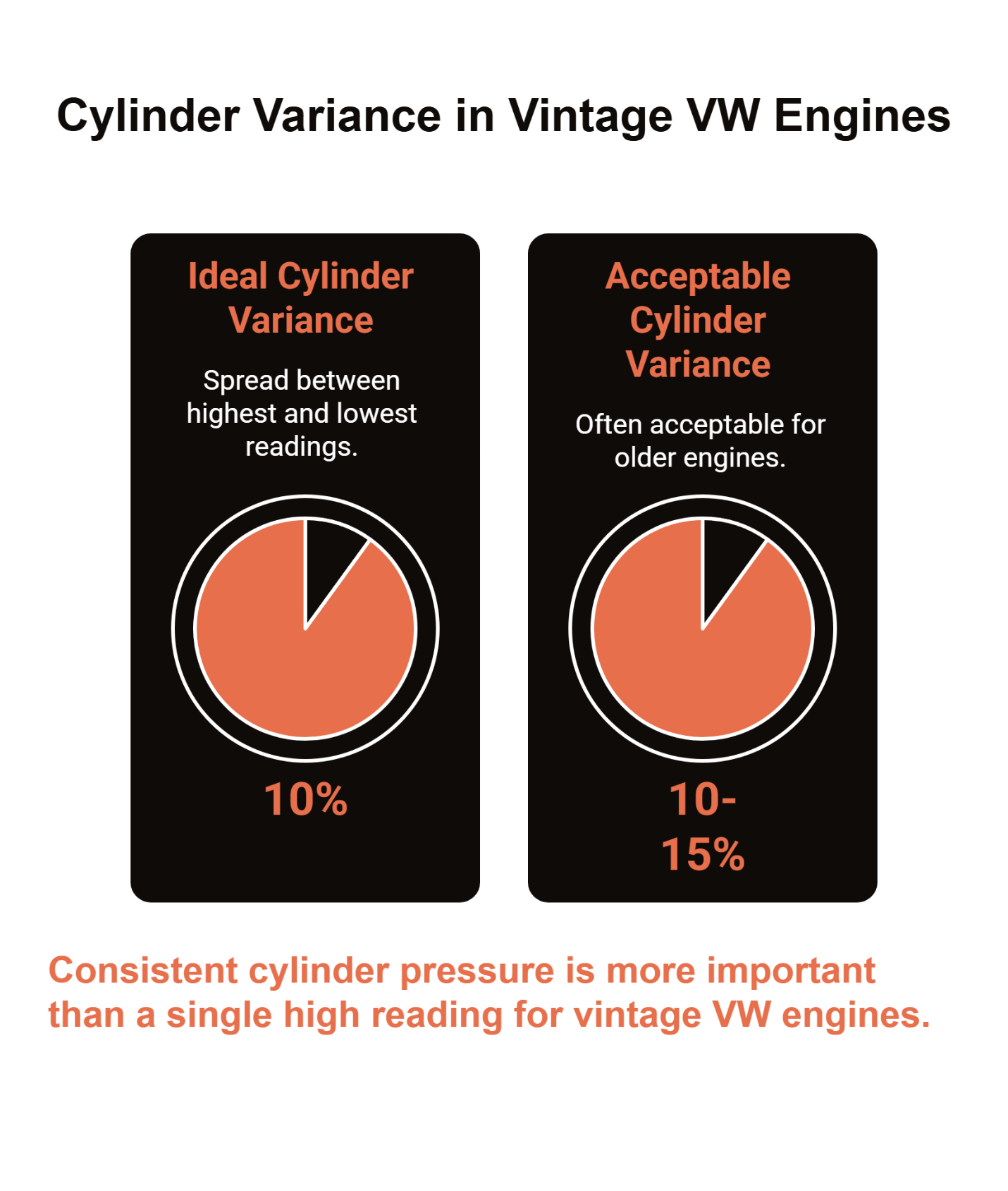
Cylinder variance is the difference between the highest and lowest compression readings across your engine. For buyer screening on a classic VW, a spread of under 10% between cylinders is the ideal safe band, though up to 15% is often acceptable for older engines. Readings in this tighter range suggest consistent sealing. Wider gaps raise questions worth investigating.
Here's why one impressive number can mislead you. A seller might quote "148 PSI compression" and feel confident about it. But if that 148 comes from cylinder one while cylinders two, three, and four sit at 118, 122, and 115, you're not looking at a strong engine. You're looking at one cylinder that's sealing well and three that aren't keeping up. The headline number masks the imbalance.
Balanced cylinder pressure reduces uncertainty in a vintage VW buying decision. Chasing one big PSI reading does the opposite—it distracts you from what the whole engine is actually doing.
What a Healthy Four-Cylinder Pattern Looks Like
Picture a test sheet showing 125, 128, 124, and 127 PSI across the four cylinders. None of those numbers would make a seller brag, but they should make a buyer relax. That tight clustering—just 4 PSI separating the lowest from the highest—suggests all four cylinders are sealing consistently. The engine is telling one story, not two.
Warm-engine testing matters here. A proper compression test happens after the engine reaches operating temperature, because cold readings bounce around and create false spreads. When someone shows you numbers taken on a warm engine and the readings repeat within a few PSI on a second test, you're seeing reliable data.
Balanced readings don't guarantee anything about the rest of the car. Rust could still be hiding in the heater channels. The transmission might have its own problems. But even cylinder vitals tell you the top end of the engine is holding together as a system, which removes one major uncertainty from your decision.
When a Strong Top Number Still Hides Risk
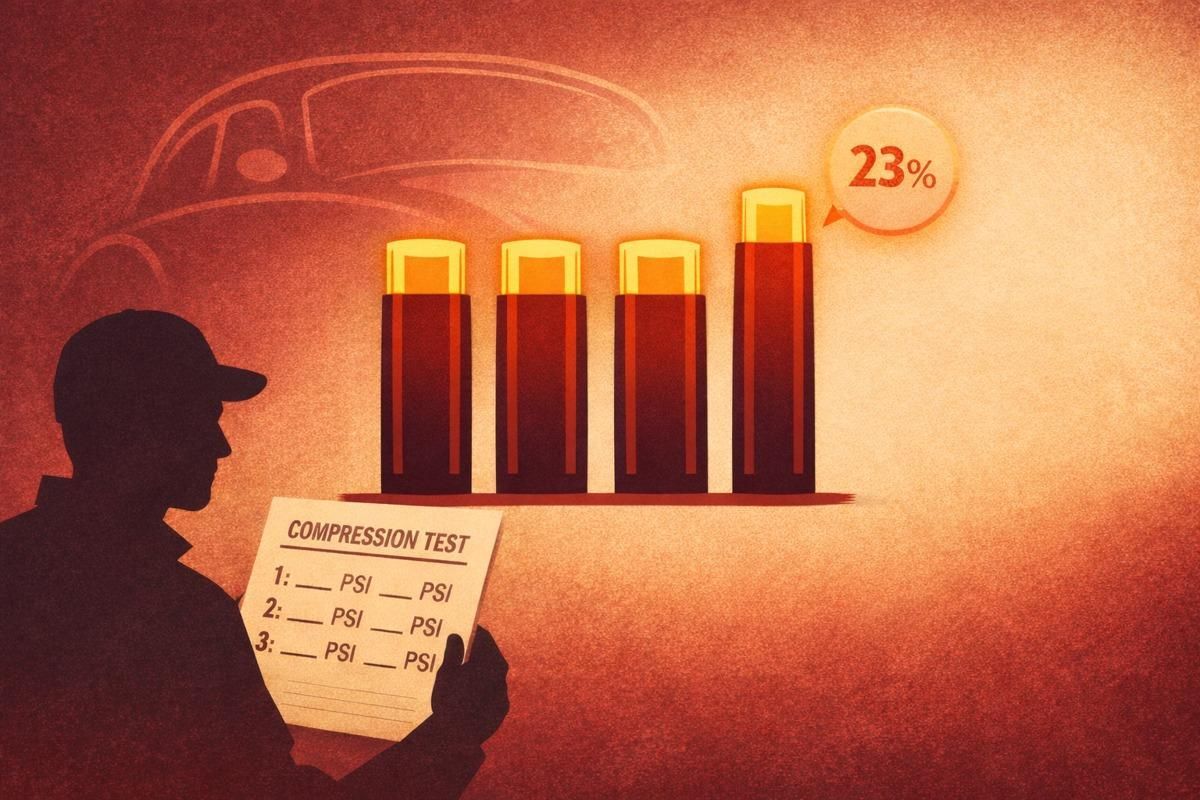
Consider a different test sheet: 150, 118, 122, and 115 PSI. The average across those four cylinders is about 126—not far from the healthy engine above. But the spread between cylinder one and cylinder four is 35 PSI. That's a 23% variance, well outside the safe band.
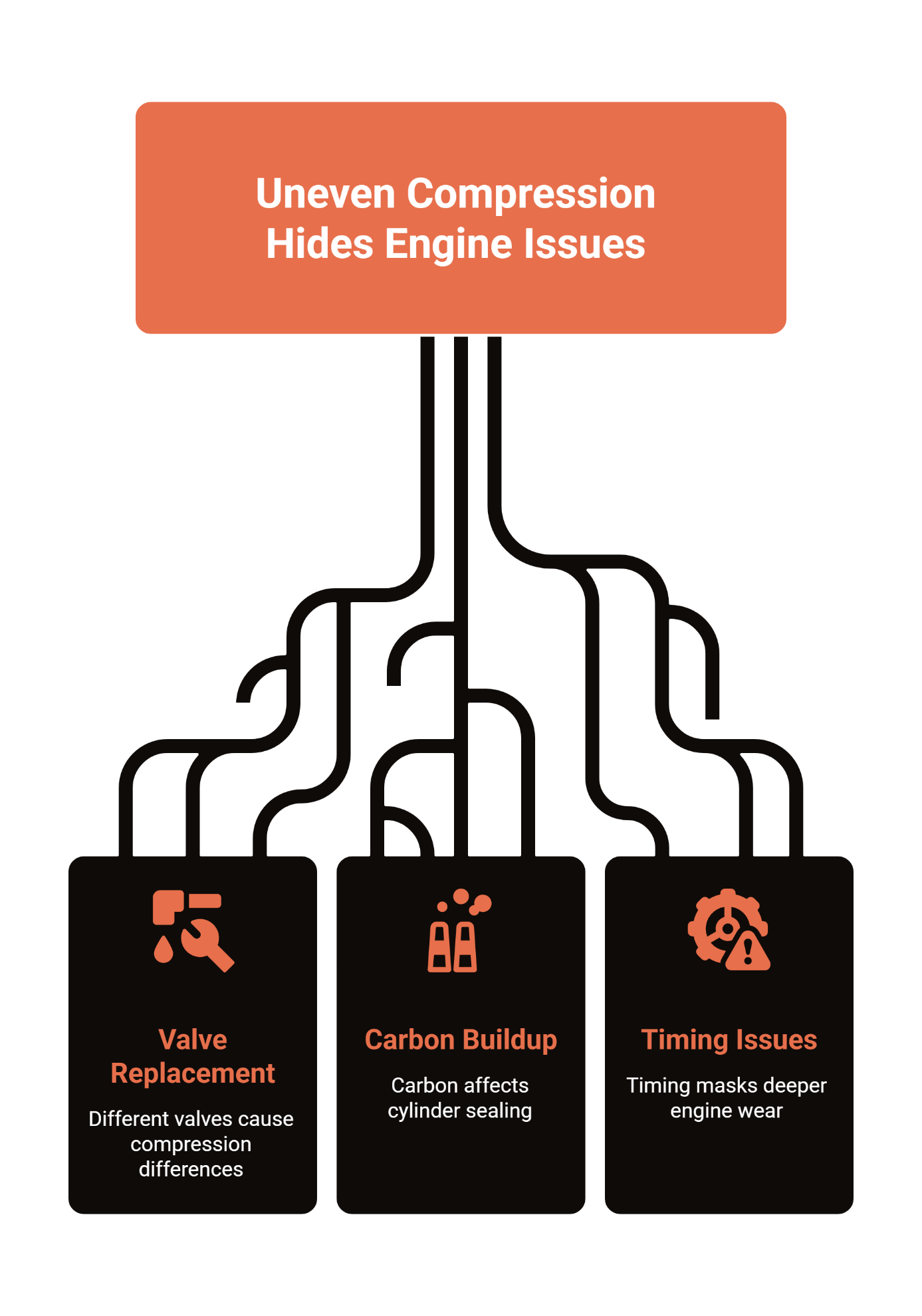
Something is different about cylinder one. Maybe a previous owner replaced one set of valves. Maybe the other three cylinders have carbon buildup affecting their seals. Maybe timing adjustments are masking deeper wear that only shows up under load. A smooth idle can hide uneven internal sealing when the engine isn't working hard.
This is where sellers frame the story in their favor. "It's got 150 compression" sounds reassuring. "Three of the four cylinders are running weak" does not. Learning to read the spread gives you negotiation leverage and a clearer picture of what you're actually buying.
A hollow puffing exhaust note, a flat feeling on acceleration, or a mismatch between the seat-of-the-pants drive and the test sheet all matter here. The compression sheet should support the driving impression, not fight with it. If the car sounds smooth but the numbers are uneven, Rough Idle on an Air-Cooled Volkswagen: What Your Senses Can Tell a Specialist gives helpful context on why idle quality alone can mislead a careful buyer.
How to Calculate Cylinder Variance in Plain English
You don't need a formula sheet to do this in someone's driveway. Take the highest cylinder reading and subtract the lowest. Divide that difference by the highest number, then multiply by 100 to get a percentage.
For the healthy engine above (128 highest, 124 lowest): 128 minus 124 equals 4. Divide 4 by 128 and you get about 0.03, or roughly 3% variance. Well inside the safe band.
For the risky engine (150 highest, 115 lowest): 150 minus 115 equals 35. Divide 35 by 150 and you get about 0.23, or roughly 23% variance. That's a caution sign.
PSI Spread Scorecard
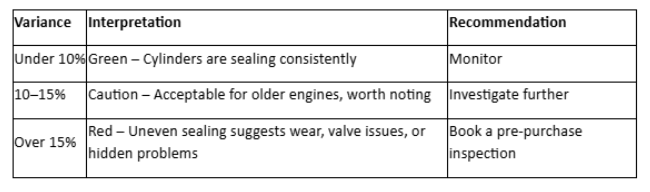
The recommendation column isn't about telling you to walk away. It's about knowing when compression numbers alone can give you confidence and when they're raising questions that deserve a leakdown test or a pre-purchase inspection.
Compression First, Leakdown Second
Compression spread reveals whether cylinder sealing is even across the engine. It's your first screening tool because it's fast and gives you a quick read on balance. But compression doesn't tell you where the air loss is happening—it just tells you that something is off.
Leakdown testing pinpoints where air loss is happening when compression raises suspicion. The test pressurizes each cylinder and listens for air escaping through the intake, exhaust, or crankcase. If compression spread looks suspicious and the car is otherwise worth pursuing, leakdown separates valve problems from ring problems from head gasket problems.
Compression raises the question. Leakdown helps narrow the answer.
When should you escalate from numbers on paper to a shop inspection? When the spread falls outside the green band. When the seller's story doesn't match what the numbers show. When auditory cues from the exhaust suggest a valve isn't seating right. Compression and leakdown should be read together when the numbers and the drive feel don't agree.
For buyers who want a deeper primer on how these two tests work together, Engine Health on a Vintage VW: What Compression and Leakdown Numbers Mean for Buyers is the natural next read.
How Buyers in Orange County Should Use the Numbers
Suppose you're comparing two Beetles. Car A has compression readings of 135, 132, 138, and 134—about 4% variance, solidly in the green. Car B shows 145, 128, 122, and 118—roughly 19% variance, deep in the red zone.
Car A's engine isn't flashy, but it's working together. Car B has one strong cylinder dragging the average up while three others lag behind. Even if Car B is priced lower, you're likely buying an engine that needs work sooner.
Use the spread as your first filter:
Compare all four cylinders, not just the best one.
Calculate the spread percentage before you negotiate.
Watch for numbers that conflict with what the car sounds or feels like.
If the spread is suspicious, move to a leakdown test and a pre-purchase inspection.
Four cylinders clustered tightly around 122 PSI can be more reassuring than one flashy 150 PSI cylinder paired with three weak numbers. The tight cluster is an engine working as a team. The outlier is an engine hiding something.
This matters even more when the rest of the car is attractive. A Beetle or Bus can be charming enough to pull attention away from the engine sheet. Rust, drivability, and maintenance history still matter too. If you're screening the whole vehicle, Hidden Rust Zones on Beetles, Buses, and Ghias: Where a Classic VW PPI Saves You Thousands helps round out the decision. You can also explore classic car maintenance services to understand how a long-term stewardship mindset differs from a quick sale mindset.
At Orange Independent Auto Repair, we've been interpreting these numbers for classic VW owners since 1971. Our team—including Eddie, who has been working on VW Beetles for more than 50 years—translates these analog readings into plain-English buying guidance every week.
As Ty M. put it: "Eddie has been working on VW Beetles for 50+ years. He's the only person that will ever touch my car."
Bruce gave the kind of proof a careful buyer looks for: "I went here yesterday for a pre purchase inspection and they did an amazing job and they were very competitively priced. Actually they were less than the dealer and they were able to fit me in right away."
That combination of experience and plain-English explanation is what matters when you're choosing between two cars that both look tempting on the surface.
For broader consumer context, the BAR consumer guide is useful for understanding repair-related paperwork and expectations in California.
If you're comparing two classic VWs and the compression numbers have you uncertain, bring the stronger candidate to our shop in Orange, CA for a pre-purchase inspection. We'll give you a clear read on whether the numbers support a confident purchase or whether the spread deserves a closer look.
Still comparing cars? Schedule a pre-purchase inspection with Orange Independent Auto Repair at (714) 633-7161, and get a calm, honest assessment before you decide.
Our Editorial Process:
Our expert team uses AI tools to help organize and structure our initial drafts. Every piece is then extensively rewritten, fact-checked, and enriched with first-hand insights and experiences by expert humans on our Insights Team to ensure accuracy and clarity.
By: About the Orange Independent Auto Repair Insights Team
The Orange Independent Auto Repair Insights Team is our dedicated engine for synthesizing complex topics into clear, helpful guides. While our content is thoroughly reviewed for clarity and accuracy, it is for informational purposes and should not replace professional advice.