
Brakes, Steering, and Tires on a Classic Volkswagen: Safety Priorities in a Pre-Purchase Inspection
📌 Key Takeaways
Brakes, steering, and tires determine whether a classic VW or Porsche is safe to drive home today, regardless of how well the engine runs.
- Three Systems Gate Every Decision: Brake hydraulics, steering play, and tire age must pass safety thresholds before considering engine condition or cosmetics.
- Must-Do Items Stop the Deal: Active fluid leaks, excessive steering play beyond two inches, or tire bulges require resolution before driving anywhere.
- Tire Age Trumps Tread Depth: DOT date codes reveal when tires aged past six to ten years lose structural integrity, even with deep tread remaining.
- Model-Specific Suspension Matters: Link-pin Beetles (pre-1966), ball-joint standards (1966+), Super Beetle struts (1971-1979), and Bus center pins (1968+) each require different inspection focus points.
- Documentation Creates Negotiation Power: Written inspection reports with Must-Do/Soon/Monitor categories replace vague "needs work" claims with specific cost leverage.
Safety-first inspection = calm decisions with clear plans.
Classic VW and Porsche buyers navigating pre-purchase evaluations will gain a systematic safety framework here, preparing them for the detailed inspection process that follows.
~ ~ ~ ~ ~ ~ ~ ~ ~ ~ ~ ~ ~ ~ ~ ~ ~ ~
You found it: the Beetle, Bus, or Ghia you've been chasing. The seller says it "runs great." You're already picturing the first drive home—until the practical question hits: is it actually safe to drive today?
In a classic Volkswagen or Porsche pre-purchase inspection, brakes, steering, and tires come first because they decide one thing immediately: is this car safe to drive right now? A strong-running engine can still hide unsafe brake hydraulics, loose steering parts, or aged tires. The goal is simple—document what's road-critical today, what belongs in the "soon" bucket, and what you can monitor—so you can buy (or walk away) with calm confidence and a clear plan.
Why These Three Systems Come First in a Classic VW and Porsche Inspection
Modern traffic doesn't care that your Beetle is a 1968 or your 911 is from 1985. Merging onto the 55 freeway near Anaheim or navigating Old Towne Orange on a Saturday requires the same stopping power and steering precision as any other vehicle on the road.
Classic VWs and Porsches have less margin for error than modern cars. No anti-lock brakes, no power steering, no traction control. What you see—and what a pre-purchase inspection documents—is what you get. If the brake master cylinder is leaking or the steering box has excessive play, those issues show up immediately in real-world driving, not months down the road.
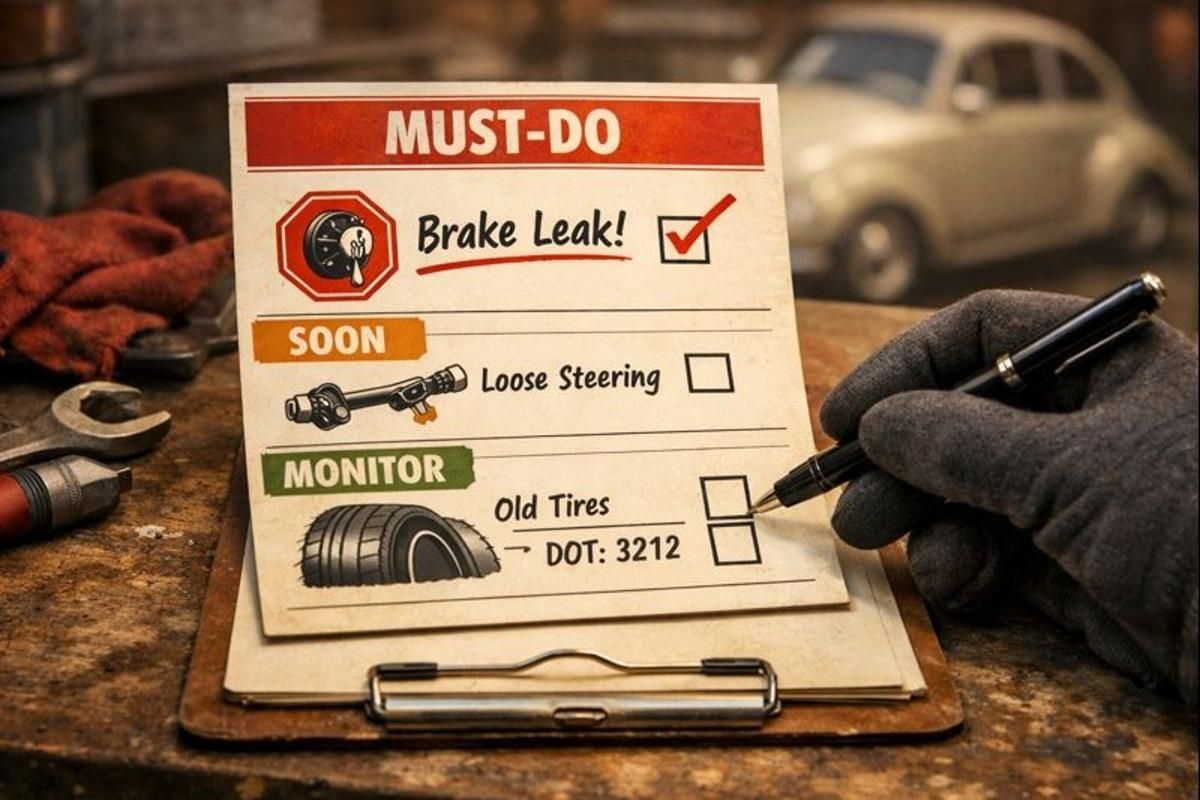
The three-bucket system (Must-Do / Soon / Monitor) exists to reduce overwhelm. Instead of a 40-item list that all feels urgent, you get a prioritized plan. Must-Do items are safety-critical and affect your decision to drive the car home. Soon items need attention within weeks or months but won't strand you today. Monitor items are things to watch but don't require immediate action or expense.
Think of it like checking a house's foundation, wiring, and exits before you get attached to the paint color. This approach prevents the risky "I'll just drive it anyway" decision that often leads to breakdowns or worse.
Brakes: What Gets Checked and What the Results Usually Mean
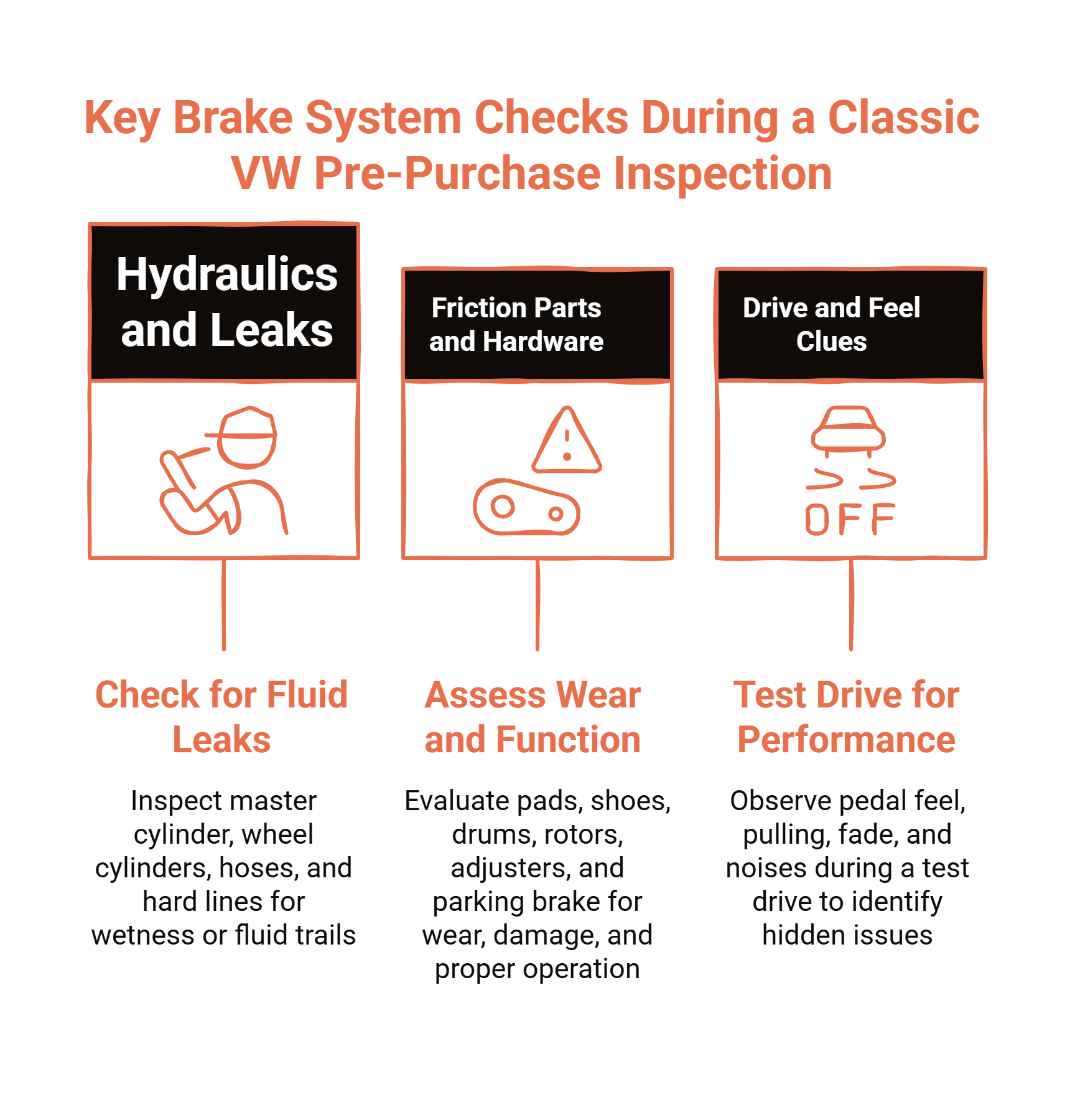
Hydraulics and Leaks (Master Cylinder, Wheel Cylinders, Hoses, Hard Lines)
Brake fluid doesn't compress—that's the whole point. When you press the pedal, hydraulic pressure forces the friction material against the drum or rotor to stop the car. Any leak in that closed system reduces pressure and stopping power.
During an inspection, wet brake components or fluid trails on backing plates are immediate red flags. A leaking wheel cylinder means brake fluid is escaping right where it's needed most. A soft or spongy pedal often indicates air in the lines or internal leaks in the master cylinder.
Old rubber brake hoses present a hidden risk. Even if they're not visibly cracked or leaking, the inner lining can deteriorate and restrict fluid flow. This creates delayed brake response or causes the car to pull to one side during stops. Hoses manufactured before current safety standards may not meet modern performance requirements.[^1]
The Must-Do category includes any active fluid leaks, severely deteriorated hoses, or compromised hard lines showing rust-through or damage.
Friction Parts and Hardware (Pads, Shoes, Drums, Rotors, Adjusters, Parking Brake)
Friction materials wear over time—that's normal. What matters is how they're wearing and whether the hardware supporting them is still functioning correctly.
Uneven pad or shoe wear often points to binding calipers, seized wheel cylinders, or out-of-round drums. A car that pulls hard to one side during braking typically has uneven friction surface contact or a hydraulic imbalance. Vibration or pulsing through the pedal usually indicates warped rotors or drums that are no longer true.
The parking brake deserves attention beyond just holding the car on a hill. On a classic VW or Porsche, it's your emergency backup if the hydraulic system fails. A parking brake that won't hold or releases unevenly creates both a safety risk and a practical problem in Orange County's hillier neighborhoods like Villa Park.
Adjusters that are seized or stripped mean the brakes can't be properly set, leading to long pedal travel and reduced effectiveness.
Drive and Feel Clues (Pull, Fade, Long Pedal, Noise)
How the brakes feel during a test drive tells you what's happening inside the system. A pedal that sinks slowly to the floor under steady pressure suggests an internal master cylinder leak. Brakes that fade after repeated stops often indicate glazed friction surfaces or overheated components that can't dissipate heat properly.
Grinding or squealing noises aren't always immediate safety issues, but they signal wear that needs evaluation. Metal-on-metal grinding means the friction material is gone and the backing plate is contacting the drum—that's a Must-Do repair.
A brake system that pulls consistently to one side typically has uneven friction, a stuck caliper, or contaminated friction material from a leak. These symptoms help categorize urgency: active pulling during normal stops is more critical than occasional noise during light braking.
Steering and Front End: Stability Checks That Predict Real-World Control
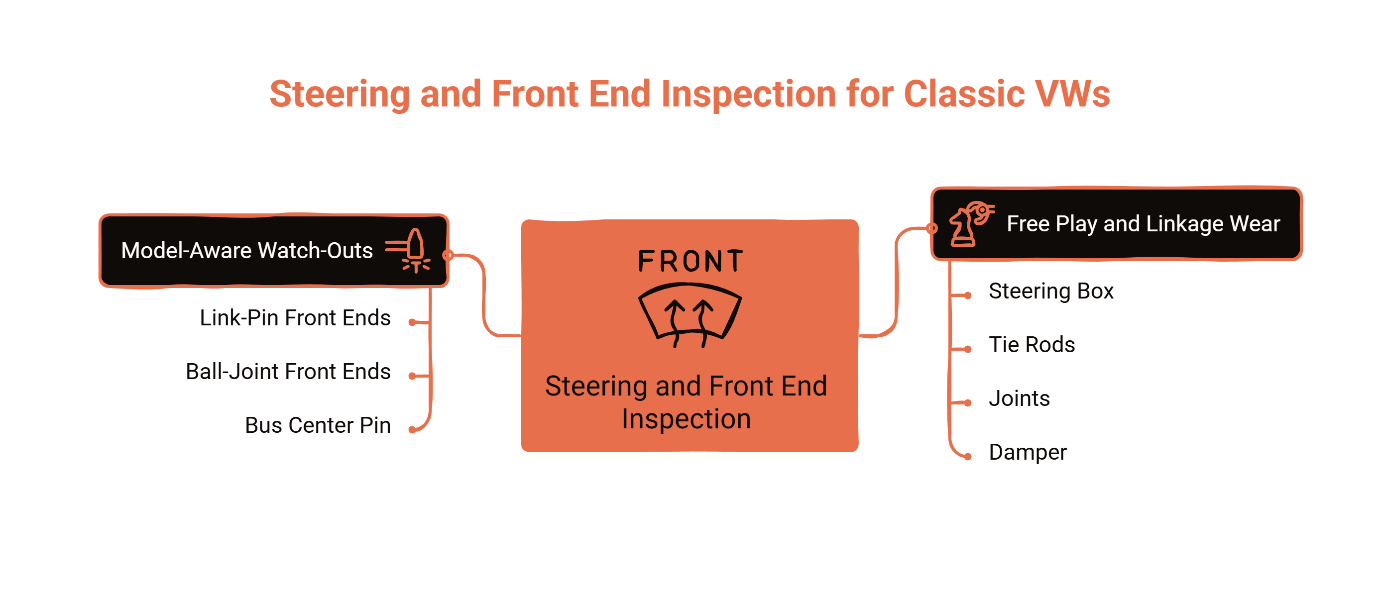
Free Play and Linkage Wear (Steering Box, Tie Rods, Joints, Damper)
Steering play is the amount of wheel movement before the front tires respond. A small amount is normal in older vehicles, but excessive play—more than an inch or two at the rim—indicates worn components that reduce your ability to make precise corrections in traffic.
The steering system on classic VWs uses a worm-and-roller box or worm-and-peg design, both of which wear over time. When the internal clearances open up, you feel it as looseness or a "dead spot" in the center position. Combined with worn tie rod ends or ball joints, this creates a wandering sensation where the car doesn't track straight and requires constant small corrections.
Clunking or popping sounds when turning the wheel point to loose joints or worn bushings. These aren't just comfort issues—they affect how predictably the car responds to steering inputs, especially during emergency maneuvers.
The steering damper (shock absorber) on the front beam helps control shimmy and vibration. A worn damper allows oscillations to build, creating a shaking sensation through the wheel that can become severe at highway speeds.
Model-Aware Watch-Outs (Ball-Joint vs. Link-Pin Front Ends; Bus Center Pin)
Link-pin front suspension (standard on Beetles before 1966 and Buses before 1968) relies on bronze bushings and kingpins. These wear differently than the ball-joint setups used in later models. Link-pin systems tend to develop vertical play that shows up as tire wear on the inside edges and a "thumping" feel over bumps.
Ball-joint front ends (1966 and later Standard Beetles/Ghias and 1968+ Buses) have different wear points. Note that 1971–1979 Super Beetles utilize a MacPherson strut setup which requires a completely different inspection of the strut cartridges and bushings.[^4] On standard ball-joint beams, the joints themselves can separate if severely worn, creating a catastrophic failure. Inspection includes checking for vertical and horizontal play at each joint.
On Type 2 Buses, the center steering pin connecting the steering box to the front beam is a known wear point. Excessive play here magnifies every other issue in the system and can make the vehicle feel dangerously unstable. For buyers considering a Bus around Tustin or Yorba Linda, this single component often determines whether the vehicle is roadworthy.
Tires and Wheels: Age, Condition, and Fitment Red Flags
Tire Age and Deterioration Cues (DOT Date Code, Cracking, Bulges, Flat-Spotting)
Tread depth alone doesn't tell the whole story. A tire can have 8/32nds of tread remaining and still be unsafe if it's 12 years old and showing sidewall cracking.[^2]
The DOT date code stamped on the sidewall shows the week and year of manufacture. Tires older than six to ten years—regardless of tread depth or storage conditions—begin to lose structural integrity. The rubber compounds harden and crack, reducing grip and increasing the risk of sudden failure.
Visible cracks in the sidewall or between tread blocks are immediate warning signs. Bulges or blisters indicate internal belt separation, which can lead to blowouts at speed. Flat-spotting from long-term storage creates vibration and uneven wear once the car is driven regularly.
For classic VWs and Porsches that spend months sitting between drives, tire condition often becomes the limiting factor for roadworthiness before mechanical systems do.
Matching Sets and Load Suitability
Mismatched tires—different sizes, brands, or tread patterns—create handling imbalances. The front and rear of a classic VW or Porsche need to work together, especially on cars without modern stability aids. Running a radial on one side and a bias-ply on the other is a recipe for unpredictable behavior in wet conditions or during hard braking.
Load rating matters particularly on Type 2 Buses. These vehicles are heavier and carry more weight than a Beetle or Ghia. Tires need to be rated for the actual load they'll carry. Using passenger-car tires on a Bus can lead to overheating, carcass failure, and loss of control.
Wheel condition also factors in—bent rims, stripped lug threads, or incorrect offset all affect safety and handling. A pre-purchase inspection should verify that wheels are straight, properly mounted, and compatible with the vehicle's suspension geometry.
Safety Priority Card: Must-Do / Soon / Monitor
Use this framework to turn an inspection report into a decision you can act on. If you like the Now / Soon / Later framing for planning and budgeting, this is the same concept—just applied to safety gates first.
Must-Do (Immediate Safety Risk)
Brakes: Active fluid leaks, metal-on-metal grinding, severely deteriorated hoses, brake pull that requires aggressive steering correction.
Steering: Excessive free play (more than 2 inches at the wheel rim), clunking or separation in ball joints, severely worn tie rod ends with visible vertical play.
Tires: Bulges or blisters in sidewalls, cracks deeper than surface level, tread depth below 3/32nds, age over 10 years.
Soon (Address Within Weeks to Months)
Brakes: Moderate pad/shoe wear, slightly spongy pedal, minor surface rust on rotors/drums, parking brake that holds but requires excessive travel.
Steering: Mild shimmy at highway speed, worn steering damper, minor play in the steering box, tie rod dust boots torn but joints still tight.
Tires: Surface cracking, age 6-10 years, uneven wear patterns, mismatched brands or types, tread depth 4-5/32nds.
Monitor (Track Over Time, No Immediate Action)
Brakes: Light noise during cold starts that goes away, minor dust buildup, brake fluid slightly below max line but not at minimum.
Steering: Slight returnability issues, minor cosmetic damage to steering wheel or column, alignment drift that corrects with minor adjustment.
Tires: Light scuffing or curb marks, tread depth 6/32nds or better with even wear, age under 5 years with no visible damage.
This framework reduces the panic that comes with a long list of findings. It helps you separate what affects your test drive decision from what belongs in a planned maintenance conversation with the seller.
How to Use the Findings to Decide: Drive Home, Negotiate, or Pause
Safety items dictate the immediate decision. If the inspection reveals Must-Do brake or steering issues, driving the car home isn't worth the risk. Either the seller addresses those items before the sale, you build the repair cost into your negotiation, or you walk away.
For Soon items, the approach is different. These findings don't prevent a test drive or short trip home, but they do affect fair market value. Documented wear in the steering system or aging tires with surface cracks give you factual leverage in price discussions. Instead of a vague "it needs work," you have specific components and realistic cost estimates.
Monitor items rarely change the deal. They're part of normal ownership on a classic vehicle. Noting them in the inspection report helps you plan ahead but shouldn't derail a purchase if everything else checks out.
The key is staying calm and fact-based. A pre-purchase inspection isn't a weapon to beat down the seller—it's a shared understanding of the vehicle's current condition. When findings are documented with clear categories and detailed notes, negotiations become conversations about priorities rather than arguments about opinions.
Even on older cars, it's smart to check official recall databases when relevant. NHTSA's recall lookup is the simplest place to start.[^3]
For buyers who discover significant issues during an inspection, understanding what the engine compression numbers mean adds another data point to the overall picture.
Next Move in Orange: Book a Pre-Purchase Inspection
A proper pre-purchase inspection delivers three things: a detailed inspection checklist, written documentation of key wear points, and a prioritized plan that separates safety risks from routine maintenance.
At Orange Independent Auto Repair, we document brake hydraulics, steering components, and tire condition with the same methodical approach we use for classic car maintenance and repair. The written report shows you exactly what we're describing—wet backing plates, cracked tie rod boots, date codes on tires. Findings are organized into Must-Do, Soon, and Monitor categories so you can make decisions without second-guessing.
Whether you're considering a Beetle in Orange, a Bus in Anaheim, a classic Porsche from Villa Park, or a Ghia from a seller in Tustin, the inspection process is the same: safety first, clear communication, and a plan you can use.
Ready to schedule? Call (714) 633-7161 to book a pre-purchase inspection and get the clarity you need before committing. You can also text a photo of the seller's notes or the vehicle and ask what a safety-first inspection would prioritize. Visit us at 187 S Main St, Orange, CA 92868, or email orange.independent@gmail.com with your timeline and we'll point you to the right next step.
Family-owned and operated since 1971, we've been helping classic VW and Porsche owners and buyers make confident decisions based on evidence, not emotion. Request your free estimate today.
Hours: Monday–Friday 7:00 AM–6:00 PM | Saturday by appointment only
FAQ
Is it safe to drive a classic Volkswagen or Porsche home right after purchase?
Sometimes—but only after brakes, steering control, and tire condition are confirmed as roadworthy. A car that "runs great" can still be unsafe the same day.
What brake findings are immediate deal-stoppers versus "fix soon" items?
Active hydraulic leaks, clearly compromised hoses/lines, or unsafe pedal feel belong in the Must-Do category. Wear trending toward limits typically falls under Soon—if basic function is stable and documented.
How do I tell if tires are too old even if the tread looks good?
Tire age and condition matter as much as tread depth. A proper inspection documents the DOT date code and checks for cracking, bulges, and storage damage.[^2]
What does steering play or wandering usually indicate on a classic VW or Porsche?
It often points to wear in the steering and front-end linkages. The key is how it affects control in real driving and whether the condition is documented as Must-Do, Soon, or Monitor.
Why do pre-purchase inspections categorize issues instead of listing everything as urgent?
Because buyers need a decision tool, not a stress list. Clear categories help you separate road-critical items from near-term planning and longer-term monitoring.
Disclaimer: This article provides general guidance on pre-purchase inspection priorities for classic Volkswagens and Porsches. Specific findings and recommendations depend on the individual vehicle's condition and your intended use. Always consult with a qualified technician for a comprehensive evaluation before making a purchase decision.
Our Editorial Process: We base recommendations on factory-correct procedures, observed vehicle condition, and documented findings. We explain options in plain language, prioritize safety first, and avoid recommending parts before confirming root cause. Content is reviewed for clarity and accuracy before publication and updated when best practices change.
By: Orange Independent Auto Repair—Classic VW and Porsche Specialist, Orange, CA
About the Author: We diagnose and repair classic Volkswagens and Porsches with factory-correct procedures, documented evidence, and transparent plans. Serving Orange, Anaheim, Villa Park, Tustin, and Yorba Linda. Family-owned and operated since 1971.
[^1]: Electronic Code of Federal Regulations, "FMVSS No. 106—Brake Hoses," Title 49, Subtitle B, Chapter V, Part 571, https://www.ecfr.gov/current/title-49/subtitle-B/chapter-V/part-571/subpart-B/section-571.106.
[^2]: National Highway Traffic Safety Administration, "Tire Safety: Everything Rides On It," Consumer Brochure, https://www.nhtsa.gov/sites/nhtsa.gov/files/brochure.pdf.
[^3]: National Highway Traffic Safety Administration, "Recalls," https://www.nhtsa.gov/recalls.
[^4]: The 1971–1979 Super Beetle's MacPherson strut front suspension differs significantly from the torsion-beam design used in Standard Beetles. Inspection focuses on strut cartridge condition, bearing plates, and control arm bushings rather than traditional ball joints and torsion bars.