
Rough Idle on an Air-Cooled Volkswagen: What Your Senses Can Tell a Specialist
📌 Key Takeaways
Your sensory observations—sounds, smells, vibrations, and visual patterns—provide critical diagnostic data that helps specialists identify rough idle causes faster and more accurately.
- Describe, Don't Diagnose: Recording what you hear, smell, and feel enables methodical testing instead of expensive guesswork with parts replacement.
- Pattern Timing Matters Most: Noting whether problems occur cold versus hot, steady versus intermittent, reveals whether issues stem from enrichment, ignition, or mechanical wear.
- Safety Thresholds Are Clear: Strong fuel smells, visible leaks, repeated stalling, or exhaust-related symptoms require immediately stopping and calling for professional guidance.
- Symptom Documentation Accelerates Diagnosis: A 10-second video, timeline notes, and smell descriptions allow specialists to form accurate hypotheses before testing begins.
- Sequential Testing Prevents Waste: Compression checks, ignition quality, fuel delivery, and valve clearances follow a prioritized order that confirms causes with measurable evidence.
Clear communication transforms uncertainty into a defined diagnostic plan backed by documentation, not hunches.
Classic air-cooled Volkswagen owners in Orange County seeking honest, methodical diagnostics will gain confidence from this framework, preparing them for the detailed observation worksheet and specialist consultation guidance that follows.
A rough idle isn't a diagnosis—it's data. When your classic air-cooled Volkswagen stumbles at a stoplight or shakes unevenly in your driveway, the rearview mirror won't sit still, and the rhythmic 'chug-chug' has turned into a staggering lope, you’re experiencing a symptom with a distinct set of mechanical culprits. The air-cooled engine in your vintage Beetle, Bus, or Karmann Ghia operates differently from water-cooled designs, and pinpointing what's causing that lumpy, uneven idle requires more than guesswork.
Think of it like tuning a vintage instrument. A luthier doesn't start replacing strings before listening to the tone and checking the tension. Similarly, a specialist working on your classic air-cooled VW needs to hear what you're hearing, smell what you're smelling, and understand when and how the problem shows up. Clear notes from your senses—sound, smell, feel, and sight—help a specialist diagnose a rough idle faster and more accurately on an air-cooled Volkswagen. You're not trying to fix it in the driveway; you're trying to describe it well enough that the right tests happen in the right order.
Picture this: You're getting ready for a weekend cruise down Chapman Avenue to the Orange Plaza. You turn the key, the engine fires, but instead of settling into that familiar rhythmic chug, it stumbles and shakes. That uncertainty—wondering if it's safe to drive, what it might cost, whether you'll get straight answers—is exactly what this guide addresses.
A Rough Idle Is Data, Not a Diagnosis
When we talk about a rough idle, we mean the engine runs unevenly at a standstill. It might feel lumpy, shaky, or produce a noticeable stumble when you're stopped at a light. Sometimes it smooths out once you're moving; other times, the problem persists or gets worse.
"Describe, don't diagnose."
This principle guides everything that follows. Your job isn't to determine whether it's the carburetor, ignition timing, or valves. Your job is to report what's happening with enough detail that a specialist can form a hypothesis and test it methodically. According to the Orange Independent Auto Repair framework, sequence beats guesswork: measure, document, explain, then prioritize.
For over five decades, our family-owned shop has built trust by combining traditional mechanical knowledge with precision testing equipment. That balanced approach means starting with what you observe, then using methodical diagnostics to confirm the cause before recommending parts or adjustments. Our experience with classic VW and Porsche models gives us the foundation to interpret what older air-cooled engines are telling us.
Quick Safety Threshold: When to Stop Driving and Call
Before we get into observation techniques, let's establish when you should stop driving immediately and contact a specialist:
- Strong, persistent fuel smell near the engine or inside the cabin
- Visible fuel or oil leaks pooling underneath
- Smoke from the engine compartment that doesn't clear quickly
- Repeated stalling in traffic or at intersections
- Loud backfiring or popping sounds that startle nearby pedestrians
- Feeling unwell (headache, dizziness, nausea) in situations where exhaust exposure could be a factor, especially around enclosed spaces like a garage
If you're experiencing any of these, the safest move is to pull over, turn off the engine, and call for guidance. A quick phone conversation can help determine whether it's safe to continue or if a tow is the better option. When in doubt, don't gamble with safety or risk turning a small issue into expensive damage.
The CDC provides guidance on carbon monoxide poisoning that underscores why exhaust-related symptoms should never be ignored. Similarly, the U.S. Consumer Product Safety Commission offers fuel safety guidelines that explain why raw fuel odors require immediate attention.
What to Listen For
Sound is often the first clue that something's off. But not all rough idles sound the same, and the pattern matters.
Lumpy vs. Rhythmic vs. Random
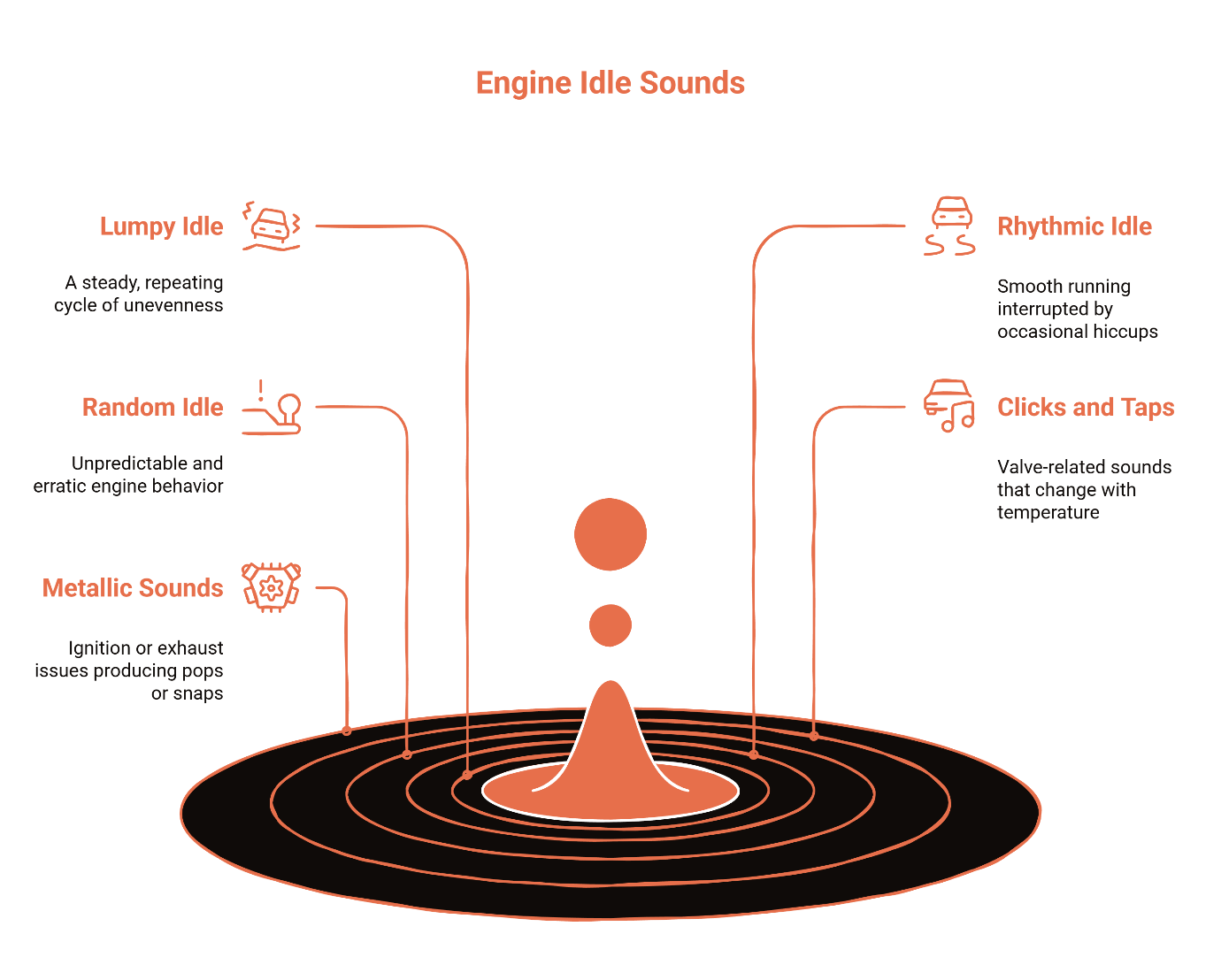
Try to describe the rhythm of the problem. Does the engine produce a steady "lope"—a repeating cycle of unevenness? Or is it more of an intermittent stumble, where it runs smoothly for a few seconds and then hiccups? Some rough idles sound random, with no predictable pattern at all.
A steady miss often points to one cylinder not firing correctly. An intermittent stumble can suggest fuel delivery or electrical issues that come and go. A completely erratic idle might indicate multiple problems or something in the air/fuel mixture that's inconsistent.
Clicks, Tapping, and Metallic Sounds
Pay attention to any clicking, tapping, or metallic noises that accompany the rough running. Note when you hear them:
- Only when the engine is cold, or only after it warms up?
- In neutral or when the transmission is in gear?
- At a specific RPM range, or throughout?
Valve-related sounds often change with temperature. Ignition or exhaust issues might produce distinct pops or snaps. The more specific you can be about timing and conditions, the faster a specialist can narrow the search.
What to Smell For
Your nose can detect problems that aren't yet visible. Different smells point to different systems.
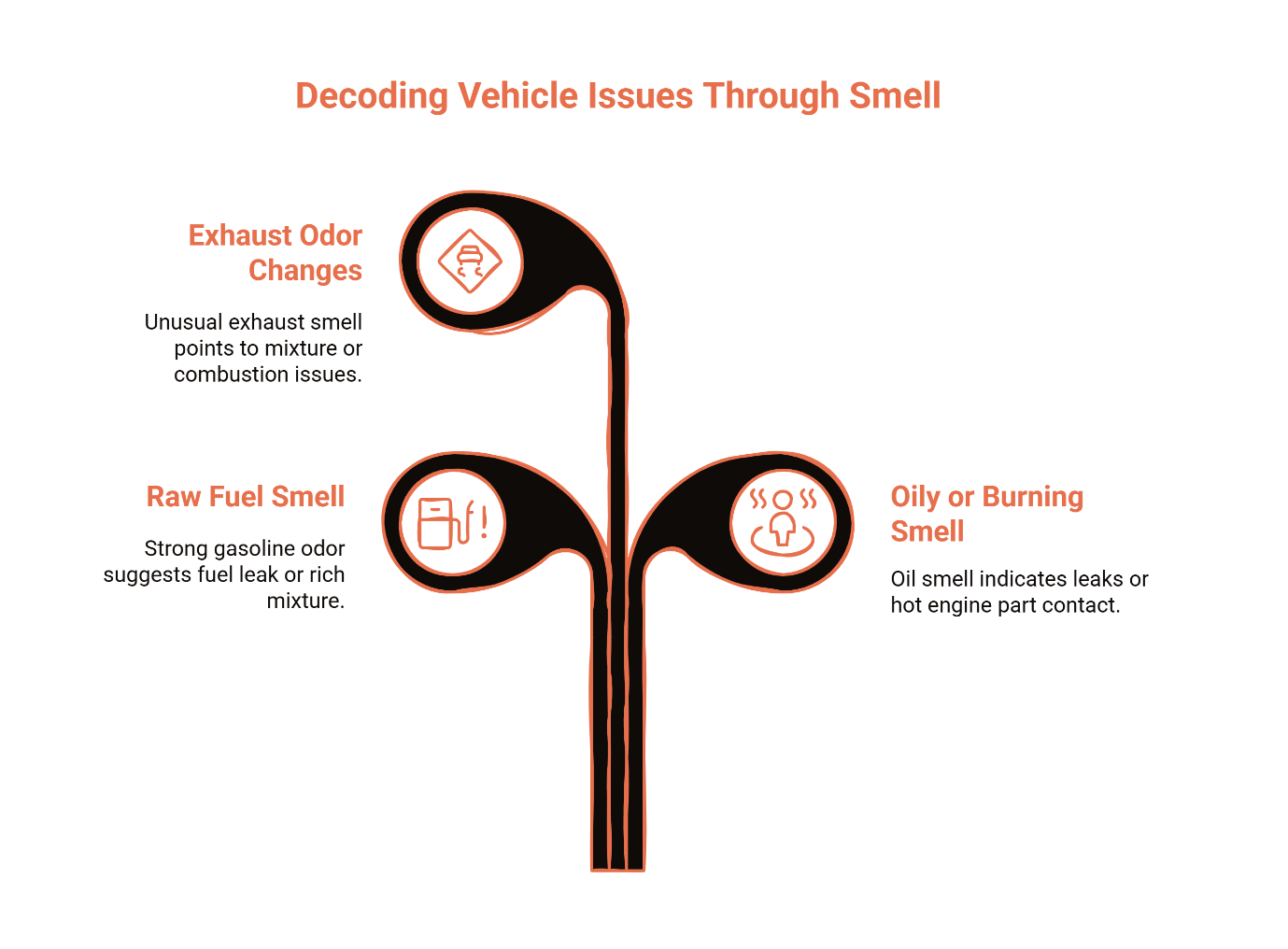
Raw fuel smell: A strong gasoline odor at idle suggests the engine is running too rich, or there's a fuel leak. This can indicate carburetor float issues, a stuck choke, or a leak in the fuel line. If the smell is overwhelming or accompanied by visible wetness, that's a safety threshold issue.
Oily or burning smell: This often means oil is seeping onto hot engine parts—common with valve cover gasket leaks or oil cooler issues on air-cooled engines. A burning oil smell can also come from a failing oil seal.
Exhaust odor changes: A sulfur-like or unusually acrid exhaust smell can indicate an overly rich mixture or combustion problems. If the exhaust smell enters the cabin more than usual, check for exhaust leaks.
Smell profiles act as a diagnostic shortcut: A fuel scent triggers a needle-and-seat or float-level inspection, while an oil scent moves the focus to pushrod tube seals or valve cover gaskets. A fuel smell means starting with carburetor and fuel delivery systems. An oil smell shifts focus to sealing and lubrication. Exhaust changes point to mixture or timing adjustments.
What to Feel: Vibration Patterns That Narrow the Search
Where you feel the vibration and when it's strongest can reveal a lot.
Do you feel it primarily through the seat and floor, or does it come through the steering wheel? Vibrations through the seat often relate to engine mounts or imbalance. Steering wheel vibrations can point to drivetrain or wheel-related issues, though a severe engine miss can also transmit through the steering column.
Note how the vibration changes:
- Is it worst at idle and smooths out above a certain RPM?
- Does it intensify when you engage the clutch or shift into gear?
- Does it get better or worse as the engine warms up?
A vibration that's only present when cold might indicate tight valves or cold enrichment issues. One that appears or worsens when hot often relates to expansion, worn bushings, or heat-sensitive electrical connections.
What to Look For (Without Touching Anything)
You don't need to start pulling parts to gather useful information. Simple visual checks can provide valuable context.
Look for visible drips or wet spots underneath the car after it's been parked. Even a small fuel leak or oil seep is worth mentioning. Check hoses and wiring for anything that looks loose, disconnected, or damaged—but don't attempt to reconnect or tighten anything yourself.
Exhaust color is another clue. A brief puff of blue-gray smoke on startup is fairly common in older engines, but constant blue smoke suggests oil burning. Black smoke indicates a rich fuel mixture. White smoke is physically impossible from a coolant leak in these engines because they are entirely air-cooled. If you see white-looking vapor, it is almost always condensation burning off within the heat exchangers or moisture trapped in the muffler.
Finally, think about recent changes. Did you switch fuel brands or grades? Has the car been sitting unused for weeks or months? Did you have any recent tune-up work, carburetor adjustments, or parts replaced? A rough idle that appears right after maintenance often points back to that work—settings that need rechecking, a gasket not seated properly, or a vacuum line left disconnected.
For more on how documentation and records can protect you during repairs, see our guide on how to document auto repair parts installation for warranty protection.
The Pattern Matters: Cold vs. Hot, Steady vs. Intermittent
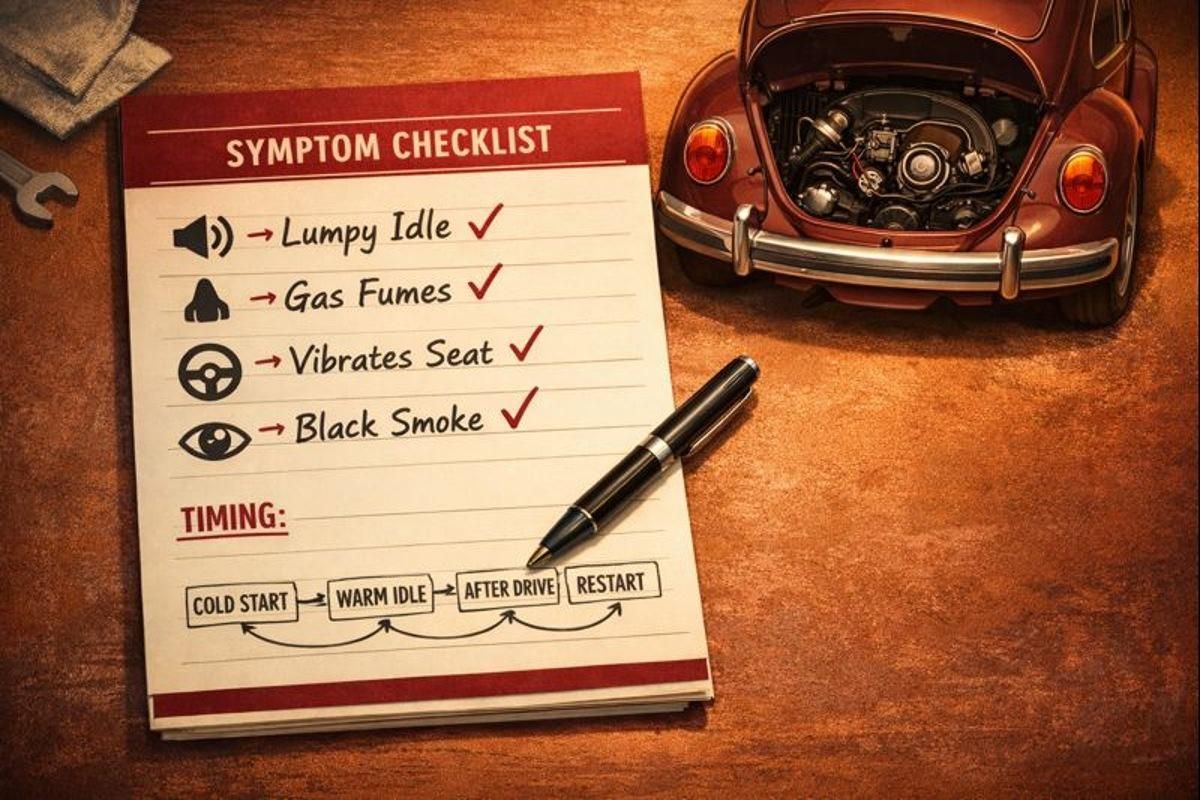
A specialist will always ask: When does it happen? A simple timeline can be incredibly helpful.
Here's a template for your notes:
- Cold start (first 30 seconds): Does it idle rough immediately, or does it start smoothly and then deteriorate?
- Warm idle (after 3–5 minutes): Does the problem get better, worse, or stay the same?
- After a drive (fully warmed up): Is the idle still rough, or has it smoothed out?
- Restart (after sitting for 10 minutes): Does the problem return, or is it gone until the next cold start?
These patterns help distinguish between cold-enrichment issues, heat-related electrical problems, and mechanical wear. A rough idle that only happens when cold often relates to choke function or valve clearances. One that only appears when hot can point to vapor lock, failing ignition components, or heat-sensitive carburetor issues.
How a Specialist Turns Your Notes Into a Diagnostic-First Plan
Once you've gathered your observations, here's what happens next. A methodical shop won't start replacing parts based on hunches. Instead, they follow a sequence designed to isolate the actual cause.
The diagnostic sequence generally flows like this:
- Baseline engine health: Compression and leakdown tests quantify cylinder condition. These numbers reveal whether the engine's mechanical foundation is sound or if there's excessive wear, valve sealing problems, or ring issues.
- Ignition and spark quality: Testing spark plug condition, ignition timing, distributor function, and coil output ensures each cylinder is firing correctly.
- Air and fuel delivery: Carburetor jetting, float levels, fuel pressure, and air leaks (vacuum leaks) are checked to confirm the engine is getting the right mixture.
- Valve-related checks: Valve clearances on air-cooled engines must be set within spec. Tight or loose valves directly affect idle quality and overall performance.
- Confirmation with evidence: Throughout this process, measurements are documented—often with photos—so you can see what was found and why specific adjustments or parts are recommended.
This isn't guesswork. It's a prioritized plan where each step either rules something out or confirms the next area to investigate. The goal is a clear "Must-Do / Soon / Monitor" list that makes sense and fits your budget. The California Bureau of Automotive Repair requires written authorization before work begins, which is why quality shops document findings and explain recommendations clearly.
For guidance on prioritizing critical repairs, check out auto repair component hierarchy: which parts should never be budget options.
Owner's Symptom Description Worksheet
Screenshot this, print it, or text it to your specialist. This worksheet helps you organize observations before your appointment.
Basics
- Model/year (if known): __________
- When did it start? __________
- Has it changed since it started? (better / worse / same)
Sound
- □ Lumpy/loping (steady uneven beat)
- □ Rhythmic stumble (repeating hiccup)
- □ Random miss (irregular)
- □ Popping
- Notes (cold/warm, neutral/in gear): __________
Smell
- □ Raw fuel smell
- □ Oily/burning smell
- □ Exhaust smell seems different than normal
- Notes (when/where strongest): __________
Feel
- □ Vibration mostly in seat/floor
- □ Vibration mostly in steering wheel
- □ Worst at idle only
- □ Worst at idle-to-off-idle transition
- Notes (cold/warm, severity): __________
Sight (no touching)
- □ Drips or fresh wetness under car
- □ Smoke that continues
- □ Something looks newly out of place
- Notes / attach photos: __________
Simple Timeline
- Cold start: __________
- After warmup: __________
- Fully warm at stoplight: __________
- After drive + restart: __________
Recent Changes
- □ New fuel or fuel brand
- □ Long storage period
- □ Recent tune-up or carb work
- □ Other: __________
What You Can Send
- 10-second idle video (rear of car)
- Photo(s) of anything you see
- Recent service history/receipts (if available)
What to Send or Bring to Your Appointment
Before you head to the shop—or even before you call—gather a few things that will speed up the process:
A 10-second video or audio clip of the idle. Hold your phone near the engine compartment while it's running. This gives the specialist something to listen to before you arrive.
Photos of anything you see: Drips, loose wires, unusual wetness, exhaust color—visual evidence helps.
Your symptom notes: Use the observations you've gathered from this guide. Write down the timeline, describe the sounds and smells, note when it's worse or better.
Maintenance history and recent receipts: If you've had any recent work done, bring those records. They provide context and can help identify if something was overlooked or needs adjustment.
The easier it is for a specialist to understand what you're experiencing, the faster they can form a hypothesis and design the right tests. This also sets clear expectations for communication—most quality shops will walk you through findings with photos or video so you can make informed decisions. Learn more about transparency in our article on auto repair invoice transparency: ensuring your record shows exactly what was installed.
Frequently Asked Questions
Is a rough idle normal on an air-cooled Volkswagen?
A slight rhythmic chug is characteristic of these classic engines, but a truly rough or unstable idle—where the engine shakes excessively, stumbles, or threatens to stall—isn't normal and indicates an issue that needs attention.
Is it safe to drive if my Beetle idles rough at stoplights?
It depends on severity and accompanying symptoms. If the rough idle is mild, with no fuel smell, no stalling, and no warning lights, short local drives are generally safe. However, if you're experiencing repeated stalling, strong fuel odors, or smoke, it's safer to have the car towed or trailered to avoid risk.
Why does it idle rough only when cold (or only when hot)?
Cold-only rough idles often relate to choke function, valve clearances that are too tight, or fuel enrichment settings. Hot-only problems can indicate heat-sensitive ignition components, vapor lock in the fuel system, or carburetor issues that appear as parts expand with temperature.
What does a strong fuel smell at idle usually indicate?
A persistent raw fuel smell suggests the engine is running too rich—delivering more fuel than it can burn efficiently. This can result from a stuck carburetor float, incorrect jetting, a choke that isn't opening fully, or a fuel leak. If the smell is strong and accompanied by visible wetness, treat it as a safety issue.
Can a vacuum leak cause a lumpy idle on an air-cooled VW?
Yes. Air-cooled engines rely on precise air-fuel ratios, and any unmetered air entering the intake (through a cracked hose, loose connection, or failed gasket) will lean out the mixture and cause rough, unstable idling. Vacuum leaks are a common culprit and are relatively straightforward to test.
What information helps a VW specialist diagnose faster?
Clear symptom descriptions—sounds, smells, vibration patterns, visual clues—combined with a timeline of when the problem occurs (cold/hot, steady/intermittent) allow a specialist to form an accurate hypothesis before even starting diagnostic tests. This reduces trial and error and prevents unnecessary parts replacement.
Do I need compression and leakdown tests for a rough idle complaint?
Not always, but they're valuable baseline tests. Compression and leakdown numbers quantify the engine's mechanical health and can quickly reveal if the problem is fundamental (worn rings, valve sealing issues) or if it's related to tuning, ignition, or fuel delivery. Many specialists recommend these tests early to avoid chasing symptoms when the real issue is internal engine wear.
Could valve settings or ignition timing make the carb feel "off"?
Absolutely. Air-cooled VW engines are highly interactive systems. Valve clearances, ignition timing, and carburetor jetting all work together to produce smooth running. If valves are too tight or too loose, or if timing is advanced or retarded beyond spec, the carburetor can't compensate—and the idle will suffer. That's why a sequence-based diagnostic approach checks these foundational settings before assuming the carb itself is the problem.
Next Step for Orange County Air-Cooled VW Owners
You now have a framework for describing what's happening with your rough idle. You've learned to observe rather than guess, to document patterns, and to communicate details that help a specialist diagnose efficiently.
If you're in Orange, Tustin, Anaheim, Yorba Linda, or Villa Park and your classic air-cooled Volkswagen is showing any of these symptoms, the next step is simple: contact us to schedule a defined diagnostic. You can call, text a photo or video clip of the idle, or stop by during business hours.
For those maintaining other classic vehicles, explore our broader guide on classic car maintenance to see how diagnostic-first principles apply across vintage platforms. Whether you're caring for a classic VW or Porsche, the same methodical approach protects your investment and preserves authenticity. You can also read what other classic car owners have experienced by visiting our testimonials page.
The goal isn't just to fix a rough idle—it's to protect your car's originality, preserve its reliability, and give you the confidence to enjoy weekend drives without worry. That starts with clear communication and ends with a plan backed by evidence, not guesswork.
Orange Independent Auto Repair
Our Location
187 S Main St, Orange, CA 92868
Contact Us
Phone: (714) 633-7161
Email: orange.independent@gmail.com
Hours of Operation
Mon–Fri: 7:00 AM - 6:00 PM
Sat: by appointment only
Primary Actions:
- Email a photo of the symptom
- Call to schedule a defined diagnostic
- Visit our Orange location
Serving Orange, Tustin, Anaheim, Yorba Linda, and Villa Park since 1971 with honest, transparent service for classic VW and Porsche owners. For additional context about our reputation and approach, you can review our Better Business Bureau profile.
Disclaimer: This content is for informational purposes and should not replace professional diagnosis or repair advice. Always consult a qualified automotive specialist for issues affecting your vehicle's safety or performance.
Our Editorial Process
Our expert team uses AI tools to help organize and structure our initial drafts. Every piece is then extensively rewritten, fact-checked, and enriched with first-hand insights and experiences by expert humans on our Insights Team to ensure accuracy and clarity.
About the Orange Independent Auto Repair Insights Team
The Orange Independent Auto Repair Insights Team is our dedicated engine for synthesizing complex topics into clear, helpful guides. While our content is thoroughly reviewed for clarity and accuracy, it is for informational purposes and should not replace professional advice.