

Leaning into the Purr: How to Sense Healthy Compression in Orange, CA Before the Gauge Even Comes Out
📌 Key Takeaways
Your senses can tell you when a classic VW engine needs testing—before you spend money on gauges or mechanics.
- Trust Your Ears First: A healthy air-cooled engine sounds like an even sewing machine rhythm, not hollow puffs or skipping beats.
- Smooth Idle Can Lie: A calm idle may hide weak cylinder sealing—test the car under acceleration to reveal the truth.
- Smell Tells the Story: Warm oil and metal are normal; sharp raw-fuel odor after warm-up means something's wrong.
- Document, Don't Diagnose: Write down what you hear, smell, and feel so a specialist can focus their inspection faster.
- Know When to Test: Rhythmic puffing, flat acceleration, or persistent fuel smell all mean compression testing before purchase.
The purr matters because it tells you when to stop guessing and start collecting proof.
Classic VW buyers evaluating Beetles, Buses, or Ghias will learn to filter promising finds from hidden problems, preparing them for the detailed diagnostic guide that follows.
~ ~ ~ ~ ~ ~ ~ ~ ~ ~ ~ ~ ~ ~ ~ ~ ~ ~
The engine is warm. You lean closer, and there it is—raw fuel, sharp and unmistakable, cutting through the afternoon heat of an Orange County driveway. The seller says the car runs great. Your nose is telling you something different.
Healthy compression is the engine's ability to build and hold cylinder pressure evenly enough that an air-cooled VW starts, idles, and pulls with a settled rhythm. Think of compression and leakdown testing as the engine's blood pressure and lung-capacity exam: one shows how strongly each cylinder builds pressure, and the other reveals how well it holds that pressure. Is a fuel smell normal for an old air-cooled VW, or is it a warning sign?
If you are shopping for a vintage Beetle, Bus, or Ghia, you already know that these cars do not come with check-engine lights or onboard diagnostics. The engine speaks through sound, smell, and feel—and learning to interpret that language can mean the difference between a solid purchase and an expensive surprise.
A healthy air-cooled VW usually speaks in an even, settled rhythm; a tired one often adds hollow puffing, raw-fuel sharpness, or a flat feeling when you ask it to work. The goal of sensory triage is not to replace a compression or leakdown test. It is to help you recognize when the engine has already told you it deserves one.
What Healthy Compression Sounds and Smells Like in an Air-Cooled VW
A healthy engine usually sounds even, smells warm rather than raw, and responds cleanly when asked to work.
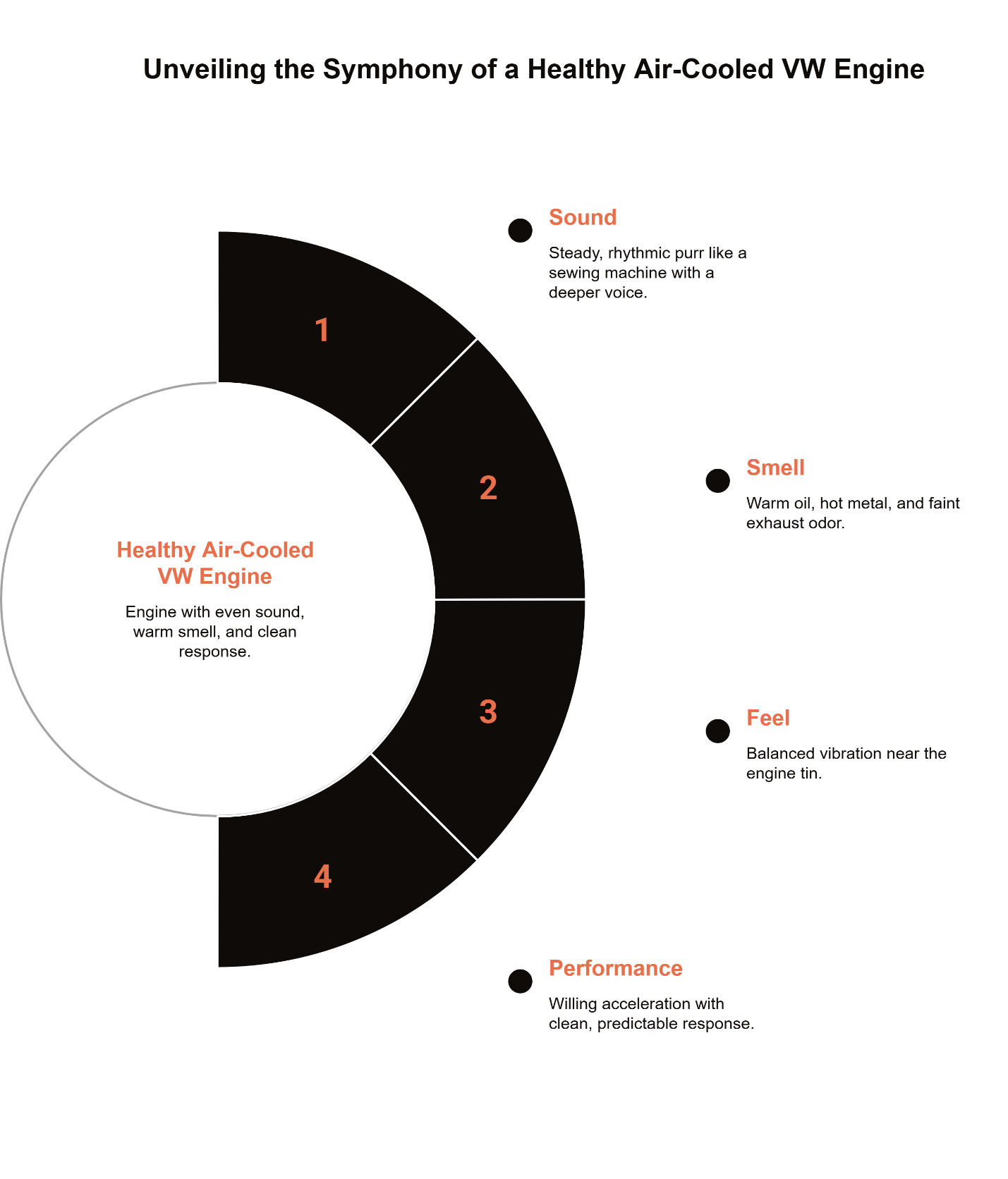
A well-sealed air-cooled engine has a particular character that experienced VW owners call the air-cooled purr. It is steady, mechanical, and rhythmic—like a sewing machine with a deeper voice. Each cylinder fires evenly, and the exhaust note stays consistent whether the engine is cold or fully warmed up. On an air-cooled Volkswagen, "healthy" does not mean silent. It means settled. The engine note should have an even mechanical rhythm rather than a broken cadence.
What you should hear: A settled, even idle with no skipping, popping, or irregular beats. The exhaust pulses blend together rather than sounding like individual "puffs." At the tailpipe, the pulses should feel consistent rather than weak-strong-weak.
What you should smell: Warm oil, hot metal, and a faint hint of exhaust. Some fuel odor is normal during cold starts, but it should fade once the engine reaches operating temperature. Around the engine bay, the normal smells of warm metal and fuel vapor should not turn into a sharp raw-fuel sting.
What you should feel: When you rest your hand near (not on) the engine tin, the vibration should feel balanced. No single cylinder should be shaking harder than the others.
Under light acceleration, a healthy engine usually feels willing. It does not need to be fast to feel right. What matters is whether the car pulls with a clean, predictable response instead of hesitating, flattening out, or sounding strained. For buyers trying to build a broader baseline, the shop's guide to Classic Car Maintenance helps place engine behavior inside the larger picture of owning a vintage car.
These clues are not proof of perfect health. They are simply the baseline that tells you the engine is worth a closer look.
Why a Smooth Idle Can Hide Low Compression
A calm idle does not rule out weak internal sealing.
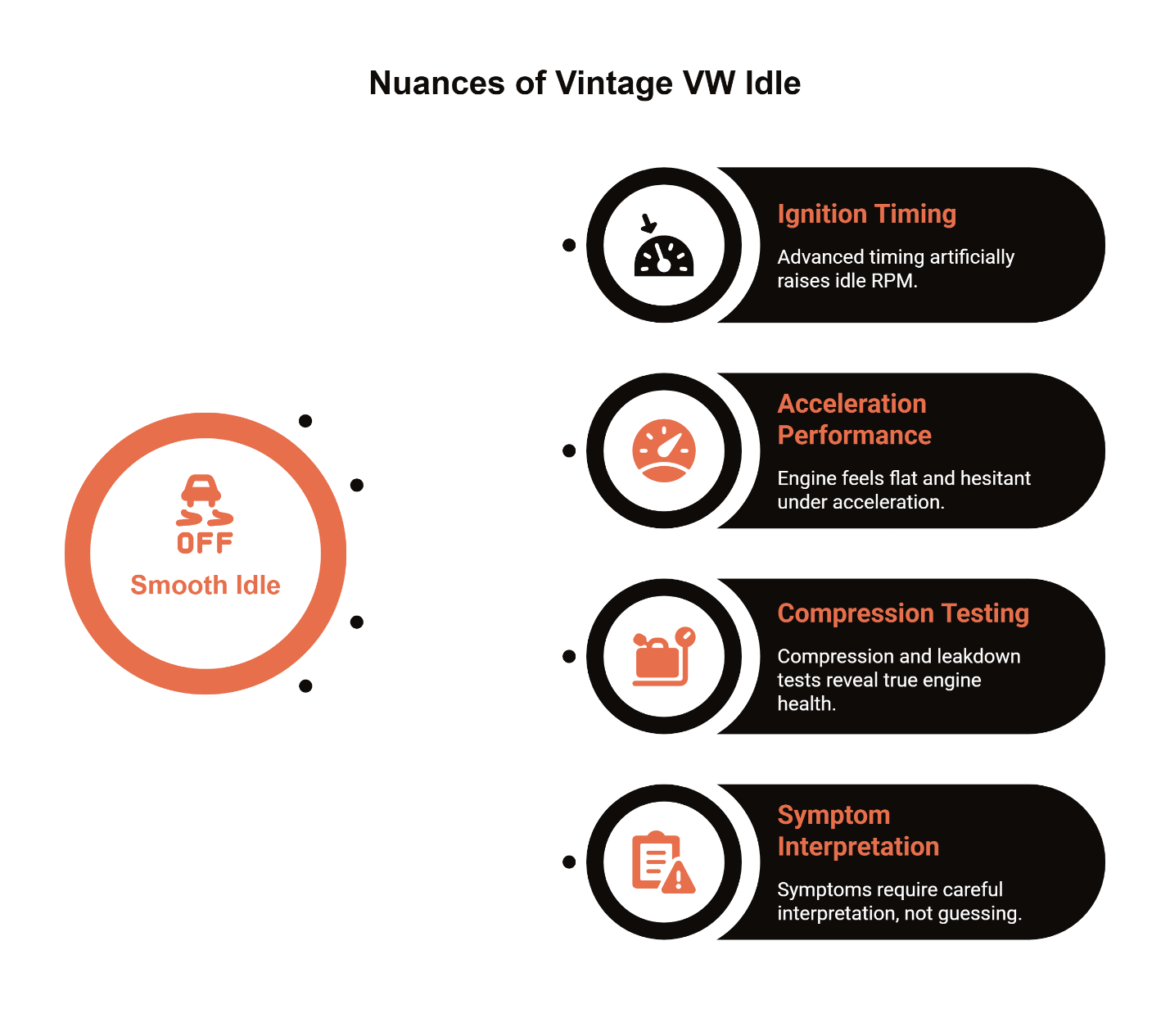
Here is the part that trips up even experienced car shoppers: a vintage VW can idle smoothly and still have weak internal sealing. The reason comes down to ignition timing.
When ignition timing is overly advanced, it raises the idle RPM, which can artificially mask the stumble of a cylinder that isn't holding pressure. The engine sounds calm at idle because it is not being asked to work hard. The moment you press the accelerator—especially under load going up a hill—the truth comes out. The engine feels flat, hesitant, or sluggish.
This is why idle quality alone is weak evidence when you are deciding whether to buy. A smooth idle can mask low compression until the engine is stressed.
The smarter approach is to listen and feel during acceleration. If the car sounds settled at idle but feels breathless when you ask it to pull, that gap is worth noting. It does not mean the car is a bad deal, but it does mean the engine deserves a compression and leakdown test before you commit.
Symptom-chasing can mislead inexperienced buyers. A rough note may come from timing, carburetion, or sealing. A smooth note may hide a deeper issue. The related guides on Rough Idle on an Air-Cooled Volkswagen and Carb Sync or Timing? are useful follow-ups because they show why old-car symptoms should be interpreted carefully rather than guessed at.
How to Use a Driveway Sensory Triage Checklist Before You Trust the Gauge
Use your senses to sort the car into "healthy enough to keep checking," "watch closely," or "test now."
Before you call a shop or schedule an inspection, you can gather useful information in the seller's driveway. The goal is not to diagnose—it is to document what you notice so you can bring better questions to a specialist. A practical driveway pass does not need special tools. It needs attention and restraint. Listen first. Smell second. Feel the car under light load. Then write down what stood out. Concrete notes are more valuable than vague impressions.
Sensory Triage Checklist
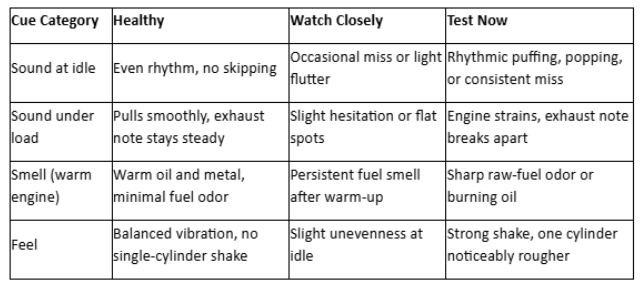
How to use this checklist: Walk through each row while the engine is running. If most of your observations fall in the "Healthy" column, you have a car worth investigating further. If you are marking "Watch Closely" or "Test Now" in multiple rows, the engine is asking for objective verification before money changes hands.
That middle category matters. Not every concern means "walk away now," but mixed signals should slow the decision down. A buyer comparing several cars can use a light Must-Do / Soon / Monitor filter:
Must-Do: Book compression and leakdown testing, and ask for a pre-purchase inspection, before agreeing on price.
Soon: Document the concern and plan specialist follow-up before treating the car as a good buy.
Monitor: Keep evaluating, but do not mistake a pleasant idle for verified engine health.
Write down exactly what you notice—specific sounds, smells, and how the car behaves when you give it throttle. These notes become valuable when you talk to a shop about a pre-purchase inspection. The key is pattern recognition, not driveway diagnosis. A buyer is not trying to name the fault. A buyer is deciding whether the engine's cylinder vitals deserve formal verification.
When Sensory Clues Mean It Is Time for a Compression or Leakdown Test
When warning signs repeat or stack up, stop guessing and move to objective testing.
Sensory triage helps you filter—but it does not give you certainty. Here is when your observations should trigger professional testing:
Must-Do (Test before purchase):
- Rhythmic puffing or hollow exhaust sound at idle
- Strong raw-fuel smell that persists after the engine is warm
- Flat, unresponsive pull under acceleration
- Visible smoke (blue for oil, black for rich fuel mixture)
Soon (Test before committing serious money):
- Occasional miss or flutter at idle that comes and goes
- Slight hesitation under load that you cannot explain
- Fuel smell that fades but never fully disappears
Monitor (Note it, but not urgent):
- Minor unevenness at cold start that smooths out
- Faint oil smell from an older engine (common, not always a problem)
An illustrative example makes the handoff clear. Imagine a promising Beetle that starts easily and idles with a pleasant rhythm. At first glance, it feels like a good driveway candidate. Then you notice a hollow puffing note at the exhaust, catch a raw-fuel edge once the engine warms, and feel the car go flat on a short pull away from the curb. None of those clues alone proves internal damage. Together, they make the case for testing before purchase.
A compression test measures the peak pressure each cylinder can build during the compression stroke. A leakdown test goes further—it measures how well the cylinder holds that pressure by injecting regulated air and listening for where it escapes, revealing whether the problem is rings, valves, or a compromised cylinder-to-head seal. Together, these diagnostics quantify the exact mechanical wear your senses detected. They replace guesswork with numbers.
For a detailed breakdown of what those numbers mean, see Engine Health on a Vintage VW: What Compression and Leakdown Numbers Mean for Buyers.
That same evidence-based mindset supports buyer due diligence beyond the engine itself. California's A Consumer's Guide to Auto Repair and the BAR's Maintenance and Repairs page are useful for understanding repair communication and consumer rights. Buyers should also run the VIN through the NHTSA Vehicle Recall Lookup before committing. For a broader pre-purchase lens, Brakes, Steering, and Tires on a Classic Volkswagen and Hidden Rust Zones on Beetles, Buses, and Ghias round out the decision.
How to Bring Better Questions to a Vintage VW Shop in Orange, CA
Bring observations, not conclusions.
Once you have gathered your observations, the next step is translating them into questions a specialist can answer. A shop can do far more with clear sensory notes than with a vague "it sounded off." Here is how to turn your notes into a productive conversation:
- Instead of: "The engine sounds weird."
- Say: "There was a hollow puffing note at warm idle—does that point toward an exhaust issue or weak sealing?"
- Instead of: "It smells like gas."
- Say: "The car smelled sharply of raw fuel after a few minutes—what would need to be ruled out before purchase?"
- Instead of: "It felt slow."
- Say: "It idled nicely, but the pull felt flat—would that justify compression and leakdown testing?"
This kind of specificity helps the shop focus their inspection. It also shows that you understand the car well enough to ask meaningful questions—which builds trust on both sides. That language keeps the conversation honest and specific.
At Orange Independent Auto Repair, the team has specialized in classic VWs since 1971. As one longtime customer put it: "Eddie has been working on VW Beetles for 50+ years. He's the only person that will ever touch my car." Rachel Elaine K. described the shop as "completely honest" after a repair turned out to be smaller than expected. That combination—plainspoken education and model-specific familiarity—is exactly what a nervous buyer needs in the driveway-decision moment.
If the sounds and smells leave you uncertain, contact Orange Independent Auto Repair to ask about a pre-purchase inspection or baseline engine verification. The shop is located at 187 S Main St, Orange, CA 92868, can be reached at (714) 633-7161 or orange.independent@gmail.com, and is open Monday through Friday, 7:00 AM to 6:00 PM, with Saturday by appointment only. The purr is valuable, but only because it tells a careful buyer when to stop trusting impressions and start collecting proof.
Resources
- Classic Car Maintenance
- Engine Health on a Vintage VW: What Compression and Leakdown Numbers Mean for Buyers
- Rough Idle on an Air-Cooled Volkswagen: What Your Senses Can Tell a Specialist
- Carb Sync or Timing? How Proper Diagnostics Separate Symptoms from Causes on Air-Cooled VWs
- Contact Orange Independent Auto Repair
Disclaimer: This article is for informational purposes and should not replace professional mechanical inspection. California consumers have specific rights regarding auto repair; for more information, see the California Bureau of Automotive Repair's consumer guide.
Our Editorial Process
Our expert team uses AI tools to help organize and structure our initial drafts. Every piece is then extensively rewritten, fact-checked, and enriched with first-hand insights and experiences by expert humans on our Insights Team to ensure accuracy and clarity.
By: The Orange Independent Auto Repair Insights Team
The Orange Independent Auto Repair Insights Team is our dedicated engine for synthesizing complex topics into clear, helpful guides. While our content is thoroughly reviewed for clarity and accuracy, it is for informational purposes and should not replace professional advice.