
Hidden Hazards: Why We Audit Previous Owner Wiring
📌 Key Takeaways
Unknown wiring from previous owners—not factory wiring—creates the real electrical risk in classic cars.
- Mystery Switches Hide Danger: Unlabeled toggles under the dash mean unknown circuits, unknown protection, and unknown fire risk.
- No Fuse = Heating Element: Any wire running straight to the battery without a fuse can overheat and start a fire, even while parked.
- Tape Hides Problems: Electrical tape covers bad connections, mismatched wires, and corrosion—it doesn't fix them.
- Trust Your Senses First: Burning smells, hot switches, flickering lights, or repeated dead batteries all signal wiring trouble.
- Audit Before You Drive: A wiring inspection in the first 30 days turns "unknown history" into a safe, known starting point.
A quick inspection now prevents expensive surprises—or worse—later.
Classic VW and Porsche owners who recently acquired a car with unknown electrical history will find a clear action plan here, preparing them for the detailed inspection checklist that follows.
~ ~ ~ ~ ~ ~ ~ ~ ~ ~ ~ ~ ~ ~ ~ ~ ~ ~ ~ ~ ~ ~ ~ ~ ~ ~ ~ ~ ~ ~ ~ ~ ~ ~ ~ ~ ~ ~ ~ ~ ~ ~ ~ ~ ~ ~ ~ ~ ~ ~ ~ ~
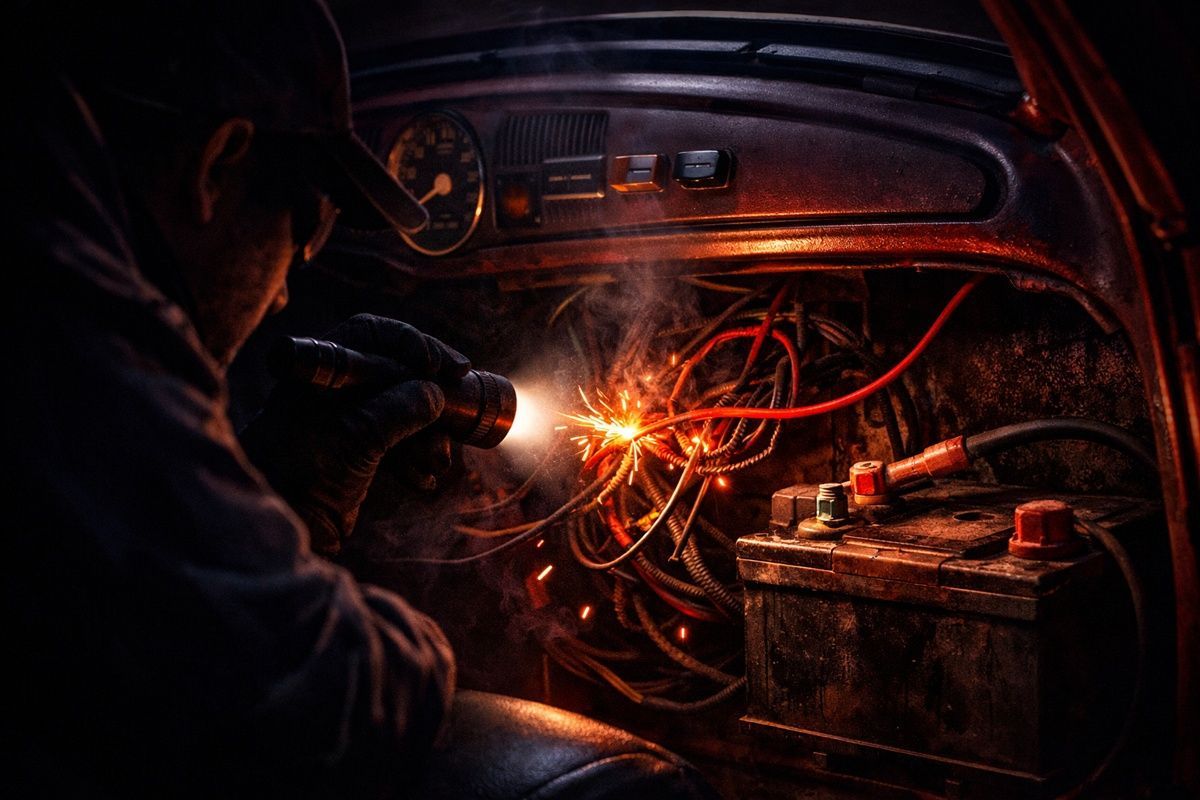
You pop the hood or slide under the dash of your newly acquired classic VW or Porsche. There it is: a tangle of wires in colors that don't match anything in the factory manual, a toggle switch nobody can explain, and electrical tape wrapped around something that disappears into the firewall. Is this normal "classic car character"—or a problem waiting to happen?
A wiring audit answers that question. It's a safety-first inspection that turns "unknown history" into a known baseline. On a classic VW or Porsche, we're not just looking for old wires—we're looking for added wires: mystery switches, splices, abandoned alarm circuits, and accessories that were never properly fused or grounded. The goal is simple: reduce the risk of overheating, shorts, and electrical gremlins so the car is safe to drive, safe to park, and dependable enough to start building a real classic car maintenance plan.
The Hidden Hazard Isn't "Old Wiring"—It's Unknown Wiring
Factory wiring on a 1970s Beetle or early 911 was designed for a radio, lights, and a heater. Over the decades, owners added stereos with amplifiers, alarm systems, auxiliary driving lights, electric fuel pumps, USB chargers, and who knows what else. Classic cars collect "helpful upgrades" the way they collect stories—often installed by different owners, shops, or friends-of-friends in layers that span decades.
The original harness usually isn't the problem. What causes trouble is the aftermarket wiring installed without proper fusing, without relays to protect sensitive circuits, and without solid grounds. The install history is typically undocumented, and the protection (fusing, relays, routing, and grounding) may not match the electrical load.
"It works" is not the same as "it's protected." A circuit can power a device for months and still be one short, chafe point, or bad ground away from heat damage.
What Can Go Wrong (And Why It's More Than an Inconvenience)
Electricity follows all available paths, prioritizing those with the least resistance. When a connection is loose, a ground is corroded, or a wire is undersized for its load, this unwanted resistance creates heat. Heat damages insulation. Damaged insulation exposes copper. Exposed copper touches metal it shouldn't, and now you have a short circuit.
The U.S. Fire Administration and National Fire Protection Association estimate that generally over 210,000 vehicle fires occur each year, [1] with mechanical and electrical failures among the leading contributing factors. Insulation around electrical wiring is one of the most commonly ignited items in vehicle fires. That doesn't mean every messy dash causes a fire. It means unknown electrical work is a category worth taking seriously because the mechanism—shorts and overheating—is real. USFA consumer guidance reinforces that vehicle fires can start from mechanical or electrical problems and should be approached with prevention and caution in mind.
Most electrical problems don't end in fire. They end in frustration: a battery that's dead every Monday morning, gauges that flicker at idle, a no-start that fixes itself for no apparent reason, or a melted connector behind the dash. But when your classic is parked in a garage attached to your house, even a small risk is worth addressing. An NHTSA recall notice confirms that electrical shorts can increase fire risk while a vehicle is parked—not just while driving.
For classic owners, the early warning signs are often sensory rather than electronic alerts. Many classics lack the warning-light systems found in modern vehicles, so the most useful triggers tend to be:
- Smells: burning plastic or insulation, hot electrical odor, "something's cooking"
- Heat: wiring that feels hot to the touch, warm switch panels, hot fuse areas
- Intermittent behavior: flickering lights or gauges, odd no-start moments, random dead battery
- Visible damage: melted connector housings, heat-darkened insulation, brittle or cracked wire jackets
Southern California heat and stop-and-go traffic can amplify weak grounds and marginal connections. Add old insulation, vibration, and decades of accessory installs, and intermittent issues become common—right when a new owner wants confidence.
The point isn't to scare you. Electrical fires are rare. But they're also preventable, and that's why a wiring audit belongs in your first 30 days of ownership.
Wiring Red Flags We See After a Purchase
Here's a quick checklist of what to look for—and what we look for during an inspection. If you spot several of these, it's time to have the system audited before you start daily driving.
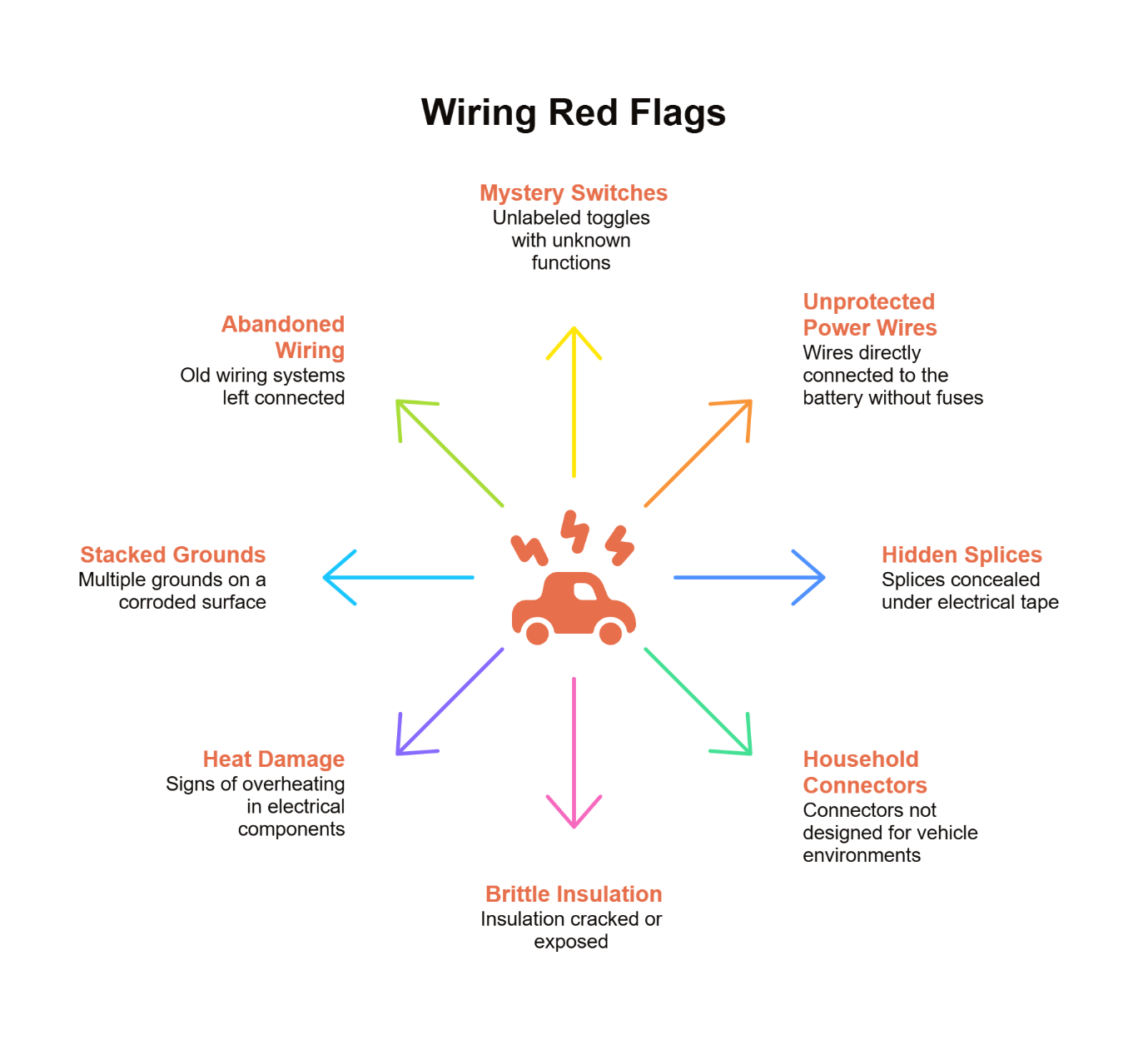
Mystery switches — Unlabeled toggles under the dash or on the console. What do they control? Are they still connected to anything? If the purpose isn't known, the circuit protection is unknown too.
Accessory power wires without fuse protection — A wire running directly from the battery or a hot terminal, with no inline fuse. One short and the wire becomes a heating element. A direct-to-battery or direct-to-hot feed without proper protection is a top-tier hazard.
Splices hidden under electrical tape — Tape doesn't make a reliable connection. It hides what's underneath and deteriorates over time, concealing twisted connections, mismatched wire gauges, or corrosion.
Household connectors — Wire nuts and push-in connectors belong in a wall outlet, not a car. They vibrate loose and corrode. They're not designed for vehicle vibration, heat, or moisture cycling.
Brittle insulation or exposed copper — Age and heat crack insulation. Exposed wire waiting to touch grounded metal is a short waiting to happen, especially where wires rub on metal brackets.
Signs of heat damage — Melted plastic, discolored connectors, or wires that feel stiff and crunchy. Something got too hot. Heat evidence often points to resistance at a connection, an overloaded circuit, or a poor ground.
Stacked grounds on rusty metal — Multiple ring terminals piled on a single bolt, attached to a surface that's corroded. Grounds are half the circuit. Bad grounds cause intermittent problems and force current through unintended paths.
Abandoned alarm or stereo wiring — Old systems get removed, but the wiring stays—spliced into ignition circuits, tapped into power, and no longer doing anything useful. These frequently cause no-starts and battery drains.
The scariest wiring is often not the original harness. It's the newer add-ons installed without proper protection, routing, or strain relief.
What a Professional Wiring Audit Includes
A wiring audit isn't a full rewire. It's a focused inspection designed to identify risk and establish a baseline—a risk-reduction and clarity service that removes guesswork early, before the car becomes a rolling list of unpredictable electrical surprises. Here's what happens during a typical vehicle inspection that includes electrical work:
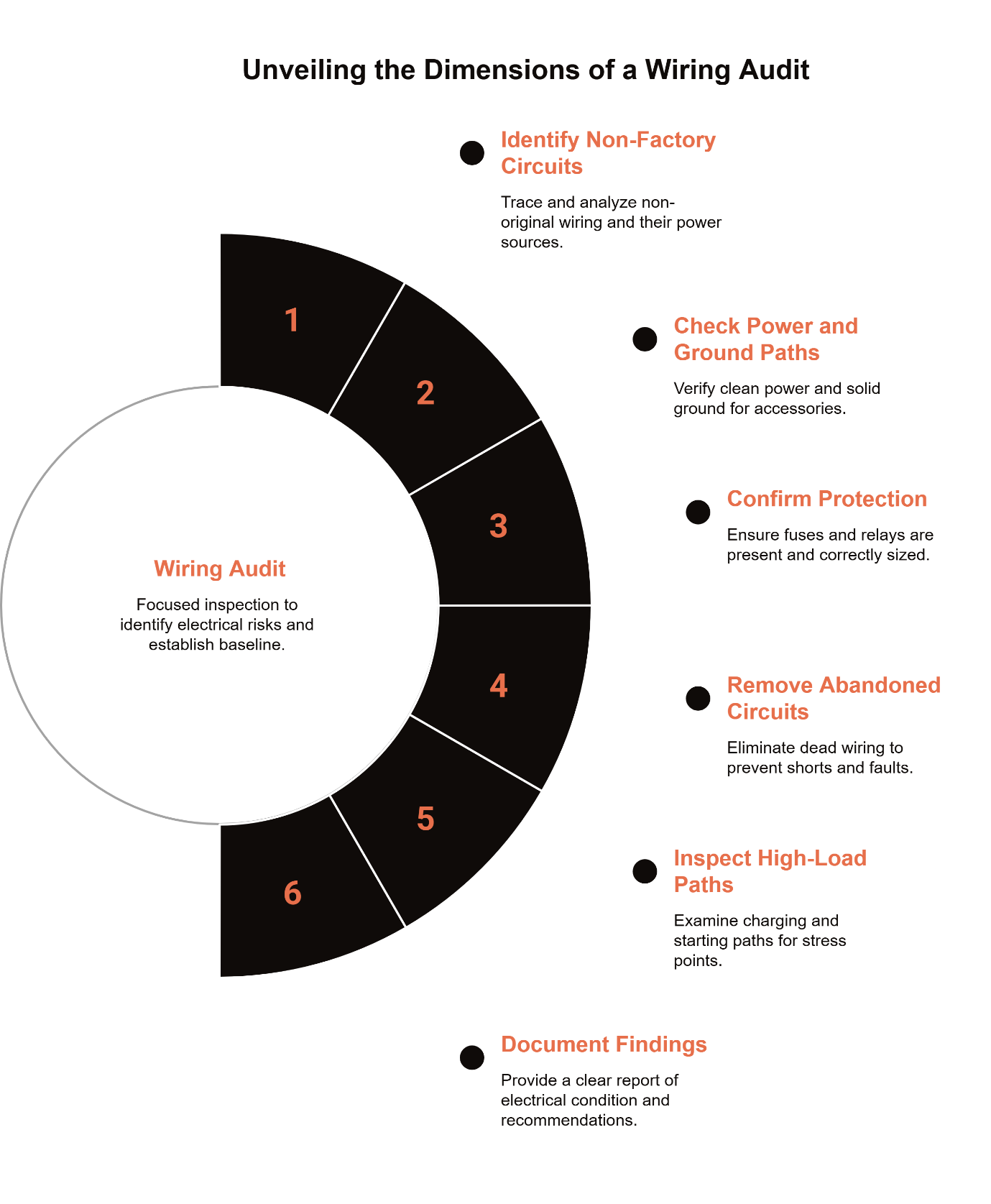
Identify non-factory circuits. We trace wires that don't belong to the original harness. What do they power? Are they still in use? What was added (stereo, alarm, lights, fuel pump, gauges)? Where does it pull power? What is it switched by?
Check power and ground paths. Every accessory needs a clean power source and a solid ground. We verify both, looking for voltage drops and resistance that signal trouble. The goal is not "fancy"—it's safe and stable.
Confirm protection. Fuses and relays exist for a reason. If an accessory is wired without them, we note it. If protection is undersized or bypassed, that's a priority fix.
Remove abandoned circuits. Dead wiring from an old alarm or a stereo that's long gone doesn't need to stay. Old alarms, unused relays, and cut harness ends can become shorts, parasitic draws, or intermittent faults later. Removing them simplifies the system and eliminates potential failure points.
Inspect high-load paths when symptoms suggest it. Charging and starting paths are common stress points because they handle higher current. A good audit checks these basics as needed—especially if there's a history of no-starts or battery drain.
Document what we find. You get a clear picture of the car's electrical state—what's good, what's marginal, and what needs attention—so future maintenance isn't guesswork. The output should be clarity: what was found, what's risky now, what can wait, and what should be addressed to support a longer-term classic car maintenance plan.
The result is a known baseline. You understand what's in the car, what powers it, and whether it's protected. That's the foundation for everything else.
When to Stop Driving and Get It Checked Right Away
Some symptoms shouldn't wait. If you notice any of the following, stop driving and have the car inspected:
- Burning smell—especially a hot plastic or electrical odor
- Smoke from under the dash or hood, even brief wisps
- Wiring or switch panels that are hot to the touch
- The same fuse blowing repeatedly
- Melted connectors, heat-darkened insulation, or scorch marks
These are signs that something is overheating right now. Even with the key out of the ignition, a compromised, unfused circuit can continue drawing current. This turns an enclosed garage into a high-risk zone for an unattended thermal event.
Don't try to diagnose it yourself. Schedule a vehicle inspection or call us at (714) 633-7161.
From Reset to Stewardship: What to Do Next
Think of the first 30 days as hitting the reset button. The goal is not perfection— it's achieving absolute certainty about your electrical system's integrity. A wiring audit is part of the "first 30 days" mindset: when you acquire a classic with unknown history, you establish a safe, known baseline before you start building on it. Electrical safety sits alongside other safety priorities to check early, like brakes, steering, and tires.
Once the wiring risks are identified and the most urgent hazards are handled, the ownership experience changes: fewer gremlins, more confidence, and a clearer path to preserving the car. A practical next sequence often looks like this:
Baseline first: Address obvious electrical hazards and unknown add-ons.
Then build a plan: Transition into a time-and-mileage approach that supports reliability—the classic VW and Porsche maintenance rhythm that keeps the car dependable for years, not just weeks.
Expand safety priorities: If this is a fresh purchase, review brakes, steering, and tires during the same "first 30 days" mindset.
Orange Independent Auto Repair has been working on classic VWs and Porsches since 1971. We also offer specialized Porsche services for owners in Orange County. If you're in Orange, Tustin, Anaheim, Yorba Linda, or Villa Park and you've just acquired a classic with questionable wiring, we can help you establish that baseline.
Schedule an inspection, or call (714) 633-7161.
You can also read customer reviews or explore more classic car care tips on our blog.
Frequently Asked Questions
Is messy wiring always dangerous in a classic car?
Not always. Some cars are simply "untidy" from age. The risk rises when wiring is unknown, poorly protected, heat-damaged, or tied to mystery switches and add-ons without clear fusing and grounding.
Can a car have an electrical fire while it's parked?
Yes. Unfused accessory wires routed directly to the battery bypass the ignition switch entirely. If that wire chafes and grounds out, it will overheat and ignite nearby materials, even if the car has been turned off for days.
What's the difference between a wiring audit and a full rewire?
A wiring audit identifies non-factory circuits, verifies protection, and removes obvious liabilities to establish a safe baseline. A full rewire is a much larger restoration-level project.
What are "mystery switches" usually for—and why be cautious?
They're commonly tied to added accessories or workarounds (fuel pump, lights, alarms). The concern is less the switch itself and more the unknown circuit protection and routing behind it.
Just bought a classic VW or Porsche—when should the electrical system be inspected?
If there's evidence of add-ons, messy splices, intermittent symptoms, or any heat/smell issues, schedule early—ideally within the first 30 days—so ownership starts from a known-safe baseline.
Resources
- U.S. Fire Administration (FEMA) — Highway Vehicle Fires
- U.S. Fire Administration (FEMA) — Vehicle Fire Safety
- University of Washington — Vehicle Fire Investigation
- NHTSA — Recall Notice (electrical short/fire risk language)
Our Editorial Process
At Orange Independent Auto Repair, we take pride in providing honest, accurate, and practical automotive guidance based on decades of hands-on experience. Every piece of content we publish is created with the goal of helping you make confident decisions about your vehicle—especially when it comes to maintenance, safety, and repair.
Our process includes:
Experience-First Insight — All advice is rooted in real-world shop experience working with classic and modern vehicles, especially VW and Porsche models.
No Hype, No Gimmicks — We don't exaggerate problems or overpromise services. We aim to explain things clearly, so you can understand your options without pressure.
Safety & Responsibility — When a topic involves vehicle safety or drivability, we prioritize caution and encourage professional inspection when needed.
Locally Grounded — Our recommendations reflect real driving conditions in Orange County and the needs of local drivers.
Final Review for Accuracy — Before publishing, we review each article to ensure it aligns with our service philosophy: integrity, clear communication, and long-term vehicle reliability.
If you ever have questions about your specific vehicle, you're always welcome to contact our team directly.
Disclaimer: This article is general information, not a substitute for a hands-on vehicle inspection. Electrical issues can become safety hazards quickly. If you notice burning smells, smoke, melting connectors, or repeated electrical failures, stop driving and have the vehicle inspected by a qualified professional.
By: Orange Independent Auto Repair
Orange Independent Auto Repair is a
family-owned shop in Orange, California (since 1971) specializing in classic VW and Porsche service. We focus on practical inspections and repairs that make older cars safer, more reliable, and easier to live with across Orange County.