
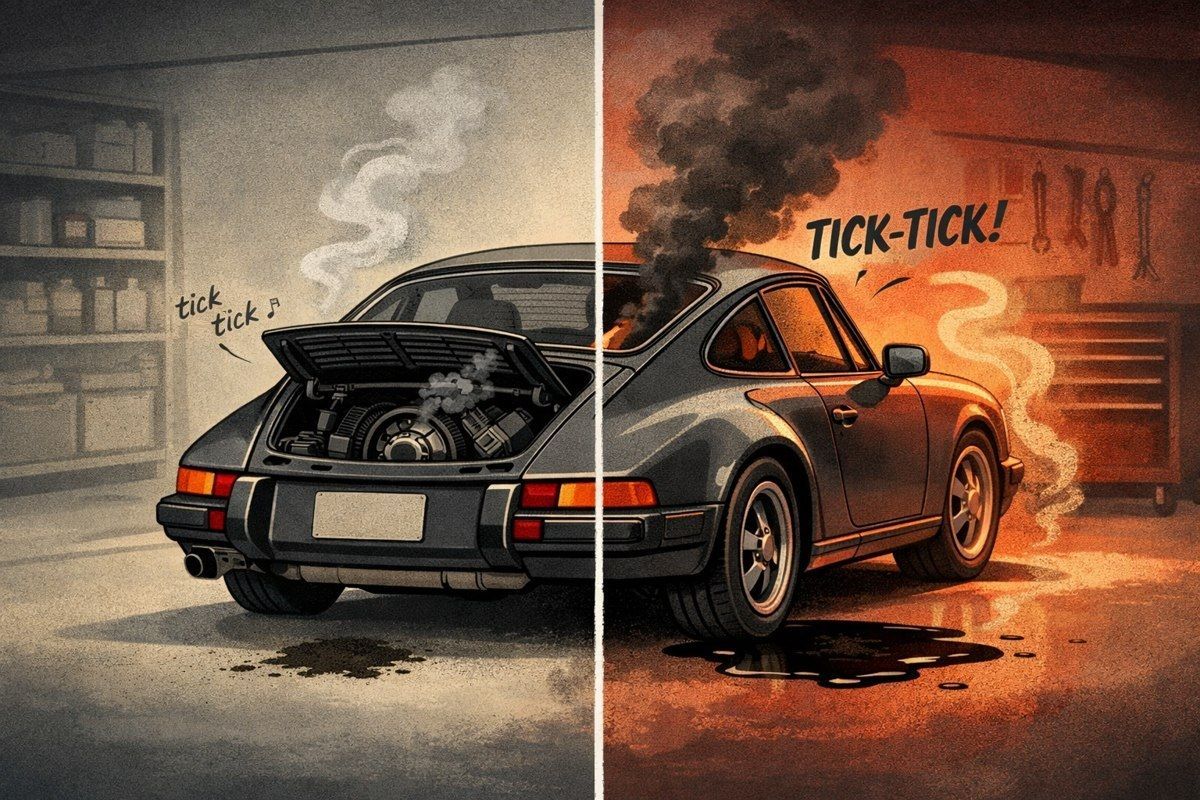
Stop Guessing with Vintage Engines: How to Read the Sounds, Smells, and Leaks of a Classic Porsche
📌 Key Takeaways
Classic Porsches talk through smell, sound, and leaks—your job is noticing when something changes, not diagnosing it yourself.
- Change Beats Noise: A new sound or smell matters more than an old, familiar one—stable quirks are character, sudden shifts are warnings.
- Combine Your Clues: One symptom can mislead, but oil smell plus smoke plus a fresh spot tells a clearer story worth investigating.
- Fuel Smell Means Stop: A sharp, raw gasoline odor is a fire risk—don't start the car until someone checks the source.
- Know Your Baseline: Track normal gauge readings, idle feel, and leak patterns so you can spot when something shifts from "always been that way" to "this is new."
- Describe, Don't Diagnose: Tell your mechanic what changed, when it happens, and what else appeared alongside it—that's more useful than guessing at causes.
Notice patterns, not problems—specialists translate your observations into repairs.
Classic Porsche owners learning to read their car's signals will build confidence here, preparing them for the sensory guide that follows.
~ ~ ~ ~ ~ ~ ~ ~ ~ ~ ~ ~ ~ ~ ~ ~ ~ ~
The moment hits without warning. You're standing in a stranger's driveway in Tustin, keys in hand, staring at a 1973 911 that looks exactly like the car you've been dreaming about for years. The seller starts it up. The flat-six settles into its distinctive burble. And then you catch it—a faint whiff of something burning, oil meeting hot metal somewhere beneath that rear decklid.
Is that normal? Should you walk away? Or is this just what a fifty-year-old air-cooled engine smells like?
This is the question that keeps new classic Porsche owners awake at night. Not because they lack intelligence or mechanical aptitude, but because nobody taught them the language. Modern cars flash warning lights and generate codes. Classic Porsches communicate differently. They speak through smell, sound, and feel—an analog vocabulary that predates computers entirely.
Learning to read these signals is not about becoming a mechanic. It is about becoming a translator.
What a Classic Porsche Is Telling You Before Any Tool Comes Out
A classic Porsche does not need a warning light to tell you something is wrong. The engine is already communicating constantly. The only question is whether you know how to listen.
That is the central shift this article is built to make: a classic Porsche usually communicates through analog symptoms first—smell, sound, leak pattern, heat, vibration, and gauge behavior. The goal is not to turn a driveway into a repair bay. The goal is to learn the difference between stable vintage character and a warning sign that changed.
Think of it like using a stethoscope instead of an MRI. Modern diagnostics give you a complete picture through technology. Analog diagnostics require you to develop your senses, to notice patterns, and to understand what those patterns mean over time. This does not mean you need to diagnose problems yourself. That is what specialists are for. Your role as an owner is to notice, to compare today against yesterday, and to recognize when something has changed enough to warrant professional attention.
One clue can mislead, but a pattern of clues usually helps. A faint oil smell after a warm drive may be nothing. A faint oil smell plus visible smoke near a hot exhaust surface, plus a fresh spot under the car, tells a stronger story. A light tick at idle may be stable vintage behavior. A tick that grows sharper with revs, appears under load, or arrives alongside weaker drivability belongs in a different category.
The car is talking. Your job is to hear it.
At Orange Independent Auto Repair, where the team has been caring for classic VWs and Porsches since 1971, this translator role defines the relationship between owner and specialist. The owner notices. The specialist interprets. Together, they keep the car healthy.
Smells: Which Odors Are Vintage Character, and Which Ones Mean Stop and Verify
Smell is often the fastest messenger on an older car. It is immediate, memorable, and hard to ignore. The first distinction to make is between a smell that is stable, faint, and context-bound, and a smell that is sharp, new, stronger, or paired with heat, smoke, or poor running. That distinction matters more than trying to describe the chemistry involved.
The smell that lingers after a drive vs. the smell that changes your plans
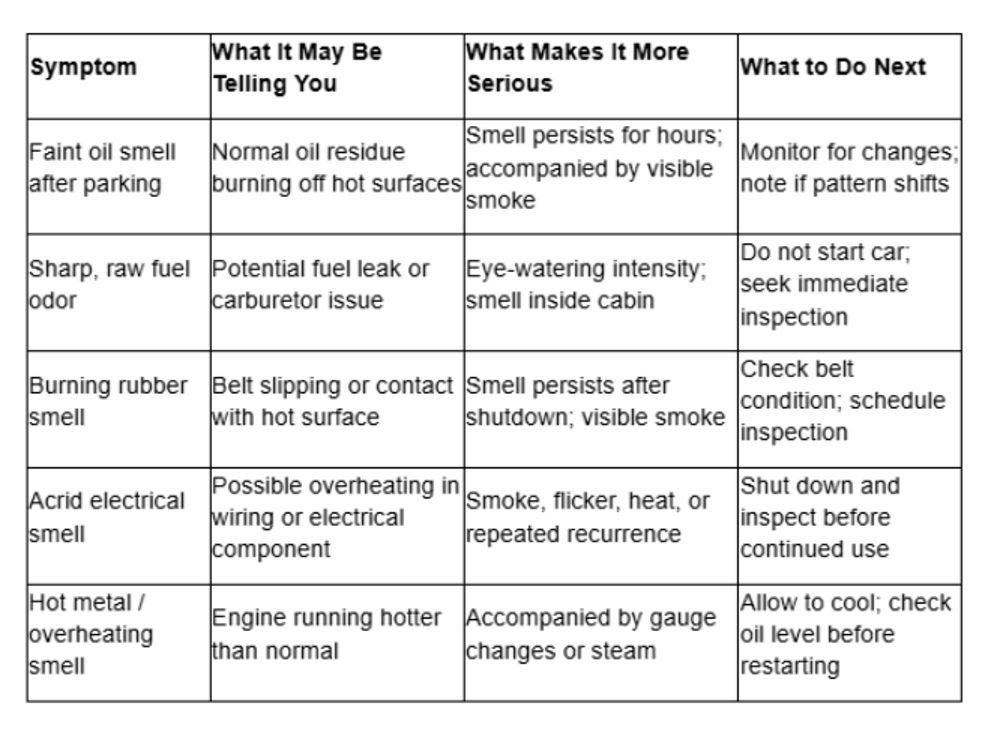
A faint oil smell that appears briefly after you park and then fades? Likely nothing to worry about, especially in an air-cooled engine where some oil residue on hot surfaces is common. But a sharp, acrid burning smell that persists? That demands attention. The difference is intensity, persistence, and context.
Fuel odors require the most caution. A raw gasoline smell—not the distant hint of fuel you might catch at a gas station, but that sharp, eye-watering scent of unburned fuel—is a fire risk. Hagerty's maintenance guidance for vintage cars emphasizes checking for fuel-line leaks and frames fuel leaks as fire hazards when an ignition source is present. If you smell raw fuel, do not start the car until the source has been identified.
Burning oil tells a different story. A faint oil smell from an air-cooled engine after a spirited drive is often just oil burning off external surfaces. But if the smell is new, if it is accompanied by visible smoke, or if it appears alongside a drop in oil pressure on your gauge—that combination suggests something has changed internally.
Burning rubber belongs in the same caution zone. So does an acrid electrical smell. Those odors suggest heat, friction, or electrical trouble rather than harmless old-car atmosphere. A useful way to sort smell clues is this:
- Usually lower concern: faint, familiar, short-lived, and not accompanied by other symptoms.
- Usually higher concern: sharp, new, stronger than usual, persistent, or paired with smoke, drivability change, or visible leakage.
Sweet smells are virtually nonexistent in true air-cooled Porsches, which rely entirely on air and oil rather than traditional water-based coolant systems. Any sweet odor in a classic model usually points to burning clutch material, a windshield washer fluid leak, or an external environmental source, rather than an internal engine issue.
The principle is consistent across all odor types: a stable, familiar smell is likely character. A new smell, a stronger smell, or a smell that appears alongside other symptoms is a signal worth investigating. For a deeper look at specific fuel and oil odors, Is That Smell Normal? A Guide to Fuel and Oil Odors in Classics provides additional context.
Sounds: How to Hear the Difference Between a Quirk and a Warning Sign
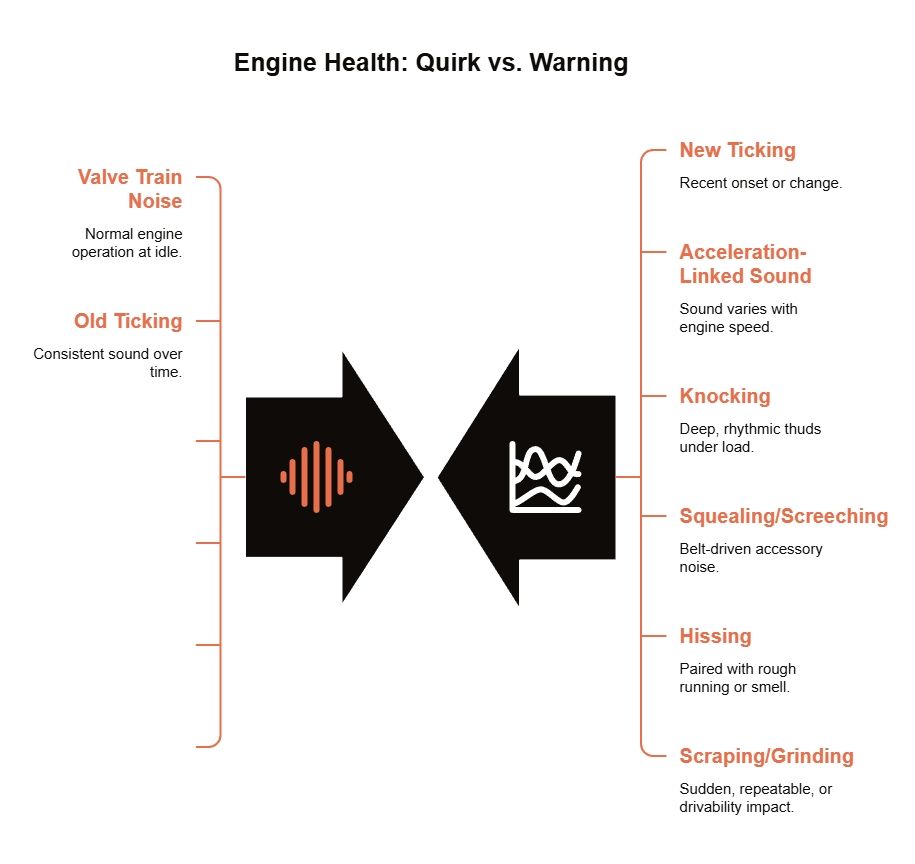
Air-cooled engines are not quiet. They tick. They whir. They make sounds that would send a modern car owner straight to the dealership in panic. But most of these sounds are simply the voice of a mechanical engine doing its job without the sound-deadening insulation that modern cars use to keep cabins silent.
The question is never "does it make noise?" The question is always "has the noise changed?"
Why a new noise matters more than an old, stable one
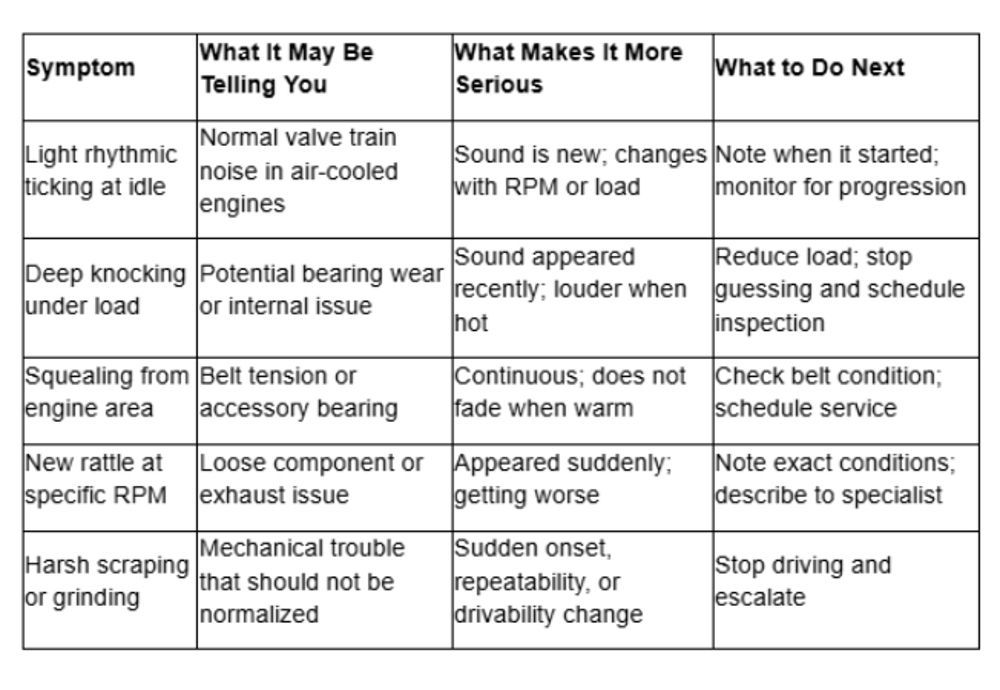
A light, rhythmic ticking at idle that has been present for years and does not change with temperature or load? That is likely valve train noise, normal in air-cooled engines, and nothing to lose sleep over. But a tick that appeared last Tuesday, or a tick that gets louder when you accelerate, or one that was not there when the engine was cold but shows up after twenty minutes of driving—these changes carry meaning.
Ticking that changes with acceleration is a specific escalation cue. If the sound speeds up or slows down directly with engine RPM, it is mechanically linked to something rotating. If it appeared recently, that something may be wearing in ways that warrant inspection.
The most useful sound categories are straightforward:
- Ticking: often less severe than a knock, but more important when it is new, louder when warm, or changes with acceleration.
- Knocking: heavy, deep, rhythmic thuds that can indicate bearing wear or other internal issues when they appear under load. This is not a "see if it goes away" category.
- Squealing or screeching: often related to belt-driven accessories; tends to be speed-sensitive and may appear or disappear depending on temperature and humidity.
- Hissing: more meaningful when paired with rough running, smell, or an obvious change in idle quality.
- Harsh scraping or grinding: sudden onset, repeatability, or an accompanying drivability change elevates this immediately.
A generally accepted classic-car principle is that sound gains meaning when tied to condition: cold start versus fully warm, idle versus load, steady cruise versus acceleration. That is why "when does it happen?" is often more useful than "what do you think it is?" Hagerty's inspection guidance also recommends starting with careful observation before drawing conclusions, and suggests that a marque-expert inspection remains the safest move when uncertainty persists.
For a more detailed breakdown of sound interpretation, The Analog Diagnostic Guide: Listening to Your Air-Cooled Engine offers further guidance on distinguishing ordinary ticking from more serious lower-end sounds.
The core principle remains: stable sounds that have been present for months or years without change are usually character. New sounds, changing sounds, or sounds that appear alongside other symptoms deserve professional evaluation.
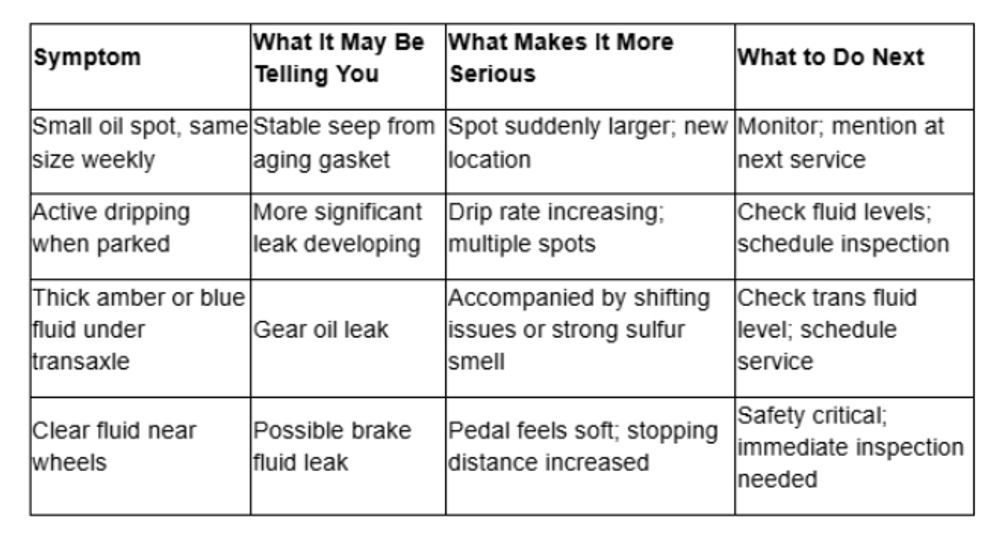
Leaks and Spots: What a Drip Pattern Can Tell You Before the Drive Home
A spot on the concrete beneath your Porsche is not automatically catastrophic. It is also not automatically meaningless. Before you panic, ask yourself four questions: Where exactly is it located? How big is it? What color is it? And most importantly—is this new?
What "sudden change" means in leak and seep language
Many classic cars seep. Gaskets age, seals harden, and small amounts of oil find their way out of engines that have been running for decades. A small, stable oil seep in the same location, leaving the same size spot week after week? That may simply be your car's established pattern.
A spot that was not there yesterday is a different matter. A puddle that is larger than it was last week. A drip that is actively falling rather than slowly seeping. These changes shift the situation from "known behavior" to "needs investigation."
Location matters. A spot directly beneath the engine area suggests different sources than a spot under the transmission or near the wheels. While you cannot diagnose the source from location alone, you can describe it accurately when you call a specialist—which helps them prepare for what they might find.
Color provides clues. Engine oil tends to be amber to dark brown. Gear oil from the transaxle is typically amber, dark brown, or sometimes blue depending on the brand, and carries a strong sulfur smell. Brake fluid is typically clear to light amber and has a distinctive slick feel. A brake fluid leak affects safety systems and demands immediate attention.
Rate reveals severity. A car that leaves a small spot overnight is behaving differently from a car that creates a visible puddle in ten minutes. Active dripping—where you can watch drops falling—suggests a more significant failure than a slow seep.
First-time buyers often get trapped by wishful thinking here. One clean idle does not erase a fresh spot. One cheerful test drive does not erase a fuel smell. A classic can charm and warn at the same time. The right response to an uncertain leak is usually not more guessing—it is a proper pre-purchase or problem-focused inspection.
Touch, Heat, and Analog Feedback: The Clues You Feel Instead of Scan
Beyond smell, sound, and sight, classic Porsches communicate through feel. The vibration through the steering wheel. The way the car pulls—or does not pull—when you accelerate. The heat radiating from different parts of the engine bay. And the information displayed on analog gauges that modern drivers often overlook.
How analog clues work best when you read them together
No single symptom tells the whole story. A slight vibration at idle might mean nothing. A slight vibration at idle combined with a new oil smell and a spot on the garage floor? That pattern suggests something worth investigating.
Vibration changes are particularly informative. A car that has always idled smoothly but now feels rougher has changed. A new shimmy at highway speeds, a pulsation through the brake pedal, a steering wheel that was not shaking last month—these tactile signals complement what you are smelling and hearing.
Unusual heat can indicate problems before other symptoms appear. If one area of the engine feels significantly hotter than others, or if heat seems to be building in unexpected places, that information is worth noting even if you cannot interpret it yourself.
Analog gauges function as a second translation layer. Oil pressure, oil temperature, and charging system behavior provide real-time data about engine health that complements your sensory observations. A gauge reading that has shifted from its normal position—even if it has not entered a red zone—is the car communicating change. Know your baseline readings, and notice when they shift.
Drivability feedback completes the picture. Does the car accelerate the way it did last month? Does it maintain speed on hills the way it always has? Changes in how the car responds to throttle input can indicate issues that have not yet produced other symptoms.
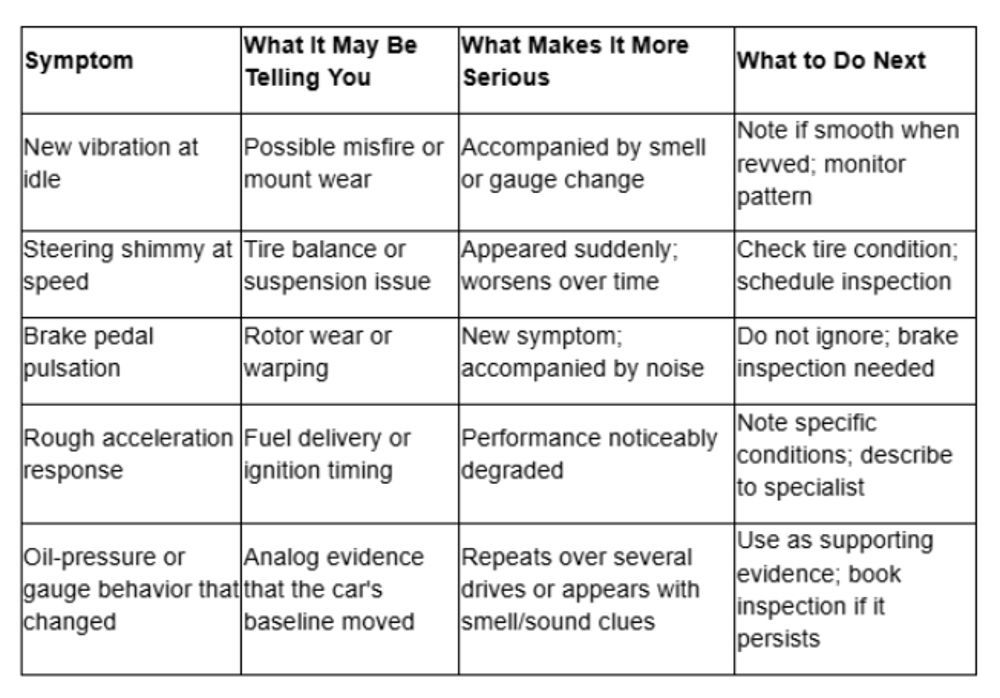
Sensory Translation Guide
The following reference organizes the most common symptoms by sense category. This is an interpretation guide, not a repair manual. The goal is to help you recognize patterns and communicate effectively with a specialist—not to diagnose problems yourself.
Smell
Sound
Touch / Vibration / Gauge Feedback
Leak Patterns
Reality-Check Questions Before Calling the Shop
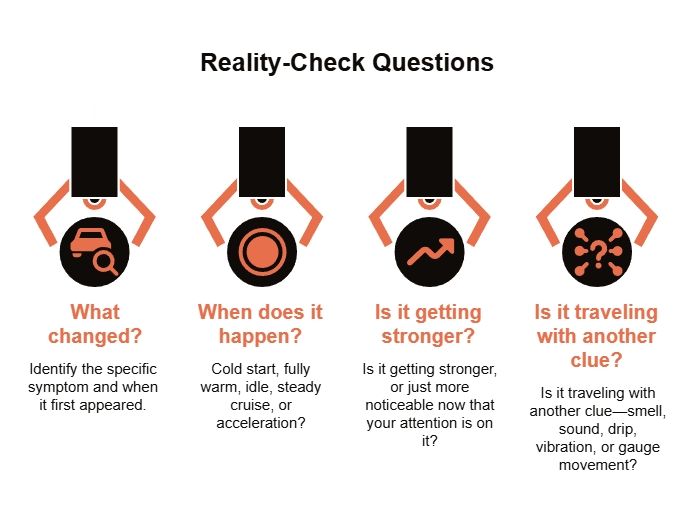
Before you make that call, write down the answers to these four questions. They move the conversation from vague concern to actionable pattern—and help a specialist prepare before the car even arrives.
- What changed? Identify the specific symptom and when it first appeared.
- When does it happen? Cold start, fully warm, idle, steady cruise, or acceleration?
- Is it getting stronger, or just more noticeable now that your attention is on it?
- Is it traveling with another clue—smell, sound, drip, vibration, or gauge movement?
A specialist who hears "something smells weird" has little to work with. A specialist who hears "I noticed a sharp fuel smell last Tuesday that appears after the car has been running for twenty minutes and seems stronger when I park on an incline" can begin forming hypotheses immediately.
When to Stop Guessing and Book a Professional Inspection
Certainty is not the goal. Better judgment is.
The signals that warrant professional attention share common characteristics. They are new—something changed from your established baseline. They are combined—multiple symptoms appearing together. They are escalating—getting worse rather than staying stable. Or they are simply unclear—you notice something but cannot interpret what it means.
None of these situations require you to diagnose the problem yourself. That is not your job. Your job is to notice, describe what you have observed, and connect with a specialist who can translate those observations into understanding.
This threshold is usually reached when the symptom is new, getting worse, paired with other clues, tied to safety, or hard to interpret with confidence. That is especially true for fuel smell, deep knocks, strong electrical odor, fast-changing leak patterns, or rising heat paired with rough running.
"I went here yesterday for a pre purchase inspection and they did an amazing job and they were very competitively priced. Actually they were less than the dealer and they were able to fit me in right away and I was in and out within 2 hours. I highly recommend them." — Bruce
The confidence that comes from professional inspection is not about replacing your own observations. It is about complementing them. You notice. They interpret. Together, you keep the car healthy and safe.
For owners in Orange County—whether in Orange, Tustin, Anaheim, Yorba Linda, or Villa Park—Orange Independent Auto Repair has been providing this translator service since 1971. Family-owned and operated, with decades of specialized experience in classic car maintenance, the shop approaches every inspection with fairness, honesty, and transparent communication. If a problem is beyond their scope, they will refer you to someone who can help. If it is something minor, they will tell you that too.
For broader preservation context, Porsche Classic is a useful marque-level resource. For general collector-car inspection thinking, Hagerty's inspection guidance is also relevant.
A classic Porsche will always speak in its own language. The win is not making it silent. The win is learning when the message is familiar, when the message changed, and when the message belongs in the hands of a specialist.
Frequently Asked Questions
What smells in a classic Porsche should never be ignored?
A strong raw fuel smell should not be ignored. An acrid electrical smell or burning rubber smell also deserves prompt attention. Those odors can point to safety issues, especially when paired with heat, smoke, or poor running. Hagerty's classic-car maintenance guidance specifically flags fuel-leak risk as a fire hazard and recommends inspection before further driving.
Is every ticking sound in an air-cooled Porsche a problem?
No. Some light ticking is widely recognized as normal mechanical character in air-cooled engines. The concern rises when the tick is new, louder when warm, changes with acceleration, or arrives alongside weaker performance.
When is a spot under a classic car normal, and when is it a warning sign?
A small, stable seep is different from a new or fast-growing leak pattern. The warning sign is not only the presence of fluid—it is the change in pattern, location, size, and frequency, especially when paired with smell or drivability change.
What should be noted before booking a professional inspection?
Note what changed, when it happens, whether it is getting stronger, and whether it appears alongside other clues such as smell, sound, vibration, or gauge movement. That information helps turn a vague concern into a useful inspection conversation.
Request Your Free Estimate Today or call (714) 633-7161 to schedule a vehicle inspection.
Hours: Monday–Friday, 7:00 AM – 6:00 PM | Saturday by appointment only
Location: 187 S Main St, Orange, CA 92868
For more guidance on keeping your classic running reliably, explore The Preservation Schedule: A Maintenance Plan for Classic VWs and Porsches and Driving is Maintenance: Why Your Classic Needs to Run.
Our Editorial Process
Our expert team uses AI tools to help organize and structure our initial drafts. Every piece is then extensively rewritten, fact-checked, and enriched with first-hand insights and experiences by expert humans on our Insights Team to ensure accuracy and clarity.
About the Orange Independent Auto Repair Insights Team
The Orange Independent Auto Repair Insights Team is our dedicated engine for synthesizing complex topics into clear, helpful guides. While our content is thoroughly reviewed for clarity and accuracy, it is for informational purposes and should not replace professional advice.