
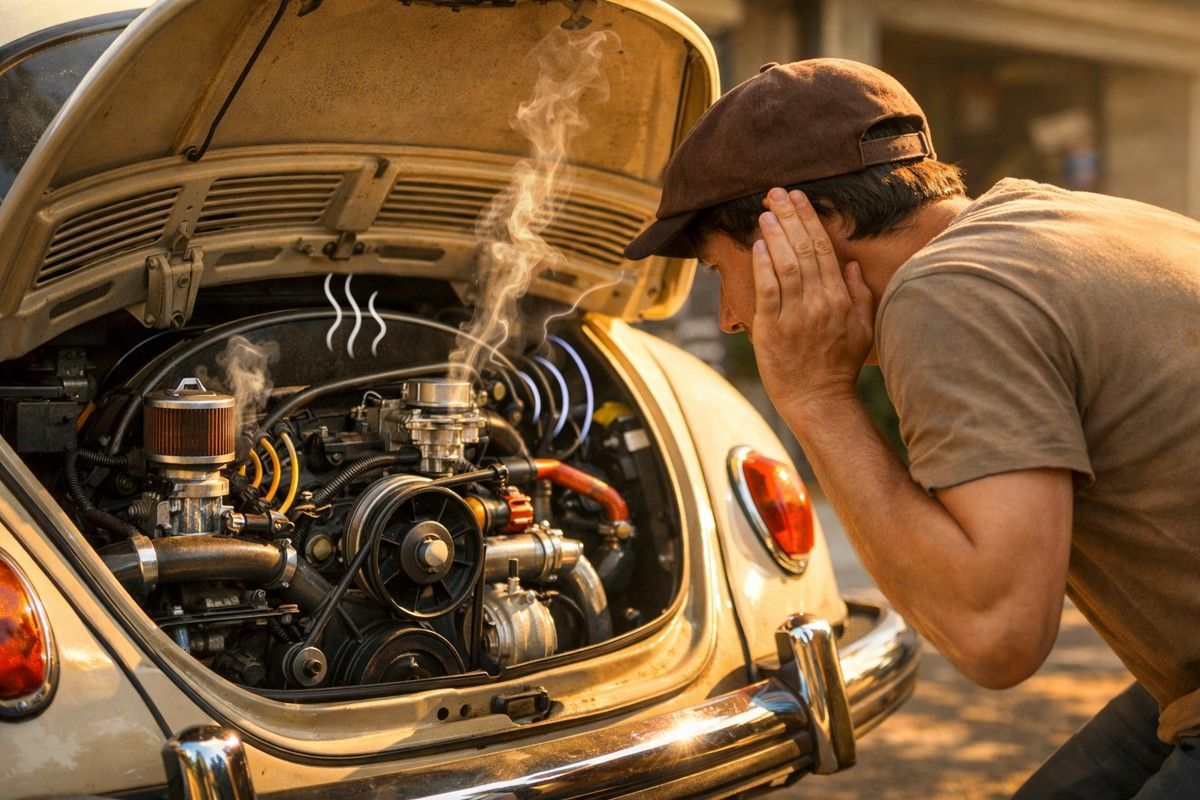
The Analog Diagnostic Guide: Listening to Your Air-Cooled Engine
📌 Key Takeaways
Air-cooled engines talk through sound, smell, and feel—learning what's normal helps you know when to worry.
- Light Ticking Is Healthy: A rhythmic tick-tick-tick at idle usually means valves have proper clearance—too-quiet engines can actually signal trouble.
- Deep Knocks Mean Stop Now: A heavy thud-thud-thud that follows engine speed often points to bearing problems—pull over and call for help immediately.
- Use Your 60-Second Routine: Listen at idle, during a throttle blip, and under light load to catch changes before they become breakdowns.
- Pair Ears With Other Senses: Fresh oil drips, fuel smells, or new smoke alongside unusual sounds tell a fuller story than noise alone.
- Silence Is Suspicious: Unlike modern cars, air-cooled engines are supposed to sound busy—worry when familiar sounds disappear.
Know your engine's voice, and you'll know when it needs help.
Classic VW and Porsche owners new to air-cooled driving will build confidence quickly here, preparing them for the sound-identification chart and stop-driving triggers detailed below.
~ ~ ~ ~ ~ ~ ~ ~ ~ ~ ~ ~ ~ ~ ~ ~ ~ ~ ~ ~ ~ ~ ~ ~ ~ ~ ~ ~ ~ ~ ~ ~ ~ ~ ~ ~ ~ ~ ~ ~ ~ ~ ~ ~ ~ ~ ~ ~ ~ ~ ~ ~
That New Noise on the Way to Cars & Coffee
The radio goes down. Your hands tighten on the wheel.
You're fifteen minutes from the Saturday meet, and somewhere behind you—under the rear deck of your Bus or beneath the tail of your 911—something just started making a sound you don't remember hearing before. Is that normal? Has it always done that? Should I pull over?
An air-cooled engine doesn't talk through warning lights the way a modern car does—it talks through sound, smell, and feel. Think of your ears as the sensors and your nose as the "check engine light." This guide helps you learn what's normal on classic VW and classic Porsche engines, what noises mean "book a check," and what sounds mean "stop driving" so you can protect the car you just became responsible for.
If you're new to air-cooled ownership, your brain will try to treat every sound like an emergency. That's the "unknown history" anxiety talking—not your engine. The goal here is simple: learn to categorize what you hear into three buckets. Normal character. Needs attention. Stop-now risk. By the end, you'll be able to sort "normal air-cooled character" from "needs attention now."
Why Air-Cooled Engines Sound Different (And Why That's Okay)
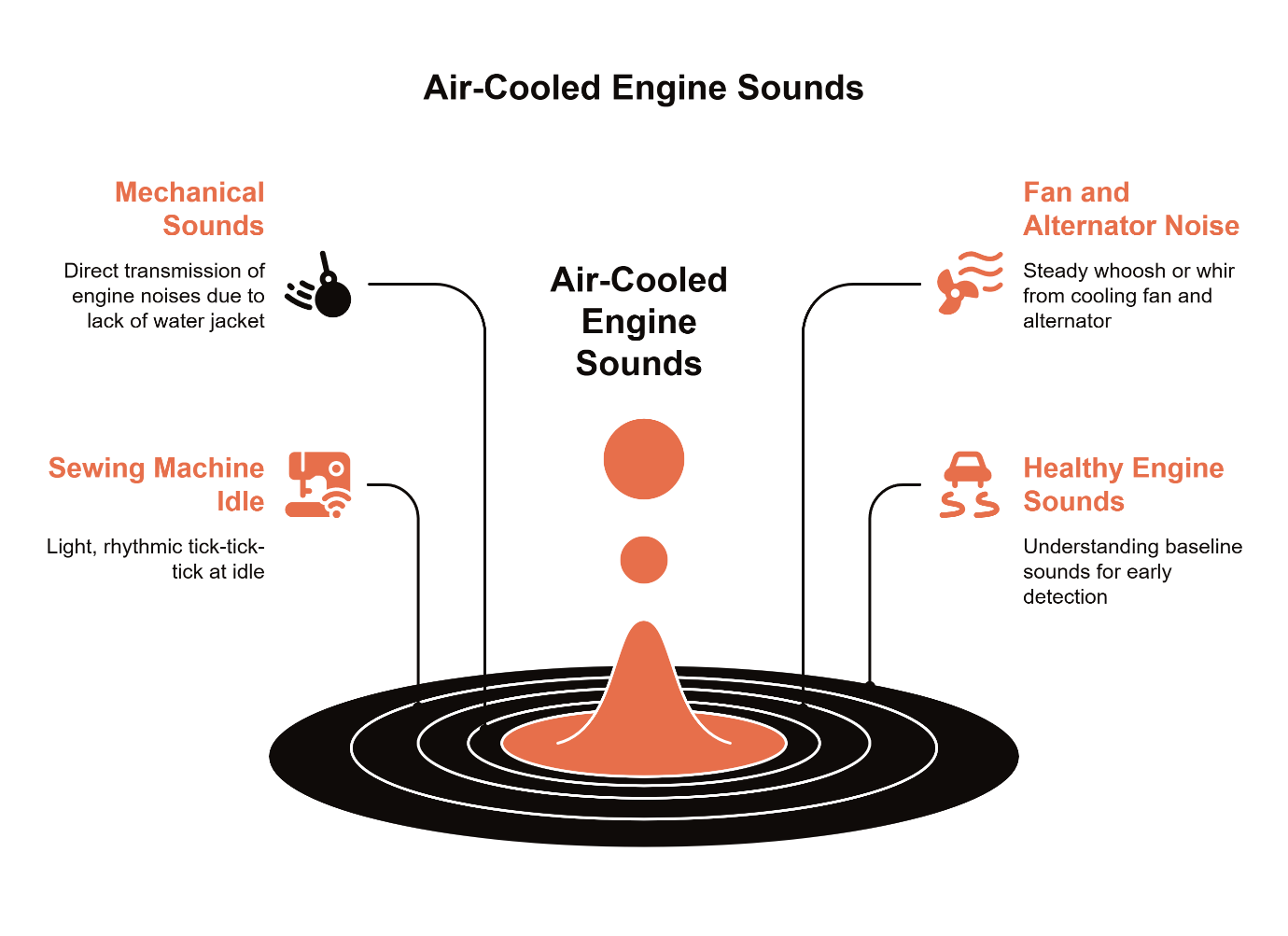
Your classic doesn't have a water jacket wrapped around the cylinders. Without that liquid buffer, mechanical sounds travel straight to your ears. This is normal. It's also why owners of water-cooled cars sometimes think something's wrong when they first ride in a healthy Beetle or early Porsche.
The cooling fan and alternator (or generator, on older cars) add their own layer: a steady whoosh or whir that rises and falls with engine speed. That's the sound of air moving, not the sound of trouble.
A healthy air-cooled engine often sounds like a sewing machine at idle—a light, rhythmic tick-tick-tick with a steady exhaust pulse. If you've never driven one before, it can seem noisy. It's supposed to be. The question isn't whether it makes sound. The question is whether the sounds are the right ones.
Understanding this baseline is the first step in any classic car maintenance plan: know what "healthy" sounds like so you can catch changes early.
Your 60-Second Listening Routine
Most novice advice sounds like: "If it starts and runs, you're fine." That's the trap. Small issues—valve clearance drift, belt concerns, exhaust leaks, ignition timing creep—often announce themselves by sound long before they strand you.
You don't need a stethoscope. You need a quiet moment and your full attention.
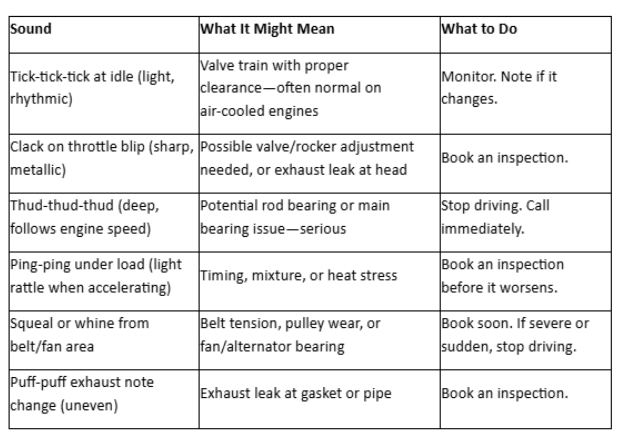
At idle (engine warm): Stand behind the car with the engine running. Listen for the rhythm. Is it steady? Does it stumble or miss? A healthy idle has a consistent pulse—not perfectly smooth like a modern car, but predictable.
With a light throttle blip: Have someone briefly tap the gas pedal while you listen. The engine should respond cleanly. Sharp metallic clacks on the blip can indicate valve train concerns or an exhaust leak. A smooth rise and fall is what you're after.
Under gentle load: On your next drive, pay attention when you accelerate lightly up a grade. Pinging or rattling under load—especially in warm weather—may point to timing, mixture, or heat-related issues that deserve a closer look.
Pair your ears with your other senses. Does the exhaust smell like raw fuel? Do you catch a whiff of hot oil? Is there new smoke at startup or under load? Are there fresh drips on your garage floor that weren't there last week? If you have gauges, watch trends—not "magic numbers." You're looking for what's normal for your car versus a sudden change.
These details help what your senses can tell a specialist narrow down the cause when you bring the car in.
Sound Identification Chart: What It Could Mean and What to Do Next
Use this chart like a translation guide. It's not a diagnosis—it's a decision tool.
"In an air-cooled engine, silence isn't golden; it's suspicious."
If scanning this chart already calmed your nerves a notch, good. That's the point.
Use this to read the symptoms and decide your next step—not to diagnose the repair yourself, but to know whether you can keep driving or need to pull over.
The Sounds You Should Not Ignore
Some sounds are conversation starters. Others are emergencies.
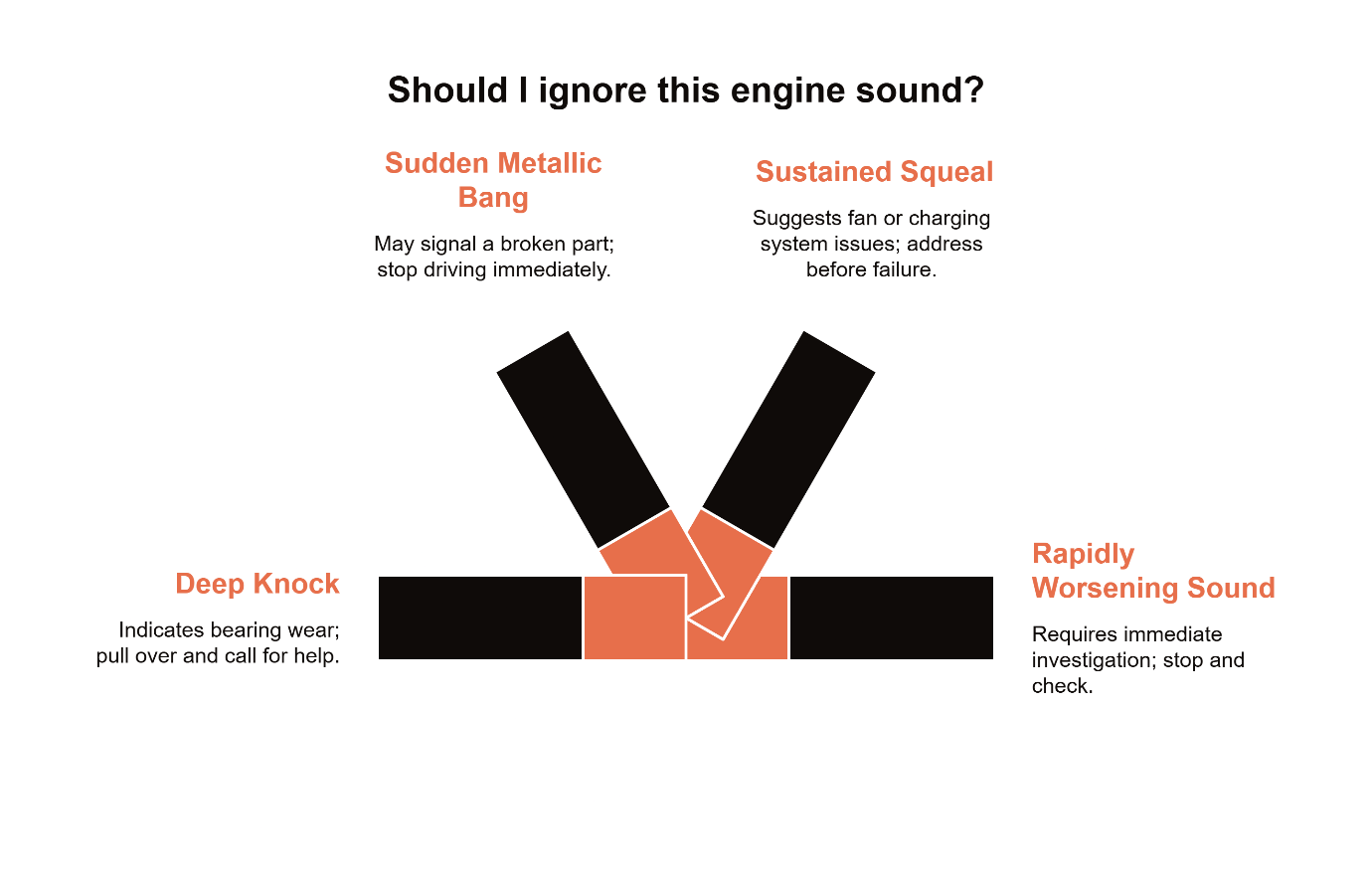
Deep knock that follows engine speed. This is different from a light tick. A heavy, rhythmic thud-thud-thud that speeds up and slows down with the engine often points to bearing wear. Pull over safely, shut it down, and call for help. Driving on a knock can turn a repairable problem into a destroyed engine.
Sudden loud metallic bang. A single sharp bang or crack—especially followed by a change in how the engine runs—may indicate something broke. Stop driving.
Sustained belt or fan squeal that doesn't fade. A brief chirp on startup can be normal. A continuous squeal—especially one that gets louder—means something in the fan or charging system needs attention before it fails completely.
Rapid worsening of any sound. If a noise you've been monitoring suddenly gets louder or more frequent, that's your cue to stop and investigate.
Stop-driving triggers to memorize:
- Smoke from the engine bay
- Sudden loss of power
- Strong hot-oil or burning smell
- New, harsh vibration through the chassis
- Oil pressure warning light staying solid or gauge dropping to zero at idle
The Valve-Tick Myth: Why a Quiet Engine is Concerning
New classic owners sometimes worry about the light ticking they hear at idle. Here's the counterintuitive truth: a little tick is often a sign that the valves have proper clearance.
Air-cooled engines need that clearance to account for heat expansion. When the valves are adjusted correctly, you'll hear a faint tick-tick-tick. It's the sound of parts not quite touching—which is exactly what you want.
What's more concerning is an engine that's too quiet. Valves that are adjusted too tight don't make noise, but they also don't seat fully when hot. Over time, tight valves can burn, leading to compression loss and expensive repairs.
So if someone tells you your engine sounds "clicky," take it as a compliment—assuming the tick is light, rhythmic, and hasn't changed recently. This is the kind of stewardship knowledge that separates confident owners from anxious ones.
When to Bring It In (And What a Classic Specialist Listens For)
Your ears can tell you a lot. But sometimes you need someone who's spent decades listening to these engines to interpret what you're hearing.
If you're building your first baseline after purchase, treat your early ownership window like a "get-to-know-you" phase for the car. That's where a classic-focused inspection earns its keep.
A proper classic-focused inspection relies on mechanical intuition, as you cannot simply plug a digital scanner into a vintage, pre-OBD-II vehicle. At a shop that knows air-cooled engines, the technician listens at idle, listens under load, and listens with a trained ear for the subtle differences between "character" and "concern." They check for oil leaks, fuel smells, exhaust leaks, and mechanical wear. They look at what's dripping, what's weeping, and what's dry when it should be wet.
Orange Independent Auto Repair has been doing this since 1971—family-owned, focused on classic VW and classic Porsche care, with technicians like Eddie who've worked on Beetles for over fifty years. That kind of pattern recognition doesn't come from a certification test. It comes from listening to thousands of engines and knowing what each sound means.
If you're in Orange, CA—or nearby in Tustin, Anaheim, Yorba Linda, or Villa Park—and you've got a sound you can't quite place, bring it by. We'd rather listen to your engine for ten minutes and tell you it's fine than have you worry all the way to the next car show.
Browse our classic VW and Porsche care articles for more sensory checklists. And if the sound is new, getting worse, or paired with smoke, smell, or vibration, contact us or call (714) 633-7161 so we can listen in person.
Disclaimer: This guide is for educational purposes and is intended to help classic car owners recognize common sounds and make informed decisions about when to seek professional inspection. It is not a substitute for hands-on diagnosis by a qualified technician. If you are unsure about any sound or symptom, have your vehicle inspected by a classic car specialist.
Our Editorial Process:
Our expert team at Orange Independent Auto Repair uses a combination of human expertise and AI tools to craft accurate and helpful automotive repair content. Every article is reviewed for practical value, technical accuracy, and relevance to our customers in Orange County.
By: Orange Independent Auto Repair Insights Team
Family-owned in Orange, CA since 1971, Orange Independent Auto Repair specializes in classic VW and Porsche service with an old-school, practical approach to diagnosing and maintaining vintage vehicles.