

Driving is Maintenance: Why Your Classic Needs to Run
📌 Key Takeaways
Driving your classic car regularly is the best way to keep it healthy—sitting still causes more damage than miles on the road.
- Drive Every Two Weeks Minimum: A 20-minute drive at full operating temperature circulates oil, charges the battery, and keeps seals flexible.
- Idling Doesn't Count: Running the engine in your driveway skips the heat and load your classic needs to burn off moisture and lubricate properly.
- Sitting Causes Real Damage: Fuel goes bad in 30 days, seals dry and crack, tires flat-spot, and batteries lose charge—all from doing nothing.
- Use Your Senses as Diagnostics: Listen for odd sounds, smell for fuel or burning oil, and check for new drips after every drive to catch problems early.
- Stop Driving If Something Changes: Raw fuel smell, sudden oil loss, overheating, loud noises, or spongy brakes mean call the shop before going further.
Every drive is maintenance—your classic was built to move, not to sit.
Classic VW and Porsche owners who want to protect their investment will find a practical drive-cycle checklist and storage tips in the detailed guide that follows.
~ ~ ~ ~ ~ ~ ~ ~ ~ ~ ~ ~ ~ ~ ~ ~ ~ ~ ~ ~ ~ ~ ~ ~ ~ ~ ~ ~ ~ ~ ~ ~ ~ ~ ~ ~ ~ ~ ~ ~ ~ ~ ~ ~ ~ ~ ~ ~ ~ ~ ~ ~
The garage door rolls up. There it sits— your classic VW or Porsche, exactly where you left it three weeks ago. The paint still gleams. The chrome still shines. But something feels off. Is it okay? Should I have driven it by now?
If you've inherited a classic, bought your first vintage Beetle, or finally pulled the trigger on that air-cooled Porsche you've been dreaming about, this question probably keeps you up at night. You want to protect it. You want to do right by it. And somewhere along the way, you convinced yourself that driving it less means saving it more.
That instinct is understandable. It's also backwards.
A quick note before diving in: this advice fits a driver-quality classic that is meant to run. It's not aimed at a never-started showpiece where long-term inactivity is an accepted tradeoff, and it's not modern-car logic applied to a decades-old drivetrain. If your classic belongs on the road, keep reading.
The Quick Answer (If You Only Read One Section)
Drive your classic at least once every one to two weeks. Each drive should last a minimum of 20 minutes—long enough for the engine to reach full operating temperature and circulate oil through the entire system.
The goal is not miles. The goal is temperature and circulation.
Starting the car and letting it idle in the driveway doesn't count. Short trips to the end of the block don't count. You need hot oil flowing through the engine, transmission fluid moving, brake components cycling, and seals staying lubricated.
If your classic has been sitting for 30 days or more, approach it with a baseline-check mindset. Look under the car for fresh drips. Check the battery. Consider the fuel. Then take it for that 20-minute drive—but stay alert for anything that smells, sounds, or feels wrong.
Why Sitting Hurts Classics More Than Modern Cars
Modern vehicles are engineered to handle neglect. Computer-controlled fuel injection, sealed systems, and sophisticated materials mean a new car can sit in an airport parking lot for months and start right up. Your classic doesn't have those advantages.
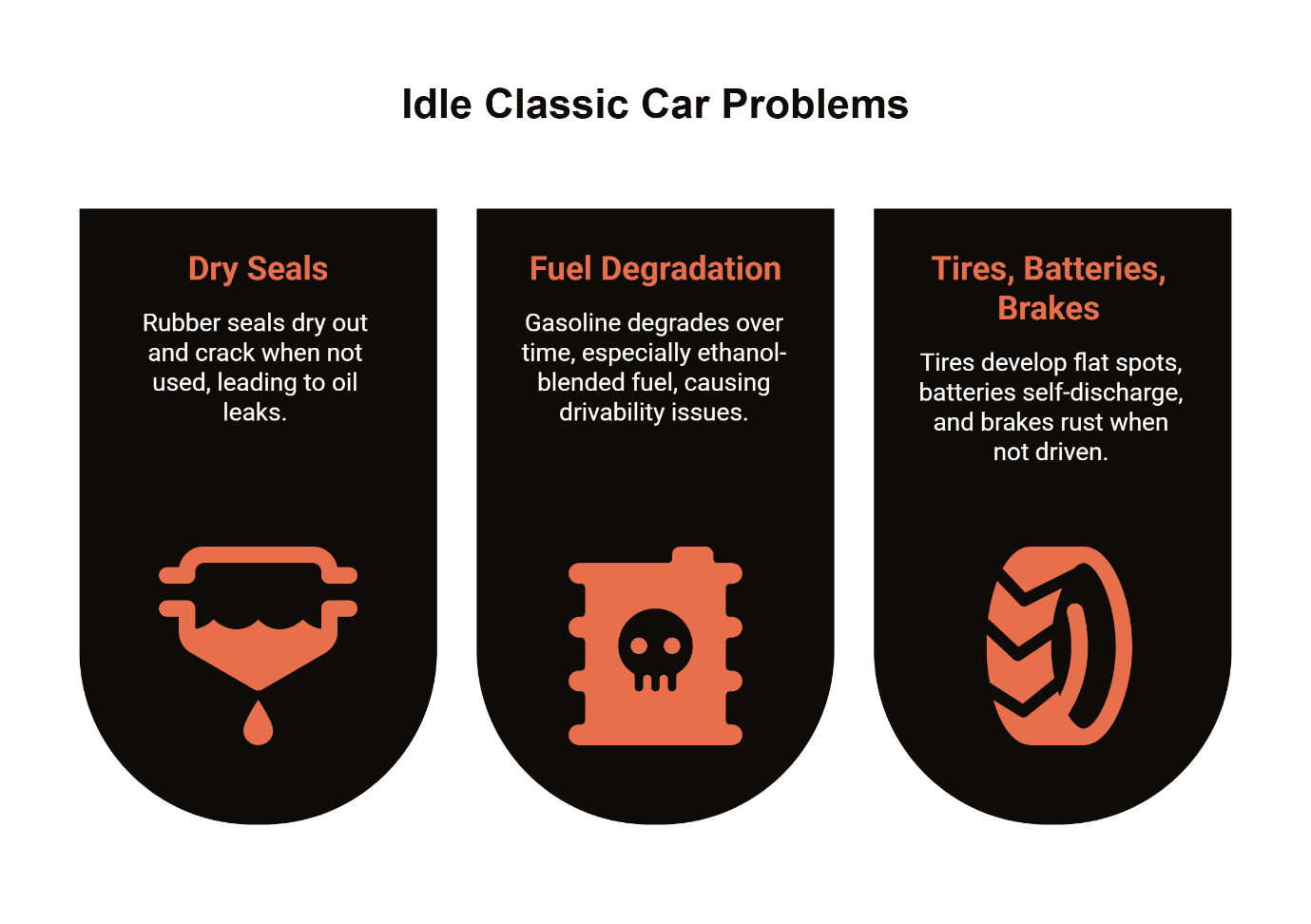
Dry Seals and the Leaks That Follow
Think of a rubber band sitting in a drawer for years. When you finally stretch it, it cracks and snaps. The rubber seals throughout your classic—around the crankshaft, valve covers, transmission, and dozens of other components—work the same way.
Regular use keeps these seals bathed in oil and flexible. Extended sitting lets them dry out, shrink, and harden. The result? That oil spot on your garage floor that wasn't there last month. What starts as a minor seep becomes a steady drip, then a repair bill that could have been avoided.
- New drips that appear only after the first drive
- A faint burning-oil smell after warm-up
- A seep that turns into a steady leak under heat and pressure
Fuel Doesn't Age Well
The gasoline sitting in your classic's tank and carburetor is slowly degrading. Ethanol-blended fuel—which is most fuel sold today—has a particularly short shelf life. According to AAA, ethanol-based gasoline can begin losing combustibility in as little as one to three months, depending on storage conditions.
In carbureted classics, this degradation shows up as varnish and gum deposits inside the carburetor. The symptoms are unmistakable: hard starting, rough idle, stumbling under acceleration, or a car that simply refuses to run after sitting. In as little as 30 days, fuel can degrade enough to cause drivability issues in older systems.
Tires, Batteries, and Brakes Don't Love Long Naps
Tires develop flat spots when they sit in one position too long. Michelin notes that extended storage can cause flat spotting that may require significant driving to work out—if it works out at all. Their guide on tire flat spotting explains causes, prevention, and when further attention may be needed.
Batteries self-discharge over time. Left alone, a classic car battery can lose enough charge to trigger sulfation—a process where lead sulfate crystals form on the plates and permanently reduce capacity. A battery that goes through repeated discharge cycles without proper charging may never fully recover.
Brake rotors surface-rust within days of sitting in humid conditions. Brake fluid absorbs moisture from the air. Parking brake cables seize. None of these problems happen to a car that gets driven regularly.
The Healthy Drive Cycle (This Is the Maintenance)
Every drive is a mini-service. That's not marketing language—it's mechanical reality. When you drive your classic properly, you're actively maintaining it.
Don't Just Idle
Firing up the engine and letting it warm up in the driveway feels productive. It isn't. Idling doesn't generate enough heat to burn off condensation in the oil. While your oil pump is generating pressure, idling generally lacks the sustained RPMs needed to maximize high-volume oil flow and thoroughly coat upper engine components under load. It doesn't exercise the transmission, brakes, or suspension. Worse, it can actually accelerate carbon buildup.
The engine needs load. It needs to work.
A controlled drive does more for oil circulation, seal lubrication under normal pressure, battery recharge, and brake conditioning than any amount of stationary idling.
The Three-Phase Drive
Phase 1: Start and Listen (First 5 Minutes)
Start the car and pay attention. Listen for unusual sounds—knocking, grinding, squealing. Smell for raw fuel or burning oil. Feel how the engine catches and whether idle stabilizes smoothly. If your classic has oil pressure or temperature gauges, glance at them to confirm normal readings, but trust your ears and nose first. This is your diagnostic window.
Phase 2: Cruise and Circulate (15+ Minutes)
Get the car up to speed. Let the engine reach full operating temperature. Vary your RPMs gently—don't lug the engine at low revs, but don't wind it out cold either. Smooth, steady driving with occasional mild acceleration is ideal.
Here in Orange County, the heat and stop-and-go traffic make completing this full warm-up cycle especially important for air-cooled engines. Short trips in Southern California traffic can be the worst of both worlds—not enough airflow to cool properly, not enough sustained driving to fully warm the oil.
Phase 3: Cool Down and Inspect (After Parking)
When you return home, don't just walk away. Let the car idle briefly to stabilize temperatures, then shut it down. After a few minutes, look underneath for fresh drips. Notice any new smells. Try a hot restart to confirm everything still functions properly. These two minutes of attention can catch problems before they become expensive.
Drive Cycle Checklist
Use this simple checklist every time you take your classic out:
Before You Start (60 Seconds)
- Quick sniff test around the car—raw fuel smell means stop and investigate
- Look under the car for fresh drips or puddles
- Check that the battery has enough strength to crank confidently
- Note your baseline: how the starter sounds, how quickly it catches, whether idle stabilizes
During the Drive (20+ Minutes)
- Let the engine reach full operating temperature
- Vary RPMs gently—avoid both lugging and high-rev cold running
- Listen for new noises; feel for new vibrations
- Complete the full drive—no cutting it short
After You Park (2 Minutes)
- Let the car idle briefly before shutdown
- Look for new drips underneath
- Notice any unusual smells
- Confirm hot restart works normally
Print this checklist. Stick it on your garage wall. Make it a habit.
If You Can't Drive It Often: Storage Reality
Life happens. Work travel, weather, health issues—sometimes you simply can't maintain that every-two-weeks cadence. When extended storage is unavoidable, a few simple strategies minimize the damage.
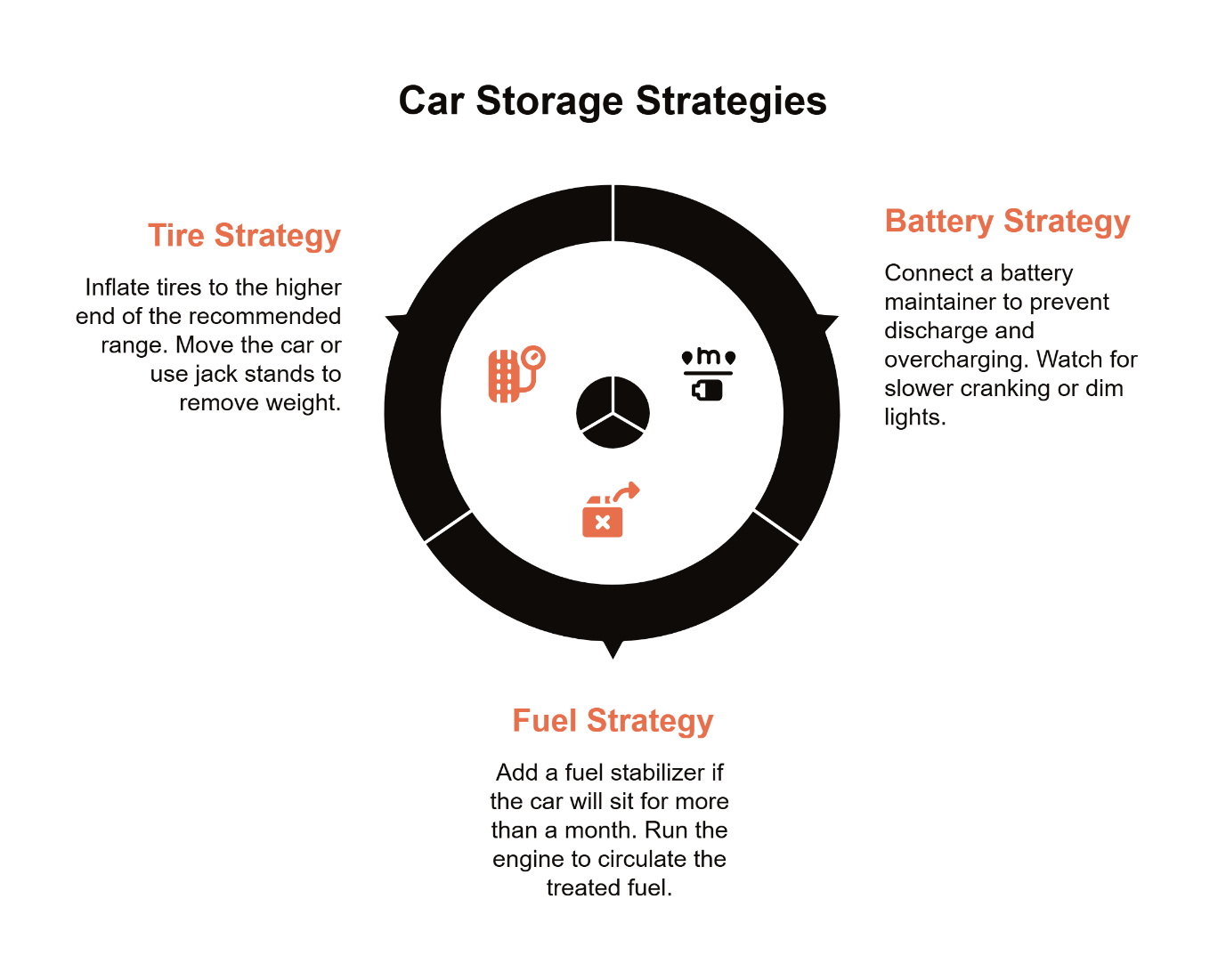
Battery Strategy
Connect a quality battery maintainer. This isn't the same as a trickle charger—a maintainer monitors voltage and provides charge only when needed, preventing both discharge and overcharging.
What to watch for: slower cranking over time, needing a jump after sitting, or lights that dim noticeably at idle.
Fuel Strategy
If you know the car will sit for more than a month, consider adding a fuel stabilizer before that last drive. Run the engine long enough to circulate the treated fuel through the carburetor. STA-BIL and similar products offer storage-use directions for this purpose. Some owners prefer to drain the carburetor float bowls entirely for very long storage.
The simple principle: the longer fuel sits, the more important it becomes to plan for fuel quality—especially for older fuel systems.
Tire Strategy
Inflate tires to the higher end of the recommended range before storage. If possible, move the car a few feet every couple of weeks to change which portion of the tire bears the weight. For storage beyond a few months, consider jack stands to remove weight from the tires entirely.
These aren't repairs you need to do yourself—they're things to discuss with your shop when planning for extended downtime.
When to Stop Driving and Get It Checked
Your classic VW and Porsche communicates through smells, sounds, feel, and fluid behavior. Learn to read what it's telling you.
Stop driving and call the shop if you notice:
- Raw fuel smell (inside the car or under the hood)
- Sudden oil loss or large fresh puddles
- Overheating behavior—steam, boiling-over sounds, or a rapid temperature climb on the gauge
- Loud knocking, grinding, or metallic sounds
- Significant new vibration at speed
- Brake pedal feel that's changed—spongy, hard, or pulling
None of these mean your car is ruined. All of them mean something needs attention before you drive further.
Your Role as a Steward
The worst thing you can do to a classic VW and Porsche is nothing at all.
That car in your garage was built to move. Its seals need oil. Its fuel needs burning. Its battery needs charging. Its tires need rolling. When you drive it—really drive it, not just idle it—you're not putting miles on the clock. You're keeping it alive.
You're not just an owner. You're a steward. And stewardship means showing up.
If your classic has been sitting too long, or if you're simply not sure where things stand, schedule an appointment for a baseline inspection. At Orange Independent Auto Repair, we've been caring for classic VW and Porsche vehicles—including Porsche service and maintenance—since 1971. We'd rather help you prevent problems than fix them.
Call (714) 633-7161 to get your classic back on the road where it belongs.
Shop Details
- Phone: (714) 633-7161
- Address: 187 S Main St, Orange, CA 92868
- Hours: Mon–Fri 7:00 AM–6:00 PM; Sat by appointment only
Learn more about our family-owned shop or explore our full range of services.
Frequently Asked Questions
How often should I drive my classic car?
Aim for at least once every one to two weeks, with each drive lasting a minimum of 20 minutes at full operating temperature.
Is idling my classic in the driveway good enough?
No. Idling doesn't generate enough heat or load to properly circulate fluids, burn off condensation, or exercise critical components. The engine needs to work under actual driving conditions.
How long can a classic car sit without problems?
Problems can begin developing within 30 days. Fuel degradation, battery discharge, and seal drying all accelerate with time. Beyond 30 days, approach the car with a baseline-check mindset before driving.
Should I use a battery tender for a classic car?
Yes, especially if you can't drive regularly. A quality battery maintainer prevents both discharge and the sulfation damage that comes with it.
What are signs my classic shouldn't be driven?
Raw fuel smell, sudden oil loss, overheating behavior, loud metallic noises, significant vibration, or changes in brake feel all warrant stopping and calling a shop before driving further.
Disclaimer: This article is for informational purposes and reflects general maintenance principles for classic vehicles. Specific recommendations may vary based on your car's make, model, year, and condition. When in doubt, consult a qualified specialist.
Our Editorial Process:
Our expert team uses AI tools to help organize and structure our initial drafts. Every piece is then extensively rewritten, fact-checked, and enriched with first-hand insights and experiences by expert humans on our Insights Team to ensure accuracy and clarity.
By: The Orange Independent Auto Repair Insights Team