
The Dashboard Lies: Why Analog Gauges Tell the Real Story of Your VW
📌 Key Takeaways
A moving needle in your classic VW or Porsche isn't broken—it's giving you real-time engine feedback that modern dashboards hide.
- Movement Is Normal: Modern gauges use software to hold needles steady, while vintage gauges show actual changes as they happen.
- Watch Patterns, Not Twitches: One odd reading means nothing—the same reading under the same conditions across multiple drives means something.
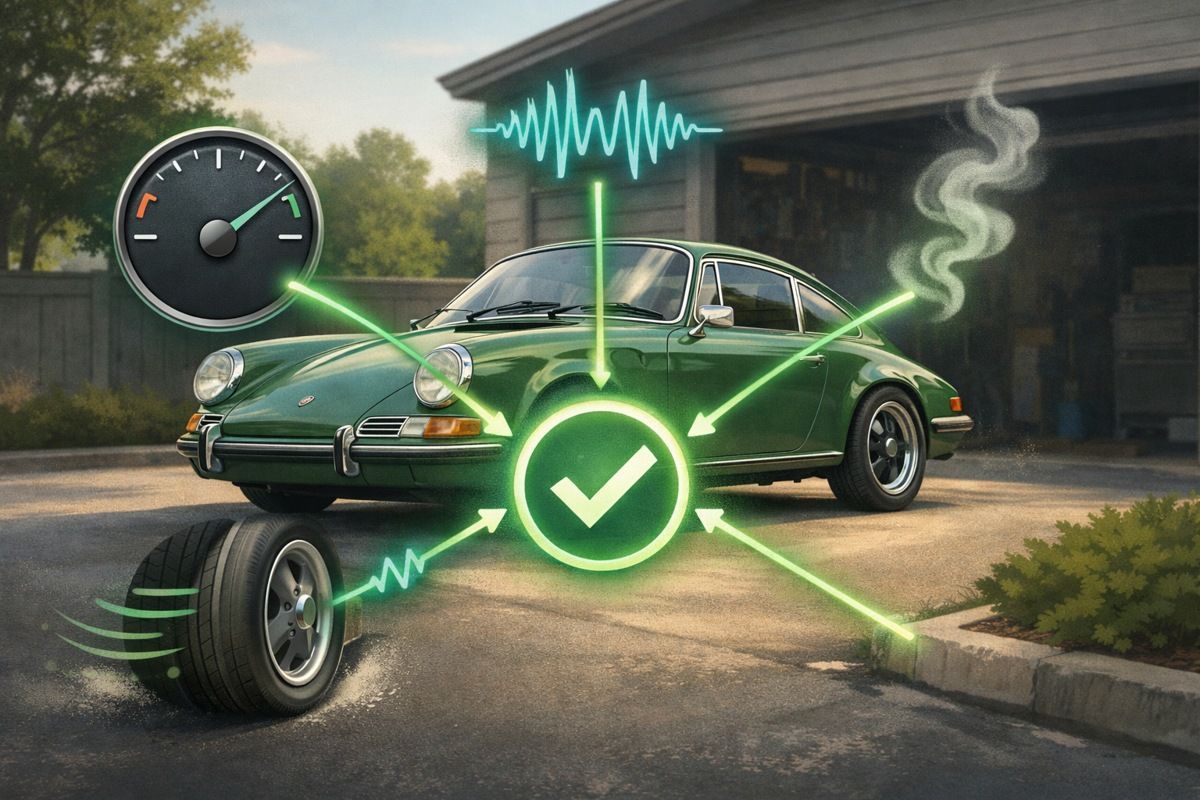
- Stack Your Senses: A strange gauge paired with strange sounds, smells, or sluggish driving tells a clearer story than the needle alone.
- Context Changes Everything: Oil pressure drops at hot idle but recovers with throttle? Normal. Drops and stays down? Pull over.
- Know When to Get Help: When gauge patterns persist and other senses confirm the trend, stop guessing and get a professional inspection.
Learn the language your gauges speak, and you'll catch problems before warning lights ever would.
Classic VW and Porsche owners learning to trust their instrument clusters will build confidence here, preparing them for the detailed diagnostics guide that follows.
~ ~ ~ ~ ~ ~ ~ ~ ~ ~ ~ ~ ~ ~ ~ ~ ~ ~
The needle jumps. It flickers twice, settles for a moment, then drifts again. Sitting behind the wheel of a classic Volkswagen on a warm Southern California afternoon, watching that oil pressure gauge twitch and bounce, the instinct is to assume something has gone terribly wrong.
That instinct comes from years of conditioning. Modern vehicles have trained drivers to expect dashboard silence. When everything works, the gauges sit still. When something fails, a warning light appears. The system is binary: fine or broken, safe or dangerous, keep driving or pull over now.
But that twitchy needle in a vintage VW or Porsche is not broken. It is not lying. It is doing something modern dashboards rarely do anymore—communicating in real time.
The Myth: Why Modern Drivers Think Old Gauges Are Lying
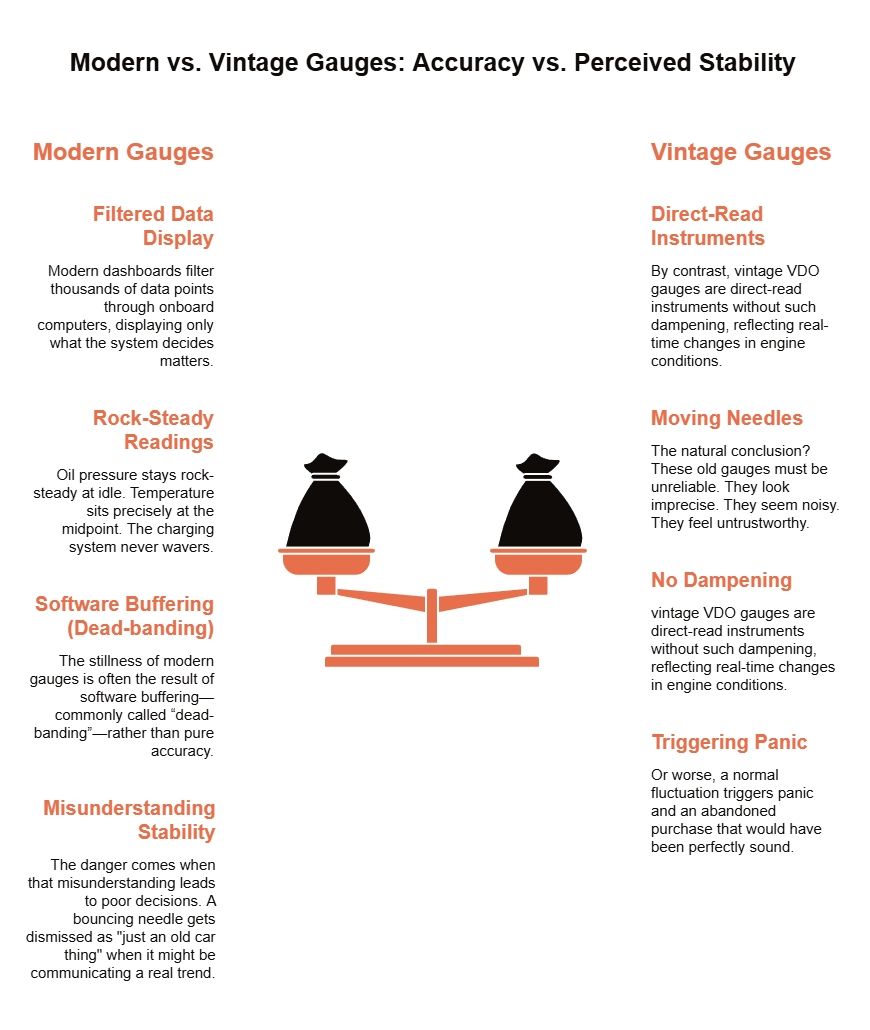
Modern dashboards filter thousands of data points through onboard computers, displaying only what the system decides matters. Oil pressure stays rock-steady at idle. Temperature sits precisely at the midpoint. The charging system never wavers.
Then that same driver sits in an air-cooled 911 or a 1972 Beetle retrofitted with VDO gauges and watches the needle move with every blip of the throttle. The natural conclusion? These old gauges must be unreliable. They look imprecise. They seem noisy. They feel untrustworthy.
This interpretation misses something important. The stillness of modern gauges is often the result of software buffering—commonly called “dead-banding”—rather than pure accuracy. For example, many coolant temperature gauges are programmed to remain at the midpoint across a broad range (roughly 75°C to 105°C), only moving when thresholds are exceeded. By contrast, vintage VDO gauges are direct-read instruments without such dampening, reflecting real-time changes in engine conditions. What appears as fluctuation is often a more transparent view of how the engine is actually behaving.
The danger comes when that misunderstanding leads to poor decisions. A bouncing needle gets dismissed as "just an old car thing" when it might be communicating a real trend. Or worse, a normal fluctuation triggers panic and an abandoned purchase that would have been perfectly sound.
The Reality: A Needle Tells a Story a Warning Light Never Can
An analog gauge provides continuous feedback. A warning light provides a single data point—on or off. By the time a modern warning light illuminates, the problem has often been developing for miles. The system waited until a threshold was crossed before speaking up.
Vintage gauges work differently. Oil pressure that drops slightly at a hot idle but recovers immediately with throttle input tells one story. Oil pressure that falls and stays fallen tells another. Temperature that climbs in stop-and-go traffic but stabilizes on the highway behaves differently than temperature that climbs regardless of conditions.
"A classic VW gauge is not a death sentence machine. It is a conversation—if you know how to listen."
The needle communicates movement, context, and change over time. Reading it well means learning to see patterns rather than reacting to isolated moments. A brief flicker at a stoplight can happen in air-cooled engines, especially at hot idle, but it isn’t something to ignore if it’s new. Repeated flickers every time the engine idles hot—that becomes a pattern worth understanding and investigating, as it may point to low oil pressure, incorrect viscosity, or internal wear.
For broader context on how drivers interpret gauge information, see this SAE paper on driver understanding of fuel and engine gauges. For a wider vintage-driving perspective, Hagerty's guide to regularly driving your vintage car offers useful companion guidance.
How to Read the Needle Without Fooling Yourself
Ask "What is the pattern?" not "Did it twitch?"
Owner-level gauge interpretation does not require technical expertise. It requires observation, patience, and a willingness to watch trends instead of chasing individual twitches.
Watch for patterns across multiple drives. One odd reading means almost nothing. The same odd reading appearing consistently under similar conditions means something worth noting. Before drawing conclusions, see whether the behavior repeats.
Compare cold behavior to fully warmed behavior. Gauges behave differently when an engine first starts versus after twenty minutes of driving. Oil pressure typically reads higher when cold and settles lower once the engine reaches operating temperature. Knowing what normal warm-up looks like makes it easier to recognize when something has actually changed.
Note the conditions when changes occur. Does the gauge behave differently at idle versus under load? In traffic versus on the highway? On a cool morning versus a hot afternoon? Context changes interpretation. A reading that looks alarming in isolation might be completely expected given the circumstances.
Never interpret a gauge in isolation. A strange needle paired with a strange smell, an unusual sound, visible leaking, or a change in how the car drives carries more weight than a strange needle by itself. Stacking signals—using multiple senses to confirm or contradict what the gauge suggests—separates useful observation from anxious guessing.
That last point matters most. Perfect stillness is not the only sign of health. Pattern recognition matters more than demanding a perfectly frozen needle.
What to Watch in a Classic VW or Porsche: Oil Pressure, Temperature, and Charging Behavior
Air-cooled Volkswagens and classic Porsches communicate through these critical channels. While classic Porsches featured them from the factory, VW owners often add aftermarket dials to uncover this mechanical story.
Oil Pressure Behavior
A flicker is not automatically an engine obituary. Oil pressure in a healthy air-cooled engine typically reads higher when cold and settles as the engine warms. Hot oil is thinner, so some pressure drop at operating temperature is expected.
What matters is behavior under load. Pressure that flickers briefly at a hot idle but recovers the moment the throttle opens behaves differently than pressure that drops and never recovers. The first might warrant calm observation; the second warrants immediate attention.
Temperature Behavior
Temperature in these engines responds directly to ambient conditions. Air-cooled means exactly that—the engine relies on airflow for cooling. Sitting in traffic on a hot day naturally produces higher readings than cruising on the highway.
The useful question is whether the temperature trend feels logical for the conditions or suddenly feels out of character for the car. A rising trend that levels off suggests the engine finding equilibrium. A rising trend that never stops suggests something requiring investigation.
Charging Behavior
A charging gauge becomes more useful when it is read as part of the car’s overall electrical behavior. Some fluctuation when accessories turn on or off is normal. Fluctuation that never settles—especially a needle that pulses with engine RPM—can point to a failing voltage regulator or worn brushes in the generator or alternator. However, in older 6V and early 12V systems, a slight drift toward discharge at very low idle with lights or accessories on is a known limitation. The key indicator is recovery: if the needle does not return to the charging side at cruising speeds (around 1,500 RPM or higher), the system may no longer be keeping up with demand.
If the reading fluctuates in a way that feels unfamiliar, pair that signal with headlight behavior, starting confidence, and general drivability before drawing conclusions. The pattern matters more than any single reading.
Never Trust a Gauge Alone: Verify With Smell, Sound, and Drivability
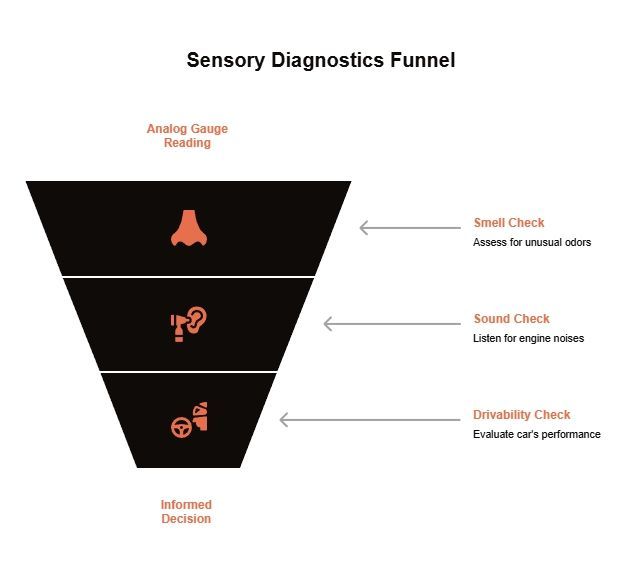
Analog gauges are only one channel in the car's wider language. A gauge is one voice in a larger conversation. The most reliable observations come from signal stacking—combining multiple senses rather than trusting any single source.
If the oil pressure gauge looks strange but the engine sounds smooth, smells normal, and drives without hesitation, there is one concerning data point and three reassurances. That combination suggests calm observation rather than panic.
If the oil pressure gauge looks strange and there is a whiff of hot oil, and the engine sounds rougher than it did ten minutes ago, and acceleration feels flat—now multiple senses tell the same story. That convergence deserves immediate attention.
This approach connects to the broader practice of sensory diagnostics for classic vehicles. Sound, smell, and feel all contribute information. A car that smells wrong while the gauge looks wrong tells a more complete story than either signal alone. Learning to cross-reference these inputs builds confidence that isolated gauge watching cannot provide.
When the Dashboard Stops Being a Conversation and Starts Becoming a Decision
Eventually, observation has to become action.
When a gauge trend persists across multiple drives rather than appearing once and disappearing, it stops being a curiosity and becomes information. When other senses—smell, sound, the way the car responds to throttle input—confirm what the needle suggests, the evidence stacks up. When a seller cannot explain unusual gauge behavior clearly, or dismisses questions without real answers, confidence should drop accordingly.
At that point, the smartest move is also the simplest: stop guessing and get professional verification.
Orange Independent Auto Repair has been helping classic VW and Porsche owners interpret what their vehicles are telling them since 1971. Family-owned and operated, the shop serves Orange and nearby communities with hands-on assessment that no app or scanner can replace. A proper vehicle inspection translates owner-level observations into professional confirmation—or catches what observation alone might have missed.
"Eddie has been working on VW Beetles for 50+ years. He's the only person that will ever touch my car." — Ty M., Long Beach, CA
The instrument cluster of an air-cooled classic doesn't filter the truth. It speaks a language most modern drivers never learned. Once that language becomes familiar, the bouncing needle transforms from a source of anxiety into an early-warning system—one that communicates mechanical truth long before a warning light ever would.
The dashboard is not the enemy. Blind faith is.
Read the trend. Check the rest of the car. Then make the next decision with clearer eyes.
For those ready to verify what the gauges seem to be saying, or for buyers who want professional confirmation before committing to a purchase, Contact Orange Independent Auto Repair to request a free estimate and schedule a classic car inspection.
For more owner-level reading, the Blog and Testimonials extend the same practical, trust-first perspective.
Our Editorial Process
Our expert team uses AI tools to help organize and structure our initial drafts. Every piece is then extensively rewritten, fact-checked, and enriched with first-hand insights and experiences by expert humans on our Insights Team to ensure accuracy and clarity.
About the Orange Independent Auto Repair Insights Team
The Orange Independent Auto Repair Insights Team is our dedicated engine for synthesizing complex topics into clear, helpful guides. While our content is thoroughly reviewed for clarity and accuracy, it is for informational purposes and should not replace professional advice.