Mastering the Leakdown: How to Pinpoint Valve vs. Ring Wear by Listening to Your Engine’s Breath
📌 Key Takeaways
A leakdown test tells you where your engine leaks, not just how much—and that location changes everything about your buying decision.
- Listen for Location, Not Just Numbers: Air escaping at the tailpipe, breather, or intake each points to different problems—and different repair costs.
- Smooth Idle Can Hide Big Problems: A vintage VW can sound perfect while losing pressure internally, so never trust idle quality alone when buying.
- Tailpipe Hiss Suggests Exhaust Valve Issues: Air leaking out the exhaust path usually means the exhaust valve isn't sealing properly—worth slowing down negotiations.
- Breather Noise Points to Ring Wear: When air escapes through the oil filler area, the piston rings may be letting pressure slip past—a different fix than valve work.
- Uncertainty Means Get Expert Help: If you hear multiple leak paths or can't interpret the sounds, bring the car to a specialist before committing.
Where the air goes matters more than how much escapes.
Classic VW buyers evaluating potential purchases will gain confidence interpreting leakdown results, preparing them for the detailed diagnostic guidance that follows.
~ ~ ~ ~ ~ ~ ~ ~ ~ ~ ~ ~ ~ ~ ~ ~ ~ ~
The paint gleams. The chrome shines. The seller swears the engine runs like new.
You lean over the warm air-cooled motor, catching that sharp whiff of fuel and hot metal, and you hear... something. A faint hiss. Maybe a soft puff. You know it means something, but you cannot translate that sound into a buying decision.
That gap between hearing and understanding is exactly where expensive mistakes hide. A vintage VW can idle smoothly while harboring internal sealing problems that will cost thousands to fix. The good news is that a leakdown test does more than produce a percentage—it tells you where the engine cannot hold pressure. And once you know how to listen to that escaping air, you gain leverage that no seller's reassurance can replace.
Key Terms to Know
Leakdown test: A diagnostic that pressurizes a cylinder and measures how much air escapes—and, critically, where that air escapes.
Breather: The engine's crankcase venting path, where ring-seal-related blow-by is typically heard during a leakdown test.
Valve sealing: How completely an intake or exhaust valve closes against its seat to hold cylinder pressure.
The Quick Answer: What Leakdown Can Tell You That Compression Alone Cannot
Compression and leakdown are partners, not substitutes. Compression testing tells you how much pressure a cylinder builds. Leakdown testing tells you how much leaks out and—here is the part that changes everything—where it leaks.
Think of compression as checking lung capacity. Leakdown is listening to the breath itself.
Compression Checks Pressure. Leakdown Checks Where the Engine Cannot Hold It.
A compression test might show a weak cylinder. That is useful, but it leaves you guessing: is the problem a tired ring, a leaky valve, or something else entirely? Leakdown narrows the field. When you pressurize that cylinder and listen for escaping air, the location of the hiss becomes your directional clue.
Why Buyers Should Care Before They Trust a Smooth Idle
Here is the trap: a vintage air-cooled engine can idle beautifully while hiding significant internal sealing loss. The "smooth idle" can mask problems that only show up under load or become obvious during a proper leakdown test. If you are evaluating a classic VW for purchase, trusting idle quality alone is like judging a house by its fresh coat of paint while ignoring the foundation.
How to Listen to an Air-Cooled VW During a Leakdown Test
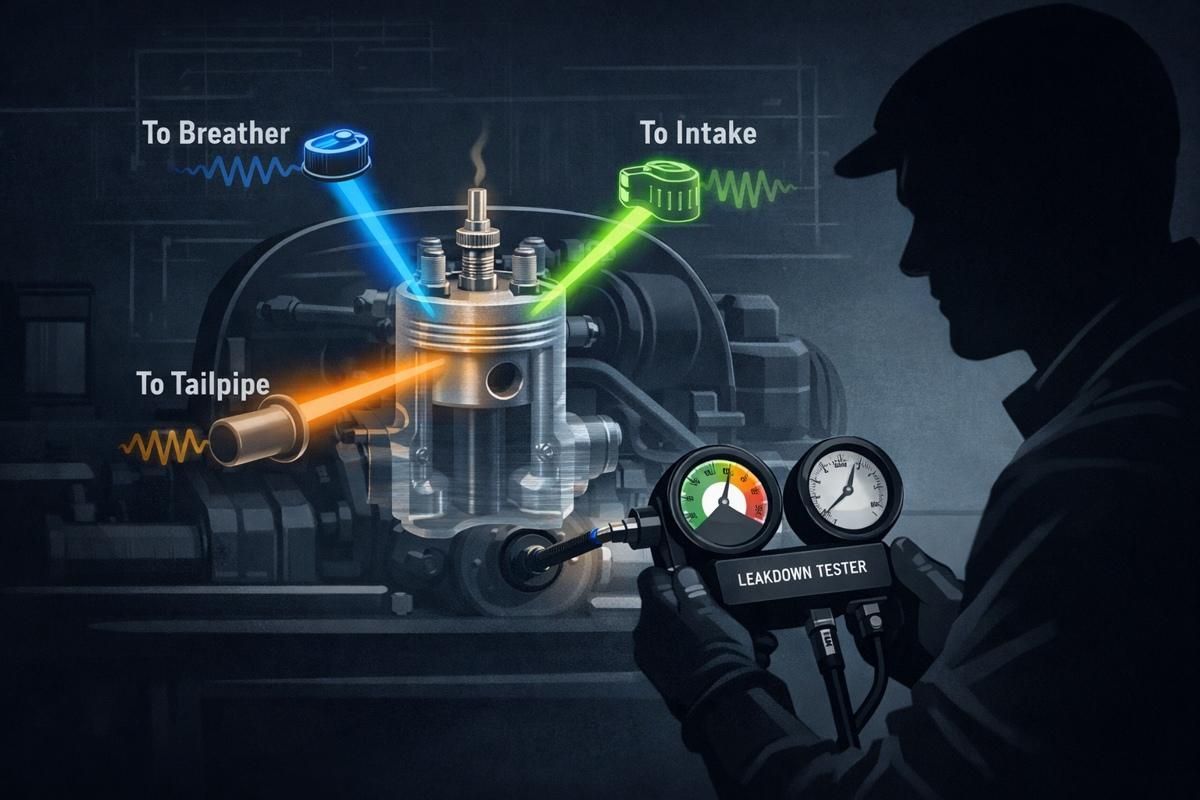
During a leakdown test, pressurized air is introduced into the cylinder. If the cylinder holds that pressure perfectly, you hear nothing. If it leaks, you hear escaping air—and where you hear it matters.
Air at the Tailpipe: What It Usually Suggests About Exhaust-Side Valve Sealing
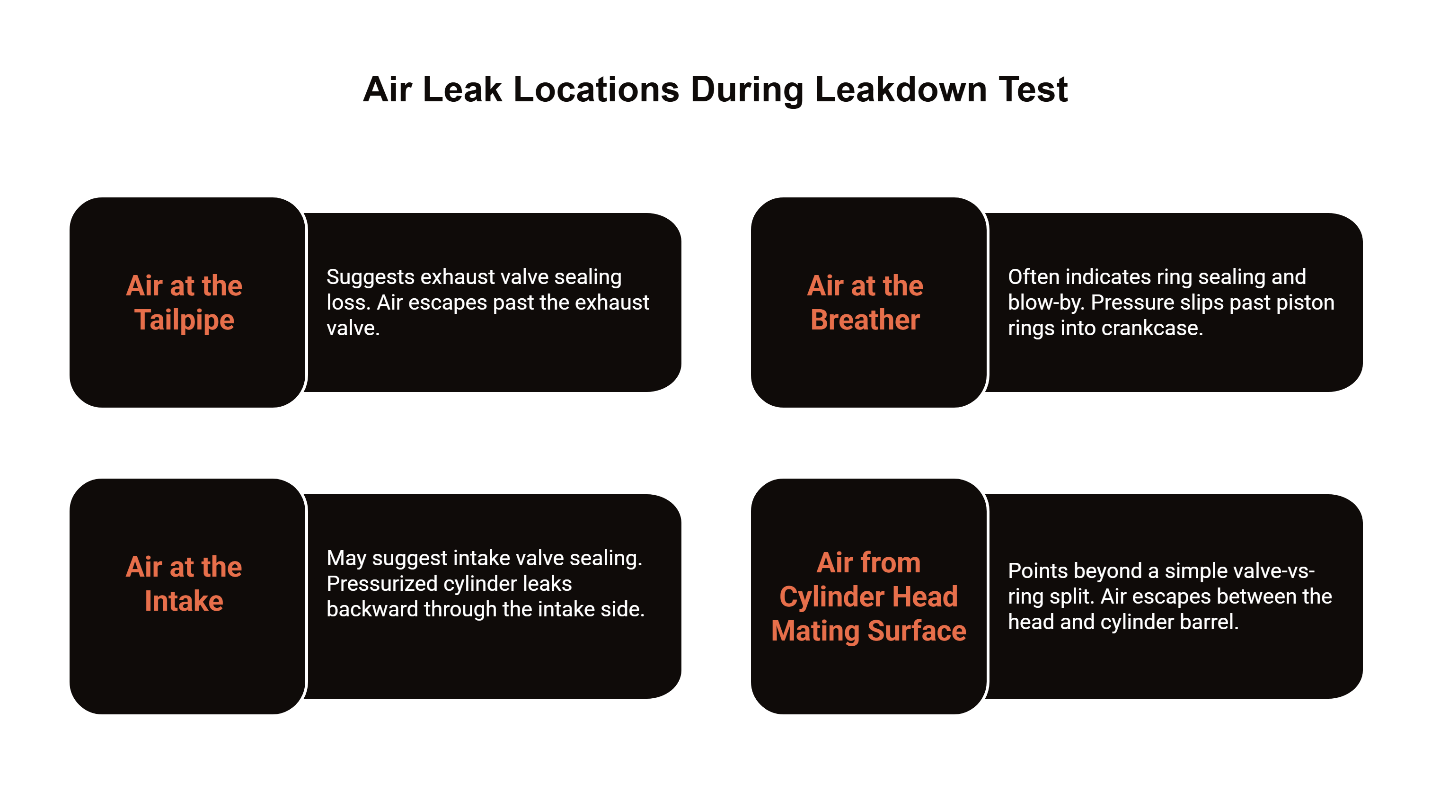
When pressurized air hisses out the tailpipe, it usually points toward exhaust valve sealing loss. The air is escaping past the exhaust valve and traveling down the exhaust path. This does not automatically mean a burned valve, but it strongly suggests the exhaust valve is not seating completely.
On an air-cooled VW, that matters because heat lives on the exhaust side. A seller may hear a decent idle and think the engine is fine. But if the cylinder is giving up air through the exhaust path during leakdown, you have a more specific reason to slow down and ask harder questions.
Air at the Breather: What It Often Suggests About Ring Sealing and Blow-By
Air escaping through the breather or oil filler cap often indicates ring-seal-related leakage. The pressure is slipping past the piston rings and entering the crankcase, where it vents through the breather system. This is the classic blow-by signature.
If the breather is the loudest escape path, the issue may be lower in the cylinder rather than up at the valve. That is a different conversation—and a different cost profile too.
Air at the Intake: What It May Suggest About Intake Valve Sealing
If you hear escaping air at the carburetor or intake manifold, the intake valve may not be sealing properly. The pressurized cylinder is leaking backward through the intake side.
That does not always get the same attention as tailpipe noise, but it matters just as much. The engine may still sound civilized at idle. It may even feel decent in a short parking-lot move. Yet if the intake side is leaking during a controlled test, the engine is telling you it cannot fully contain pressure when it counts.
Air from the Cylinder Head Mating Surface: When the Test Points Beyond a Simple Valve-vs-Ring Split
Sometimes the sound does not fit neatly into the tailpipe, breather, or intake categories. Air might escape past the cylinder head mating surface, creating a distinct external hiss or "chuffing" sound between the head and the cylinder barrel. While a generic water-cooled car might reveal an internal leak via bubbles in a coolant reservoir, an air-cooled VW generally vents this lost cylinder pressure directly outward. These findings change the diagnostic picture entirely and often require closer inspection.
Why Sound Location Matters More Than False Confidence
The Smooth-Idle Trap on Vintage Engines
A smooth idle is seductive. It feels like proof that everything is fine. But internal sealing issues—worn rings, marginal valve seats—can coexist with a pleasant-sounding idle. The engine may run acceptably until heat, load, or time reveals the hidden weakness. A leakdown test bypasses the idle illusion and checks the cylinder's actual ability to hold pressure.
Why Leakdown Is Directional Evidence, Not a Shortcut to Certainty
Hearing air at the tailpipe does not mean you can skip a teardown and declare the exhaust valve burned. It means the evidence points toward exhaust-side sealing loss. The same logic applies to breather noise or intake leakage. Leakdown gives you direction—a starting point for the next diagnostic question—not a final verdict.
For this reason, a good diagnosis relies on terms like "usually suggests" rather than absolute certainties. Overclaiming based on a single sound turns useful diagnostic clues into misleading confidence.
Older Volkswagens do not hand you the neat digital story newer cars sometimes do. You need analog evidence—ears, smell, feel, test results. The same logic applies to what your senses can tell a specialist when describing a rough idle or other symptoms.
Myth: A leakdown test is just a percentage score.
Fact: On an air-cooled VW, the leak path matters as much as the number. Tailpipe, intake, and breather audio each point the diagnosis in a different direction.
When a Leakdown Result Should Change Your Buying Decision
When the Findings Justify Slower Negotiation or a Specialist Inspection
If a leakdown test reveals meaningful leakage—especially if you can clearly hear air escaping at one of the key locations—that is not a reason to panic. It is a reason to slow down, ask better questions, and consider what the finding means for price and future costs.
A 15% leakdown with clear breather noise tells a different story than a 15% leakdown with tailpipe hiss. The percentage alone does not capture that.
If you are not confident in your interpretation, the right move is to bring the car to a specialist who can confirm the findings and estimate what repair—if any—is actually needed. Pair that judgment with classic VW pre-purchase inspection priorities and the rest of the car starts coming into focus.
When to Pair Leakdown Interpretation with the Compression Numbers Article
This article focuses on where escaping air points. For a fuller picture of what healthy compression and leakdown percentages actually look like on a vintage VW, pair this with the companion piece: what compression and leakdown numbers mean for buyers.
Expert Q&A
If I hear air at the tailpipe during a leakdown test, does that automatically mean a burned exhaust valve?
While it points to exhaust-side sealing loss, it is not definitive proof of a burned valve. Factors like tight valve lash, carbon buildup on the seat, or general guide wear can also cause this leak path. It is directional evidence requiring visual inspection to confirm.
Common Pitfalls to Avoid When Interpreting Leakdown by Ear
Mistaking One Audible Clue for a Complete Diagnosis
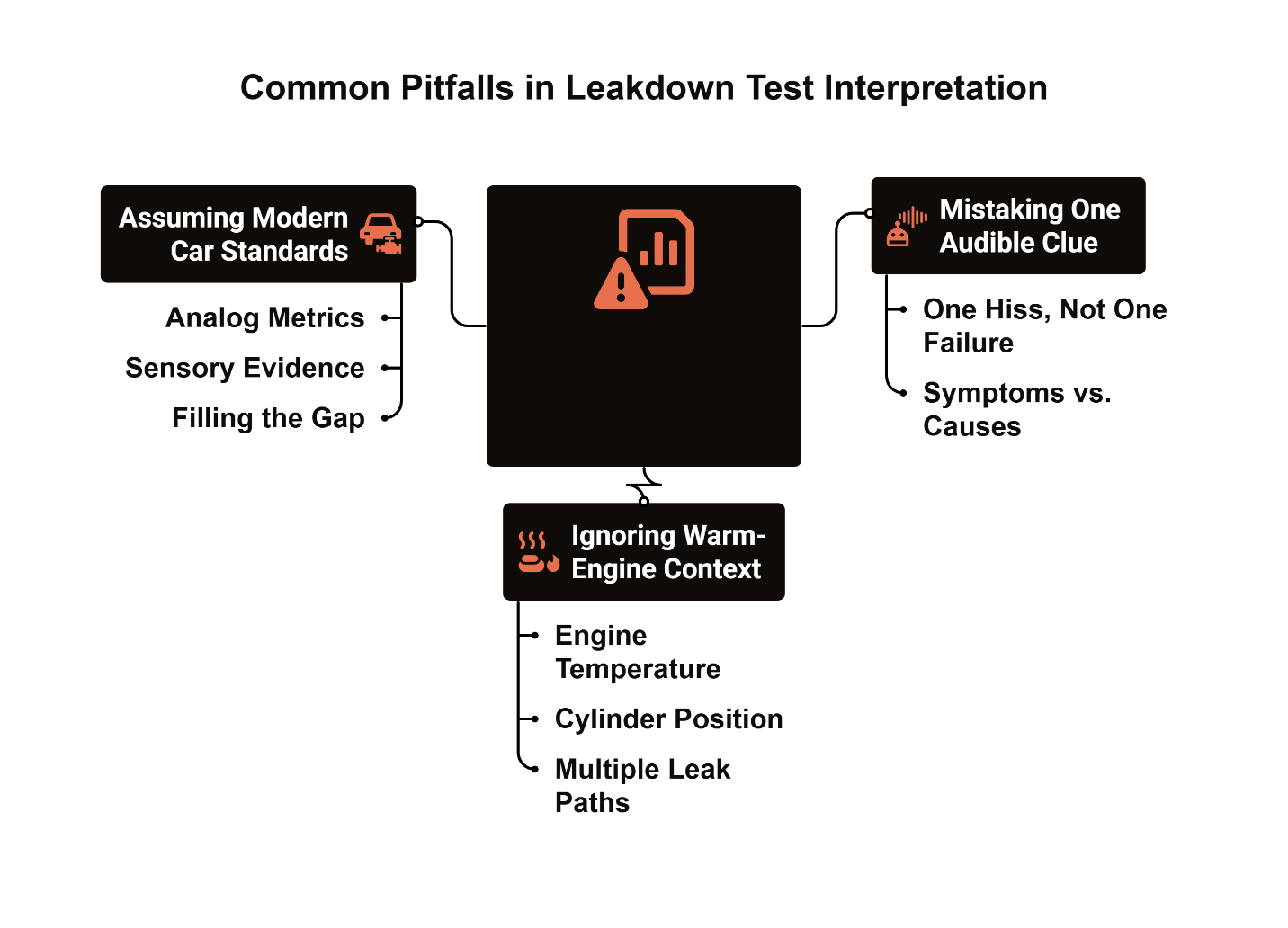
One hiss does not equal one certain failure. It points you in a direction. That is valuable, but it is not the same as opening the engine and confirming what is actually worn. The same discipline shows up in how proper diagnostics separate symptoms from causes. One symptom can tempt you. A better process protects you.
Ignoring Warm-Engine Context, Setup Consistency, or Multiple Leak Paths
Leakdown results can vary with engine temperature, cylinder position, and how the test is performed. A single rushed test may not tell the whole story. And sometimes you hear more than one leak path—breather noise plus tailpipe hiss, for example. That complexity is real. Do not force the result into a simple category if it does not fit.
Assuming a Low-Tech Vintage Engine Should Be Judged Like a Modern Scanner-Driven Car
Modern cars throw codes. Vintage air-cooled VWs tell you their truth through analog metrics and sensory evidence. There is no dashboard warning light for marginal ring sealing. There is no scanner readout for a valve that seats incompletely. The leakdown test—and your ears—fill that gap.
What If You Hear More Than One Leak Path or the Result Feels Borderline?
This is where honesty matters most. If the leakdown result does not clearly point in one direction, or if you hear multiple leak paths, do not force a conclusion. Uncertainty is valid. The correct next step is not overconfident guesswork—it is a specialist inspection from someone who works on these engines regularly and can interpret the findings in context.
When to Bring a Vintage VW to a Specialist in Orange, CA
Why Heritage-Specific Air-Cooled Experience Matters
Generic "European car" service is not the same as hands-on classic VW experience. Air-cooled engines have quirks, tolerances, and sensory tells that require familiarity built over years—not a scanner and a service manual. That kind of depth comes from pattern recognition built over decades of working on the same engines.
Orange Independent Auto Repair has been family-owned since 1971 and specializes in classic car maintenance for vintage VWs and Porsches. Lead technician Eddie has over 50 years of direct Beetle and Bus experience. That means the difference between guessing and knowing.
The goal is not pressure. It is clarity—fair, straightforward, honest clarity. If the answer is simple, you want to hear that. If the engine needs deeper work, you want that said plainly too. And if the right next step belongs with another specialist, a trustworthy shop says that instead of bluffing.
What to Do Next If the Engine's Breath Points to Internal Sealing Concerns
If a leakdown test leaves you uncertain, or if the findings suggest internal sealing problems worth investigating, the smartest move is a professional inspection. You will get clarity, honest advice, and—if repair is needed—a shop that only fixes what actually needs fixing.
Ready to schedule? Contact Orange Independent Auto Repair or schedule service. You can also call (714) 633-7161.
187 S Main St, Orange, CA 92868 Mon–Fri 7am–6pm | Sat by appointment only
By pairing leakdown audio with compression data, technicians map engine health before teardown, ensuring you only pay for the diagnostics and repairs the engine actually needs.
Disclaimer: This article is informational and educational. Leakdown sounds and percentages are diagnostic clues, not a substitute for a hands-on inspection and repair authorization process.
About the Orange Independent Auto Repair Insights Team
The Orange Independent Auto Repair Insights Team is our dedicated engine for synthesizing complex topics into clear, helpful guides. While our content is thoroughly reviewed for clarity and accuracy, it is for informational purposes and should not replace professional advice.