
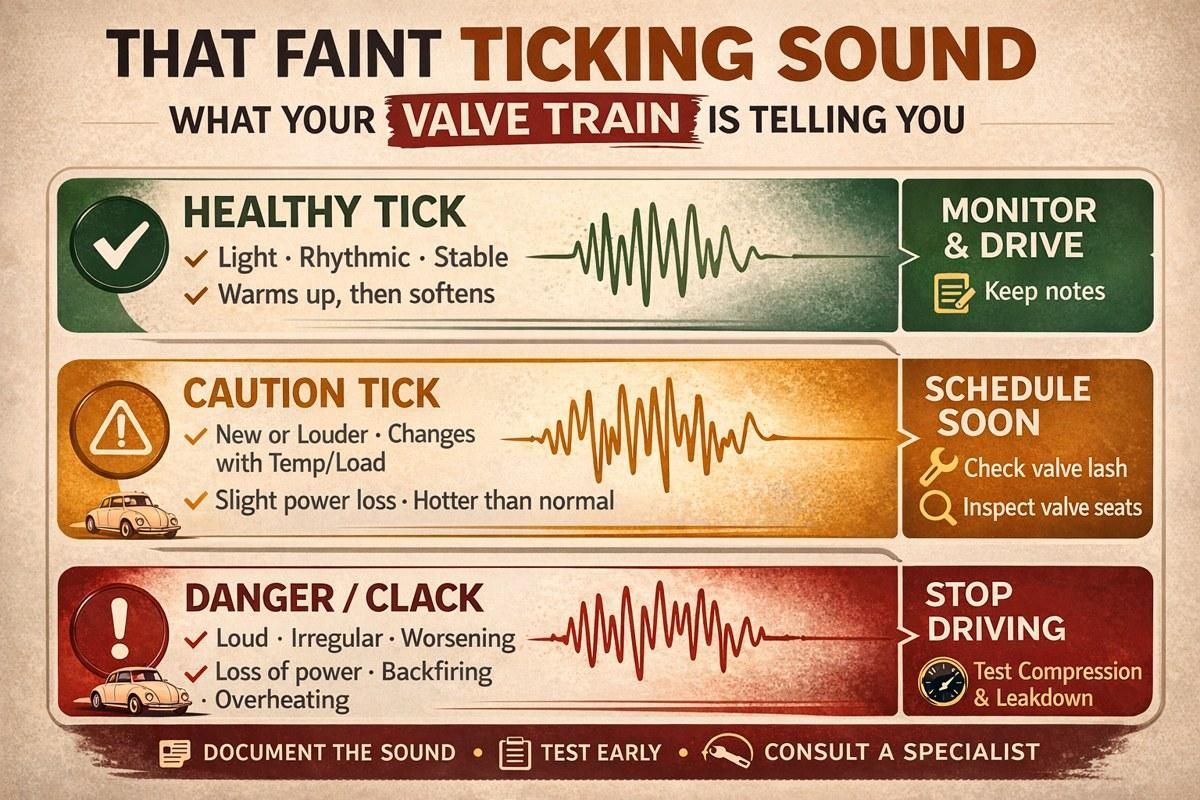
That Faint Ticking Sound: What Your Valve Train in Tustin is Trying to Tell You About Internal Health
📌 Key Takeaways
A light tick from your classic VW engine can be normal—but a new tick, a changing tick, or one paired with weak power needs attention.
- Sound Changes Matter Most: A tick that wasn't there before, gets louder when warm, or appears under load is your engine asking for help.
- Know the Three Categories: Healthy tick is light and steady; caution tick is new or temperature-sensitive; danger clack is sharp, irregular, and often means stop driving.
- Repeated Adjustments Signal Trouble: Setting valves once is normal maintenance, but if the tick returns within a few hundred miles, something deeper is wearing out.
- Pair Sound with Performance: A tick by itself might be fine—but a tick plus flat acceleration, rough idle, or weak pull means it's time for compression or leakdown testing.
- Document Before You Visit: Note when the sound started, whether it changes hot versus cold, and any related symptoms—this helps your mechanic diagnose faster.
Your ears are the only warning system a vintage VW has—trust what they're telling you.
Classic VW owners in Orange County who want to catch small concerns before they become expensive repairs will find actionable guidance here, preparing them for the detailed diagnostic steps that follow.
~ ~ ~ ~ ~ ~ ~ ~ ~ ~ ~ ~ ~ ~ ~ ~ ~ ~
Tick-tick-tick.
You're standing in your Tustin driveway, engine idling, and there it is. A faint metallic rhythm coming from somewhere under the deck lid. Your stomach tightens. Is that normal? Has it always done that?
A light mechanical tick from a classic air-cooled VW can be completely normal. These engines aren't silent. They breathe, they click, they make their presence known. The real question isn't whether your engine makes noise—it's whether that noise has changed.
A sound that's new, a rhythm that's different warm versus cold, or a tick that arrives alongside weak acceleration—those patterns matter far more than the tick itself. This guide will help you listen with purpose, understand what you're hearing, and know when it's time to have a specialist take a closer look.
The Short Answer: A Faint Tick Can Be Normal, but a New or Changing Sound Deserves Attention
Air-cooled VW engines have mechanical valve trains with adjustable clearances. A light, even tick at idle is often just the normal sound of valve lash doing its job. Thousands of healthy Beetles, Buses, and Ghias make this sound every day.
The concern starts when something shifts. A tick that wasn't there last month. A sound that gets louder once the engine warms up. A rhythm that seems irregular or sharper than before. Those changes are your engine communicating—and classic VWs don't have warning lights to translate for you.
A light air-cooled tick can be normal. A new tick, a changing tick, or a tick with weak pull is the part you should never ignore.
Key Terminology: Valve Lash, Receding vs. Dropped Seat, and Leakdown
Before we go further, let's define three terms you'll encounter when discussing valve-train health:
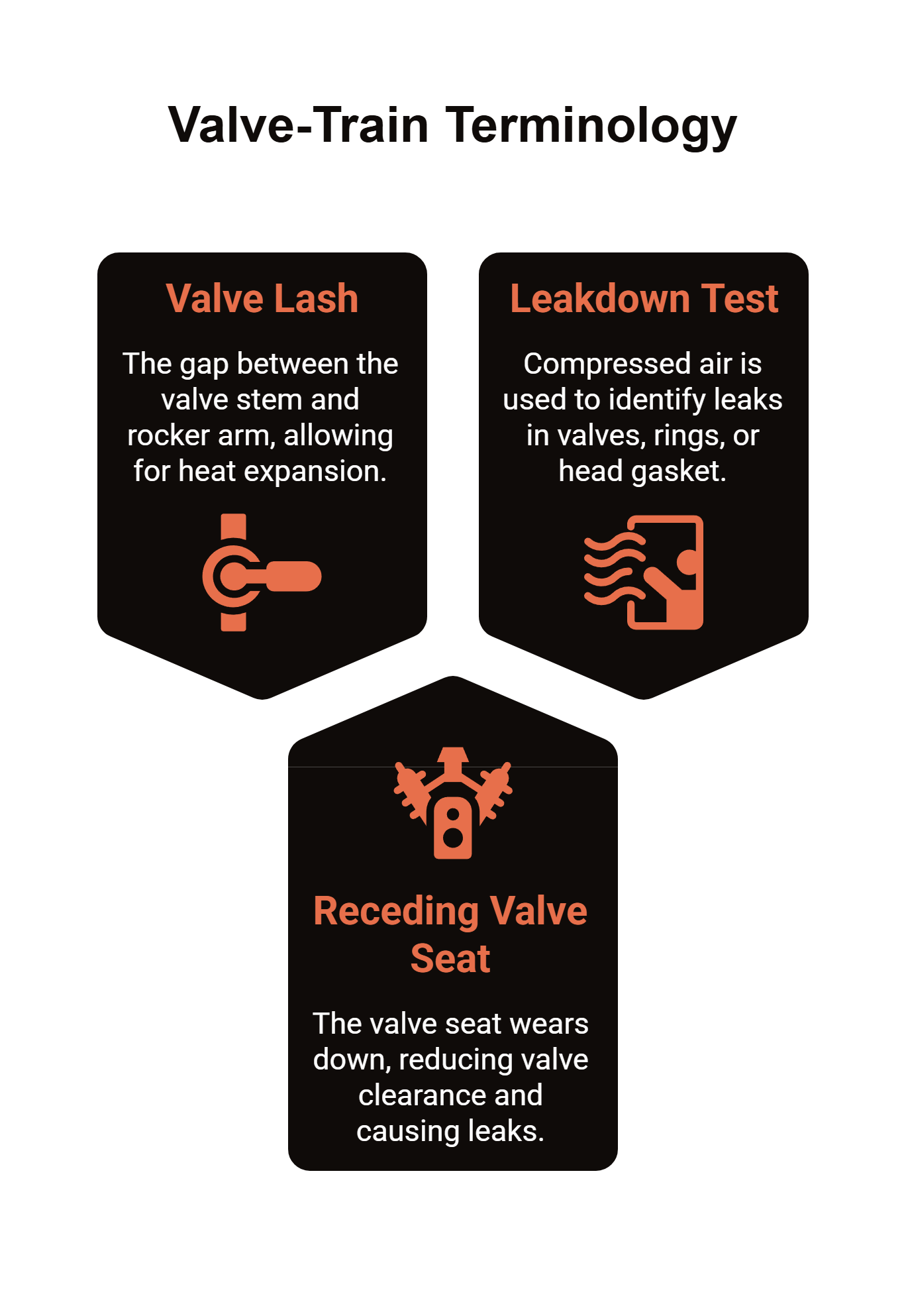
Valve Lash: The small gap between the valve stem and the rocker arm. This gap is adjustable and necessary—it allows for heat expansion. When lash is too tight or too loose, you'll hear it.
Receding Valve Seat: Over time, the metal seat where the valve closes can wear down or sink into the cylinder head. As it sinks, the valve stem pushes closer to the rocker arm, reducing your valve clearance to zero. Once that gap is gone, the valve is held slightly open—like a window that can't close flush. The seal weakens, leading to burned valves and lost compression.
Leakdown Test: A diagnostic procedure where compressed air is introduced into a cylinder while the valves are closed. By listening for where the air escapes, a specialist can pinpoint whether the valves, rings, or head gasket are losing their seal.
What a Healthy Tick Sounds Like vs. a Danger Clack
Not all valve-train sounds mean trouble. The key is learning to distinguish between a healthy tick, a caution tick, and a danger clack.
The Noise Navigator
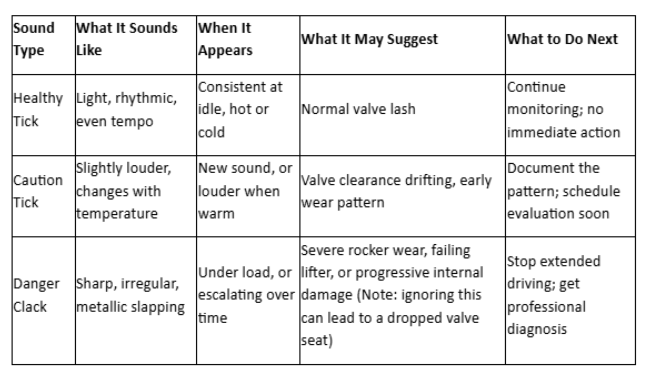
This is the simplest way to think about it: healthy tick, caution tick, danger clack. The sound alone is not the diagnosis—it's the first layer of triage.
Step 1: Notice When the Sound Shows Up
Before you assume the worst, pay attention to when the tick appears:
- Cold start only — A tick that fades as the engine warms is generally not valve lash, since the aluminum/magnesium alloy of an air-cooled VW engine case and cylinder heads expand at a different rate than the pushrods. Because factory pushrods are aluminum and cylinders are cast iron, thermal expansion dynamics mean clearance often tightens slightly or stays consistent when hot. A fading cold tick is more likely a minor exhaust manifold leak that temporarily seals up as the metal expands, or slight piston slap.
- Hot idle only — A tick that arrives after the engine is warm could mean clearances are loosening as metal expands.
- Under load or acceleration — A tick that appears when you ask for power, especially with flat pull, suggests something deeper.
- After a recent adjustment or tune-up — If the sound appeared right after work was done, the adjustment may need revisiting.
The pattern tells the story. A cold-start tick that disappears is very different from a warm-idle tick that gets louder under load.
Step 2: Understand What the Tick Might Be Telling You
Once you've noted the pattern, you can start to interpret what your engine might be communicating.
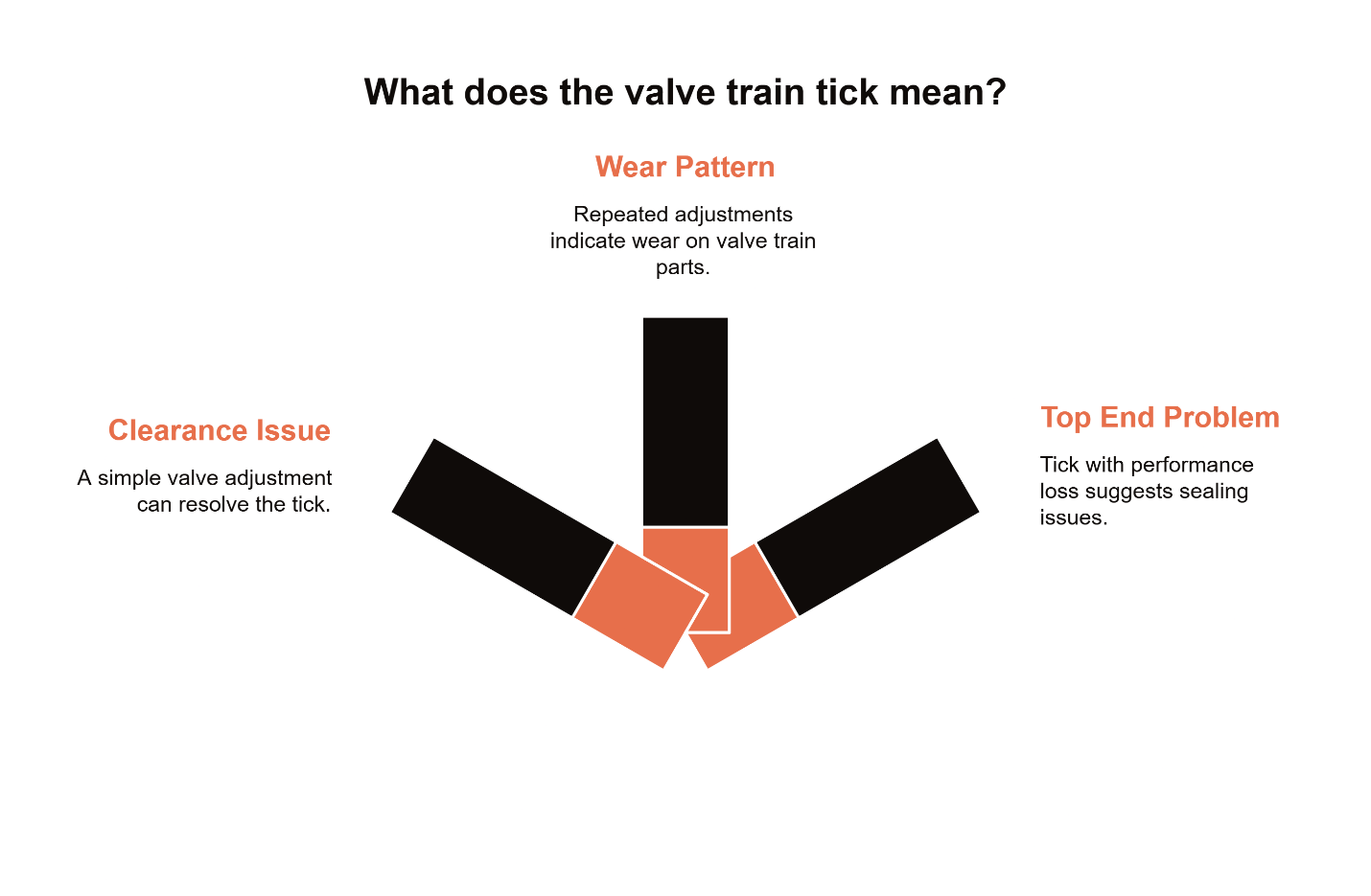
A Clearance Issue
The most common cause of valve-train noise is simply that the lash has drifted out of specification. This happens naturally over time. A straightforward valve adjustment often resolves it.
A Valve-Train Wear Pattern
Repeated adjustments that don't hold, or clearances that keep changing in the same direction, can indicate wear on the rocker arms, pushrods, or cam followers. The parts are still working, but they're telling you they've seen some miles.
A Sign the Top End Needs Closer Evaluation
When a tick is paired with performance loss—flat acceleration, rough idle, or a cylinder that feels weak—the sound may be pointing toward a sealing problem. A cracked cylinder head or worn valve guides can generate a distinct mechanical chatter, while a burned valve will typically produce an audible pneumatic chuffing or misfire as cylinder pressure escapes. (Keep in mind, if a valve seat is receding, you will lose compression but the engine will actually become suspiciously quiet rather than noisy).
Sound alone isn't enough to diagnose the problem. But sound combined with performance changes is a strong signal that analog verification should come next.
When a Simple Adjustment Helps — and When Repeated Adjustments Are a Red Flag
A one-time valve adjustment is normal classic car maintenance. Clearances drift, and bringing them back into spec is part of owning a vintage VW.
The red flag appears when the adjustment doesn't stick. If you set the valves, the tick goes away, and then the same noise returns within a few hundred miles—that's not routine. It's a pattern. And patterns of recurring ticking usually point toward rapid mechanical wear on the rocker arms, pushrod ends, or cam followers. Conversely, if your valves continually get tighter (losing clearance and becoming suspiciously quiet), this points toward a valve seat that's receding into the head, eating up the clearance no matter how many times you reset it.
If left unchecked, this receding seat will overheat, lose its press-fit in the aluminum head, and drop into the cylinder—instantly transforming a suspiciously quiet engine into a catastrophic 'danger clack.
Myth: If there's no warning light, the noise can wait.
Fact: Vintage air-cooled VWs have no engine warning lights for internal wear. Sound is often the first and only early warning you'll get. Ignoring a changing tick because no light is on can mean missing the window for a simpler repair.
When the Next Step Should Be Compression or Leakdown Testing
Sound interpretation is useful, but it has limits. When the tick crosses from "interesting" to "concerning," objective measurement becomes the smart next step.
Consider scheduling compression or leakdown testing if:
- The noise is new and you can't explain it
- The tick changes character—louder warm, sharper under load
- Valve adjustments keep drifting back out of spec
- You notice weak pull, flat acceleration, or rough running alongside the sound
- The tick is paired with smells, exhaust puffing, or raw-fuel odor
- You're evaluating a car for purchase and want to know the engine's real condition
These tests turn guesswork into data. A leakdown test, in particular, can pinpoint whether air is escaping past the intake valve, exhaust valve, rings, or head gasket. That's information you can act on. For more on interpreting these numbers, see what compression and leakdown numbers mean for buyers.
If the car also has a shaky idle or mixed symptoms, it can help to compare that story with guidance on rough idle on an air-cooled Volkswagen or carb sync versus timing.
What to Tell the Shop Before You Bring the Car In
When you schedule an inspection, the information you provide helps the specialist understand what they're listening for. Before your visit, note:
- When the sound first appeared (or when you first noticed it)
- Whether the tick is different cold versus warm
- Whether it changes under load or acceleration
- Whether the valves were recently adjusted, and how long ago
- Any related symptoms: rough idle, weak pull, unusual smells, smoke, exhaust puffing, or raw-fuel odor
This context transforms a diagnostic appointment from a fishing expedition into a targeted evaluation. The more detail you can provide, the faster your specialist can zero in on what's actually happening.
Common Pitfalls to Avoid When Interpreting Valve-Train Noise
Assuming All Air-Cooled Ticking Is Harmless
Yes, these engines make mechanical sounds. No, that doesn't mean every tick is fine. The danger is normalizing a sound that's actually changed. If you've owned the car for years, trust your ear. If you're evaluating a car you've never driven, ask when the tick started.
Assuming Every Quiet Engine Is Healthy
Silence is not proof of good condition. The real clue is whether the sound and performance story still make sense together. An unusually quiet engine that runs rough or feels weak deserves the same attention as one that ticks loudly.
Chasing the Sound Without Tracking Patterns
A single listen at idle doesn't tell the whole story. Does the tick change warm? Does it appear under load? Does it come and go? Jumping to conclusions after one cold-start listen can lead you to fix the wrong thing—or ignore the right one.
Treating Repeated Valve Adjustments as the Whole Solution
Adjusting the valves once is maintenance. Adjusting them every few hundred miles because they keep drifting is a symptom. If the clearance won't stay put, something else is moving—and that something deserves investigation, not just another adjustment.
What If the Tick Suddenly Gets Louder After a Drive?
This is the scenario that triggers real anxiety. You drove the car, it felt fine, and now the tick is noticeably louder.
First, don't panic. But don't ignore it either.
Here's a calm three-step response:
- Stop driving aggressively. Avoid highway pulls, heavy loads, or extended trips until you understand what's happening.
- Document what changed. Did the tick get louder, sharper, or more irregular? Did performance change? Write it down while it's fresh.
- Schedule an evaluation. A specialist with air-cooled experience can listen, measure, and tell you whether you're dealing with a simple adjustment or something deeper.
A sudden change in sound after driving can mean thermal expansion revealed a clearance issue—or it can mean something more serious. Either way, the smart move is verification, not guessing.
The Reader Challenge
Most people ask: Can I make the tick go away?
The better question: What changed inside the engine to create a new sound?
The first question chases silence. The second question chases understanding. And understanding is what gives you control over the situation—whether that means a simple adjustment, a planned repair, or the confidence to keep driving without worry.
Listen Early, Verify Honestly
Your classic VW's valve train is talking to you. While baseline valvetrain chatter is a hallmark of the air-cooled experience, any deviation from that baseline—particularly when accompanied by a loss of power—demands immediate investigation.
Listening early gives you options. Verifying honestly gives you facts. And facts are what let you make calm, confident decisions about a car you care about.
If your classic VW in Tustin or anywhere in Orange County is making a sound that's new, louder warm, or paired with flat pull, the next step is clear: have a specialist listen with you. For drivers in the Tustin area, local auto repair that understands classic VWs makes a real difference.
Contact Orange Independent Auto Repair to schedule an inspection. Our shop in Orange has been working on classic VWs since 1971, and we'd rather help you catch a small concern early than watch it become a bigger one later.
Phone: (714) 633-7161
Address: 187 S Main St, Orange, CA 92868
Hours: Mon–Fri 7am–6pm; Sat by appointment only
Frequently Asked Questions
Is a ticking sound normal on an air-cooled VW?
Yes, audible valvetrain operation is a standard characteristic of a well-adjusted air-cooled flat-four. The concern is when the sound is new, louder than before, or changing with temperature or load.
What's the difference between a valve tick and a dangerous clack?
A healthy tick is light, rhythmic, and consistent. A dangerous clack is sharper, irregular, or escalating—often paired with flat acceleration, rough running, or a cylinder that feels weak.
Can a valve adjustment fix ticking on a classic VW?
Often, yes. But if the noise returns quickly after adjustment, or if the clearance keeps drifting in the same direction, deeper inspection is warranted. The adjustment may be treating a symptom, not the cause.
When should a ticking classic VW get a compression or leakdown test?
When the sound is new and unexplained, changes with heat, returns quickly after adjustment, or is paired with weak pull, rough idle, or other sensory clues. These tests turn sound into data.
What should I tell a specialist if my VW is making a ticking sound?
Share when the sound started, whether it changes hot versus cold, whether power has changed, whether the valves were recently adjusted, and any related symptoms like unusual smells, smoke, or exhaust noises.
Disclaimer: This article is for educational purposes and general guidance. It is not a substitute for hands-on diagnosis by a qualified technician. If you're uncertain about your vehicle's condition, consult a specialist before driving.
Our Editorial Process:
This content was developed by the Orange Independent Auto Repair team to help classic VW owners understand their vehicles better. We prioritize accuracy, clarity, and honest guidance over sales language.
By: The Orange Independent Auto Repair Insights Team