
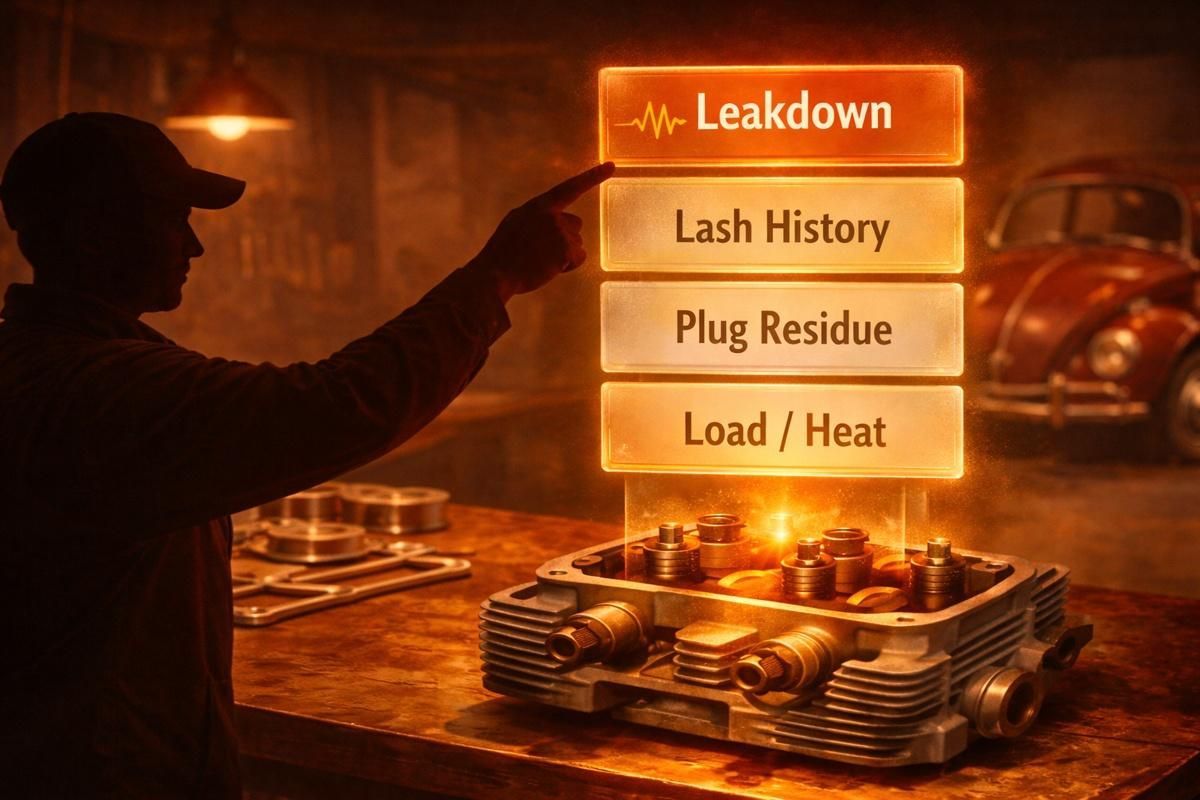
The Precision Seal: A Master Mechanic’s Guide in Yorba Linda to Assessing Valve-to-Seat Mating without Engine Disassembly
📌 Key Takeaways
A specialist can assess valve-seat health without removing the heads by stacking multiple clues—but no external test can guarantee what only disassembly confirms.
- Listen for Where Air Escapes: During a leakdown test, air hissing from the tailpipe points to exhaust valve trouble, while air pushing through the intake suggests intake valve issues—the direction matters more than the percentage alone.
- Smooth Idle Proves Little: At idle, engines don't work hard enough to expose weak seals; problems often surface only under sustained load, heat soak, or freeway acceleration.
- Watch for Recurring Lash Drift: If valve clearance keeps tightening on the same cylinder after adjustments, the valve may be sinking into the seat—a pattern that deserves investigation.
- Stack Evidence Before Deciding: One borderline number isn't cause for alarm, but when leakdown direction, lash history, plug residue, and throttle response all point the same way, it's time for specialist attention.
- Test Under Real Conditions: Short neighborhood drives hide what canyon climbs reveal—buyers and owners should evaluate engine behavior under load and heat, not just at idle.
Converging clues tell the story; isolated numbers don't.
Classic VW owners in Yorba Linda and Orange County evaluating a purchase or monitoring an aging engine will find a clear decision framework here, preparing them for the detailed diagnostic guidance that follows.
~ ~ ~ ~ ~ ~ ~ ~ ~ ~ ~ ~ ~ ~ ~ ~ ~ ~
A skilled specialist can assess valve-to-seat sealing health without pulling the heads. The method relies on stacking multiple lines of evidence—leakdown behavior, compression context, valve-adjustment history, where escaping air is heard, throttle response under load, and plug residue—until the pattern either clears the engine or raises genuine concern. This is an assessment of probability and severity, not x-ray vision. No external test can guarantee what only disassembly can confirm. But converging evidence, interpreted correctly, often tells the story clearly enough to guide your next decision.
For Yorba Linda owners evaluating a vintage VW purchase or watching an existing engine age, that distinction matters. Top-end work is expensive. False confidence is costly. And so is unnecessary teardown.
What Valve-to-Seat Mating Actually Means
Think of valve-to-seat mating like checking whether a window is fully closed or only mostly closed. A window that looks shut but leaves a thin gap still lets air slip through. You might not notice it in calm weather. But when the wind picks up, you feel the draft.
A window that is wide open is obvious. A window that is cracked open is harder to spot. Valve sealing problems often behave like that second case.
In an air-cooled engine, each valve must seal completely against its seat during the compression and combustion strokes. The valve face presses into a machined ring in the cylinder head. When that contact is precise, combustion pressure stays where it belongs—pushing the piston down. When the seal is compromised, pressure leaks past the valve. Power drops. Heat builds unevenly. Combustion efficiency suffers.
The tricky part is that weak sealing doesn't always announce itself. A valve that's 90% sealed might idle smoothly and start without complaint. The problem only surfaces under sustained load, extended heat soak, or higher cylinder demand. That's why owners can drive for months believing everything is fine—until a long grade or a hot restart reveals what idle never did.
What Evidence Matters Most When the Heads Stay On
Not all diagnostic clues carry
equal weight. A specialist stacks evidence in a rough hierarchy, with some tests offering stronger signal than others.
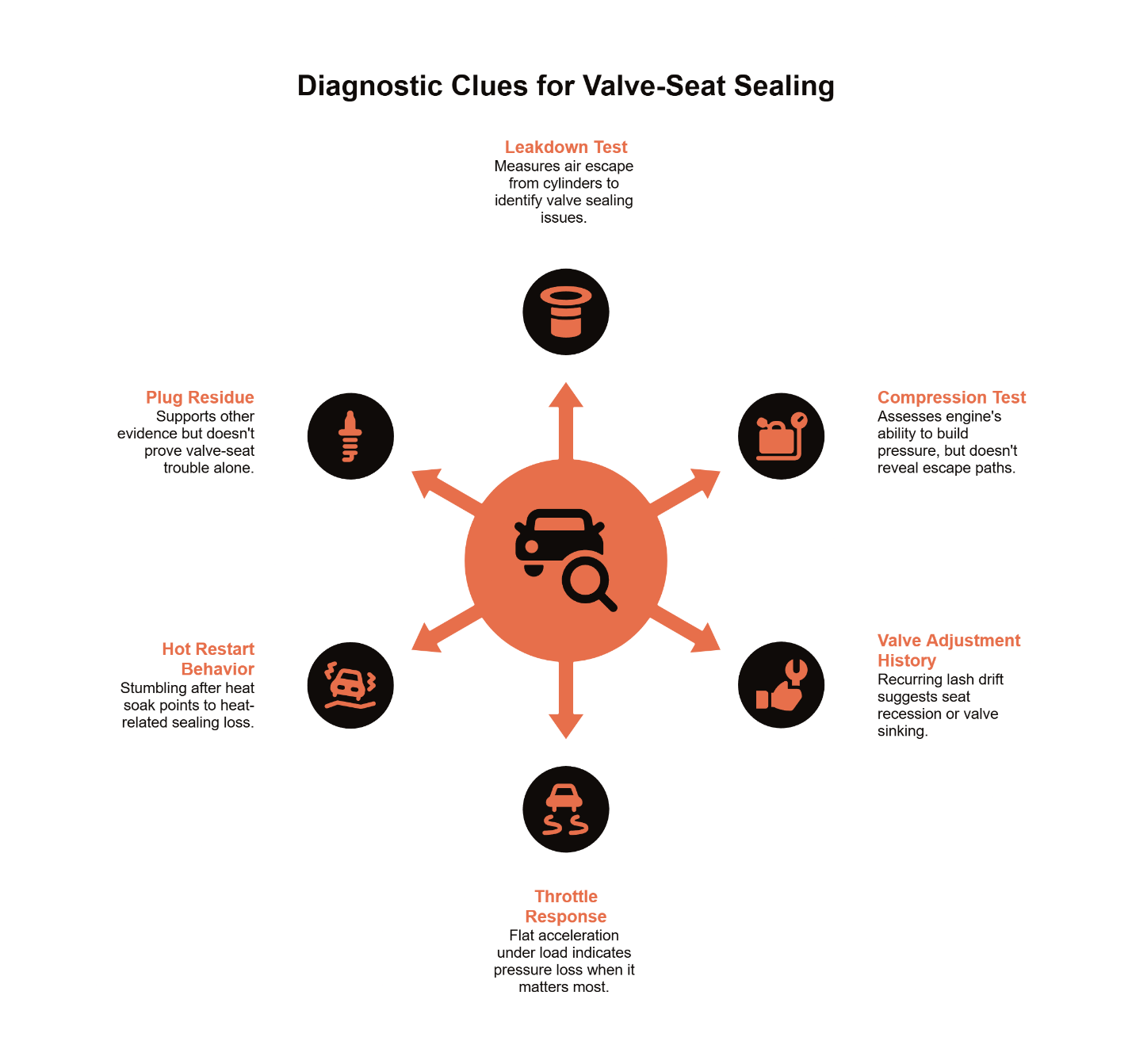
Leakdown behavior sits near the top. A leakdown test pressurizes each cylinder with the valves closed and measures how much air escapes. The percentage matters, but directionality matters more. Where is the air going? A hiss at the tailpipe points toward exhaust valve sealing. Air pushing back through the carburetor or intake tract suggests intake valve trouble. Noise at the oil breather or dipstick tube implies ring or piston issues. Knowing the escape path changes everything about interpretation.
In the benchmark ranges discussed in engine health on a vintage VW, leakdown under 10% is generally strong, while numbers over 20% deserve serious attention. The more important point is this: where the air goes changes the meaning of the number.
Compression testing provides context, not a verdict. A cylinder that holds acceptable compression might still have early sealing wear that only shows under load. Compression is a snapshot of the engine's ability to build pressure. Leakdown reveals where that pressure goes when it escapes. Carbon can influence numbers. Testing conditions vary. A problem that shows up more clearly hot may not fully reveal itself in a simple cold check. Compression tells you how the engine performed during that test. Leakdown helps explain why.
Valve-adjustment history often signals trouble before hard numbers do. A single tight valve might mean nothing. A pattern of recurring lash drift—especially on the same cylinder, especially on the exhaust side—suggests the seat is receding or the valve is sinking into the head. When clearance keeps tightening, the geometry is changing. That's worth attention.
A fresh adjustment can quiet the symptom for the moment. It does not prove the problem is gone. This is where standard maintenance advice can mask risk. An owner hears valve noise, gets an adjustment, and feels relieved because the engine sounds better. But if the lash keeps drifting, the adjustment may be covering the trail rather than solving the cause.
Throttle response under load exposes what idle hides. A car that feels flat accelerating onto the freeway, even though it sounds fine in your driveway, may be losing pressure exactly when it matters most. This is especially telling in air-cooled engines, where sustained load and climbing grades put real demand on every cylinder.
Hot restart behavior can reveal heat-related sealing loss. A car that fires up cold without complaint but stumbles or feels weak after a heat soak may be experiencing valve expansion that's pushing sealing margins past their limit.
Plug residue offers supporting evidence, but only that. According to NGK's spark plug reading guide, carbon fouling patterns can suggest combustion irregularities. But plug color alone doesn't prove valve-seat trouble. It confirms or supports what stronger evidence has already suggested. A mechanic who leads with plug readings and ignores leakdown directionality is working backward.
Why a Smooth Idle Can Fool You
A decent idle is comforting. It's also a poor test of valve-seat integrity.
At idle, cylinder pressure demands are low. A valve that's 85% sealed might create just enough turbulence to slightly roughen the idle—or it might not. The engine isn't working hard enough to expose the weakness. It's only when you demand full power, hold the throttle open on a sustained climb, or restart after the engine has soaked in heat that the compromised seal shows itself.
This is where Yorba Linda and Orange County driving patterns become relevant. Short local trips—grocery runs, school drop-offs, stop-and-go errands—rarely stress an air-cooled engine the way a canyon drive or a long pull up a grade does. An owner who never leaves surface streets might never feel the symptoms that would appear immediately on a freeway merge or a Trabuco Canyon run.
The false comfort of a smooth idle is one of the most common reasons valve-seat problems go unnoticed until they've progressed. If you're evaluating a purchase or monitoring an aging engine, idle quality alone tells you almost nothing. That's why rough idle on an air-cooled Volkswagen should never be read in isolation from heat and load behavior.
A Practical Decision Tree: Monitor, Test Further, or Suspect Top-End Trouble
The goal isn't to chase every imperfect number. It's to know when the evidence stack points somewhere real.
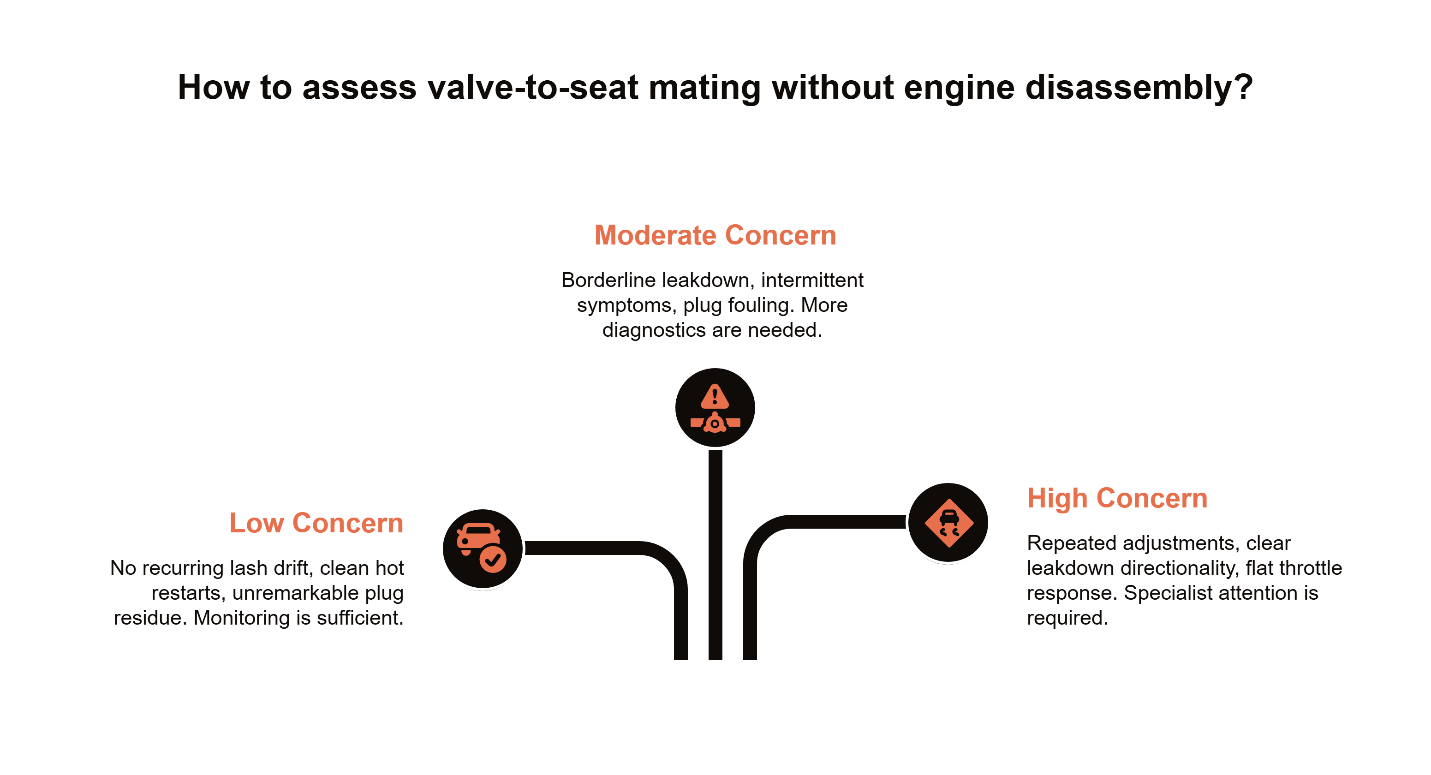
Low Concern — Keep Watching
No recurring lash drift. Leakdown shows no strong directional clues. Throttle response feels coherent under load. Hot restarts are clean. Plug residue is unremarkable. The numbers may not be perfect, but nothing stacks in the same direction.
Moderate Concern — Needs More Diagnostics
Borderline leakdown percentages. Mixed evidence—one test looks fine, another raises a question. Intermittent symptoms that come and go. Plug fouling that supports, but doesn't prove, sealing trouble. This is the zone where a single test isn't enough. A specialist may want to retest under different conditions, compare cylinders more carefully, or correlate road behavior with bench findings.
High Concern — Specialist Attention Now
Repeated valve-adjustment tightening on the same cylinder. Clear leakdown directionality pointing toward valve sealing loss. Flat throttle response under load that doesn't improve with tuning. Evidence keeps stacking in the same direction. At this point, monitoring is no longer enough. The engine is telling you something, and pretending a fresh adjustment solved it won't change the outcome.
The logic in carb sync or timing still matters here, but top-end sealing risk has to move up the list when several clues align.
What Does Not Prove Healthy Valve-Seat Sealing
Certain reassurances carry less weight than owners often assume.
A smooth idle, a fresh adjustment, or an acceptable compression reading are insufficient proofs of health. Short, easy local drives rarely demand enough from the engine to expose underlying weakness. A cylinder can remain 'mostly sealed' and entirely mask early failure under casual observation.
What This Means for a Yorba Linda Owner or Buyer
Yorba Linda sits at a crossroads between short suburban trips and the kind of terrain that exposes air-cooled weaknesses. A classic VW that lives on flat, low-demand routes may hide sealing issues for years. Take that same car up Carbon Canyon or through the Santa Ana Mountains, and the story changes.
For buyers evaluating a potential purchase, this means a test drive around the seller's neighborhood isn't enough. You need load. You need heat. You need someone who knows how to interpret what the engine does under those conditions.
For owners monitoring an aging engine, it means short-trip patterns can mask problems that sustained driving would expose. If your VW only runs errands, an annual classic car maintenance check that includes leakdown interpretation is worth the time.
Orange Independent Auto Repair, located in Orange and serving Yorba Linda and the surrounding area, has been family-owned and operated since 1971. The shop's long-standing classic VW and Porsche experience comes with a reputation for honest recommendations, fair treatment, and not pushing repairs prematurely. Their approach to engine health on a vintage VW emphasizes evidence stacking over guesswork—and candor about what non-disassembly methods can and cannot prove.
When to Bring the Car In
Consider scheduling a specialist evaluation if any of the following apply:
Valve clearance keeps changing, especially on the same cylinder. Ticking or clacking patterns shift in ways that don't match adjustment history. Leakdown findings have moved from borderline to directional. Power feels dull under load, even after addressing ignition and fueling. You're evaluating a purchase and want a specialist reading before committing.
A quick conversation about what you've noticed—and what the engine does under real-world conditions—often tells a specialist where to focus. From there, the evidence either clears the engine or points toward further work.
To schedule a diagnostic consultation, contact Orange Independent Auto Repair or call (714) 633-7161.
FAQs
Can a leakdown test distinguish valve trouble from ring wear on an air-cooled VW?
Yes, and that's the primary value of the test. By listening to where the pressurized air escapes—tailpipe, intake path, or breather/crankcase—a specialist can identify whether the leak is at the valve, the rings, or elsewhere. Directionality is more useful than the percentage alone.
Does a smooth idle mean my valve seats are fine?
No. A smooth idle only means the engine can manage low-demand conditions without obvious roughness. Valve-seat problems often don't surface until the engine is under sustained load or heat. Idle quality is not a reliable indicator of sealing health.
How serious is it if valve clearance keeps changing?
Recurring lash drift—especially tightening—can indicate that the valve is sinking into the seat or that the seat itself is receding. A single adjustment is maintenance. A pattern of repeated changes on the same cylinder is a diagnostic signal worth investigating.
Can carbon buildup mimic valve-seat problems?
It can complicate the picture. Heavy carbon deposits may affect sealing behavior or alter plug readings without indicating true seat recession. A specialist accounts for carbon as a variable but doesn't let it override stronger mechanical evidence like leakdown directionality or lash history.
Should I rebuild immediately if one cylinder looks weak?
Not necessarily. One soft reading without supporting evidence may be a monitoring situation rather than an emergency. The decision to authorize top-end work should be based on stacked evidence, not a single number in isolation. A specialist can help you understand whether the findings justify action now or continued observation.
Our Editorial Process
Our expert team uses AI tools to help organize and structure our initial drafts. Every piece is then extensively rewritten, fact-checked, and enriched with first-hand insights and experiences by expert humans on our Insights Team to ensure accuracy and clarity.
By: The Orange Independent Auto Repair Insights Team
The Orange Independent Auto Repair Insights Team is our dedicated engine for synthesizing complex topics into clear, helpful guides. While our content is thoroughly reviewed for clarity and accuracy, it is for informational purposes and should not replace professional advice.