
One Family Vehicle, Several Problems: How Orange-area Drivers Can Prioritize Safety Repairs
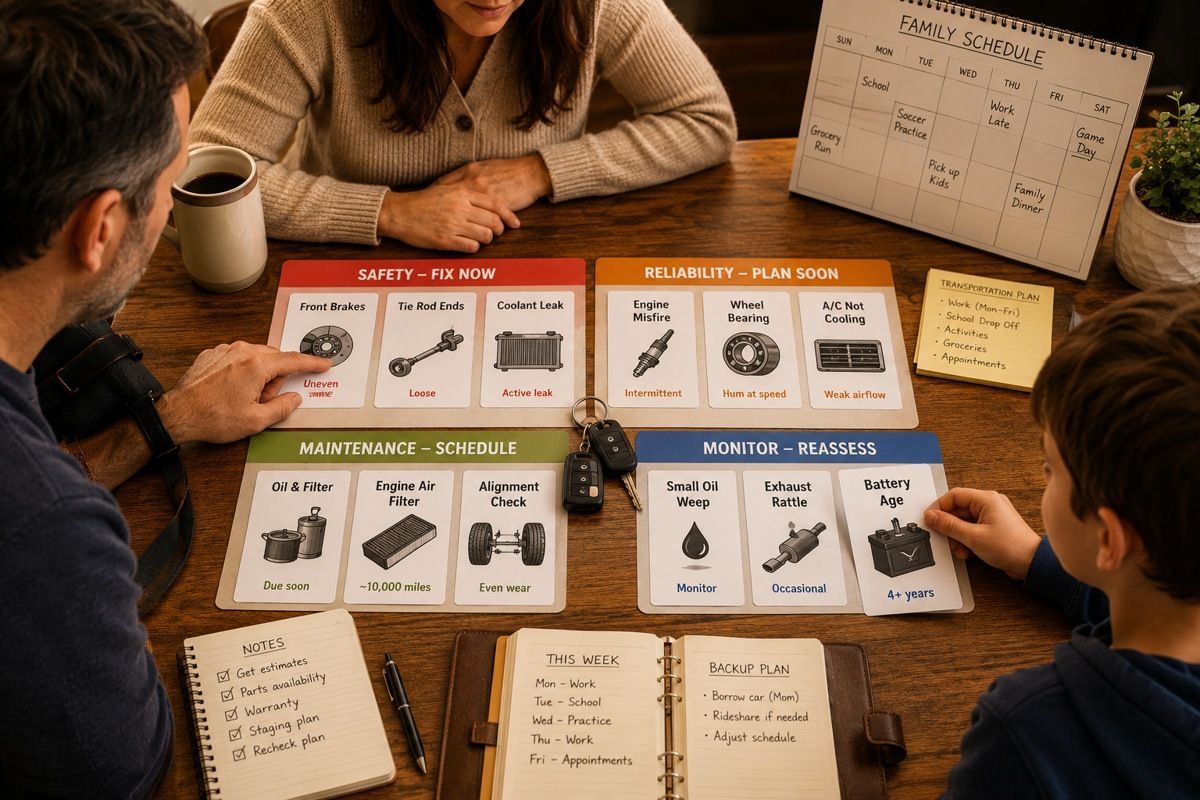
📌 Key Takeaways
The author recommends ranking repairs by evidence, vehicle function, possible consequences, and timing before considering price.
- Prioritize Evidence First: Compare confirmed findings, affected functions, consequences, and timing before reviewing repair prices.
- Separate Types of Urgency: Safety, reliability, maintenance, and monitoring concerns need different timelines, even when one inspection lists them together.
- Make Monitoring Active: A useful monitoring plan records a baseline, review date, and clear changes that should trigger earlier reassessment.
- Re-Rank Changing Symptoms: New, stronger, or combined symptoms can change repair timing, but only a professional can confirm their cause.
- Plan Around Family Needs: Heavy household use may justify earlier work or backup transport, but it does not prove greater mechanical risk.
Evidence sets repair priority; family needs shape planning.
Orange-area families sharing one vehicle will make clearer repair choices using the evidence-based questions and planning framework below.
~ ~ ~ ~ ~ ~ ~ ~ ~ ~ ~ ~ ~ ~ ~ ~ ~ ~
One vehicle may need to cover school drop-offs, work, errands, and caregiving while an inspection lists several unrelated findings. For an Orange-area household without a convenient backup, that can make every line on the estimate feel equally urgent.
The number of findings does not establish one urgency level. Start with four questions: What vehicle function may be affected? What evidence supports the finding? What could happen if the condition changes or remains unresolved? What would change the recommended timing? The goal is to build a staged, vehicle-specific plan—not to determine remotely whether a vehicle is safe.
A Long Repair List Is Not One Urgency Level
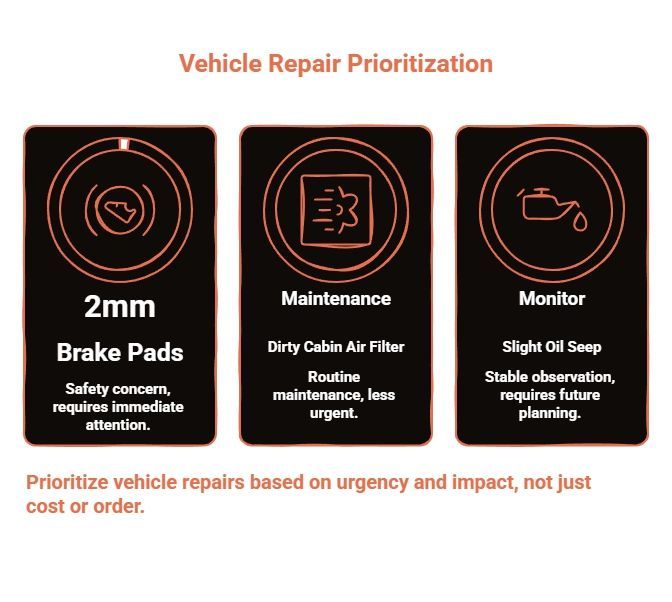
An inspection may combine confirmed defects, reported symptoms, maintenance items, stable observations, and work suggested for future planning. Those entries can have different consequences and timelines.
The printed order may reflect documentation rather than household priority. For example: An inspection might flag brake pads at 2mm (Safety), a dirty cabin air filter (Maintenance), and a slight oil seep (Monitor). Instead of viewing all three as a single, overwhelming emergency, you can plan them based on their distinct categories. Price also answers a different question. The most expensive recommendation is not automatically the most consequential, and completing several inexpensive items first could consume funds needed for a more important concern.
Ask the repair professional to identify the primary finding and explain the reasoning. Compare the affected function, evidence, possible consequence, and timing before comparing prices. The related guide, Why a Long Repair List Is Not the Same as an Urgent Repair List, expands on this distinction.
Separate Safety Impact, Reliability Impact, Maintenance, and Monitoring
Four decision lenses can make a mixed repair list easier to discuss. They are working categories rather than permanent labels; new evidence or a changing symptom may alter the priority.
A safety-impact finding affects your ability to control the car, see the road, contain fuel, or protect your passengers. The shop should explain what was actually confirmed, how the condition affects the vehicle, and what timing is recommended. Continued operation alone does not establish that a concern is minor.
Reliability impact concerns the possibility of losing dependable transportation. An intermittent starting, charging, or drivability problem may disrupt work, school, or caregiving even when it is not described as an immediate safety finding.
Maintenance is routine work that manages wear and keeps your car dependable. Maintenance should not be presented as an immediate safety conclusion without supporting evidence. When an oil-change example is relevant, the approved general baseline is 5,000 miles or 12 months, whichever comes first, while vehicle-specific instructions may differ.
Monitor means active observation. A meaningful monitoring plan identifies the current baseline, what to record, when the issue should be reviewed, and what change should prompt earlier reassessment.
A confirmed finding comes from the inspection; a symptom comes from the driver. A clear vehicle inspection should connect those two without treating every observation as proof of one diagnosis.
Vehicle era also matters. Classic VW and Porsche examples should be described through smells, noises, vibration, leaks, drivability, and analog-gauge behavior. A modern or OBD-era vehicle may also display warning symbols or messages, but the meaning and recommended response can vary by make, model, year, and system. The applicable owner’s manual is the appropriate source for a specific warning.
Use a Family-Vehicle Priority Matrix
Put every finding on one shared list so household members are working from the same information. Record what was observed rather than only the name of a part. Then identify what the shop has confirmed and what remains uncertain.
The examples below are hypothetical. They illustrate the framework; they do not classify a real vehicle or replace a qualified inspection.
| Finding or Symptom | Evidence Observed | Possible Consequence | Recommended Timing | Household-Use Impact | Monitoring Trigger | Question to Ask |
|---|---|---|---|---|---|---|
| Finding that may involve a safety-relevant function | Inspection identified a condition, but severity and effect need explanation | May affect operation depending on the vehicle and condition | Obtain vehicle-specific guidance before deciding whether to postpone | Essential trips may require a transportation alternative | Any meaningful change in control, visibility, odor, leakage, or related behavior | What did the inspection confirm, and how does it affect the vehicle’s function? |
| Intermittent starting or charging concern | Occurs under certain conditions and is becoming more repeatable | May cause loss of dependable transportation | Plan reassessment or repair around upcoming essential use | A no-start could disrupt school, work, or caregiving | Increased frequency, longer starting time, or another related symptom | What evidence supports the recommendation, and what could change its timing? |
| Stable maintenance or observation item | Condition is documented without a significant recent change | May require planned service or continued observation | Follow the vehicle-specific interval or agreed review date | Can be scheduled around higher-priority work | A change in frequency, intensity, sound, leak pattern, or drivability | What should be recorded, and when should it be checked again? |
The matrix moves the discussion away from price-first decisions and exposes missing information. A blank “evidence observed” cell signals that the household needs a clearer explanation; a blank “monitoring trigger” cell means postponement has not yet been turned into an actionable plan.
Avoid giving each item a numerical score or a simple safe/unsafe checkbox. Those formats can imply more certainty than the inspection supports.
Re-Rank the List When Symptoms Combine or Change
A repair plan should be reassessed when the pattern changes. A new symptom, stronger odor, increased frequency, faster leak, altered drivability, or different gauge behavior can be relevant information. A condition that was occasional but becomes sudden or repeatable may warrant a new conversation.
Compounding symptoms are observations that occur together or change close in time. Two findings involving the same system may require different consideration from two unrelated observations, but timing alone does not confirm a shared cause. Describe the sequence: which symptom appeared first, what happened next, and under what operating conditions.
When evaluating older, non-computerized models, pay attention to how physical symptoms interact—for example, if a rough idle suddenly pairs with a distinct fuel odor. For newer cars with onboard diagnostics, document the specific dashboard alert alongside any accompanying physical hesitation or noise, rather than just noting that a light came on.
Accurate description gives a qualified professional better information for deciding whether the findings are related and whether timing should change.
Let Household Use Affect Timing—Not the Diagnosis
Suppose a vehicle previously used for occasional errands will soon become the household’s daily school-and-work car. The underlying mechanical finding has not necessarily changed. The household’s tolerance for a reliability problem has.
That shift may justify earlier inspection, earlier planned work, or backup transportation. This is a planning decision based on transportation dependence, not proof that the vehicle has become mechanically worse.
Keep two questions separate:
- What does the vehicle-specific evidence indicate?
- How much disruption can the household absorb if the concern becomes more frequent?
Schedule pressure should not define technical risk. When essential trips cannot be moved, plan transportation around the professional recommendation instead of allowing convenience to settle a safety question.
“Monitor” Needs a Record and a Trigger
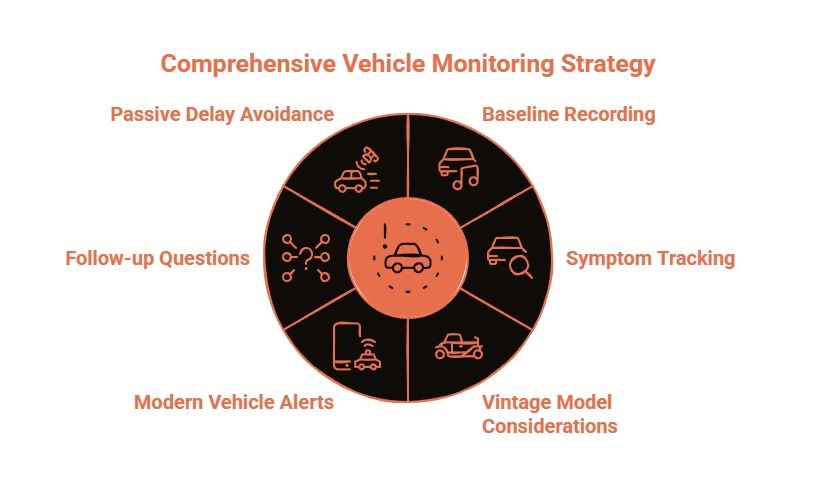
Monitoring begins with a baseline. Record the date, mileage, operating conditions, frequency, intensity, and any related symptoms. Record stable behavior as well as changes.
For vintage models, this means logging the exact conditions when a symptom occurs—such as engine temperature or speed—so you can spot when a minor quirk worsens. For modern vehicles, capture a photo of the dashboard message when it triggers, as digital alerts can reset or clear intermittently without resolving the underlying fault. A temporary disappearance does not prove the issue is resolved.
Ask two direct questions: When should this be checked again, and what change should bring the vehicle back sooner? The answer may depend on time, mileage, recurrence, intensity, or another vehicle-specific condition.
Monitoring becomes passive delay when there is no review date or reassessment trigger. Monitor, Don’t Guess: When a Vehicle Issue Needs Observation Before Action provides a useful companion framework.
Questions to Ask Before Approving or Postponing Work
A decision-ready recommendation should explain more than a part name or an “urgent” label. Ask:
- What did the inspection actually confirm?
- What vehicle function may be affected?
- Is this primarily a possible safety concern, reliability concern, maintenance item, or monitoring item?
- What is the possible consequence if the condition changes or remains unresolved?
- Are any findings potentially related?
- What could change the recommended timing?
- What should be documented if the item is monitored?
- When should it be checked again?
- Does the household’s planned use change the practical recommendation?
Evaluate the explanation by its evidence, consequence, timing, and acknowledged uncertainty—not by certification claims, equipment claims, or price alone. The Repair Recommendation Translator can help structure that conversation.
For separate official information, California drivers can consult the Bureau of Automotive Repair’s maintenance and repairs resource without treating it as a substitute for vehicle-specific advice. When a recall question arises, the National Highway Traffic Safety Administration recall lookup provides the official federal search tool.
Frequently Asked Questions
Can a repair shop rank several recommendations?
Yes. Ask the shop to explain the evidence, affected function, possible consequence, recommended timing, and what would change the priority. A label such as “urgent” is less useful without that reasoning.
Does “monitor” mean the repair can be ignored?
No. Monitoring should identify what to observe, how often to record it, when the condition should be reinspected, and what change warrants earlier assessment.
Can family use change repair priority?
It can change planning and tolerance for reliability risk. A vehicle becoming the daily school, work, or caregiving car may justify earlier inspection or repair planning. The use change does not establish a mechanical diagnosis.
Build One Shared Plan
The first repair to address is not automatically the cheapest, the most expensive, or the first item printed. Organize each finding by evidence, affected function, possible consequence, timing, change, and household impact.
Prepare a short record of each finding, when it occurs, what has changed, and the questions a repair professional should answer. Orange Independent Auto Repair is a family-owned and -operated Orange business that has operated since 1971 and states a commitment to fair, honest, transparent communication. The same structured questions can support a clearer discussion with any qualified repair professional.
Disclaimer: This article is for general informational purposes only and does not constitute compliance, safety, technical, or professional advice. Requirements, risks, and best practices may vary by context, jurisdiction, system, provider, or use case. Confirm important decisions with the appropriate qualified professional, authority, or technical expert.
Our Editorial Process
Our expert team uses AI tools to help organize and structure our initial drafts. Every piece is then extensively rewritten, fact-checked, and enriched with first-hand insights and experiences by expert humans on our Insights Team to ensure accuracy and clarity.
By Orange Independent Auto Repair Insights Team
The Orange Independent Auto Repair Insights Team develops owner-level, evidence-first guidance shaped by decades of hands-on experience serving classic VW and Porsche owners in Orange and the surrounding communities.