
What Needs Prompt Attention and What Can Be Monitored? An Orange-area Repair-Priority Ladder for Family Cars
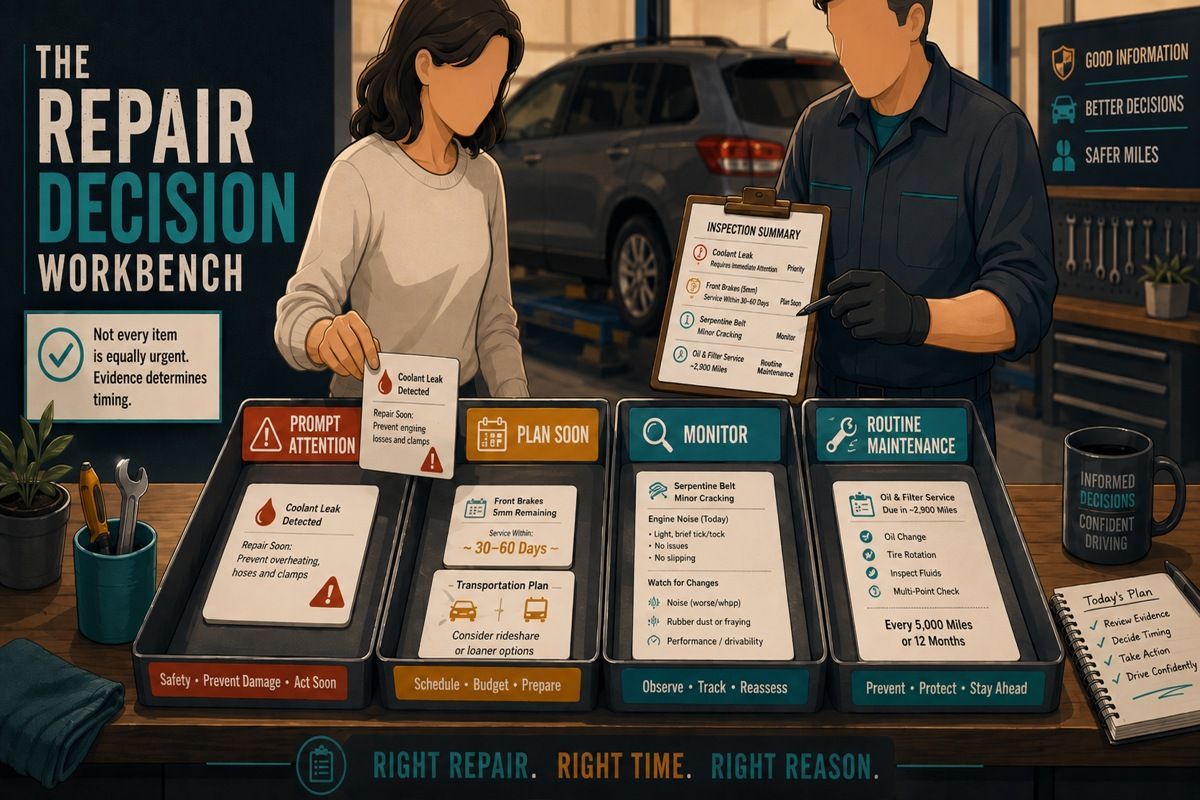
📌 Key Takeaways
The framework recommends ranking repairs by evidence, risk, and timing instead of treating every estimate item as equally urgent.
- Demand Clear Evidence: Providers should explain what they found, which system is affected, and why the proposed timing fits.
- Separate Types of Risk: Safety, reliability, and maintenance concerns require different responses, even when they appear on one estimate.
- Make Monitoring Active: A monitoring plan needs a baseline, warning signs, recheck point, and clear trigger for contacting the provider.
- Reassess Changing Symptoms: New or worsening symptoms may raise the priority, but they do not prove a specific failure.
- Plan Around Vehicle Use: Trips and family duties can justify earlier action because they reduce the household’s room for breakdowns.
Evidence sets the priority; changing conditions reset it.
Orange-area families managing one main car will make clearer repair choices using the practical priority guidance that follows.
~ ~ ~ ~ ~ ~ ~ ~ ~ ~ ~ ~ ~ ~ ~ ~ ~ ~
A family car can return from an inspection with a worn item, a leak, overdue maintenance, and a symptom needing more evaluation. For an Orange-area household coordinating work, school, caregiving, or a longer trip, the list can feel like one large emergency.
It is not. The useful question is not, “How many items are on the estimate?” It is, “What evidence supports the timing of each item?”
The framework below helps organize that conversation. It cannot determine whether a particular vehicle should be driven, because that decision depends on the specific vehicle, its condition, observed evidence, symptom pattern, and intended use.
Use A Four-Level Repair-Priority Ladder
Repair providers may use words such as “urgent,” “recommended,” or “can wait” differently. Ask what each label means in practical terms rather than assuming the labels are standardized.
| Priority level | What the provider should explain | What the owner should do | What changes the priority |
|---|---|---|---|
| Prompt attention | The observed evidence, affected system, possible consequence, and immediate next step | Obtain vehicle-specific direction and arrange the recommended assessment or repair | Worsening behavior, an additional symptom, or a change in intended use |
| Plan soon | Why delay may increase breakdown risk, wear, or inconvenience | Agree on a timeframe and prepare a transportation plan | Increasing frequency, reduced performance, or a new related symptom |
| Monitor under defined conditions | The baseline condition, what to observe, the recheck trigger, and the planned review | Record changes and follow the recheck plan | A stronger odor, louder noise, changing leak, altered drivability, gauge change, or modern warning change |
| Routine maintenance | What makes the service due and which approved interval applies | Schedule it with other planned service when appropriate | Time, mileage, vehicle use, or a new inspection finding |
This ladder organizes decisions; it does not rank components universally. Cost and technical priority answer different questions. A monitored condition may need reassessment when its pattern changes.
The Fix Now, Can Wait, or Monitor repair-priority guide offers a related plain-language framework.
Start By Separating Safety, Reliability, And Maintenance
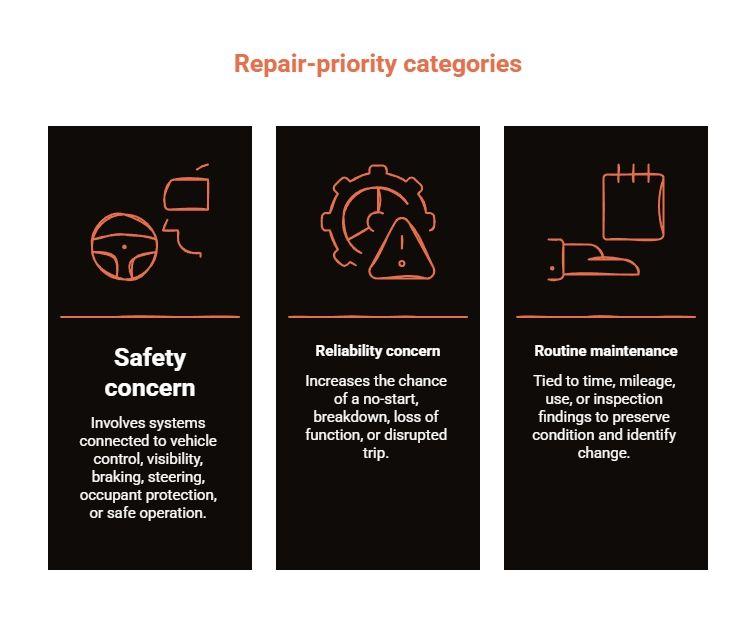
A safety concern may involve a system connected to vehicle control, visibility, braking, steering, occupant protection, or another aspect of safe operation. The label should be supported by vehicle-specific evidence. A component name alone does not establish the level of concern.
A reliability concern may increase the chance of a no-start, breakdown, loss of function, or disrupted trip. That distinction matters to households that depend on one primary vehicle, even when the finding is not being described as a current safety concern.
Routine maintenance is generally tied to time, mileage, use, or an inspection finding. Its role is to preserve condition and create opportunities to identify change. Routine does not mean optional forever.
One finding may cross categories. For example, an intermittent starting concern may be mainly reliability-related under current use, yet deserve earlier planning before a longer trip. The diagnosis has not necessarily changed; the household’s tolerance for interruption has.
A provider should explain that relationship rather than merely assign a label. Information about vehicle inspections and repair services can clarify the type of evaluation involved, but priority still depends on the findings.
Ask For The Evidence Behind The Timing
A repair recommendation becomes useful when the reasoning is understandable. “Recommended” should be followed by a reason, and a part name is not the same as evidence.
Ask:
- What did you observe or measure?
- Which system is affected?
- Is the main concern safety, reliability, maintenance, or a combination?
- What may happen if the condition changes or the work is delayed?
- What makes the proposed timing appropriate?
- Is this the primary concern, or is it secondary to another finding?
- What would move the priority up or down?
- What uncertainty remains?
Support may include an observed condition, measurement, inspection finding, written estimate, or verbal explanation. The goal is to understand the evidence, consequence, timing, and uncertainty.
If one item sounds overstated, evaluate it separately rather than rejecting the entire list. The Repair Recommendation Translator provides additional questions for that discussion.
For California-specific information about estimates, authorization, and changes to repair work, consult the California Bureau of Automotive Repair’s Maintenance and Repairs guidance. That official resource explains the state’s current consumer process.
“Monitor” Should Be A Plan, Not A Shrug
Monitoring is an active decision based on a known starting point. It should not mean forgetting the issue or assuming an intermittent symptom has disappeared.
A useful monitoring plan identifies:
- The current baseline
- What the owner should observe
- The conditions under which observations should be recorded
- The change that requires contacting the provider
- The recheck point established after inspection
- Whether a change in vehicle use requires reassessment
Record the date, conditions, frequency, and change from the prior pattern. Specific notes are more useful than “car sounds bad.”
On a classic VW or Porsche, relevant observations may include a changed odor, a new or louder sound, a different vibration, a changing leak pattern, altered drivability, or unusual analog gauge behavior where applicable. Those signs help guide inspection; they do not confirm a failed component.
On a modern OBD-era vehicle—one equipped with onboard diagnostic systems—a warning indication or stored fault may add evidence. It still needs to be interpreted with drivability, physical symptoms, and inspection findings. A warning or code is not automatically a confirmed diagnosis.
There is no universal recheck interval for every monitored condition. The appropriate point may vary by system, severity, vehicle design, use, and the evidence found during inspection. For example, a slight oil seep around a valve cover might warrant checking the level every 500 miles and reinspecting in six months, whereas a rapid coolant leak cannot be safely monitored and requires prompt attention.
Compounding Symptoms Can Raise The Priority
A single observation may be less informative than a pattern. When a second symptom appears, or a long-standing condition changes, the earlier priority may no longer fit.
Consider a hypothetical classic vehicle with a previously stable seep. If the amount or location changes and a new odor appears, continuing the old monitoring plan without reassessment may no longer be appropriate. The combination does not prove a particular failure, but it adds evidence.
The same reasoning applies to a modern vehicle. A warning indication combined with shaking or reduced performance provides more context than the warning alone.
Ask which finding is primary and which is secondary. One issue may be the direct concern, while another increases the consequence, complicates the diagnosis, or reduces the household’s tolerance for delay. Use language such as “may justify prompt reassessment,” not “proves failure.”
Vehicle Use And Family Logistics Can Change The Decision
The vehicle’s physical condition and the household’s inconvenience are not the same thing. A work schedule, school run, or caregiving obligation does not change a mechanical condition by itself. It can, however, change how much reliability risk the household can reasonably absorb.
An intermittent starting concern may be planned differently when another vehicle is available than when the same car will soon be needed for repeated caregiving travel or a longer trip. That does not automatically convert a reliability issue into a safety issue. It may justify earlier reassessment or repair planning.
Prepare alternate transportation before the vehicle becomes unavailable. Identify the commitments that are hardest to rearrange and whether another vehicle is available.
Before materially changing the vehicle’s use, ask whether the prior timing still applies. A better question than “Can this wait?” is: “Does the current evidence and intended use still support the original priority?”
Classic And Modern Vehicles Provide Different Evidence
The priority framework works across vehicle eras, but the evidence may look different.
For a classic VW or Porsche, diagnostics hinge on physical shifts—such as fresh fuel odors, unfamiliar engine knocks, sudden fluid drips, or a change in analog gauge readings. While vintage vehicles have familiar quirks, a newly worsening symptom should never be brushed off with “old cars do that.” In contrast, modern OBD-era vehicles provide a digital starting point through stored fault codes and warning lights. However, these electronic alerts only inform the bigger picture; hands-on physical inspections remain critical to the final diagnosis.
Model-specific warnings, gauges, and operating instructions should be checked against the correct owner’s manual or official manufacturer guidance. The vehicle year and configuration matter; guidance for another generation may not apply.
Turn The Repair List Into A Written Next-Step Plan
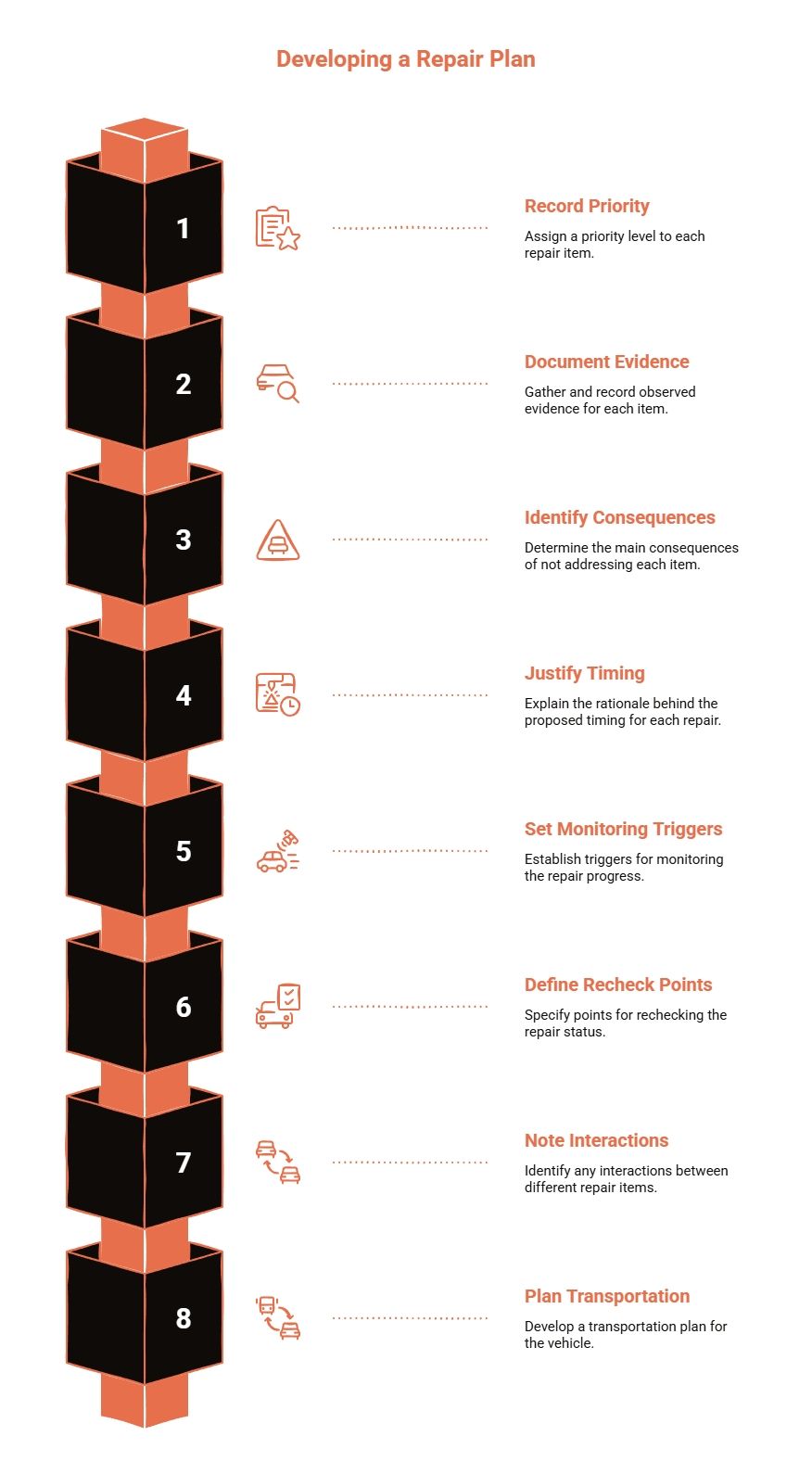
For each item, record the priority level, observed evidence, main consequence, timing rationale, monitoring trigger, recheck point, interaction with another finding, and transportation plan.
The plan can be brief. Its value is that it makes the reasoning visible and separates technical priority from budget decisions.
When symptoms change, new evidence appears, or vehicle use changes, revisit the plan. Priorities should respond to current evidence rather than remain fixed because a label was assigned during an earlier visit.
For recall status, use the National Highway Traffic Safety Administration’s recall lookup. The tool allows owners to search for open recalls (though it generally does not show safety recalls older than 15 years), but a recall search does not replace a vehicle-specific inspection.
Frequently Asked Questions
Can a vehicle problem be monitored instead of repaired immediately?
Sometimes, but only when the provider has defined the current condition, what should be observed, what change requires reassessment, and when the item should be rechecked. Monitoring is not the same as ignoring the problem.
Does the most expensive repair need to be done first?
Not necessarily. Repair cost and repair priority measure different things. Ask whether the concern mainly involves safe operation, reliability, maintenance, or another consequence, then ask what evidence supports the timing.
What should a repair shop explain when it says an item can wait?
The provider should explain what was observed, why delay is considered reasonable, what could change, what the owner should monitor, and when the item should be reinspected. “Can wait” should describe a defined plan, not vague reassurance.
Does an upcoming trip or heavier vehicle use change repair priority?
It can change the household’s tolerance for reliability risk and may justify earlier reassessment. It does not automatically change the vehicle’s physical condition or turn a non-safety issue into a safety issue. Ask for vehicle-specific guidance before the change in use.
Clarity Is The Goal, Not An All-At-Once Answer
A responsible repair plan does not require approving everything or rejecting everything. It explains what needs prompt attention, what should be planned, what can be monitored under defined conditions, and why each item belongs in that category.
Orange Independent Auto Repair is a family-owned shop in Orange operating since 1971. Its supplied materials emphasize fair, honest, and transparent service, and the business offers vehicle inspections while identifying classic VW and Porsche as specialties.
For a classic VW or Porsche, the owner and provider must pay close attention to physical shifts, such as new fuel odors, unusual engine knocks, fresh fluid drips, hesitations in drivability, and fluctuating analog gauge readings. Familiar quirks should be distinguished from a developing problem. “Old cars do that” is not a sufficient explanation for a symptom that has changed.
Disclaimer: This article is for general informational purposes only and does not constitute compliance, safety, technical, or professional advice. Requirements, risks, and best practices may vary by context, jurisdiction, system, provider, or use case. Confirm important decisions with the appropriate qualified professional, authority, or technical expert.
Our Editorial Process
Our expert team uses AI tools to help organize and structure our initial drafts. Every piece is then extensively rewritten, fact-checked, and enriched with first-hand insights and experiences by expert humans on our Insights Team to ensure accuracy and clarity.
By Orange Independent Auto Repair Insights Team
The Orange Independent Auto Repair Insights Team develops owner-level, evidence-first guidance shaped by decades of hands-on experience serving classic VW and Porsche owners in Orange and the surrounding communities.