
Fuel Smells, Oil Drips, and Burning Odors in Classic VW and Porsche Vehicles: What to Do Before Driving in the Orange Area
📌 Key Takeaways
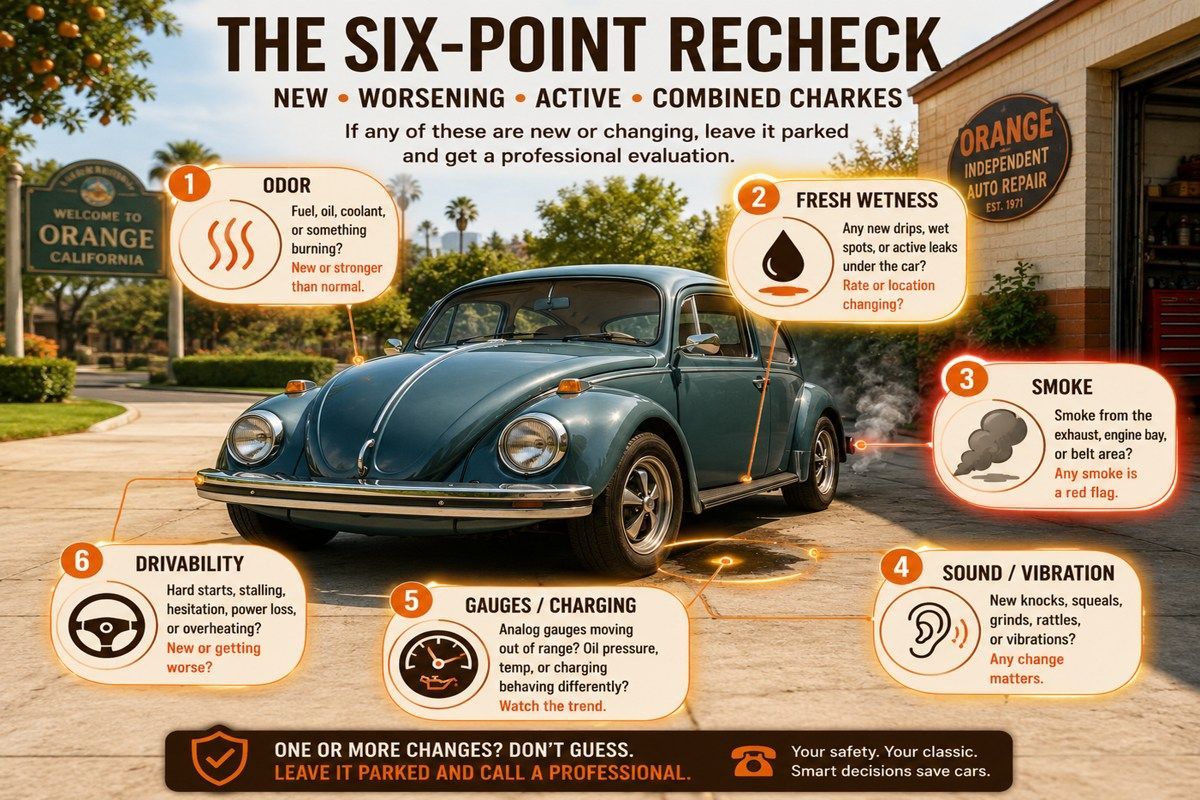
New or worsening smells, leaks, smoke, or driving changes call for professional guidance before moving a classic vehicle.
- Park When Conditions Change: The author recommends parking when symptoms are new, active, worsening, or paired with changes in vehicle operation.
- Treat Fuel Smells Seriously: A new, strong, or lasting fuel smell needs professional inspection because odor alone cannot reveal its source.
- Watch The Full Pattern: Smoke, unusual sounds, gauge movement, weak charging, heat, or poor driving behavior can signal greater risk.
- Record Safe Observations: Note timing, visible wetness, recent service, and operating changes without touching fluids or approaching hot parts.
- Act Quickly Around Fire: For smoke, flames, or burning rubber or plastic, the author recommends following official vehicle-fire guidance immediately.
Changes matter more than spot size or smell alone.
Classic VW and Porsche owners will make safer decisions by using the symptom checks and professional evaluation guidance that follows.
~ ~ ~ ~ ~ ~ ~ ~ ~ ~ ~ ~ ~ ~ ~ ~ ~ ~
A new fuel smell, fresh oil spot, smoke, or burning odor around a classic VW or Porsche deserves attention before the vehicle is moved. Do not rely exclusively on warning lights. Begin with whether the condition is new, active, worsening, or accompanied by changes in sound, gauges, charging behavior, heat, or drivability.
The goal is not to identify a failed part from the driveway. While fuel odors often stem from degraded rubber hoses or tank vents, and burning smells frequently indicate electrical faults or fluid hitting a hot exhaust, diagnosing the exact source requires professional tools. It is to decide whether the vehicle should remain parked, what details matter, and what to report when arranging professional evaluation.
Before You Start the Engine: The Symptoms That Change the Decision
Movement or towing decisions can vary with the model, configuration, surroundings, and circumstances, so uncertain cases need direct guidance from a qualified repair provider.
| What you notice | What it changes | What to record | Cautious next step |
|---|---|---|---|
| New, strong, or persistent fuel-like odor | Do not deliberately reproduce a suspected fuel condition by starting the engine | When it began, whether the vehicle had been sitting, and visible wetness from a safe position | Leave the vehicle parked and obtain professional guidance before operating it |
| Visible fresh liquid or active dripping | Active leakage matters more than an old stain, even when the fluid is unknown | Where it appears, whether dripping continues, and how the pattern changed | Arrange evaluation before moving the vehicle |
| Smoke, flames, or burning rubber or plastic odor | This may indicate an active fire or heat-related hazard | Whether occupants are clear and emergency help has been called | Follow official vehicle-fire guidance immediately |
| New or rapidly changing oil spot | Sudden change matters more than a universal “acceptable” size | How quickly it returned and whether odor or smoke is present | Leave it parked while seeking qualified advice |
| Familiar, unchanged spot with no other changes | An established pattern differs from an accelerating leak but does not prove driving is appropriate | Previous frequency, current appearance, and recent changes | Document it and arrange follow-up |
| Odor or leakage with stalling, hesitation, noise, heat, gauge movement, or weak charging | Multiple symptoms make remote reassurance less appropriate | The exact combination and when it occurred | Stop using the vehicle and request evaluation |
The National Fire Protection Association advises immediate action when smoke or flames are visible or when burning rubber or plastic is smelled. If a vehicle catches fire, the U.S. Fire Administration says to stop safely, turn off the engine, get everyone out, move at least 100 feet away, call 911, and avoid opening the hood or trunk when fire is suspected. Those instructions address a possible fire; they do not diagnose an odor or leak.
Fuel Odor, Oil Odor, or Something Burning: What the Difference Can and Cannot Tell You
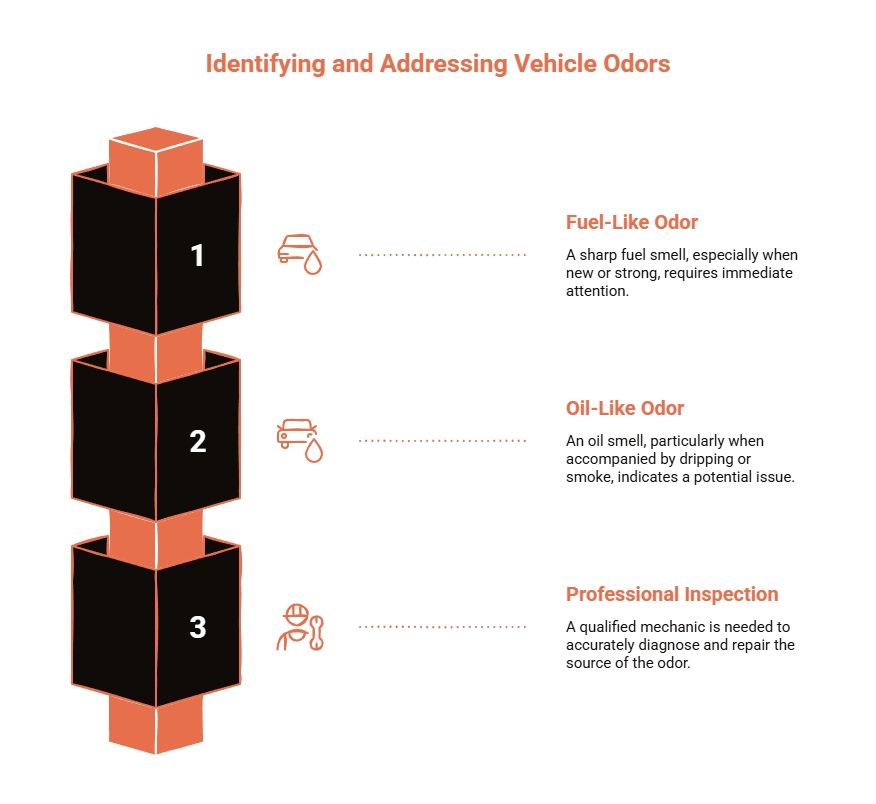
A smell can narrow what you report, but it cannot confirm the failed part. Age, heat, airflow, contamination, and vehicle configuration can affect how an odor presents.
Fuel-Like Odor
A sharp fuel-like odor is a high-priority observation when it is new, strong, persistent, or paired with visible wetness. Record whether it appeared before starting, while running, after shutdown, inside the cabin, or outside the vehicle.
Do not start the engine solely to see whether the odor returns. Do not lean close to trace the smell to a hose, pump, carburetor, injector, or fitting. A professional inspection is needed to identify the source.
For example, if a parked classic VW develops a strong new fuel-like odor before ignition, leave it off, note where the odor was first noticed from a normal standing position, and contact a qualified provider.
For additional context, see fuel and oil odors in classic vehicles.
Oil-Like Odor
An oil-like smell may become more noticeable as fluid or old residue is heated, but that does not establish whether the source is fresh, long-standing, minor, or serious.
Fresh dripping, new smoke, a growing spot, or a change in operation carries more weight than the label “oil smell.” A familiar odor that suddenly becomes stronger also deserves attention, even when the vehicle still seems to run normally.
Burning Rubber, Plastic, or Electrical-Type Odor
A new burning odor is an escalation signal, not a diagnosis. Note whether it occurred with smoke, dimming lights, slow cranking, weak charging behavior, belt squeal, stalling, or another operating change.
After-shutdown timing does not make the condition harmless. If visible haze follows a burning odor, do not approach hot components to search for a source. When smoke or flames suggest a possible fire, follow the U.S. Fire Administration’s vehicle-fire guidance and the NFPA car-fire safety guidance.
A sweet smell does not guarantee a coolant leak. Cooling-system configurations vary by model and year, and coolant-related assumptions only apply to vehicles equipped with liquid-cooling systems.
A Familiar Seep Is Not the Same as a Sudden Leak
An established seep is a previously observed pattern that has remained relatively consistent. An active leak involves fresh wetness or continuing fluid loss. These descriptions organize observations; neither one independently determines whether the vehicle should be driven.
What changed is often more useful than the absolute size of the spot. A mark that has appeared in the same place for months differs from one that returns sooner, grows, begins dripping, creates a stronger odor, or appears with smoke. Old stains can also make current leakage difficult to judge.
Suppose a classic Porsche has left a familiar mark after storage. If the next spot appears faster or is joined by a burning odor, the change is the important fact.
Spot size should never become a coin-based safety rule. A small mark does not identify the fluid, source, rate, or conditions under which it appeared. An established seep still deserves maintenance attention; “established” does not mean permanently harmless.
VW owners can read more about oil spots under a classic VW.
Look Beyond the Spot: Smoke, Sound, Gauges, and Drivability
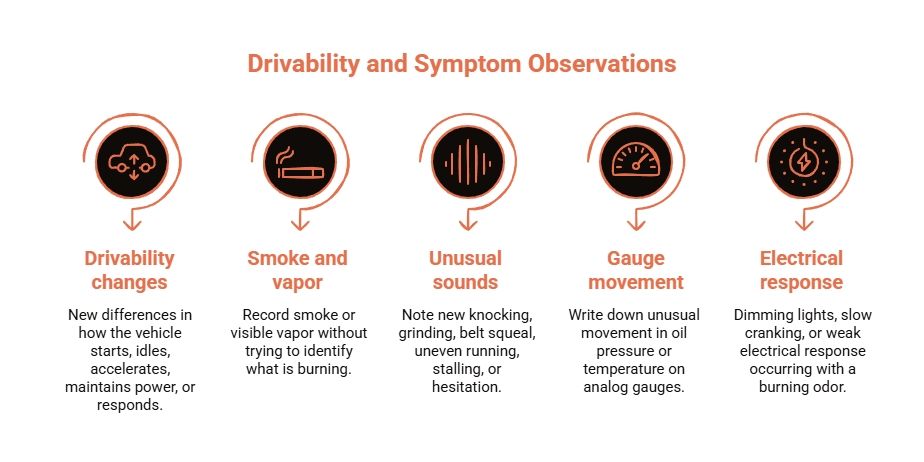
A drivability change is a new difference in how the vehicle starts, idles, accelerates, maintains power, or responds. Odor or leakage paired with altered operation deserves more caution than an isolated, unchanged observation.
Record smoke or visible vapor without trying to identify what is burning. Note new knocking, grinding, belt squeal, uneven running, stalling, or hesitation. Where analog gauges are fitted, write down unusual movement in oil pressure or temperature rather than applying a number taken from another model.
Dimming lights, slow cranking, or weak electrical response may matter when they occur with a burning odor. For example, a generator or alternator light that stays illuminated or flickers at higher RPMs often indicates a failing electrical component that is overheating. They do not prove a particular failure; they help a repair provider understand the pattern.
Combinations matter. A small spot with no detectable change is not the same pattern as a spot with smoke, gauge movement, hesitation, or unusual heat. Normal-feeling operation also does not identify the source of a fuel odor or prove that a new leak is harmless.
When a symptom comes and goes, record what happened during the last normal use and whether the change repeated. Do not create a second occurrence by starting or driving the vehicle solely for testing.
What to Record Before Contacting a Repair Provider
Good notes can turn “something smells wrong” into a focused professional evaluation. Limit observations to what can be gathered from a safe standing position.
- When the odor, spot, smoke, or behavior change first appeared.
- Whether the vehicle had been sitting, running, or recently shut down.
- Where the odor was noticed without leaning over hot or leaking areas.
- Whether fresh wetness, active dripping, smoke, or only an old stain was visible.
- Whether sound, idle, acceleration, temperature, gauges, lights, starting, or charging behavior changed.
- Whether recent service, fueling, storage, or a long period of non-use preceded the symptom. Treat this as context, not proof of a cause.
Photos may help only when they can be taken without approaching a hot, smoking, actively leaking, roadside, or otherwise unsafe vehicle.
Do not start the engine solely to reproduce a suspected fuel condition. Do not touch unknown fluid or hot parts, open a hot or pressurized system, crawl beneath an unsupported vehicle, or tighten, disconnect, adjust, or replace components based on general online guidance.
Arranging Evaluation in the Orange Area
Contact a repair provider before deciding how to move a classic vehicle with an unresolved fuel odor, active leak, smoke, burning odor, or changing operation. Describe the model, year, recent history, timing, visible conditions, and any change in gauges or drivability. Those details support evaluation, but they do not establish the repair or allow a precise quote from the smell alone.
Orange Independent Auto Repair is a family-owned and -operated business in Orange, California, that has operated since 1971. It works with classic VWs and classic Porsches and lists classic car maintenance and vehicle inspections among its services. The shop proudly serves the surrounding communities, including Tustin, Anaheim, Yorba Linda, and Villa Park.
Frequently Asked Questions
Is Any Fuel Smell Normal in a Classic VW or Porsche?
A new, strong, or persistent fuel-like odor should not be dismissed as ordinary classic-car character. The odor cannot identify the source remotely. Leave the vehicle parked and seek qualified guidance before deciding whether to operate or move it.
Can I Drive if the Oil Spot Is Only a Few Drops?
Size alone is not enough. Consider whether the spot is new, recurring faster, actively dripping, smoking, or paired with a burning odor, unusual sound, gauge movement, heat, or altered drivability. No universal coin-size or drip-count rule can establish that driving is appropriate.
What if the Odor Appears Only After the Engine Is Shut Off?
Record when it begins, how long it lasts, whether smoke or fresh wetness appears, and whether anything changed during the preceding drive. After-shutdown timing is useful information, but it does not identify the cause or make the symptom automatically harmless.
Does a Sweet Smell Always Mean Coolant?
No. Cooling-system designs vary across classic VW and Porsche models and years. Coolant-related guidance applies only where a liquid-cooling system is present, and the source requires model-appropriate inspection.
Make the Decision From the Full Pattern
A smell or oil spot becomes more meaningful when considered with change, active leakage, smoke, sound, gauges, charging behavior, heat, and drivability. When the condition is new, worsening, active, or difficult to classify, the conservative next step is to leave the vehicle parked while arranging qualified evaluation.
Contact Orange Independent Auto Repair to arrange an evaluation, and describe what was observed before deciding how the vehicle should be moved.
Disclaimer: This article is for general informational purposes only and does not constitute compliance, safety, technical, or professional advice. Requirements, risks, and best practices may vary by context, jurisdiction, system, provider, or use case. Confirm important decisions with the appropriate qualified professional, authority, or technical expert.
Our Editorial Process
Our expert team uses AI tools to help organize and structure our initial drafts. Every piece is then extensively rewritten, fact-checked, and enriched with first-hand insights and experiences by expert humans on our Insights Team to ensure accuracy and clarity.
By Orange Independent Auto Repair Insights Team
The Orange Independent Auto Repair Insights Team develops owner-level, evidence-first guidance shaped by decades of hands-on experience serving classic VW and Porsche owners in Orange and the surrounding communities.