Monitor, Don’t Guess: When a Vehicle Issue Needs Observation Before Action
📌 Key Takeaways
Monitoring a vehicle issue means tracking clear changes, not hoping it disappears.
- Watch The Pattern: A symptom matters more when it repeats, grows stronger, or appears in new situations.
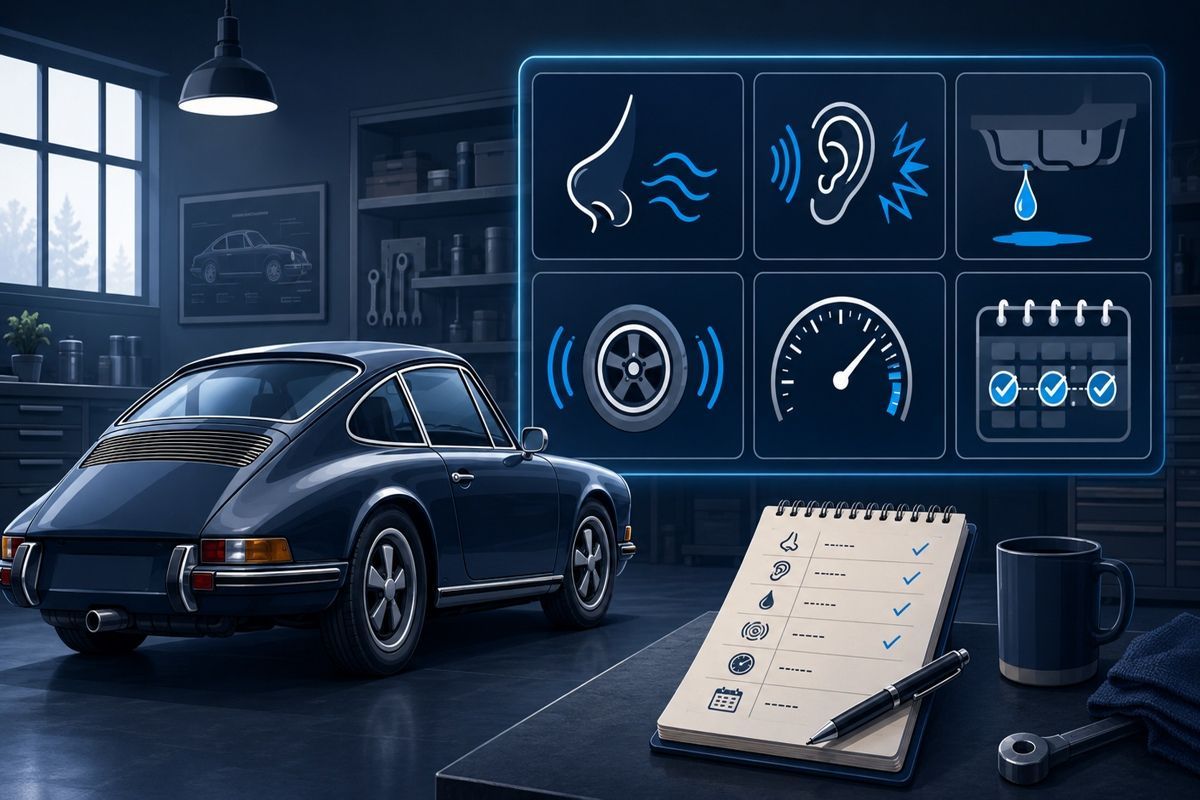
- Track Real Clues: Smells, noises, leaks, vibration, gauges, and drivability changes give the shop better facts.
- Know The Line: Strong fuel smells, smoke, grinding, active leaks, or braking changes need faster attention.
- Ask Clear Questions: A good shop should explain what to watch, what matters, and when to call back.
- Use Notes Well: Simple details about timing, temperature, and driving conditions can make inspections more useful.
Clear notes turn vague car trouble into a smarter repair conversation.
Classic VW and Porsche owners will gain a calmer way to handle new symptoms, preparing them for the detailed overview that follows.
~ ~ ~ ~ ~ ~ ~ ~ ~ ~ ~ ~ ~ ~ ~ ~ ~ ~
A vague answer feels risky.
The same faint rattle shows up again as you ease out of the driveway. The engine is warm, the windows are cracked open, and you pause with your hand still on the shifter. Was that there yesterday?
When a shop says to “monitor it,” you should not leave feeling brushed off. You should know what to watch, what change matters, and when to call back.
That is especially true with classic VW and Porsche vehicles. Older cars often speak through sound, smell, leaks, vibration, and gauges before they give a clean, modern warning. A small change can be harmless character, early wear, or a sign that the issue deserves a closer look.
Monitoring is not guessing. It is organized observation.
For vintage and modern owners throughout the region, the primary objective is to determine if an emerging symptom remains baseline or requires immediate intervention. That helps you avoid two bad outcomes at once. You do not want to approve work you do not understand. You also do not want to delay something that could affect safety or reliability.
What “Monitor It” Should Mean
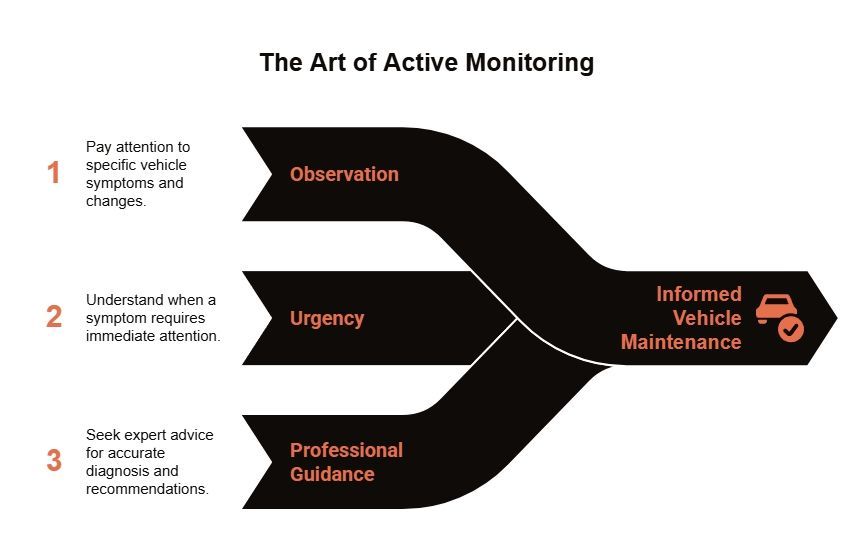
A useful monitor recommendation should never sound like “just keep driving and see what happens.”
It should sound more like this: “Here is what we noticed. Here is what you should watch. Here is what would make it more urgent.”
That difference matters. Monitoring is active. Ignoring is passive.
For a classic VW and Porsche owner, monitoring may mean paying attention to a new fuel smell after parking, a belt squeal on start-up, a drip that appears in a new place, a vibration that gets stronger under load, or an oil pressure or temperature gauge that behaves differently than usual.
You are not trying to diagnose the car yourself. You are trying to describe the pattern clearly enough that a professional can make a better recommendation.
A good monitor recommendation should include three things:
- what to observe;
- what change would matter;
- when to call back or schedule a vehicle inspection.
Without those details, “monitor it” can feel dismissive. With those details, it becomes a practical plan.
Orange Independent Auto Repair has served Orange, CA as a family-owned shop since 1971, with a stated focus on fairness, honesty, and helping customers understand their vehicles. That kind of plain explanation is important when the right answer is not simply “repair it now” or “forget about it.” Learn more about the shop’s approach on the Orange Independent Auto Repair About page.
Classic vs. Modern: Why the Vehicle Era Matters
Classic and modern vehicles do not always ask for attention in the same way.
On classic VW and Porsche vehicles, the first clues are often physical. You may smell fuel or oil. You may hear a knock, grinding sound, belt squeal, or uneven idle. You may notice a fresh drip, a stronger vibration, weaker acceleration, stalling, hard starting, or overheating behavior. Gauges and charging behavior can also matter where applicable.
Modern OBD-era vehicles can add another layer. A dashboard warning light may help point the conversation in a direction, but it still needs context. A warning light on a modern vehicle should be described with what the car is doing: how it starts, drives, smells, shifts, brakes, and feels.
That distinction keeps the advice honest.
Classic triage should not be built around warning lights. Many classics do not communicate that way. Modern diagnostics may use electronic information where appropriate, but even then, owner observations still matter.
The Vehicle Issue Watch-List Card
Use this tracking framework to document your vehicle's performance baselines, whether you are preparing for an initial inspection or following a technician's guidance to track an intermittent condition.
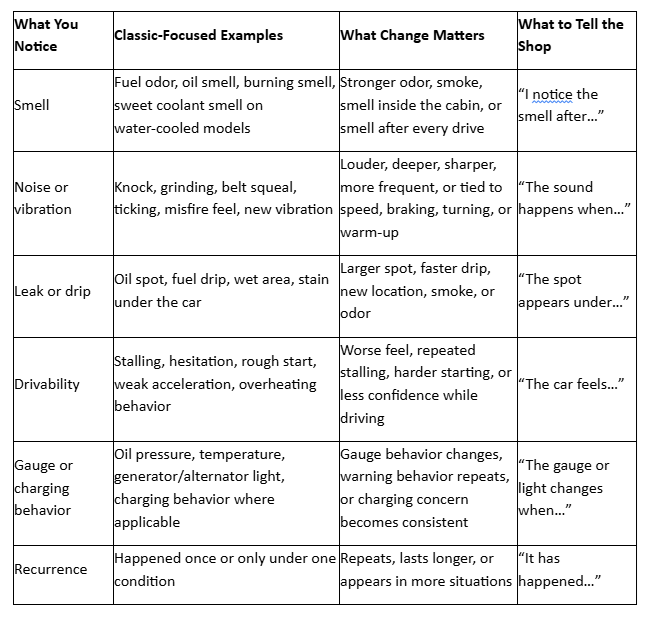
The most useful detail is often not the first symptom. It is the change.
A faint smell once after parking may not tell the whole story. A stronger fuel smell after every drive is different. A small oil spot that stays the same is one thing. A larger drip with smoke or odor deserves faster attention.
The pattern is the point.
When Monitoring Is Reasonable
Monitoring can be reasonable when a symptom is mild, intermittent, stable, and not affecting safety or drivability.
A faint squeak that appears once and disappears may be worth noting. A small spot under the car that does not grow may deserve observation. A brief hesitation that does not repeat may need context before anyone recommends parts.
That kind of restraint can protect your budget.
It also builds trust. A responsible shop should be able to explain why something can wait. Not every observation needs to become a repair order.
This is where owner-level notes help. Write down when the symptom happened, whether the vehicle was cold or warm, whether you were turning or braking, and whether the condition repeated. A clear note can save time later because the shop is not starting from a blank page.
For classic vehicle owners, this is especially useful. Older systems can have normal mechanical character, but character should not be used as an excuse to ignore change. A noise that has always been there is different from a noise that appeared 6 days ago and is now louder.
When Monitoring Is Not Reasonable
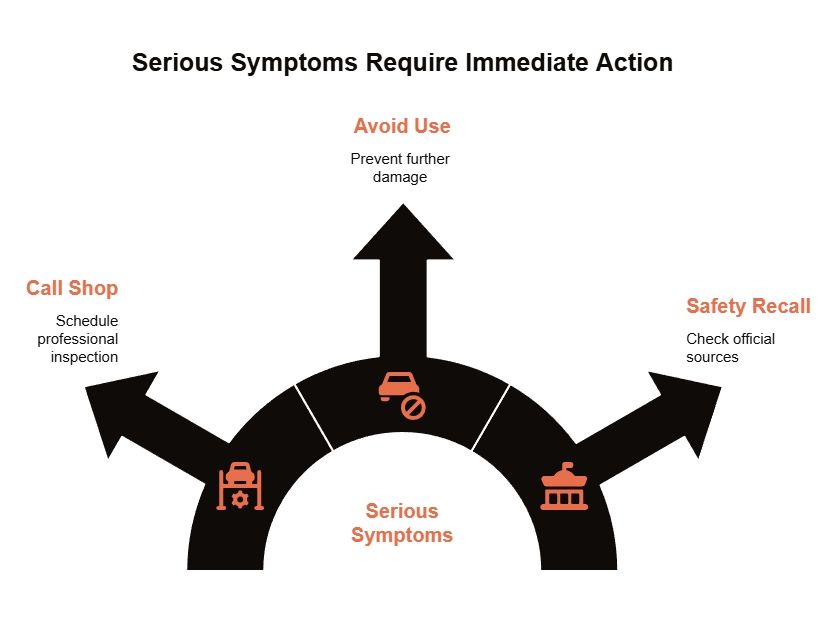
Some symptoms should not be treated as casual watch items.
Call the shop, schedule an inspection, or avoid normal use when a symptom suddenly becomes stronger, repeats often, or affects how the vehicle starts, stops, steers, smells, leaks, charges, cools, or drives.
Pay closer attention to:
- a sudden strong fuel smell;
- active dripping;
- smoke;
- grinding or knocking;
- braking changes;
- steering changes;
- overheating behavior;
- repeated stalling;
- severe vibration;
- a charging concern that repeats.
Do not treat those as “wait and see” issues without guidance.
A professional inspection can confirm what is happening. Orange Independent Auto Repair lists vehicle inspections among its services, and inspections are the better next step when observation is no longer enough.
If a concern may relate to an official safety recall, check a high-authority source such as NHTSA Recalls. Recall questions should not be handled as ordinary watch items.
What About Modern OBD-Era Vehicles?
Modern vehicles can add warning lights, stored codes, and electronic diagnostics to the conversation.
That applies to OBD-era cars. It should not be generalized to classic VW and Porsche vehicles that rely more heavily on mechanical symptoms, analog indicators, and owner observation.
For a modern vehicle, a warning light is one piece of information. It becomes more useful when paired with what you notice: rough running, power loss, fuel smell, overheating behavior, braking changes, or unusual noises.
Modern diagnostics where appropriate can help narrow the concern. Still, the owner’s description matters. A scan may show where to begin, but the symptom pattern explains how the problem behaves in real driving.
That is why “monitor it” should always include a next step.
Questions to Ask Before You Leave the Shop
A clear question can prevent a vague recommendation from becoming a stressful one.
When a shop recommends monitoring, ask:
- “What should I watch for?”
- “What would make this more urgent?”
- “Is this related to safety, reliability, comfort, or maintenance timing?”
- “Should I write down when it happens?”
- “When should I call you back or schedule a vehicle inspection?”
- “Is there anything I should avoid doing until it is checked?”
These are owner-level questions. They do not require mechanical training.
They also fit with general consumer guidance. The FTC’s Auto Repair Basics encourages vehicle owners to ask questions and understand repair decisions before authorizing work. In California, the official publication A Consumer's Guide to Automotive Repair in California, issued by the Bureau of Automotive Repair (BAR), outlines your explicit legal rights regarding mandatory written estimates and repair authorizations.
Those resources reinforce a simple principle: clear communication protects the owner.
How Priority Language Reduces Pressure
A helpful shop conversation should sort concerns by priority.
The clearest categories are simple:
- fix now;
- can wait;
- monitor;
- not needed yet.
Those categories reduce pressure because they do not treat every finding as equally urgent. They also help the owner understand why a recommendation is being made.
This matters with classic VW and Porsche vehicles because age alone does not tell the whole story. Some issues are normal wear. Some are early warning signs. Some are safety concerns. The owner should not have to guess which category applies.
Orange Independent Auto Repair presents its service model around honest communication and practical care for classic and modern vehicles. Its official service pages include Classic Car Maintenance, Porsche Services, and broader auto repair services in Orange, CA.
The best version of “monitor it” is not a delay tactic. It is a clear priority recommendation.
Frequently Asked Questions
Is monitoring a vehicle issue the same as ignoring it?
No. Ignoring has no plan. Monitoring means watching a specific symptom, knowing what change matters, and understanding when to call the shop.
What should classic VW and Porsche owners monitor first?
Start with owner-level observations: smells, noises, vibrations, leaks, drivability, overheating behavior, charging behavior, and gauge changes where applicable. Do not try to diagnose the part. Describe the pattern.
Should warning lights guide classic vehicle triage?
Not usually. Many classic vehicles do not communicate through warning lights the way modern OBD-era vehicles do. For classics, physical symptoms usually matter more: smell, sound, leaks, drivability, and gauges.
When should monitoring turn into an inspection?
Schedule an inspection when the symptom gets stronger, repeats more often, affects driving, creates a stronger smell, produces active leaking, changes gauge behavior, or makes the vehicle feel less safe or reliable.
Turn the Symptom Into a Clear Conversation
The rattle at the end of the driveway does not have to become a guessing game.
Write down when it happens. Notice whether it changes. Pay attention to smell, noise, leaks, drivability, gauges, and recurrence. Then use that pattern to ask a clearer question.
If the symptom stays stable, you have a watch list. If the symptom changes, the priority changes.
For local drivers in Orange, Tustin, Anaheim, Yorba Linda, and Villa Park, Orange Independent Auto Repair provides owner-level service conversations without turning every concern into a pressure-filled repair decision.
When observation is no longer enough, bring your notes and ask for a clear next step.
Schedule Your Diagnostic Inspection or Consultation Today.
Clear symptom. Clear priority. No guessing.
Our Editorial Process
Our expert team uses AI tools to help organize and structure our initial drafts. Every piece is then extensively rewritten, fact-checked, and enriched with first-hand insights and experiences by expert humans on our Insights Team to ensure accuracy and clarity.
By Orange Independent Auto Repair Insights Team
The Orange Independent Auto Repair Insights Team develops owner-level, evidence-first guidance shaped by decades of hands-on experience serving classic VW and Porsche owners in Orange and the surrounding communities.