How Orange County Classic VW Buyers Can Plan a Pre-Purchase Inspection Before Money Changes Hands
📌 Key Takeaways
A classic VW inspection works best before final payment, while the buyer can still act on the findings.
- Inspect Before Paying: Schedule the inspection before final payment so problems can still shape the purchase decision.
- Plan Seller Cooperation: Ask early whether the seller will allow a local shop inspection before the deal feels final.
- Bring Clear Context: Share the listing, repair notes, receipts, and concerns so the shop can focus its review.
- Sort Findings Clearly: Separate urgent needs, later repairs, watch-list items, and major concerns before deciding.
- Know Added Risk: A refused inspection does not prove dishonesty, but it leaves the buyer with more uncertainty.
Inspection first. Payment second. Confidence depends on what you learn before the deal closes.
Orange County classic VW buyers will make calmer purchase choices here, preparing them for the detailed overview that follows.
~ ~ ~ ~ ~ ~ ~ ~ ~ ~ ~ ~ ~ ~ ~ ~ ~ ~
You found the classic VW. Maybe it is a Beetle in Anaheim, a Bus near Orange, or a project Ghia that looks better in photos than expected. The seller is ready, the car has personality, and the pressure to move quickly feels real.
That is exactly when the inspection plan matters most.
A classic VW pre-purchase inspection is most useful before final payment, while the buyer still has room to ask questions, compare the findings against the asking price, and decide whether the vehicle fits the intended use. It does not guarantee a perfect car, and it does not catch every future issue. It can, however, help separate normal old-car needs from concerns that may change the purchase decision.
For buyers near Orange, Tustin, Anaheim, Yorba Linda, and Villa Park, planning early also helps with the practical side: where the car is stored, whether the seller will cooperate, whether the car can be driven to a shop, and what information the buyer should bring prior to the final transaction.
The Best Time to Arrange a Classic VW Pre-Purchase Inspection
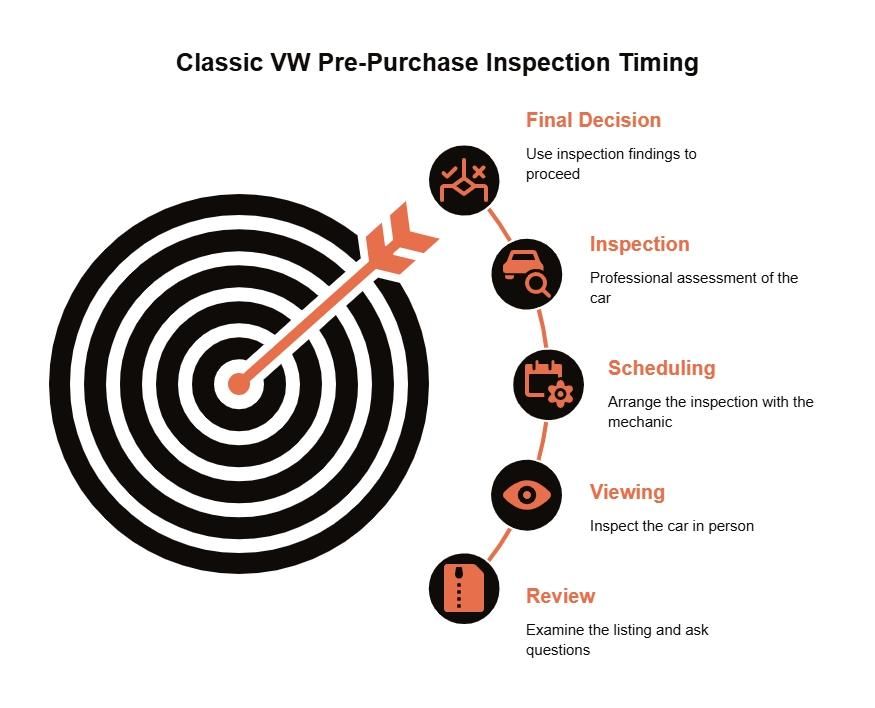
The best time to arrange a pre-purchase inspection is before the deal becomes hard to unwind. In practical terms, that usually means before final payment, before transport is arranged, and before the buyer starts planning registration, storage, or immediate repairs.
A general planning sequence looks like this: review the listing, ask the seller about inspection cooperation, view the car if possible, schedule the inspection, then use the findings to decide what comes next. This is buyer-planning guidance, not legal advice. Payment terms, deposits, title transfer, and seller agreements can vary by situation, so important terms should be clarified prior to finalizing the purchase.
If the seller asks for a deposit before an inspection, keep the conversation simple and specific. Ask what the deposit means, whether it is refundable, and what happens if the inspection uncovers concerns. For official California vehicle registration and title-transfer context, buyers can review the California DMV’s guidance on registering a vehicle purchased from a private party and title transfers. Those resources are useful for transaction context, but they do not replace professional advice for a specific dispute or agreement.
The key point is timing. An inspection after payment may still be useful for repair planning, but it is less useful as a buying-decision tool.
Classic VW Pre-Purchase Inspection Planning Checklist
Use this checklist before calling the shop or asking the seller to coordinate. It keeps the process organized and helps the inspection focus on the actual vehicle, not only the listing description.
Before contacting the seller
- Save the listing link or screenshots.
- Note the model year, asking price, and stated condition.
- Write down whether the car is intended as a weekend cruiser, project, daily-ish driver, or restoration candidate.
- List anything that already looks unclear from the photos.
Before calling the shop
- Confirm where the car is currently located.
- Ask whether the car can be driven or needs transport.
- Gather repair receipts, seller notes, and photos if available.
- Prepare VIN or title details if the seller has shared them.
- Make a short list of concerns from the viewing.
What to ask the seller
- “Would you be open to a local pre-purchase inspection before final payment?”
- “Can the car be driven safely to a shop, or would it need transport?”
- “Do you have receipts or records for recent work?”
- “Will you be present for the appointment, or can you authorize the shop visit?”
What to send or bring
- Listing screenshots.
- Seller’s stated repair history.
- Receipts, invoices, or parts notes.
- Photos of visible rust, leaks, engine bay, underside, or interior concerns.
- Notes about smells, noises, oil drips, fuel smell, drivability, overheating behavior, and gauge behavior.
What to ask after the inspection
- What needs attention before regular driving?
- What can wait?
- What should be monitored?
- Are there structural concerns?
- Does the car match the intended use?
Use a Local Shop-Based Inspection When the Car Is Close Enough
A driveway viewing can help a buyer decide whether the car is worth pursuing. A shop-based inspection can go further because the vehicle can be reviewed in a setting built for vehicle inspections.
For classic VWs, many useful clues are physical and mechanical. Instead of focusing on warning lights, a buyer should pay attention to smell, sound, leaks, drivability, and analog gauges. A fuel smell, repeated oil drips, unusual vibration, rough running, loose steering feel, or questionable brake feel may not tell the buyer exactly what is wrong, but each observation gives the shop useful context.
Orange Independent Auto Repair offers classic car maintenance, works with classic VW and Porsche vehicles, and offers vehicle inspections, including pre-purchase inspections. Those are verified service facts from the provided brief and internal source material. The article should not imply that any inspection guarantees a safe or problem-free purchase.
Logistics matter just as much as mechanical interest. Before booking, confirm whether the seller can bring the vehicle to the shop, whether the buyer needs to meet the seller there, whether the car can be driven, and whether transport is needed. A non-running project car may still be worth inspecting, but the inspection plan will be different from a running Beetle that can be driven locally.
Call ahead before assuming a specific appointment time is available.
What to Ask the Seller Before You Book the Inspection
Seller coordination is often the hardest part of the inspection plan. Many private sellers are not trying to be difficult; they may simply be busy, cautious, or unsure how the process works. A respectful request makes cooperation more likely.
A clear way to ask is:
“Before final payment, I’d like to have a local shop familiar with classic VWs look it over. Would you be open to coordinating a pre-purchase inspection this week?”
This phrasing does three things. It explains the timing, identifies the type of shop, and avoids accusing the seller of hiding problems.
After that, ask practical questions. Can the car be driven safely to a shop? Are the brakes, steering, tires, and lights suitable for local movement? Has the car been sitting? Are there receipts for recent work? Does the seller know of fuel leaks, oil leaks, overheating behavior, or starting issues?
If the seller says the car was “recently serviced” but has no receipts, avoid turning that into a confrontation. Treat it as context. The shop can still inspect visible condition and help the buyer understand whether the seller’s claims match what can be observed.
The earlier this conversation happens, the less awkward it feels. Asking after the seller believes the deal is complete can create unnecessary tension.
What to Bring or Send Before the Appointment
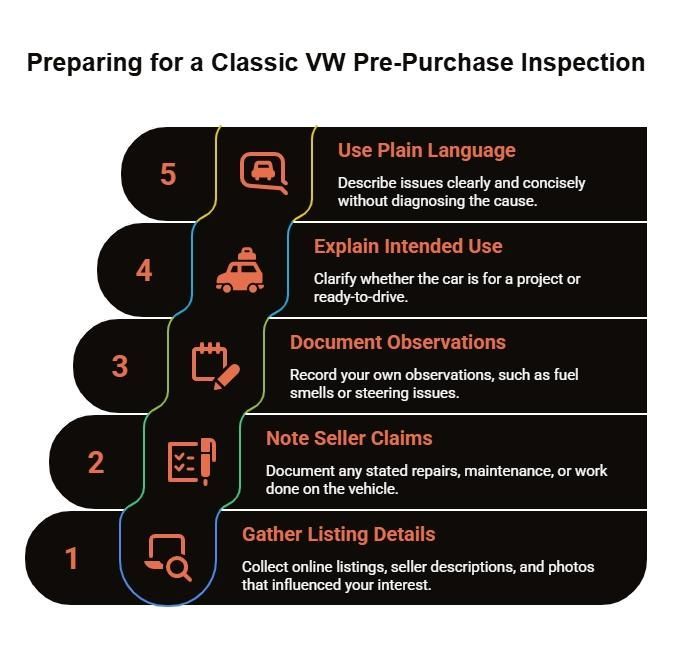
A pre-purchase inspection is more useful when the shop has context. The vehicle matters most, but the listing, seller claims, receipts, and buyer observations can help the shop understand what to look at more carefully.
Bring the listing or screenshots because online listings can change or disappear. Include the seller’s description, stated repairs, and any photos that influenced the buyer’s interest. If the seller mentioned engine work, brake work, rust repair, suspension work, or recent maintenance, bring that note even if no receipt exists.
Also explain the intended use. This is important because a project car and a weekend cruiser are judged differently. A classic VW that makes sense for a patient hobby buyer may not fit someone who wants a ready-to-enjoy vehicle with minimal sorting.
Use plain language. The buyer does not need to diagnose the car. Notes such as “fuel smell after startup,” “oil drip after parking,” “hesitates when accelerating,” “temperature seemed high,” or “steering felt loose” are more helpful than guessing at the cause.
For buyers still preparing for the first viewing, this related internal guide may help: The Air-Cooled Walkaround: A First-Time Buyer’s Pre-Purchase Checklist.
Questions to Ask After the Inspection
The inspection should turn uncertainty into decision support. It should not be treated as a simple pass/fail stamp.
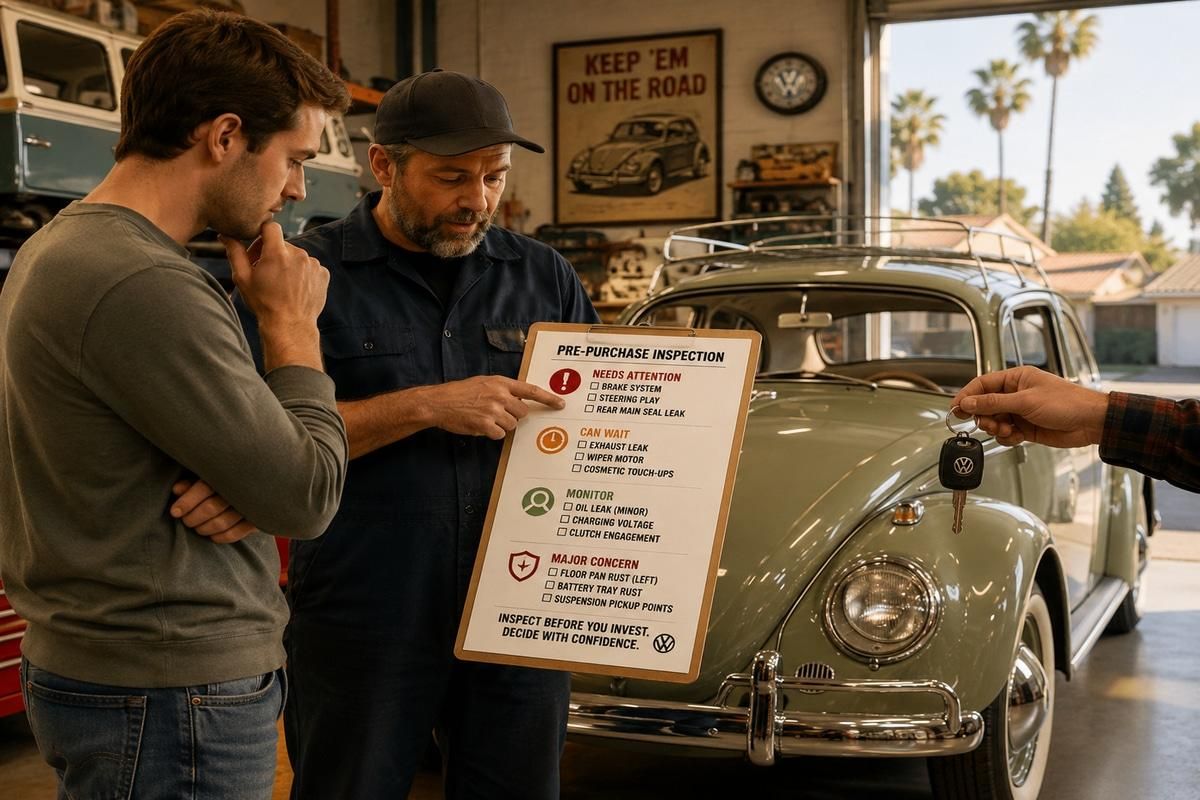
After the inspection, ask the shop to separate findings into practical categories. This helps prevent two common mistakes: ignoring a serious concern because the car is exciting, or walking away from a reasonable car because it has normal old-car needs.
| Finding Type | What It Means for the Buyer | What to Ask Next |
|---|---|---|
| Needs attention before regular driving | The car may require work before it is used confidently. | “What should be addressed before I drive it regularly?” |
| Can wait | The issue belongs in the budget but may not stop the purchase. | “How should this be prioritized after purchase?” |
| Monitor | The issue should be watched over time. | “What change would make this more urgent?” |
| Structural concern | Rust or body integrity may affect the purchase more than cosmetic flaws. | “Does this change how the car should be evaluated?” |
| Fit concern | The car may not match the buyer’s intended use. | “Is this realistic for my use, or is it more of a project?” |
| Beyond inspection scope | A deeper or specialty evaluation may be needed. | “Who should evaluate this next?” |
This framework is a general buyer-planning tool. It does not assign repair prices, predict outcomes, or tell the buyer what to pay. The final decision depends on budget, seller terms, intended use, and risk tolerance.
If rust comes up during the inspection, the related guide on hidden rust zones on classic VWs can help a buyer understand why structural questions deserve attention. If the inspection raises use-and-safety concerns, this article on brakes, steering, and tires on a classic Volkswagen may provide useful follow-up reading. For general national vehicle safety and recall resources, NHTSA’s vehicle safety page is an appropriate high-authority reference.
Local Planning Tips for Orange-Area Classic VW Buyers
Local planning should stay practical. The important question is not how many city names can fit into the article; it is whether the buyer can realistically get the car inspected before payment.
Start by identifying the four locations involved: where the buyer is, where the seller is, where the car is stored, and where the inspection will happen. Sometimes those are close together. Sometimes they are not. The brief supports references to Orange, Tustin, Anaheim, Yorba Linda, and Villa Park, but it does not support claims about travel time, service radius, same-day availability, or local inspection pricing.
If a buyer finds a Beetle in Anaheim and wants it inspected in Orange, the plan may be simple if the seller agrees early. If the car is not roadworthy, the buyer may need to discuss transport or another arrangement. If the seller can only meet on a weekend, appointment details should be confirmed directly with the shop.
For current location, hours, and contact details, use the Orange Independent Auto Repair contact page rather than assuming availability.
When the Seller Says No to an Inspection
A seller refusing an inspection does not automatically prove dishonesty. Some sellers have limited time, dislike extra coordination, or do not want the car moved before payment. Still, refusal changes the buyer’s risk.
A calm follow-up can help:
“I understand the scheduling may be inconvenient. Is there any inspection option you would be comfortable with before final payment?”
If the seller still says no, ask whether they can provide receipts, additional photos, a cold-start video, or time for a longer viewing. These are not equal substitutes for a shop-based inspection, but they may provide more context than the listing alone.
If the seller requires payment first, slow the decision down. A classic VW can be emotional, especially if it is the right color, body style, or project story. But once money changes hands, the buyer may have fewer options if the car needs more work than expected.
The right choice varies by vehicle and buyer. A rare project car, a documented driver, and a non-running vehicle all carry different tradeoffs. The point is to understand those tradeoffs before accepting them.
Classic VW Pre-Purchase Inspection FAQs
Should a buyer get a pre-purchase inspection before paying for a classic VW?
Whenever the seller and logistics allow it, yes. The inspection is most useful before final payment because findings can still inform the purchase decision.
What if the seller will not bring the car to a shop?
Ask whether another arrangement is possible, such as a later appointment, transport, additional documentation, or a shop the seller is comfortable using. If no inspection is possible before payment, the buyer should understand the added uncertainty.
What should a buyer bring to a classic VW pre-purchase inspection?
Bring the listing, seller notes, receipts, photos, VIN or title details if available, and notes about smells, noises, leaks, drivability, or gauge behavior.
Can a pre-purchase inspection tell the buyer whether to buy the car?
It can help the buyer understand condition and risk, but it is not a guarantee and should not be treated as a final command. The decision depends on budget, intended use, seller terms, and risk tolerance.
Can Orange Independent Auto Repair inspect a classic VW before purchase?
Orange Independent Auto Repair offers pre-purchase inspections and classic VW care. Contact the shop to discuss scheduling and logistics before finalizing the purchase.
Make the Inspection Part of the Purchase Plan
A classic VW pre-purchase inspection works best when it is planned early. Ask the seller before final payment, gather the listing and repair history, explain the intended use, and use the findings to sort what needs attention now, what can wait, and what may change the purchase decision.
Orange Independent Auto Repair has been family-owned and -operated since 1971 and works with classic VW and Porsche vehicles. If the classic VW is near Orange, Tustin, Anaheim, Yorba Linda, or Villa Park, contact Orange Independent Auto Repair to ask about scheduling a pre-purchase inspection before finalizing the purchase.
Disclaimer: This article is for general informational purposes only. It is not a substitute for advice from a qualified professional, provider, or official source relevant to your situation. Always verify important decisions with the appropriate expert, authority, or service provider.
Our Editorial Process
Our expert team uses AI tools to help organize and structure our initial drafts. Every piece is then extensively rewritten, fact-checked, and enriched with first-hand insights and experiences by expert humans on our Insights Team to ensure accuracy and clarity.
By Orange Independent Auto Repair Insights Team
The Orange Independent Auto Repair Insights Team develops owner-level, evidence-first guidance shaped by decades of hands-on experience serving classic VW and Porsche owners in Orange and the surrounding communities.