Questions to Ask a Local Shop Before a Classic VW Pre-Purchase Inspection in Orange, Tustin, or Anaheim
📌 Key Takeaways
Ask the shop clear questions before scheduling, because a classic VW inspection should reduce uncertainty before money changes hands.
- Ask Before Booking: Confirm the shop knows classic VWs and can explain older-car concerns in plain language.
- Know The Limits: A pre-purchase inspection can reveal concerns, but it cannot find every hidden problem.
- Bring Better Context: Records, photos, seller notes, and symptom details help the shop ask better questions.
- Plan The Move: Confirm safety, registration, and seller logistics before driving an older VW across town.
- Sort The Findings: Group concerns into safety issues, near-term repairs, watch items, and seller follow-up questions.
Clear questions now can prevent expensive confusion later.
Classic VW buyers near Orange, Tustin, and Anaheim will make calmer inspection choices, preparing them for the detailed overview that follows.
~ ~ ~ ~ ~ ~ ~ ~ ~ ~ ~ ~ ~ ~ ~ ~ ~ ~
A clean-looking classic VW can make a buyer move quickly. Maybe the car is a Beetle, Bus, Ghia, Thing, Vanagon, or another vintage Volkswagen near Orange, Tustin, or Anaheim. The seller may be ready for an answer, but rushing into the purchase without asking the right inspection questions can leave too much uncertainty.
A pre-purchase inspection can help reduce that uncertainty. It does not guarantee a good purchase, reveal every hidden issue, or predict future reliability. What it can do is help the buyer understand more about visible condition, mechanical concerns, safety-related issues, records, drivability symptoms, and what should be discussed before money changes hands.
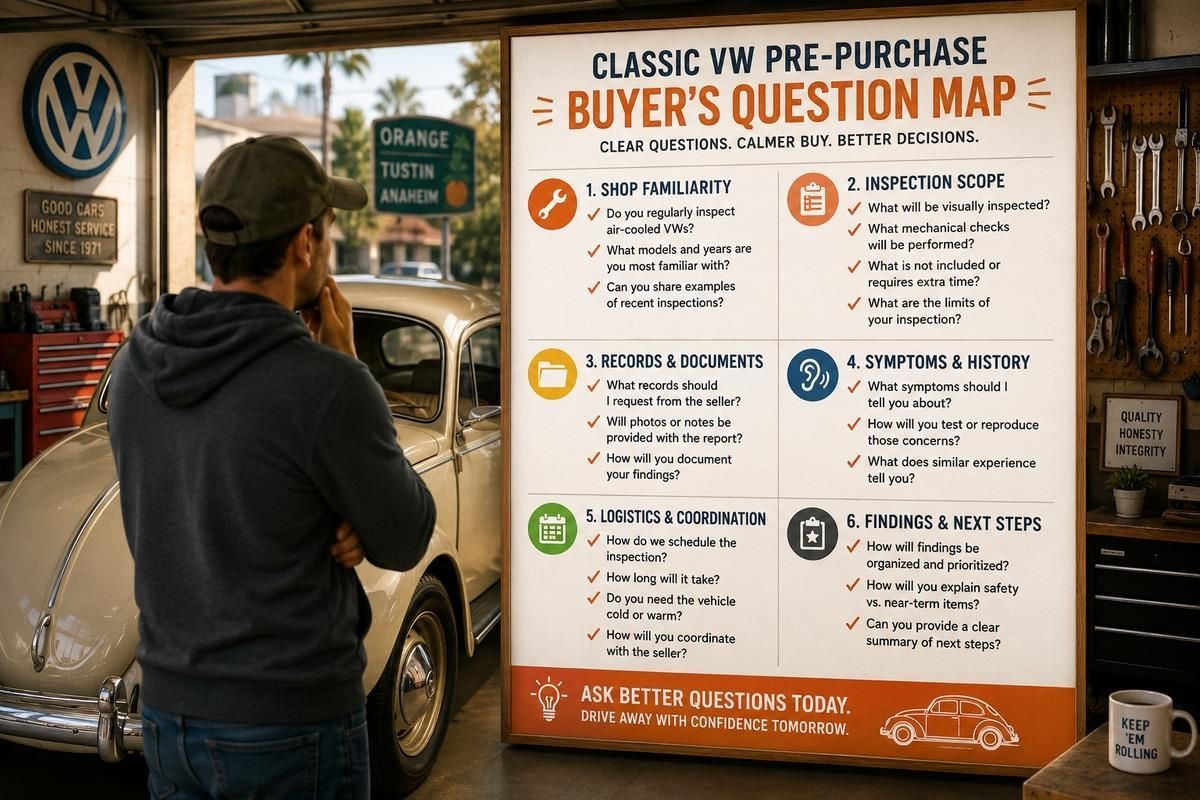
Before arranging a shop-based inspection, ask questions that clarify five things: classic VW familiarity, inspection scope, seller coordination, what information to bring, and how findings will be explained.
Start With These Questions Before Scheduling the Inspection
| Question to ask | Why it matters | What a helpful answer should clarify |
|---|---|---|
| Have you worked with classic VWs like this model or era? | Classic VWs can involve older mechanical systems, analog gauges, age-related wear, older wiring, and drivability concerns that differ from many newer vehicles. | The shop should be comfortable discussing older VW symptoms in plain language. |
| What does your pre-purchase inspection usually include? | Inspection scope can vary by shop and by vehicle condition. | A helpful answer should explain the main areas reviewed without promising more than an inspection can reasonably provide. |
| What are the limits of the inspection? | No inspection can uncover every hidden problem. | The shop should be clear about what may require deeper diagnosis, teardown, or specialist review. |
| Do you need the car at the shop? | Seller coordination can affect whether the inspection is practical. | Ask whether the vehicle must be brought in and what the shop needs before the seller moves the car. |
| What records or photos should be brought? | Better information gives the shop a clearer starting point. | Ask about maintenance records, seller notes, listing details, photos, and VIN information if available. |
| Can findings be separated into safety concerns, near-term repairs, and monitoring items? | A buyer needs priorities, not just a list of observations. | The shop should help explain what matters before purchase and what can be discussed later. |
| How should smells, noises, leaks, drivability issues, or gauge behavior be described? | Classic VW concerns are often noticed through symptoms. | The shop may ask about the frequency and duration of the symptom, whether it has evolved, and what you or the seller have specifically observed. |
| What should be asked of the seller before bringing the car in? | The seller may know about recent work, known issues, or whether the car can be driven safely. | Ask what should be confirmed before arranging drop-off. |
| How much time should be planned for drop-off, review, and discussion? | The buyer and seller may both need to coordinate schedules. | The shop should explain how to discuss timing without promising availability before it is confirmed. |
| If the car may not be safely drivable, what should be asked before moving it? | Brakes, steering, tires, fuel smell, wiring concerns, or poor drivability may affect next steps. | Ask the shop what information is needed before deciding how the vehicle should be moved. |
Ask About Classic VW Familiarity, Not Just General Repair Experience
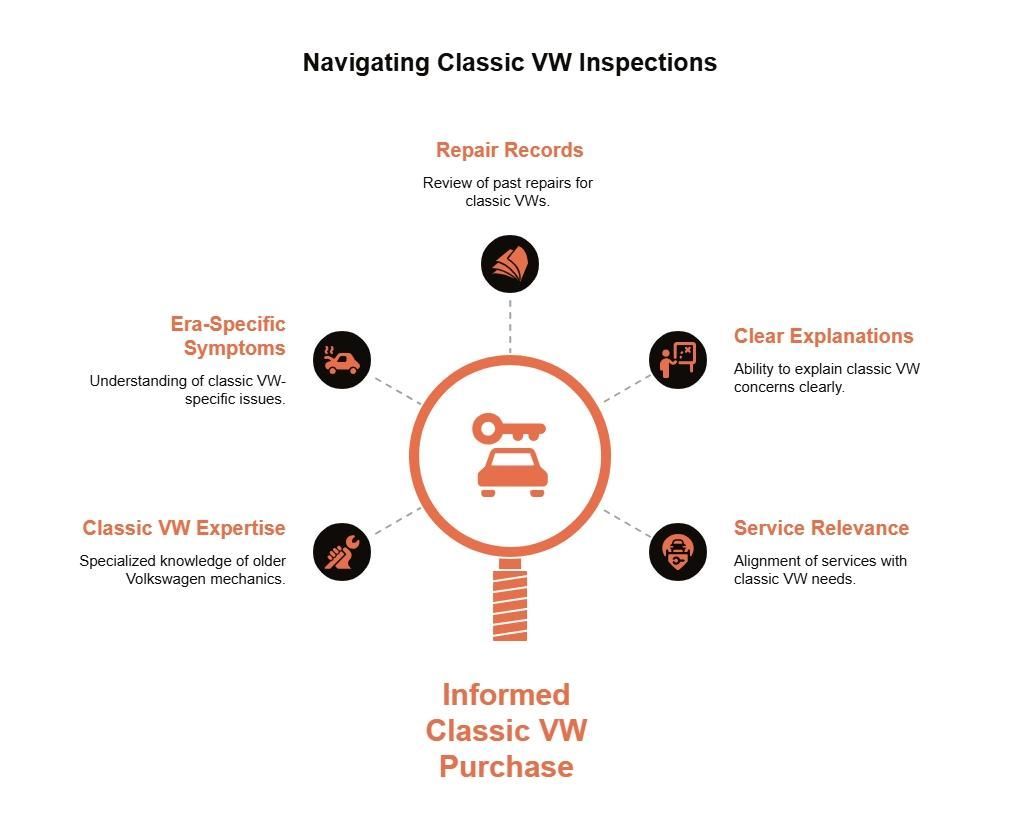
A classic VW pre-purchase inspection is not the same as asking whether a shop works on cars in general. As a general principle, older Volkswagens can involve different concerns from late-model vehicles: older mechanical systems, analog indicators, carburetion or fuel-delivery issues depending on the model, aging wiring, oil or fuel smells, and evidence of prior repairs.
The useful question is not only, “Do you inspect classic VWs?” A stronger version is: “Have you worked with classic VWs from this era, and what symptoms or records should be described before the inspection?”
A buyer does not need to speak like a mechanic. The goal is to find out whether the shop can explain classic VW concerns clearly and whether the inspection process fits the specific car.
Orange Independent Auto Repair’s site lists classic car maintenance and pre-purchase inspections among its classic car services. The business also identifies classic VW and Porsche service as part of its work. It should be understood as service relevance, not as a guarantee about any individual vehicle.
| If the shop says... | What it may tell the buyer |
|---|---|
| “Tell us the model, year or era, what the seller disclosed, and what symptoms you noticed.” | Helpful. The shop is gathering context before the appointment. |
| “We inspect cars.” | Too vague by itself. Ask a follow-up about classic VW experience and inspection scope. |
| “We can explain what is urgent, what can wait, and what needs seller follow-up.” | Helpful. The shop is thinking in practical purchase terms. |
| “The inspection will tell you everything.” | Be cautious. A pre-purchase inspection can reduce uncertainty, but it cannot remove all risk. |
Clarify What the Inspection Can and Cannot Tell You
A pre-purchase inspection is most useful when expectations are clear. It can help a buyer better understand the car’s condition, but it should not be treated as a certification that the vehicle is problem-free.
Ask the shop what the inspection usually covers. Then ask what it does not cover. That second question matters, especially with older vehicles that may have hidden rust, prior repairs, intermittent drivability symptoms, or issues that only appear under certain conditions.
A practical way to frame the follow-up conversation is to ask whether findings can be grouped like this:
| Finding category | What to ask next |
|---|---|
| Safety concern | “Should this be addressed before regular driving or before purchase?” |
| Near-term repair | “Is this something to budget for soon if the car is purchased?” |
| Monitor item | “What should be watched, and what symptoms would make it more urgent?” |
| Seller follow-up question | “What record, receipt, or explanation should be requested?” |
| Buyer preference | “Is this a condition issue, a restoration preference, or a comfort-level decision?” |
Orange Independent Auto Repair lists vehicle inspections as a service. For California consumer-repair context, the California Bureau of Automotive Repair also publishes an official consumer guide to auto repair, which can be a useful general reference when thinking about repair communication, estimates, and expectations.
Bring This Before the Inspection
A shop can usually ask better questions when the buyer brings organized information. This does not require technical expertise. It requires clear notes.
Bring or prepare:
- Listing link or seller description
- VIN if available
- Title or registration details the seller is willing to share
- Maintenance records and receipts
- Notes about recent work the seller claims was completed
- Known issues disclosed by the seller
- Photos of the exterior, interior, engine bay, and underside if available
- Notes from the viewing or test drive
- Any concerns about smells, noises, leaks, drivability, or gauge behavior
For VIN context, NHTSA provides an official VIN Decoder. That tool is most useful for vehicles with a standard 17-character VIN. Many classic vehicles may require additional care when confirming identification details, so buyers should ask the seller and shop how to handle the specific vehicle’s records.
When describing symptoms, avoid vague labels like “engine problem” if more detail is available. A clearer note would be: “fuel smell after startup,” “fresh oil spot after parking,” “hesitation on acceleration,” “rough idle,” “vibration at speed,” or “gauge behavior that seemed unusual.”
Those notes are not a diagnosis. They are practical context. Orange Independent Auto Repair’s air-cooled walkaround checklist may also help a first-time buyer organize early observations before speaking with a shop.
Plan the Local Logistics Before the Seller Gets Impatient
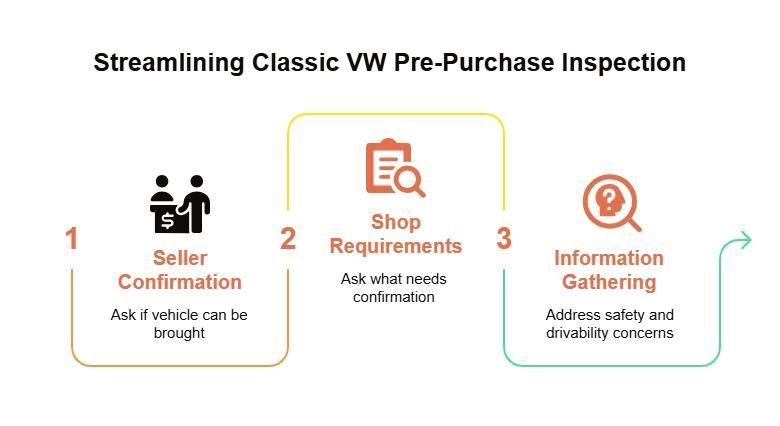
Local coordination can be the hardest part of a classic VW pre-purchase inspection. The buyer may be in one city, the seller may be somewhere else, and the shop may need information before deciding what can be scheduled. Keep the conversation practical and specific.
Ask the seller whether the vehicle can be brought to a local shop before the sale is final. Then ask the shop what should be confirmed before the appointment. This is especially important if the car may not be registered, insured, roadworthy, or safe to drive.
Do not assume a classic VW should be driven across town just because it starts. If there are concerns about brakes, steering, tires, fuel smell, wiring, or drivability, ask the shop what information is needed before the vehicle is moved. For general tire-safety context, NHTSA’s TireWise resource is a helpful official reference, but tire condition on a specific classic VW should be evaluated by a qualified professional.
For Orange, Tustin, and Anaheim buyers, the practical question is not “How close is the shop?” The better question is, “What has to happen before the seller, buyer, and shop can coordinate this inspection without confusion?”
Ask How Findings Will Be Explained After the Inspection
The inspection should help the buyer make a clearer decision. That does not mean the shop should tell the buyer exactly what to pay or whether every car is a yes-or-no purchase. It means the findings should be explained in a way the buyer can use.
Ask the shop: “After the inspection, can findings be explained as urgent items, near-term repairs, monitoring items, and seller follow-up questions?”
This helps prevent two common mistakes. One is overreacting to every minor issue on an older vehicle. The other is underreacting to a concern that could affect safety, drivability, or purchase budget.
A helpful explanation should make three points clear: what was noticed, why it matters, and what the likely next step is. If the concern involves safety-related systems, ask for plain-language guidance and avoid guessing. For additional owner-level context, the article on fuel and oil odors in classics can help buyers understand how to describe symptoms before speaking with a shop.
When to Contact Orange Independent Auto Repair
Orange Independent Auto Repair is a family-owned shop in Orange, CA, operating since 1971. The provided business information confirms that the shop emphasizes fairness and honesty, services classic VWs and classic Porsches among other vehicles, and lists vehicle inspections and classic car pre-purchase inspections on its website.
Confirmed local details from the brief:
| Detail | Information |
|---|---|
| Location | 187 S Main St, Orange, CA 92868 |
| Phone | (714) 633-7161 |
| Hours | Monday–Friday, 7:00 AM–6:00 PM; Saturday by appointment only |
Before coordinating with the seller, prepare the questions above and contact Orange Independent Auto Repair to ask what information the shop needs for a classic VW pre-purchase inspection.
FAQs About Classic VW Pre-Purchase Inspection Questions
Should a classic VW pre-purchase inspection happen before making an offer?
It is often wise to discuss inspection options before committing money, but timing depends on the seller, the vehicle’s availability, and whether the car can reasonably be brought to a shop. At minimum, ask a local shop what information is needed before the next step.
What should be asked of the seller before bringing the car to a shop?
Ask whether the VIN and title information are available, what recent work has been done, whether records or receipts exist, what known issues the seller is aware of, and whether the vehicle can be brought to a shop. Also ask whether there are any drivability or safety concerns before moving it.
What if the seller will not allow a shop-based inspection?
That does not automatically answer whether the vehicle is good or bad, but it does increase uncertainty. Ask why the seller is refusing, whether another inspection arrangement is possible, and whether records, photos, or a shop conversation can still help. If the seller will not cooperate at all, consider that uncertainty before committing money.
Can a pre-purchase inspection find every problem on a classic VW?
No. A pre-purchase inspection can help reduce uncertainty and identify visible or mechanical concerns, but it cannot guarantee future reliability or uncover every hidden issue. Treat it as a decision-support step, not a promise that the vehicle is problem-free.
Ask Better Questions Before Money Changes Hands
A classic VW can be exciting, especially when the right-looking car appears close to home. The best next step is not to rush or overcomplicate the process. Ask a local shop about classic VW familiarity, inspection scope, seller coordination, records, symptoms, logistics, and how findings will be explained.
A pre-purchase inspection cannot remove every risk. It can, however, help a buyer understand the car more clearly before making a decision.
Have questions before arranging a classic VW pre-purchase inspection? Contact Orange Independent Auto Repair before coordinating with the seller.
Disclaimer: This article is for general informational purposes only. It is not a substitute for advice from a qualified automotive professional, service provider, or official source relevant to your situation. Always verify important purchase and safety decisions with the appropriate expert or service provider.
Our Editorial Process
Our expert team uses AI tools to help organize and structure our initial drafts. Every piece is then extensively rewritten, fact-checked, and enriched with first-hand insights and experiences by expert humans on our Insights Team to ensure accuracy and clarity.
By Orange Independent Auto Repair Insights Team
The Orange Independent Auto Repair Insights Team develops owner-level, evidence-first guidance shaped by decades of hands-on experience serving classic VW and Porsche owners in Orange and the surrounding communities.