Classic VW Floor Pan and Heater Channel Concerns That Can Change a Project Car Decision

📌 Key Takeaways
Lower-body rust can turn a classic VW project from manageable to risky, so slow down before committing.
- Rust Location Matters: Floor pans and heater channels deserve closer review because hidden rust can change the whole project.
- Ask Before Trusting: Seller claims like “surface rust” need photos, repair details, receipts, and inspection access.
- Clues Stack Together: Soft floors, bubbling, bad door fit, and patchwork create more concern when they appear together.
- Fresh Coating Can Hide: New carpet, paint, or undercoating may cover honest repairs or problems needing review.
- Inspection Reduces Guessing: A pre-purchase inspection helps clarify risk before money changes hands on a rusty classic VW.
Rust does not always mean walk away, but hidden lower-body doubt should slow the deal.
Classic VW buyers comparing project cars will make calmer purchase decisions here, preparing them for the detailed overview that follows.
~ ~ ~ ~ ~ ~ ~ ~ ~ ~ ~ ~ ~ ~ ~ ~ ~ ~
A classic VW project can look promising from a few steps away. The body shape is right, the interior has character, and the seller says the rust is “normal for an old Volkswagen.” Then the carpet lifts, the lower body shows bubbling, or one door does not close quite like the other.
That is the moment to slow down.
Project cars are expected to need work. Floor pan and heater channel concerns are different because they can change the scope of the project, the confidence a buyer has in the body, and the decision to proceed before a professional inspection. Visible clues do not provide a complete diagnosis, but they can help a buyer decide when to ask more questions, inspect more carefully, negotiate with caution, or pause before committing.
Why Lower-Body Rust Can Change a Classic VW Project Decision
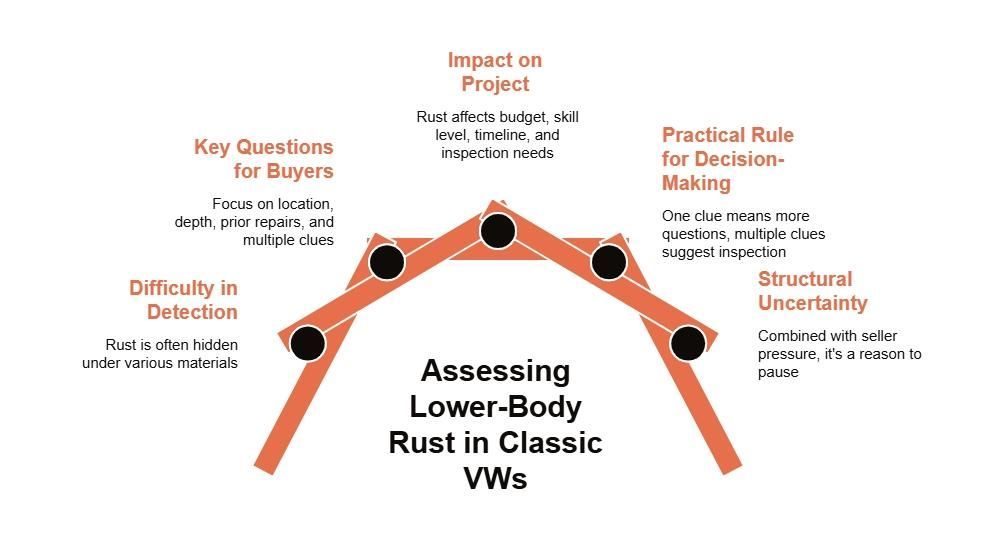
Lower-body rust deserves attention because it is often harder to judge than paint flaws, worn upholstery, or missing trim. A scratched fender is easy to see. A weak floor area or questionable heater channel repair may be partly hidden under carpet, undercoating, seam sealer, trim, or fresh paint.
For a classic VW buyer, the key issue is not whether the car has any rust at all. Many older vehicles show some age-related corrosion. The more useful question is where the rust is, how deep it appears, whether prior work was done properly, and whether multiple clues point to a larger lower-body concern.
Floor pans and heater channels matter because they sit in areas that affect how confident a buyer can feel about the project. A car can look “rough but manageable” while still hiding work that changes the budget, skill level, timeline, or inspection needs.
A practical rule helps keep the decision grounded: one visible clue usually means ask more questions. Several lower-body clues together may be worth a pre-purchase inspection. Structural uncertainty combined with seller pressure is a reason to pause.
Floor Pans: What Buyers Should Notice Before They Fall in Love with the Car
The floor pan is the lower floor area beneath the seats, mats, and carpet. For a buyer, it is one of the first areas worth checking because it can reveal moisture history, prior repairs, hidden corrosion, and the overall honesty of the car’s condition.
Look for holes, soft spots, heavy scaling, uneven seams, patched metal, or fresh coating over areas that deserve a closer look. A buyer may see “minor” rust under the carpet and assume it is only surface-level. That may be true in some cases, but location and depth matter more than the seller’s label.
The battery tray area is also worth checking. Corrosion near the battery or nearby floor area may suggest that moisture, battery acid, or long-term neglect affected more than one visible spot. That does not prove the car has a serious structural problem. It does mean the buyer should ask what was repaired, what was covered, and what remains original.
A replaced or patched floor pan is not automatically bad. Many older cars have been repaired over time. The concern is whether the repair appears sound, consistent, and documented. A clean repair with photos and receipts is easier to evaluate than a fresh black coating with no explanation.
Ask the seller:
- What floor pan work was done?
- Was metal replaced, patched, or only coated?
- Who performed the repair?
- Are there photos from before and during the work?
- Are receipts or repair notes available?
- Is a pre-purchase inspection allowed?
The goal is not to learn how to repair the floor yourself. The goal is to understand whether the visible condition still fits the project you are willing to take on.
Heater Channels: Why Hidden Lower-Body Rust Deserves Extra Caution
Heater channels can be harder for buyers to judge because concerns may be hidden behind trim, paint, carpet, running-board areas, or lower body panels. A seller may describe bubbling along the lower body as cosmetic. That could be accurate in some cases, but the location makes the issue worth a closer look.
A heater channel concern may indicate a more involved lower-body issue than exterior bubbling alone. Without a professional inspection, a buyer should avoid making a final structural judgment from photos or a driveway view. Still, certain clues deserve attention: bubbling along lower edges, soft areas, uneven seams, old patch panels, or door fit that appears inconsistent from side to side.
Official Volkswagen Classic Parts catalogues can help owners research genuine Volkswagen parts and view assembly diagrams, but a parts catalogue does not determine whether a specific car’s lower body is sound. That judgment depends on condition, repair history, access for inspection, and the experience of the person evaluating the car.
A heater channel concern does not automatically mean the car is a bad project. It does mean the buyer should avoid brushing it off as cosmetic until the surrounding clues are understood.
Door Gaps, Soft Floors, Patchwork, and Seller Claims: How Clues Stack Together
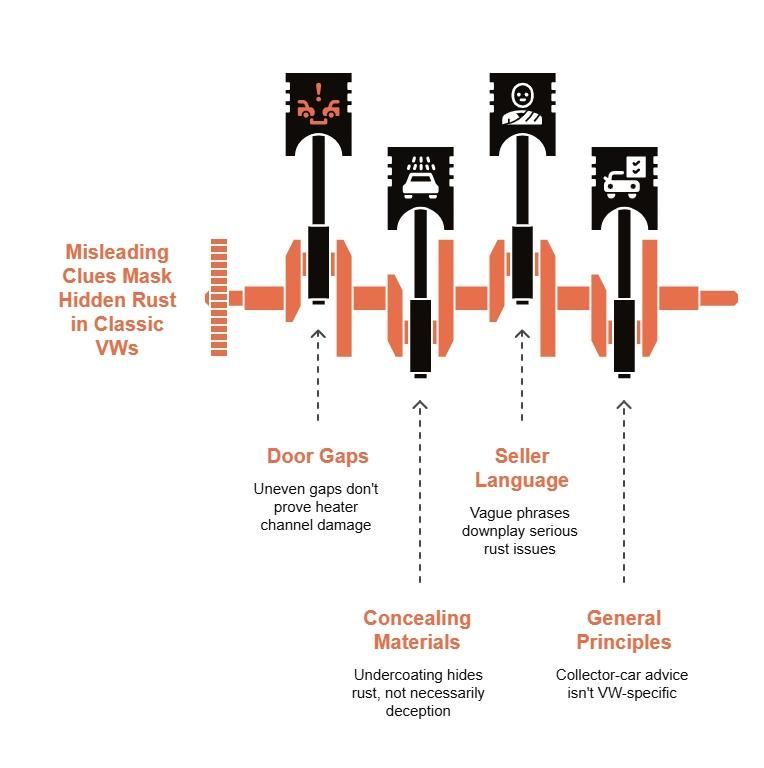
A single clue rarely decides the whole car. A soft floor, lower-body bubbling, unclear patchwork, and a door that closes poorly together deserve more caution than any one of those clues alone.
Door gaps are a useful example. Uneven gaps or difficult door closing do not prove heater channel damage. Older cars can have door-fit issues for several reasons. But when door behavior appears alongside floor pan rust, heater channel bubbling, or undocumented lower-body repairs, it becomes part of a larger pattern.
Fresh undercoating, new carpet, seam sealer, or recent paint should also be interpreted carefully. Those materials are not proof of deception. They may be part of legitimate repair or cleanup. The buyer’s job is to ask what happened before those materials were applied.
Seller language matters too. Phrases such as “just surface rust,” “easy patch,” or “all old VWs have this” may be meant honestly, but they are not enough by themselves. A better response is calm and specific: ask for documentation, ask what metal was replaced or covered, and ask whether an experienced classic VW professional can inspect the car before purchase.
Hagerty’s collector-car inspection guidance also emphasizes the value of looking at details such as body-panel gaps, paint differences, odors, door operation, and professional review before buying. Those are general collector-car principles, not a substitute for model-specific classic VW evaluation.
Quick Decision Checklist: Inspect, Negotiate, or Walk Away?
| Area or clue | What the buyer may notice | Why it matters | What to ask or check next | Decision signal |
|---|---|---|---|---|
| Floor pan holes or softness | Soft areas, holes, flexing, heavy rust under mats | May change the project from cosmetic cleanup to deeper lower-body work | Ask whether metal was replaced, patched, or coated | Inspect |
| Rust near battery tray | Corrosion around the battery or nearby floor | May suggest damage beyond one small visible spot | Ask for close-up photos and repair history | Ask more / inspect |
| Uneven door gaps or difficult door closing | Door rubs, drops, sticks, or gaps vary side to side | May deserve review when paired with lower-body rust | Compare both sides and ask about prior body work | Inspect |
| Bubbling near heater channel or lower body | Paint bubbles, soft lower edges, patch outlines | May indicate hidden lower-body concerns | Ask what is under the paint, trim, or coating | Inspect |
| Heavy undercoating over suspect areas | Fresh black coating, thick texture, uneven finish | Can make the metal underneath harder to evaluate | Ask when it was applied and what repair came first | Ask more |
| Prior patch panels with no documentation | Visible seams, mismatched metal, no receipts | Repair quality and extent are unclear | Ask who did the work and whether photos exist | Inspect / pause |
| Seller says “just surface rust” but refuses inspection | Reassuring claim with limited access | The buyer cannot verify the condition before purchase | Ask for inspection permission before committing | Consider walking away |
This checklist is not a pricing guide and does not decide the purchase for you. It helps sort the clues so the decision stays practical instead of emotional.
When a Pre-Purchase Inspection Is Worth It
A pre-purchase inspection is most useful when the buyer likes the car but the lower-body clues are ambiguous. That is common with classic VWs because photos, seller descriptions, and driveway walkarounds do not always reveal the full condition of the lower body.
Inspection is especially worth considering when several clues appear together: floor pan softness, heater channel bubbling, rust near the battery tray, door-fit concerns, fresh undercoating, prior patch panels, or vague repair history. The inspection may help confirm what is visible, identify what needs deeper review, and help the buyer decide whether the project still fits their expectations.
Orange-area buyers considering a classic VW can review Orange Independent Auto Repair’s classic car maintenance and vehicle inspections information before committing to a project car. Orange Independent Auto Repair is a family-owned and -operated shop in Orange, CA, with classic VW and Porsche care among its service areas.
If lower-body rust raises questions on a classic VW near Orange, CA, contact Orange Independent Auto Repair about a pre-purchase inspection before making the purchase decision.
FAQs About Classic VW Floor Pan and Heater Channel Rust
Is floor pan rust always a dealbreaker on a classic VW?
No. Floor pan rust depends on location, depth, prior repairs, and the rest of the lower body. A patched or replaced pan may still fit the project if the work is documented and sound. The concern grows when holes, soft areas, battery-area corrosion, or unclear repairs appear together.
Why are heater channels important on a classic VW?
Heater channel concerns can be harder to judge visually and may point to more involved lower-body work. Because exact condition varies by vehicle, the safest approach is to treat bubbling, soft areas, patchwork, or door-fit changes as reasons for closer inspection rather than as proof of a specific structural issue.
Can door gaps mean heater channel problems?
Door gaps do not prove heater channel failure. They may come from several causes on an older car. However, uneven door gaps or difficult door closing paired with lower-body rust may be worth professional review before purchase.
What should a buyer ask the seller about floor pan or heater channel repairs?
Ask what was repaired, who did the work, whether metal was replaced or covered, whether photos or receipts exist, and whether a pre-purchase inspection is allowed. A seller’s willingness to provide detail can help the buyer judge how much uncertainty remains.
Should a buyer get a pre-purchase inspection before buying a rusty classic VW?
If floor pans, heater channels, battery-area corrosion, patches, or door gaps raise questions, a pre-purchase inspection can help clarify risk before committing. It should not be treated as a guarantee that every hidden issue will be found, but it can provide a more informed basis for the purchase decision.
Final Takeaway
Floor pan and heater channel concerns do not always mean a classic VW project should be rejected. They do mean the buyer should slow down, ask better questions, and avoid treating covered or patched areas as settled without review.
The decision is rarely “all rust is harmless” or “any rust means walk away.” A more useful approach is to look at where the rust appears, how deep it seems, what repairs were done, and how several clues stack together.
When the lower body raises enough questions, a pre-purchase inspection is a practical next step before money changes hands.
Disclaimer: This article is for general informational purposes only and does not constitute compliance, safety, technical, or professional advice. Requirements, risks, and best practices may vary by context, jurisdiction, system, provider, or use case. Confirm important decisions with the appropriate qualified professional, authority, or technical expert.
Our Editorial Process
Our expert team uses AI tools to help organize and structure our initial drafts. Every piece is then extensively rewritten, fact-checked, and enriched with first-hand insights and experiences by expert humans on our Insights Team to ensure accuracy and clarity.
By Orange Independent Auto Repair Insights Team
The Orange Independent Auto Repair Insights Team develops owner-level, evidence-first guidance shaped by decades of hands-on experience serving classic VW and Porsche owners in Orange and the surrounding communities.