
When Several Maintenance Items Come Due Together: How Orange-Area Families Can Build a Three-Visit Service Plan

📌 Key Takeaways
Build your maintenance calendar around the shop’s technical timing, then fit each visit to your budget, transportation, and schedule.
- Let The Shop Time It: Ask the shop to time every item before you decide which work belongs in each visit.
- Safety Overrides The Template: If the shop finds something needing prompt attention, its technical timing should come before calendar convenience.
- Bundle Only When It Fits: Combining related work may reduce repeated steps, but you should not assume every pairing saves money.
- Budget By Visit: Build each reserve around the shop’s estimate, not three equal shares, and plan transportation before every appointment.
- Rechecks Can Change Plans: New findings or rechecks may move work earlier, later, or change the number of visits.
The shop sets timing; your household builds the plan.
Orange-area families facing several maintenance needs will turn a long estimate into a workable plan using the steps below.
~ ~ ~ ~ ~ ~ ~ ~ ~ ~ ~ ~ ~ ~ ~ ~ ~ ~
Several maintenance items are due on the family car in the same stretch of months. The estimate covers brakes, a cooling system flush, belt replacement, an oil change, and a follow-up on a condition the shop flagged last time. Handling everything in a single appointment would strain the household budget and leave you arranging transportation for most of a workday. But deciding on your own which items can wait feels risky, because you are not the one who can judge whether a delayed repair creates a safety problem.
You do not need to guess. Ask your repair shop to assign technical timing to every item on the list, then organize those recommendations into a series of purposeful visits. Three visits is a practical planning template (your vehicle may need fewer or more), and the framework works because it separates two different jobs: the shop determines what needs to happen and when, while the household determines how to fit those appointments into the budget, the calendar, and the transportation plan.
Ultimately, the shop determines the technical timing, while the household organizes the calendar.
This article does not tell you which repairs are safe to postpone. For guidance on sorting urgent findings from items that can be monitored, see why a long repair list is not the same as an urgent repair list.
Start With One List and Ask the Shop to Put Timing Behind Every Item
Before you can design a visit calendar, you need one consolidated document. Pull together the most recent estimate or inspection notes, your vehicle's maintenance records, and any recheck instructions from earlier appointments. If recommendations arrived at different visits or from different providers, combine them so nothing falls through the cracks.
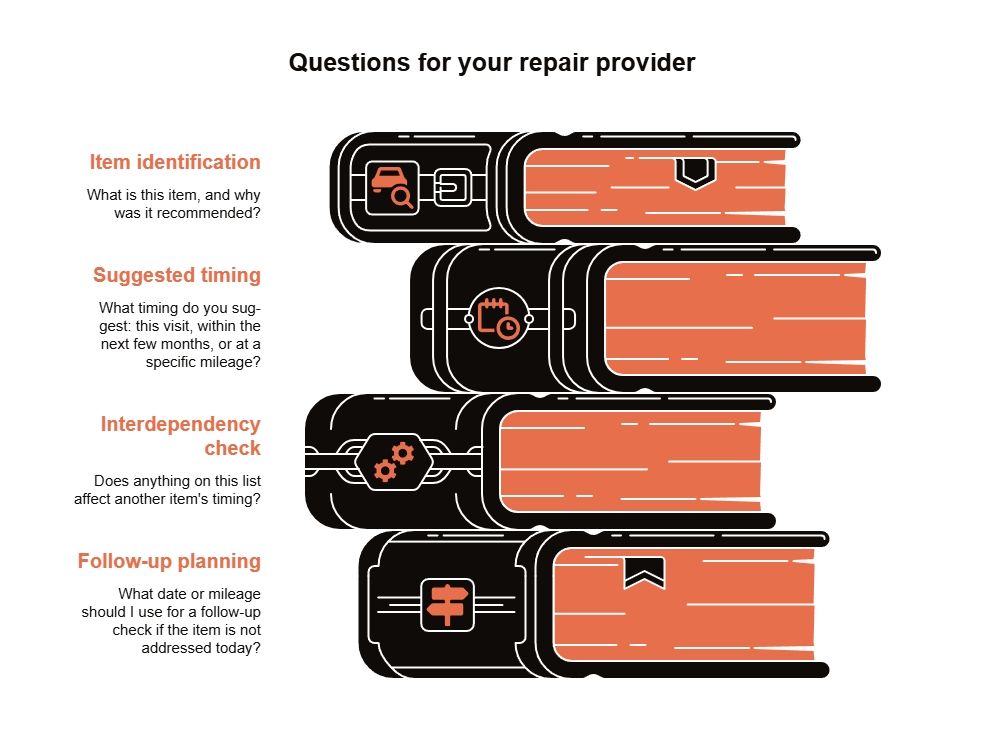
Then bring that list to your repair provider and ask four questions about each item:
- What is this item, and why was it recommended?
- What timing do you suggest: this visit, within the next few months, or at a specific mileage?
- Does anything on this list affect another item's timing?
- What date or mileage should I use for a follow-up check if the item is not addressed today?
A recheck is a shop-recommended follow-up at a specified date or mileage to revisit an earlier observation or recommendation. Record the answers to all four questions. The shop's responses become the raw material for your visit calendar.
Notice that none of these questions ask you to decide whether a repair is safe to delay. That judgment belongs to the repair provider. Your job is to capture the information clearly enough to build a workable schedule around it.
Technical timing is the shop's professional assessment of when each item must be completed. Household scheduling is your decision about how to allocate budget, arrange transportation, and choose appointment dates to make that timing possible. The two work together, but only the first one requires automotive expertise.
Visit 1: Establish the Plan and Complete the Work the Shop Assigns to This Window
The first visit accomplishes two things: completing whatever the shop places in the earliest window and establishing a documented plan for everything else.
Ask the shop to confirm which items belong in this appointment based on their technical assessment. If the shop identifies something that needs prompt attention, that finding overrides the three-visit template. Technical timing and safety come before calendar convenience. Complete that work, then use the remaining time in the conversation to walk through the full list together. For each item that will move to a later visit, record why: the shop recommended a specific mileage threshold, the item depends on a part that needs to be ordered, or it connects logically to work planned for the next appointment.
Consider a household with an older daily driver that needs an oil change, new belts, a brake inspection follow-up, a coolant flush, and a suspension evaluation. The shop reviews the list and assigns the oil change and belt replacement to Visit 1, asks the owner to return for the brake and coolant work in Visit 2, and schedules the suspension evaluation for Visit 3 after a few hundred more miles of observation. The owner records those assignments rather than rearranging them based on price.
Before you leave, confirm the following:
- What work was completed today.
- What recommendations remain open.
- When the shop recommends addressing each remaining item.
- Whether any item requires a recheck, and at what date or mileage.
- What new finding or change during today's service would cause the later schedule to be revised.
Update the vehicle's maintenance history at the same time. That record prevents future visits from depending on memory and gives the next service conversation a clearer starting point.
For owners of classic VW and Porsche vehicles, planning information may arrive differently than it does for modern cars. Rather than a warning light triggering a recommendation, the shop might note a faint oil smell near the engine, a new vibration at certain speeds, a slow drip that was not present at the last appointment, or a gauge reading that has shifted. Those observations become planning fields on the calendar, and any recheck the shop recommends should be recorded with the same detail you would use for a modern vehicle's diagnostic code follow-up. More owner-focused information is available in the classic car maintenance section.
The goal of Visit 1 is not simply to complete work. It is to leave with a documented reason and timing for every remaining item.
Visit 2: Ask What Can Logically Be Combined
The second visit is where grouping becomes useful, but only after you ask the right questions. Service bundling — scheduling related tasks in the same appointment — can sometimes reduce duplicated setup or inspection steps, but not every pair of items on a maintenance list shares labor, access, fluids, or teardown. Assuming they do can lead to disappointment when the estimate does not change the way you expected.
Ask the shop directly: do any of the items planned for this visit involve the same system access, inspection area, or setup? Would completing them together change the labor, evaluation time, or parts requirements? Record the answer rather than assuming a particular outcome. If related work genuinely overlaps, the shop can explain how. If it does not, you have avoided building your budget around a discount that was never available.
This visit is also where you can ask about duplicated evaluation. If one item already needs a follow-up assessment, ask whether that evaluation can sensibly happen during the same visit as other related work. The answer depends on the vehicle and the specific recommendations, so treat it as a shop question rather than an expected savings opportunity.
Earlier recheck instructions come back into play here as well. Pull up the notes from Visit 1 and confirm whether any monitored condition has changed enough to affect the plan. Suppose the shop asked you at Visit 1 to watch for a slow fluid weep and return for a recheck at a certain mileage. That recheck now becomes a confirmed line item on Visit 2 rather than something you try to remember weeks later. If the recheck reveals a change, the calendar may need to shift: an item originally planned for Visit 3 might move forward, or the shop might confirm that the original schedule still holds.
Three-Visit Maintenance Planning Table
Use this table to organize every item on the list. Fill in the "Shop-Recommended Timing" and "Planned Visit" columns based on the repair provider's guidance, not your own assessment of urgency.
| Item / Recommendation | Why It Is on the List | Shop-Recommended Timing | Planned Visit | Related Work to Ask About | Recheck Date or Mileage | Household Reserve | Transportation Plan | What Would Change the Schedule |
|---|---|---|---|---|---|---|---|---|
| (example row) | (reason) | (shop's window) | (1, 2, or 3) | (ask if linked to another item) | (date or miles) | (set aside amount) | (ride, second car, walk) | (new symptom, finding, or mileage trigger) |
Copy or adapt this table for your own vehicle. Each row should reflect a conversation with the shop, not an independent judgment about what can wait.
Visit 3: Close the Loop and Build the Next Maintenance Horizon
The third visit is not simply "whatever is left." It completes the items the shop assigned to this window, revisits any earlier observations or rechecks, and transitions the household into the next planning cycle.
Start by confirming that conditions monitored since Visit 1 or Visit 2 have not changed the plan. Do not assume that every item remaining after Visit 2 automatically belongs in Visit 3 regardless of what the shop found during earlier appointments. Conditions change. A recheck might reveal that an item originally planned for this window no longer needs attention, or it might surface something new. Let the shop confirm.
Complete the scheduled work, then update:
- Completed work and current mileage.
- Remaining recommendations, if any.
- Future rechecks.
- Maintenance likely to enter the plan next.
- The household reserve needed for the next planning period.
If your vehicle follows a standard oil-change interval (5,000 miles or 12 months, whichever comes first), that next service date becomes the anchor for your upcoming maintenance horizon. Begin building a maintenance reserve before the next cluster of needs develops, so the planning process does not restart from scratch every time.
Staged maintenance is not the same as simply delaying repairs. The framework organizes technical recommendations that the shop has already timed. It does not authorize the household to move work to a later date on its own. A three-visit plan may also end before Visit 3 if the shop changes the timetable, or it may extend beyond three appointments when the vehicle and findings call for that. The number of visits is secondary. What matters is that each appointment has a defined purpose based on shop-recommended timing.
Give Each Visit a Budget Reserve and a Transportation Plan
A three-visit plan only works if the household can actually get to the shop and cover the cost each time. Two practical steps make that easier.
First, create a maintenance reserve — money the household sets aside for an upcoming service visit — based on the actual estimate the shop provides rather than an arbitrary fraction of the total. Dividing the estimate into three equal dollar amounts is a common mistake, because the work in each visit is rarely equal in scope or cost. For example, Visit 1 might require $600 to address immediate safety concerns like brakes, while Visit 2 might only require $150 for scheduled fluid exchanges. Build the reserve around what the shop assigns to each window, and leave room for the possibility that findings during the appointment could adjust the final number.
Second, confirm how you will get to and from the shop for each appointment. If the vehicle will be there for several hours, decide in advance whether a family member can provide a ride, whether a second household vehicle is available, whether the shop's location allows you to walk to nearby errands, and whether the appointment requires time away from work or an adjustment to school or other responsibilities. Confirm drop-off and pick-up logistics directly with the repair provider so both sides share the same expectation.
Needing to plan around household cash flow does not make the maintenance recommendations less legitimate. The useful response is to build a documented schedule that respects both the shop's technical timing and the household's real constraints.
For Orange-area households planning repeated visits to a local shop, a familiar routine with a trusted provider can simplify the transportation question over time. Orange Independent Auto Repair, a family-owned shop in Orange, CA since 1971, is one example of a local provider where an ongoing service relationship supports this kind of visit-by-visit planning.
Six Questions to Ask Before You Agree to the Three-Visit Calendar
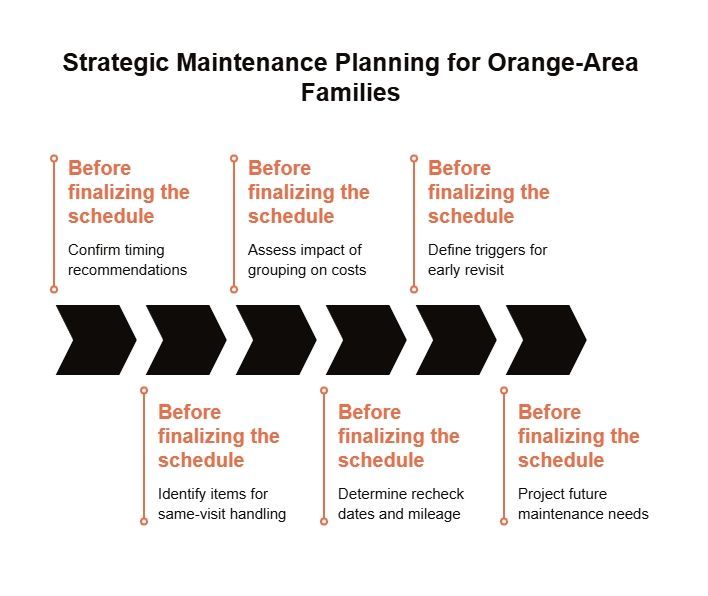
Before finalizing the schedule, confirm these six points with the shop:
- What timing do you recommend for each item on the list? Make sure every recommendation has shop-provided timing rather than only a place on your calendar.
- Which items, if any, make sense to handle in the same visit? The goal is not to bundle as much as possible. Ask whether there is a genuine relationship between the work.
- Does grouping them change labor, evaluation, or parts requirements? Ask specifically rather than assuming shared access or evaluation will change the estimate.
- What should be rechecked, and at what date or mileage? Put the answer directly into your maintenance calendar.
- What new symptom or finding would make us revisit this schedule sooner? Record the shop's answer beside the relevant recommendation.
- What maintenance is likely to enter the plan after these three visits? Start the next reserve before another group of known maintenance needs reaches the calendar at once.
These questions keep the planning conversation grounded in the shop's technical knowledge rather than the household's budget anxiety. Budget pressure is real, but it should not be the only factor shaping the calendar. Technical timing and safety override scheduling convenience. For a deeper look at how to evaluate individual repair recommendations, see questions to ask before approving repairs.
FAQs
Can I simply divide a long maintenance estimate into three appointments?
Not by splitting the dollar amount into equal thirds. Ask the shop to explain the timing and relationship between items first. The three-visit framework organizes that information into a calendar; it does not replace technical judgment about what belongs in each window. A shop-recommended change in timing may result in fewer or more than three visits.
Does combining maintenance items always save money?
No such promise should be built into the plan. Ask whether the specific work shares access, setup, inspection, fluids, or other labor and whether grouping it changes the estimate. Record the shop's answer for that vehicle and appointment.
What if something changes between planned visits?
Follow the shop's recheck instructions and contact the repair provider if a new or worsening condition — a new noise, a faster leak, a change in drivability, or a shift in gauge behavior — could affect the agreed schedule. Do not independently assume the existing calendar still applies. A recheck, new finding, or revised technical recommendation may move an item or change the number of planned visits.
Turn the Maintenance List Into a Calendar You Can Actually Use
The useful outcome is not three equal bills. It is a set of purposeful appointments with shop-provided technical timing, documented rechecks, household reserves, transportation plans, and clear reasons to revise the schedule when necessary.
Before your next service conversation, put every due or recommended item on one list and ask the shop to assign technical timing, related work, and any recheck date or mileage. That single step turns a stressful estimate into a calendar you can manage.
Disclaimer: This article is for general informational purposes only and does not constitute compliance, safety, technical, or professional advice. Requirements, risks, and best practices may vary by context, jurisdiction, system, provider, or use case. Confirm important decisions with the appropriate qualified professional, authority, or technical expert.
Our Editorial Process
Our expert team uses AI tools to help organize and structure our initial drafts. Every piece is then extensively rewritten, fact-checked, and enriched with first-hand insights and experiences by expert humans on our Insights Team to ensure accuracy and clarity.
By Orange Independent Auto Repair Insights Team
The Orange Independent Auto Repair Insights Team develops owner-level, evidence-first guidance shaped by decades of hands-on experience serving classic VW and Porsche owners in Orange and the surrounding communities.