The Annual Maintenance File for an Older Daily Driver: What Orange-Area Families Should Keep in One Place
📌 Key Takeaways
An older daily driver needs one honest, current maintenance file that separates confirmed work, recommendations, observations, and unknown history.
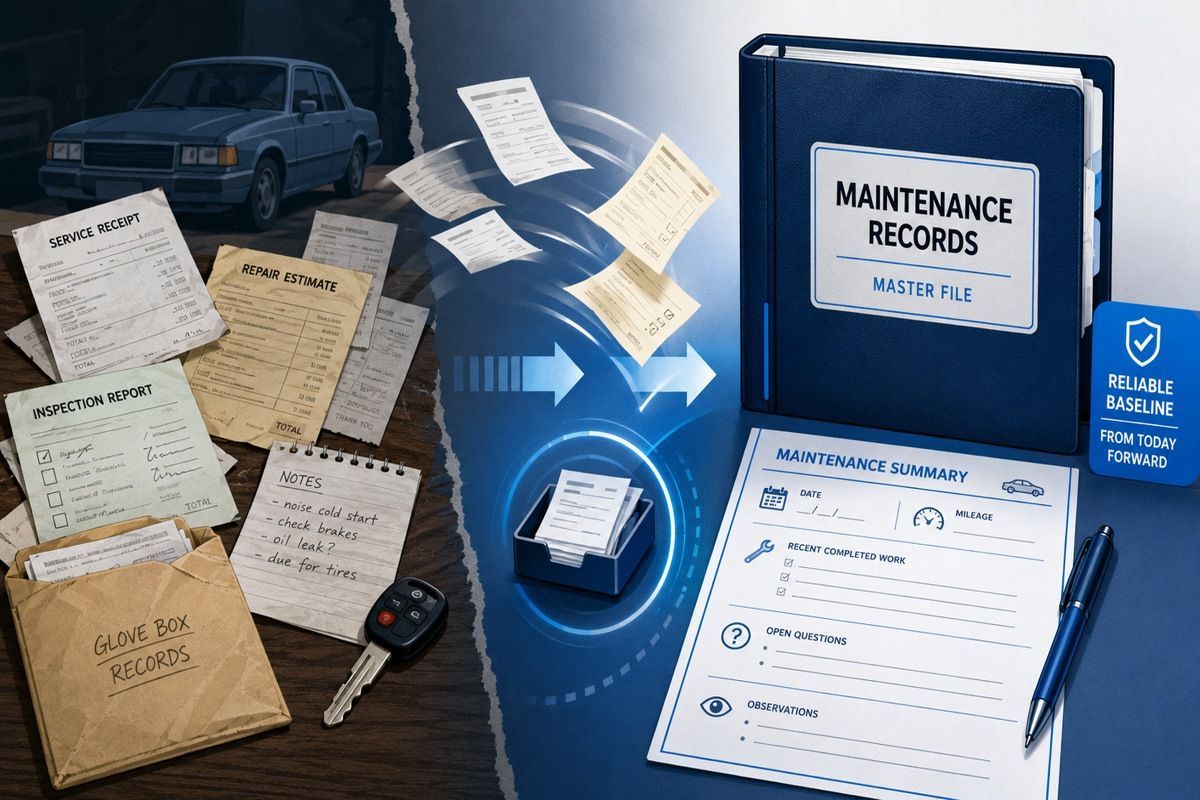
- Label Every Item: Use Completed, Recommended, Monitor, and Unknown labels so estimates, memories, and missing records never become false proof.
- Track Date And Mileage: Record the date and mileage together whenever possible, and leave missing details blank instead of guessing.
- Build From Today: Start a reliable baseline today even when older records are incomplete, preserving uncertainty without turning assumptions into facts.
- Keep One Shared File: Keep one master index and current summary that every responsible household member can find and update.
- Summarize Before Service: Bring a one-page summary to service visits with recent work, open questions, observations, and important unknowns.
One honest file beats scattered paperwork and confident guesses.
Orange-area families with older daily drivers will make repair conversations clearer by using the recordkeeping system that follows below.
~ ~ ~ ~ ~ ~ ~ ~ ~ ~ ~ ~ ~ ~ ~ ~ ~ ~
You can have years of repair receipts and still lack a usable maintenance history. Someone knows there are invoices somewhere, a glove-box folder holds a few older receipts, and an inspection report from two years ago sits in a desk drawer. The paperwork exists, but nobody in the family can say with confidence which work was actually completed, what was only recommended, what the mileage was at the time, and what questions remain open.
For any family depending on an older daily driver, that gap between "having documents" and "understanding the car's current status" is the problem worth solving. Saving every receipt is a start, but storage alone does not create status, chronology, or a current summary a repair provider can use. The system below takes roughly an hour to set up and a few minutes to maintain after each service visit or new observation. By the end, you will have one file that any household member, or a repair provider, can read and trust.
What An Annual Maintenance File Is Supposed To Do
The word "annual" does not mean every maintenance task happens once a year. It means the file is maintained throughout the year and reviewed periodically, then rolled forward so it stays current heading into the next year.
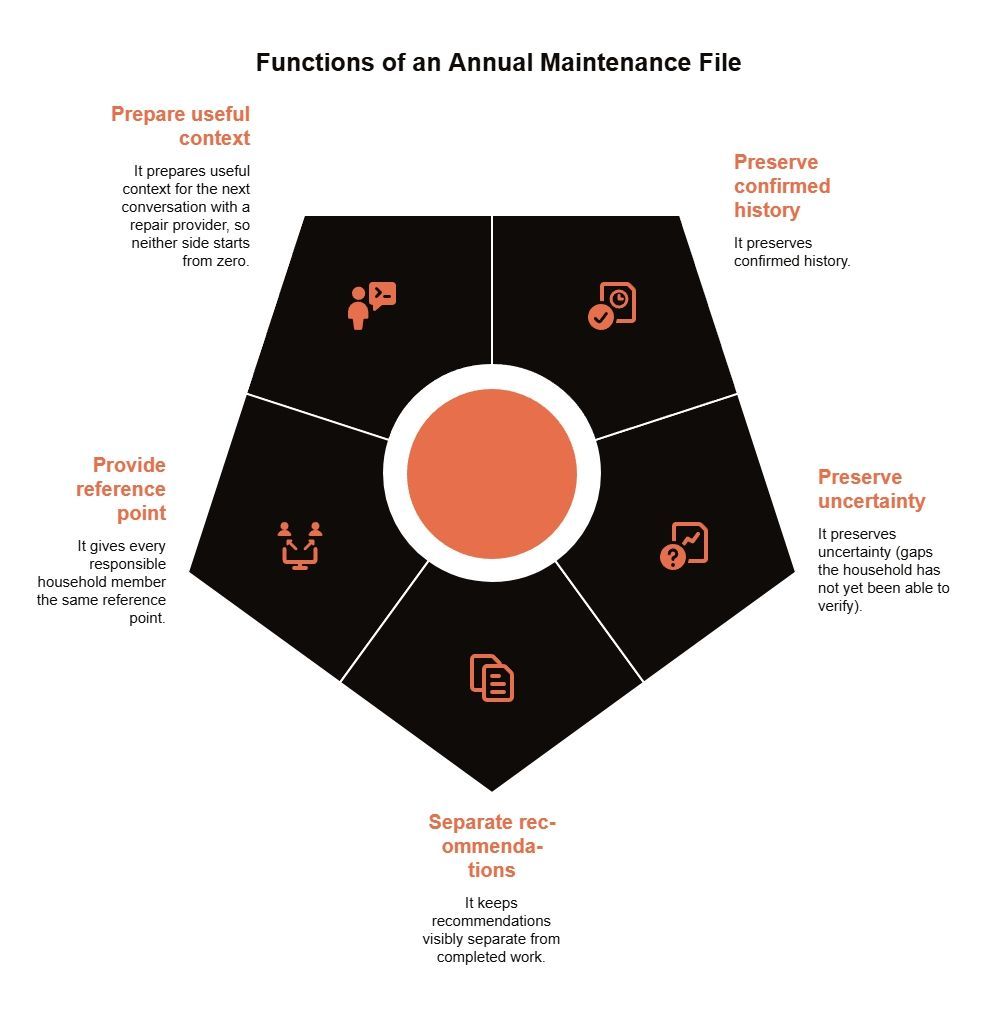
A useful maintenance file does five things. It preserves confirmed history. It preserves uncertainty (gaps the household has not yet been able to verify). It keeps recommendations visibly separate from completed work. It gives every responsible household member the same reference point. And it prepares useful context for the next conversation with a repair provider, so neither side starts from zero.
The file is not a diagnostic tool and not a complete maintenance schedule. It is a factual record of what is known, what has been suggested, and what remains unclear. Exact maintenance timing still depends on the vehicle and the appropriate service information. You do not need mechanical expertise to maintain it. The value comes from consistent, honest recording, not from diagnosing the car.
A few terms make the system easier to follow. Service history is the documented record of maintenance, repairs, inspections, and related vehicle information over time. A maintenance baseline is the point from which you have a reliable current record, even if earlier history is incomplete. An inspection finding is something documented during a vehicle inspection. A recommendation is work or follow-up that was suggested but is not documented as completed. An unresolved observation is something a driver noticed that has not yet been explained or closed out.
Keep These Seven Record Categories Together
The table below is the core of the file. Each row represents a category of information worth capturing. You do not need to fill every column on day one. Start with what you have and add detail as new records come in.
| Record Category | What to Save | Minimum Details to Capture | Status | What Question It Answers Later |
|---|---|---|---|---|
| Vehicle snapshot | Year, make, model, current odometer reading, VIN if available | Date the snapshot was recorded | Not applicable | "What vehicle are we talking about, and where does the odometer stand today?" |
| Completed services | Invoices, receipts, service records | Date, mileage, provider, work performed | Completed | "What has actually been done, and when?" |
| Vehicle inspection findings | Dated inspection reports or written findings | Date, mileage, source of the inspection, what was found | Completed or Recommended (depending on whether findings led to work) | "What did a qualified look at the car reveal?" |
| Open recommendations | Estimates, written suggestions, verbal recommendations recorded by the owner | Date, mileage, who recommended the work, what was suggested | Recommended | "What has been suggested but not yet documented as done?" |
| Unresolved observations | Owner notes describing what was noticed | Date, mileage, conditions at the time, what the driver observed (smell, noise, leak, vibration, drivability change) | Monitor | "What has the driver noticed that has not yet been evaluated?" |
| Unknown or missing history | Gaps, previous-owner claims without receipts, unclear dates | What is claimed, what documentation exists (if any), what remains unconfirmed | Unknown | "Where are the gaps in this car's story?" |
| Upcoming questions or maintenance window | Items the household plans to ask about or revisit at the next service visit | The question or item, relevant context, approximate timeframe if known | Pending | "What should we bring up next time?" |
A few notes on using the table. For completed services, the invoice or receipt is the anchor document. If you can point to a record that confirms the work was performed, it belongs in that row. Understanding what a repair invoice should document can help you recognize whether your records are capturing the right details.
For unresolved observations, record what you noticed rather than guessing at the cause. "Small oil spot under the car on two mornings this week" is a useful entry. "Rear main seal failure" is not, unless a service record supports that conclusion. Include the date, the approximate mileage, and the conditions at the time (parked overnight, idling, highway driving) so the observation has context when reviewed later.
Keep original documents whenever possible rather than rewriting technical findings from memory. A receipt or inspection report preserves specific language that a summary from recall may lose or distort.
Use Four Status Labels So The File Does Not Tell A False Story
Most maintenance and historical items in the file will carry one of four primary labels:
Completed means an invoice, receipt, or reliable service record confirms the work was done. Recommended means a provider or inspection suggested the work, but no document confirms it was performed. Monitor means someone in the household observed something (a sound, a smell, a small leak, a change in how the car drives) or a lower-priority item is being watched and has not yet been professionally evaluated. Unknown means the history cannot currently be confirmed.
These labels prevent the most common recordkeeping error: treating an old estimate, a family member's recollection, or a previous owner's verbal claim as proof that something was completed.
A practical example: a two-year-old estimate lists brake work, but no final invoice exists. The file records this as Recommended (or Unknown if even the estimate's accuracy is in question), not Completed. That distinction matters the next time someone in the household approves or declines a repair.
A status label records what the household can confirm about the paperwork. It does not prove the mechanical condition of the car.
Record Date And Mileage Together
Whenever you add an entry, capture both the date and the odometer reading if they are available. A date without mileage tells you when something happened but not how much the car has been driven since. Mileage without a date creates the opposite gap. Together, they give a repair provider enough context to frame maintenance timing without guesswork. Record the date and mileage so that model-specific maintenance timing can later be checked against the appropriate schedule.
If one value is missing, leave it blank rather than estimating. A blank is more honest than a guess, and the file stays trustworthy.
This matters when you eventually need to ask whether something should be inspected, revisited, or scheduled. Instead of saying "I think that was done a while ago," you can provide the documented date and mileage and ask the question from a known starting point.
If Old Records Are Missing, Build A Baseline Without Guessing
Incomplete history is normal for an older vehicle, especially one that has changed hands. The goal is not to reconstruct a perfect past. Unknown history can remain unknown while the household starts a reliable baseline today.
A practical sequence:
- Gather every source currently available: glovebox receipts, emailed invoices, inspection reports, handwritten notes, text messages from a previous owner.
- Enter confirmed completed work first, with dates and mileage where available.
- Create a separate list for recommendations and observations that are not documented as completed.
- Mark anything you cannot confirm as Unknown.
- Record today's date and mileage as your new baseline reference point.
- Bring the list of unknowns to a future vehicle inspection or maintenance conversation rather than converting assumptions into facts.
For example, a previous owner may have said the timing belt was replaced but supplied no receipt. The household records that claim under Unknown and starts a confirmed history from the current date and mileage. The seller's statement is preserved as context, not promoted to fact, and not used as a reason to skip future verification.
Missing paperwork establishes uncertainty. It does not establish the mechanical condition of the vehicle or prove that a particular repair is necessary. Starting with an honest baseline is more useful than filling gaps with optimistic guesses that nobody can verify later. Missing documentation does not automatically mean a part needs replacement. It means the history has not been confirmed yet, and that open question belongs in a future maintenance conversation.
Make The File Easy For The Whole Household To Update
If more than one person drives the car, pays for repairs, or schedules service, the file needs to survive handoffs. A system that only one household member understands will eventually fall behind.
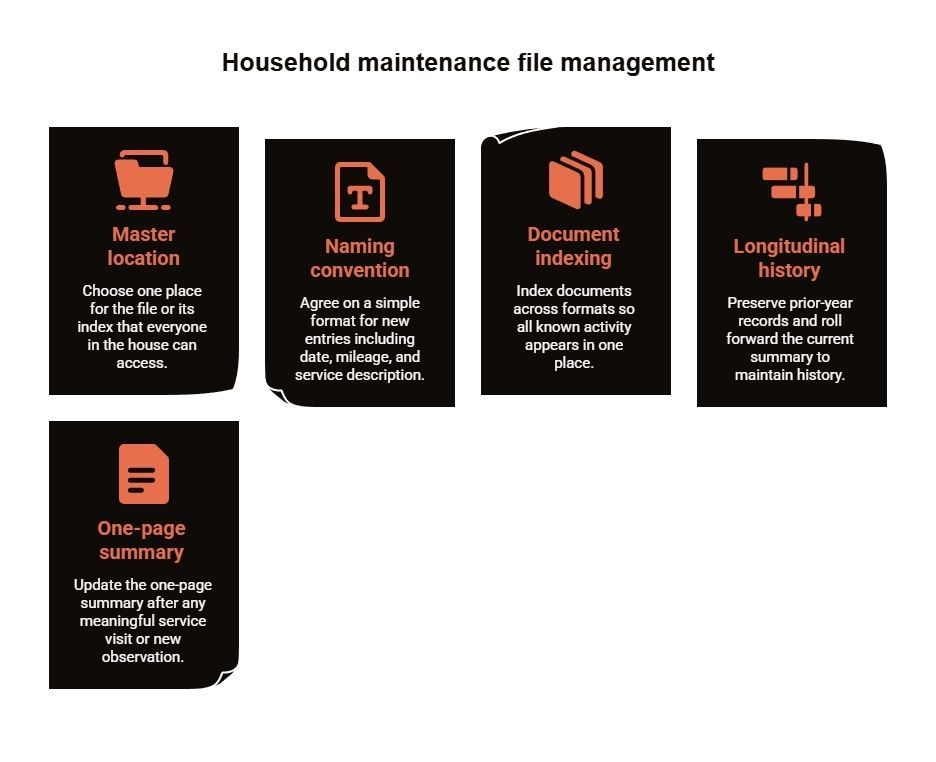
Choose one master location for the file or its index. Paper in a labeled folder, a shared digital folder, or a simple spreadsheet can all work. Using a cloud service like Google Drive, or a specialized vehicle management app like Carfax Car Care, is also a great option as long as everyone in the house has access. The format matters less than having one place everyone knows about and can update.
Agree on a simple naming convention for new entries: date, mileage, and a short description of the service or observation. A digital record might look like this: May 12, 2026 | 128,400 miles | Service invoice | Provider name. You do not need to rename years of old documents before starting. Organize new records consistently, then work older documents into the system as needed.
If one household member receives an emailed invoice while another keeps paper receipts in the glovebox, both get indexed in the same file so all known activity appears in one place. The annual file indexes documents across formats without requiring every original to live in the same medium.
When you create a new annual summary, preserve prior-year records rather than discarding them. The longitudinal history gives a repair provider a fuller picture. Roll forward the current summary and keep the older documents behind it.
After any meaningful service visit or new unresolved observation, update the one-page summary described below.
If your repair shop already maintains records for your vehicle, the household file still serves a different purpose. It can combine documents from multiple years, providers, previous owners, and family members into one history that stays with the household regardless of where the car is serviced next.
Before The Next Service Visit, Make A One-Page Current Summary
The full file may grow to dozens of pages over time. A repair provider does not need every receipt. What helps is a single-page snapshot showing the vehicle's current status:
- Current mileage and the date it was recorded.
- Most recent confirmed services (the last few completed items with dates and mileage).
- Open recommendations that have not been addressed.
- Unresolved observations the household has noticed.
- Important unknown history (gaps the provider should know about).
- Questions the household wants answered at this visit.
This summary does not replace the full file. It points back to it. When a provider asks a follow-up question, you can pull the original invoice or inspection record from the file behind the summary.
For Orange-area families who bring their vehicle to a local auto repair and maintenance provider, arriving with a one-page summary and a labeled file turns a maintenance conversation from "I think something was done a while ago" into a focused, productive discussion. The summary gives both sides a shared starting point, and the unknowns are just as useful to communicate as the confirmed work.
A household-level file also consolidates records that may span multiple years and multiple providers. Your current repair shop may have its own service history for the visits it has handled, but only the household has the complete picture across every provider, previous owner, and family member who has touched the vehicle.
Frequently Asked Questions
What if I have almost no service records from the previous owner?
Gather what you can confirm, record today's date and mileage, and mark the missing history Unknown. Build a reliable record from this point forward. You do not need a complete past to start keeping an accurate present.
Should I keep repair estimates and recommendations if I did not approve the work?
Yes. They provide historical context for future decisions. Label them Recommended so they are never mistaken for completed work.
Should I organize maintenance by date or mileage?
Record both whenever they are available. Each provides different context. A date shows when something happened; mileage shows how much the vehicle had been driven at that point. If either one is missing, leave it unknown instead of guessing.
Is a paper folder or digital file better?
Either can work. The important point is having one master index and one current summary that every responsible household member can find and update. A hybrid approach (paper originals indexed in a shared digital summary) is practical for many families.
What should I bring to a repair shop when the vehicle's history is incomplete?
Bring your one-page current summary, whatever invoices or inspection records you have, the current mileage, a list of open recommendations and unresolved observations, and a clear note of what history is missing. Present unknown items as unknown rather than filling them in from memory. Being upfront about what you do not know saves your technician from chasing false leads.
Build A Reliable History From Today Forward
The goal is not a perfect reconstruction of every service since the car was new. It is one file that tells an honest, current story: what was done, what was suggested, what was observed, and what remains unknown. That file gives every household member the same reference and turns the next maintenance conversation into a clearer, more useful exchange.
Before the next service visit, put the vehicle's completed work, open recommendations, current mileage, unresolved observations, important unknowns, and questions on one page. That single step moves the household from scattered paperwork to a maintenance baseline worth building on.
Orange Independent Auto Repair is a family-owned and operated shop that has served the Orange area since 1971, providing vehicle inspections and a full range of automotive maintenance and repair services.
Disclaimer: This article is for general informational purposes only. It is not a substitute for advice from a qualified professional, provider, or official source relevant to your situation. Always verify important decisions with the appropriate expert, authority, or service provider.
Our Editorial Process
Our expert team uses AI tools to help organize and structure our initial drafts. Every piece is then extensively rewritten, fact-checked, and enriched with first-hand insights and experiences by expert humans on our Insights Team to ensure accuracy and clarity.
By Orange Independent Auto Repair Insights Team
The Orange Independent Auto Repair Insights Team develops owner-level, evidence-first guidance shaped by decades of hands-on experience serving classic VW and Porsche owners in Orange and the surrounding communities.