
Before Approving Repairs: Questions Orange-Area Drivers Can Ask About Safety, Timing, and Monitoring

📌 Key Takeaways
The author recommends sorting each repair finding by evidence, risk, timing, uncertainty, and monitoring needs before approving work.
- Ask For Evidence: The author recommends asking what the shop observed, measured, tested, or reproduced before discussing the proposed repair.
- Separate Repair Priorities: Safety concerns, scheduled work, and monitored conditions need different deadlines because a long repair list is not always urgent.
- Define The Timing: Link “soon” or “later” to a date, mileage point, symptom change, or follow-up visit.
- Make Monitoring Specific: A useful monitoring plan needs a baseline, safe observation method, review point, change trigger, and clear next action.
- Report Useful Symptoms: The author recommends reporting when symptoms happen and what changes, without guessing which part failed.
Clear evidence turns repair lists into practical plans.
Orange-area drivers will make clearer repair decisions using the safety, timing, and monitoring questions that follow below.
~ ~ ~ ~ ~ ~ ~ ~ ~ ~ ~ ~ ~ ~ ~ ~ ~ ~
A repair list can contain a possible safety concern, a maintenance item, a developing reliability problem, and a condition worth monitoring. Those findings should not be presented as though they share one deadline.
Before approving work, Orange, CA, drivers can ask the repair shop to separate each finding by safety implication, recommended timing, and monitorability. The purpose is not to challenge every recommendation or diagnose the vehicle. It is to understand what the inspection showed, what remains uncertain, what may change if work is delayed, and what would raise the priority.
The questions below turn an unclear estimate into a structured conversation and a plan that can be explained to another household member.
Start by Asking the Shop to Separate the Findings
A finding is something the provider observed, measured, tested, heard, or reproduced. A safety implication means the condition may affect a safety-related function and requires vehicle-specific guidance. A reliability concern may affect whether the vehicle continues operating as expected without being presented as an immediate safety issue.
Ask: “Can you separate these findings into possible safety concerns, items that can be scheduled, and conditions that can be monitored?”
Consider a hypothetical three-item estimate. The provider places one finding in a possible safety category, gives a planning window for a maintenance or reliability item, and defines a monitoring plan for a third condition. That explanation is more useful than treating the entire list as one urgent decision. See
why a long repair list is not always an urgent repair list for related context.
| Category | Question to Ask | What a Useful Answer Should Clarify |
|---|---|---|
| Safety | Does this finding affect braking, steering, visibility, tire condition, restraint function, fuel containment, temperature control, or another safety-related system? | The concern, evidence, and vehicle-specific operating guidance |
| Evidence | What did the inspection show? | The observation, measurement, test result, or reproduced symptom |
| Timing | What does “now” or “soon” mean for this vehicle? | A timeframe tied to use and possible consequences |
| Monitoring | What should be watched, and how often? | The baseline, observation method, and review point |
| Change trigger | What change should prompt another call? | A worsening symptom, new behavior, or provider-defined threshold |
| Uncertainty | Is the cause confirmed, or is another inspection step needed? | What is known, suspected, and proposed next |
“Not immediate” does not mean unimportant. Likewise, “monitor” should not mean indefinite delay. A finding can move categories when evidence or symptoms change.
Ask What Evidence Supports Each Recommendation
Ask what the inspection showed before focusing on the proposed repair. A useful answer should identify what was observed and explain how it supports the recommendation.
Then clarify whether the finding is confirmed and whether the cause is confirmed. A provider may verify that a condition exists without yet knowing its complete cause. Appropriate uncertainty can be part of a careful process when the next step is clear.
Ask:
- “What was observed, measured, tested, or reproduced?”
- “Is the proposed cause confirmed or still being evaluated?”
- “What will the first inspection or diagnostic step determine?”
- “Are related components being evaluated?”
- “What was outside the inspection scope?”
The inspection scope is what the initial evaluation was intended to cover. A short list does not prove that nothing else is wrong, just as a long list does not prove pressure or dishonesty.
An intermittent symptom may not occur during the first visit. The provider can still explain what was checked, what remains uncertain, and what information would help if it returns. Clarify upfront whether you will need to pay another diagnostic fee if you have to bring the vehicle back when the symptom becomes more frequent.
Orange Independent Auto Repair lists vehicle inspections and repair services. The scope and first approved step should still be discussed for the vehicle in question.
Turn “Soon” Into a Practical Timing Plan
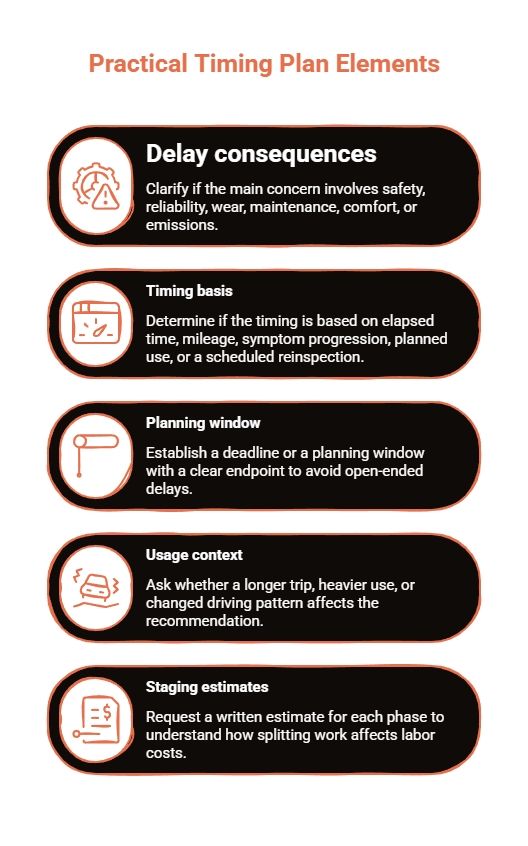
Words such as “recommended,” “soon,” and “when convenient” need a reason and a review point. Ask the provider to translate the label into a practical plan.
Begin with: “What could change if this repair is delayed?” The answer should clarify whether the main concern involves safety, reliability, wear, maintenance, comfort, emissions, or another category. Specific consequences vary by vehicle and condition, so broad predictions should be avoided.
Ask what the timing is based on: elapsed time, mileage, symptom progression, planned use, or a scheduled reinspection. A deadline and a planning window are different. A deadline indicates limited time for action; a planning window allows coordination but still needs an endpoint.
A lower-priority item should have a date, mileage point, symptom trigger, or follow-up visit attached to it. Otherwise, “later” can become open-ended.
Also ask whether a longer trip, heavier use, or changed driving pattern affects the recommendation. This gives the provider context for discussing reliability and scheduling without making every item urgent.
When repairs compete for a limited budget, do not rank them by price alone. Compare the evidence, safety implication, consequence of waiting, uncertainty, timing, and monitoring feasibility. Ask whether work can be staged and whether related findings should be addressed together. Staging may help planning, but it does not change the underlying condition. When staging these repairs, ask the provider to supply a written estimate for each phase so you understand how splitting the work might affect total labor costs or overlapping fees.
Give Monitoring a Baseline and a Change Trigger
Monitoring is useful only when defined. A baseline is the condition as it exists now. A change trigger is a provider-defined development that should prompt earlier contact or another evaluation.
A practical monitoring plan contains:
- The current condition.
- A safe observation method.
- A review interval or follow-up point.
- A worsening-condition trigger.
- The action to take when that trigger appears.
Ask whether the owner can realistically observe the condition and whether it may worsen without an obvious symptom. If personal monitoring is unreliable, a scheduled reinspection may be more appropriate.
Observation should not require touching hot parts, opening pressurized systems, reaching near moving components, or accessing energized equipment. The provider should define a safe method for the specific vehicle and condition.
In a hypothetical classic VW or Porsche, a previously discussed smell, vibration, leak pattern, drivability change, or gauge behavior may change. Report when the change occurs and what appears with it rather than naming a failed part.
For a modern OBD-era vehicle, a warning may become more frequent or appear with changed drivability. That context can support renewed evaluation, but it does not establish a universal cause or operating instruction.
See what responsible vehicle monitoring should include for more questions that help turn observation into a plan.
Bring Different Details for Classic and Modern Vehicles
Classic and modern vehicles do not always communicate problems in the same way. The useful description depends on the vehicle and what the driver can observe.
For Classic VW and Porsche Vehicles
For a classic VW or Porsche, report changes in smell, sound, leaks, drivability, vibration, or gauges. Note whether the condition is new, more frequent, or different from the vehicle’s established pattern.
Explain whether it appears cold, warm, at idle, under load, after sitting, or after recent service. Mention recent work as timing information, not proof of causation.
A concise hypothetical report could be: “A new smell appears after the vehicle warms up, and the idle now feels different. What should be inspected, and what change should prompt another call?” This supplies observable facts without assigning a cause.
For Modern OBD-Era Vehicles
For a modern OBD-era vehicle, describe the warning’s behavior and any accompanying change. Record whether it was steady, flashing, or intermittent, along with the exact wording or symbol if known.
Note whether other indicators appeared and whether braking, steering, temperature behavior, sound, smell, vibration, or drivability changed. Explain what happened beforehand, whether the warning cleared and returned, and whether there was recent service or battery work.
For example: “The warning appeared intermittently after startup, cleared later, and returned the next day. The vehicle hesitated once, and battery work was completed recently.” This is a symptom report, not a diagnosis.
Model-specific meanings and operating instructions can vary. Consult the applicable owner’s manual for the exact vehicle and model year, then seek vehicle-specific guidance from a qualified repair provider.
Explain How the Vehicle Is Actually Used
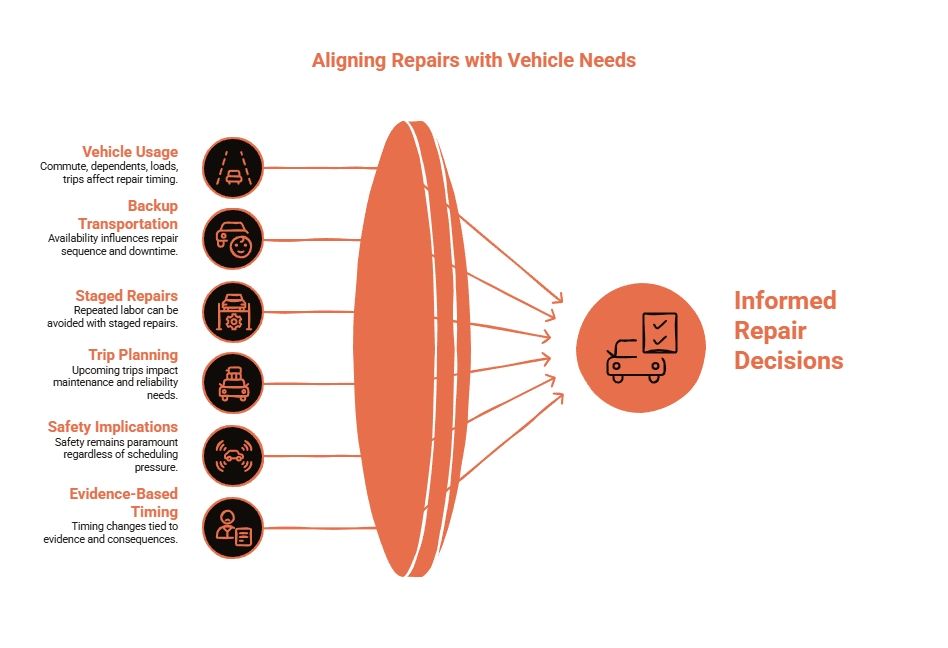
A technical finding does not change because a household has one vehicle, but use can affect planning. Explain whether the vehicle handles a long commute, carries dependents, operates under heavy loads, or has a longer trip planned.
Mention whether backup transportation is available and whether staged repairs could create repeated labor or downtime. These details help the provider explain how the recommendation fits the driver’s circumstances.
Consider a household with one primary vehicle, a regular commute, and an upcoming trip. Ask: “Does this use pattern change the recommended timing, repair sequence, or need for reassessment?”
Scheduling pressure does not make a safety implication less important. A planned trip also does not automatically make every maintenance or reliability item immediate. Any change in timing should be tied to the evidence and possible consequences.
Repeat the Plan Back Before Approving Work
Before authorizing the next step, summarize the plan and ask the provider to correct any misunderstanding.
Confirm:
- What was found and what evidence supports it.
- Whether the cause is confirmed or suspected.
- Whether the finding has a safety implication.
- What timeframe is recommended and why.
- What may change if work is delayed.
- Whether monitoring is appropriate.
- What the baseline and change trigger are.
- Whether vehicle use changes the recommendation.
- What the first approved step will determine.
- When the plan will be reviewed.
A useful repeat-back might be: “The first finding has the highest priority for the reason discussed. The second has a defined planning window. The third will be monitored from this baseline, with another call if the stated change appears. Is that accurate?”
This creates a shared understanding and gives another decision-maker a concise summary.
Frequently Asked Questions
What is the most important question to ask before approving a repair?
Ask what was found, what evidence supports it, and whether the concern mainly involves safety, reliability, maintenance, or comfort. Then request the timeframe and ask what would change the priority.
Does “monitor” mean the repair is not necessary?
No. Monitoring means the condition has a defined baseline, review point, and worsening-condition trigger. Whether repair is eventually needed depends on the finding, how it changes, and the provider’s vehicle-specific evaluation.
How can a driver ask whether a repair can wait?
Ask what may change if work is delayed, what timeframe is recommended, and what that timing is based on. Request a planning window or review point rather than an absolute assurance that waiting is safe.
What details should be reported when a problem is intermittent?
Note what happened beforehand, when the symptom appeared, and whether it changed with temperature, speed, load, or time. Record smells, sounds, leaks, vibrations, braking or steering changes, and drivability changes. For a modern vehicle, report whether a warning was steady, flashing, or intermittent.
Use the Questions to Build a Clear Repair Plan
A clear repair recommendation should explain the finding, evidence, priority, timing, uncertainty, and conditions that would change the plan. That information helps a driver authorize the next step without treating every item as equally urgent or assuming monitoring means inaction.
Orange Independent Auto Repair is a family-owned Orange, CA, shop serving drivers since 1971. The business states that fairness and honesty guide its customer treatment, and vehicle inspections are among its listed services. Prepare your questions, then contact Orange Independent Auto Repair to discuss a vehicle inspection or repair recommendation.
Disclaimer: This article is for general informational purposes only and does not constitute safety, technical, or professional advice. Vehicle conditions, risks, and appropriate next steps vary by vehicle and circumstance. Confirm repair, driving, towing, timing, and monitoring decisions with a qualified repair provider who can evaluate the specific vehicle.
Our Editorial Process
Our expert team uses AI tools to help organize and structure our initial drafts. Every piece is then extensively rewritten, fact-checked, and enriched with first-hand insights and experiences by expert humans on our Insights Team to ensure accuracy and clarity.
By Orange Independent Auto Repair Insights Team
The Orange Independent Auto Repair Insights Team develops owner-level, evidence-first guidance shaped by decades of hands-on experience serving classic VW and Porsche owners in Orange and the surrounding communities.