
One Older Car, One Household Budget: How to Separate Scheduled Maintenance From a Repair Reserve
📌 Key Takeaways
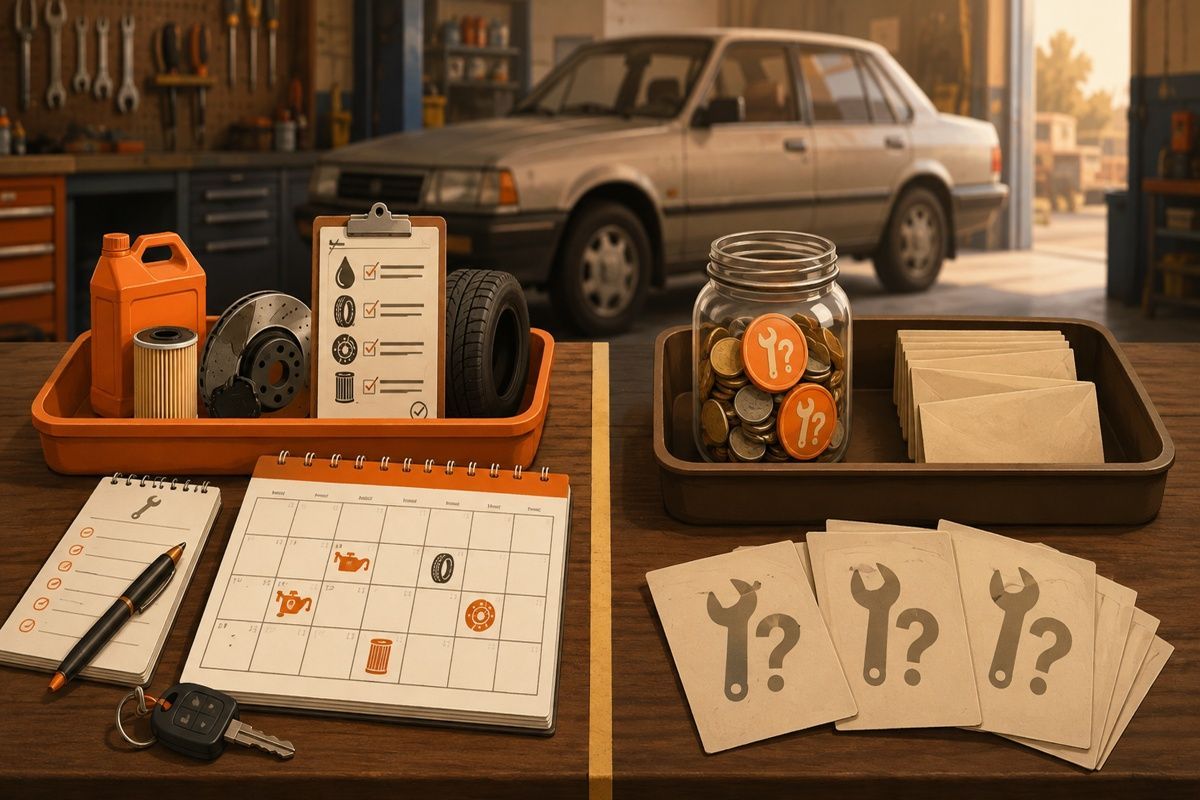
Separate predictable maintenance from uncertain repairs so one surprise does not make your entire car budget feel broken.
- Use Two Budget Buckets: Put scheduled maintenance on a calendar and keep separate money available for repairs you cannot predict.
- Keep Reserves Flexible: Do not assign repair money to guessed failures before the car or shop provides better information.
- Update The Plan: Record completed work, add future triggers, and move confirmed repairs from the reserve into defined budget items.
- Coordinate Work Carefully: Ask whether jobs are truly related before combining them into one service visit.
- Plan For Transportation: Build vehicle downtime into your calendar, especially when one car supports the entire household.
Plan what you know; reserve for what you do not.
One-car households will manage older-vehicle costs more clearly, using the maintenance calendar and service questions that follow.
~ ~ ~ ~ ~ ~ ~ ~ ~ ~ ~ ~ ~ ~ ~ ~ ~ ~
Your older car needs an oil change, the brakes were flagged at the last visit, a recheck is coming up for a slow leak, and the tires are getting close. None of these arrived out of nowhere, yet together they feel like one large, unplanned expense. For a household running on a single vehicle, that kind of quarter can make it seem like everything went wrong at once.
The problem usually isn't that everything went wrong at once; it's that scheduled maintenance and repair uncertainty are sharing the same mental budget. When both live in one category called "car repair," every invoice feels like a surprise, even when some of those costs were foreseeable.
A more useful approach splits vehicle spending into two tracks: a maintenance calendar for the work you can reasonably predict, and a repair reserve for everything you cannot. Once you have both in place, you can stop reacting to every invoice and start planning around it, with specific questions ready for your next service conversation.
Start With Two Buckets, Not One "Car Repair" Budget
Scheduled maintenance covers work that follows a known trigger: time, mileage, or a manufacturer's service schedule. Oil changes, fluid checks, filter replacements, and routine inspections all fall here. You may not know the exact date, but you can place each one on a calendar within a reasonable window.
A repair reserve is different. It exists because wear, age, and the unexpected do not follow a calendar. A component fails, an inspection reveals something new, or a noise appears that was not there last month. You cannot schedule these events, but you can hold money and flexibility aside for when they arrive.
Separating the two makes the plan easier to update. When you finish an oil change, it drops off the calendar and the next one goes on. When the shop identifies a new repair need, it draws from the reserve without disrupting the maintenance schedule you already built. If both categories share one pool, a single unexpected repair can make it feel like the entire plan collapsed.
Keep the money separate as well. If funds are already committed to scheduled maintenance, do not mentally count the same dollars again as available repair reserve. Double-counting creates a plan that looks stable on paper but collapses the moment both categories need money in the same month.
The reserve is not a prediction that a specific failure will happen. It is an acknowledgment that not every automotive need can be scheduled. That honesty makes the rest of the planning process more reliable.
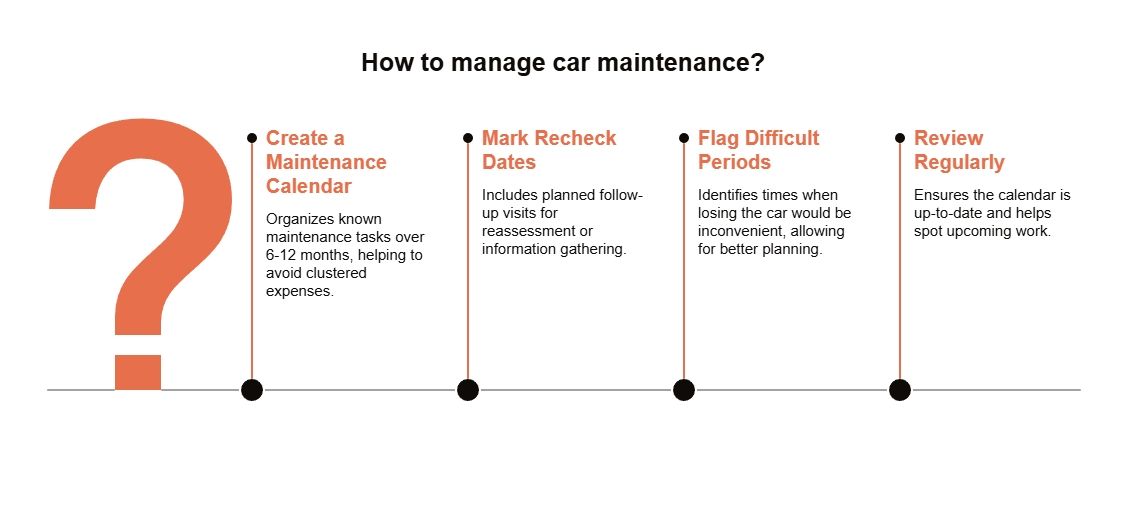
Put Known Maintenance on a 6 to 12 Month Calendar
Start with whatever service records you have. If the previous owner's records are incomplete, begin with what you can confirm and use a vehicle inspection or service conversation to fill gaps rather than guessing.
For each known maintenance item, record the trigger (time or mileage) and the approximate window when it will come due. An oil change every 5,000 miles or 12 months (whichever comes first) is a straightforward calendar entry. Other items follow the intervals in your owner's manual. If you are unsure of a specific interval, note the item and ask at your next appointment rather than guessing at the intervals.
Once you have a working list, layer in two additional details. First, mark any upcoming recheck dates. A recheck is a planned follow-up visit used to reassess a known condition or gather additional information. Its timing should come from the shop's guidance, not from a date you guess at random. It belongs on the calendar as its own entry. Second, flag periods when losing the car for a day would be especially difficult, such as weeks with medical appointments, school commitments, or heavy work schedules.
Review this calendar every month or two instead of rebuilding it only when a bill appears. A periodic check helps you spot clusters of upcoming work before they become a compressed expense.
Crucially, the maintenance calendar organizes household timing. It does not decide repair urgency. Questions about whether a particular repair requires prompt attention need to be based on the actual finding, its consequences, and guidance from the shop.
Maintenance Calendar vs. Repair Reserve Planner
| Item / Need | Known Maintenance or Uncertain Repair? | Time/Mileage Trigger (if known) | Planned Month or Visit | Recheck Needed? | Transportation Plan Needed? | Question for the Shop | Reserve Impact |
|---|---|---|---|---|---|---|---|
| Oil change | Known maintenance | 5,000 miles or 12 months | Next scheduled visit | No, unless advised | Note if needed | When should the next service be recorded? | None (scheduled) |
| Brake follow-up | Uncertain (depends on findings) | Shop-recommended recheck | Following visit | Yes | Possibly | Has wear changed since last check? | Reserve if findings warrant |
| Slow leak, monitored | Uncertain repair | Recheck date from shop | Following visit | Yes | Possibly | Is the leak rate or location changing? | Reserve held until recheck |
| Tires approaching replacement | Known (timing uncertain) | Tread and age | Summer | No | Yes | Coordinate with another visit? | Reserve for this window |
| New leak, noise, or drivability change | Uncertain repair | No maintenance trigger | Arrange evaluation rather than forcing an arbitrary deadline | Depends on findings | Possibly | What does the finding mean for timing and next steps? | Reserve remains available |
| Manufacturer service | Known maintenance | Per owner's manual | Check manual | No | Ask shop | Is the history clear enough to schedule this now? | Scheduled expense |
Adapt the rows to your own vehicle. The purpose is to separate what belongs on the calendar from what stays in the reserve and to identify questions worth asking before each visit.
Keep the Repair Reserve Unassigned Until the Car Gives You Better Information
The repair reserve is for uncertainty, which means you do not yet know what the money will be used for. Resist the urge to assign the reserve to a specific imagined failure. If you decide in advance that the reserve is "for the transmission" or "for the air conditioning," you have already spent it in your mind. That is spending the reserve twice: once in your mental budget and again when the actual need turns out to be something different.
Instead, let the car and the shop give you better information over time. A new noise, a fresh leak, a change in how the engine runs, or a finding from a vehicle inspection can convert part of the reserve from "unassigned" to a defined repair with a timeline behind it.
Consider how this works across a year. A household builds its calendar in January with known maintenance already assigned to planned visits. Months later, a new leak appears and a vehicle inspection identifies a repair need. At that point, part of the unassigned reserve can become associated with a real finding. Before the inspection, assigning that money to a specific guessed repair would have served no planning purpose.
Similarly, do not convert a shop's repair recommendation into a scheduling choice without understanding the timing involved and the consequences of waiting. The shop can explain what was found, how quickly it may change, and what happens if action is delayed. If you need help sorting which repairs need prompt attention and which can be monitored, that is a separate conversation from household budget planning.
The reserve works best when it stays flexible. Its job is to absorb what the calendar cannot predict.
Before Combining Work, Ask Whether the Jobs Are Actually Related
When several items appear on an estimate or come due around the same time, it is natural to wonder whether they can be handled in one visit. Sometimes coordination makes sense. Other times, the items only share a due date. Before assuming a shared appointment is automatically the better choice, ask a few questions:
- Are these items connected mechanically, or do they simply happen to be due around the same time?
- Would addressing them during the same visit change the evaluation or labor involved?
- Does one job need to happen before the other can be assessed accurately?
- Is there a reason to schedule a recheck between the two, and what information should you bring back for that recheck?
- Would separating the visits mean duplicating part of the evaluation?
The useful question is "could these be coordinated?" rather than "will combining them cost less?" Coordination may reduce duplicated steps in some situations, but that is a conversation to have with the shop based on the specific work involved.
If one item is scheduled maintenance and the other is a repair triggered by a recent finding, they may follow different timelines for good reasons. Let the shop help you decide whether combining makes sense for the work itself.
Staging visits can also be useful when the shop recommends it. One planned visit might address established maintenance or gather information. A later recheck becomes a separate calendar point. A subsequent repair visit should be added only when the underlying finding and timing are clear enough to define it. Staging in this sense is a coordination method, not permission to defer work on your own.
Build Transportation Planning Into the Maintenance Plan
For a household with one vehicle, every service appointment is also a transportation decision. The car will be unavailable for some period, and that period may be longer than expected if additional work is identified during the visit.
Build this reality into the plan rather than treating it as an afterthought. When placing maintenance on the calendar, note the weeks when losing the car would create the most disruption. Ask the shop what type of appointment is expected so you can make reasonable assumptions about vehicle downtime.
Keep transportation planning separate from repair-priority decisions. An inconvenient week does not change whether a repair is necessary, but it does affect when you schedule a planned maintenance visit or a recheck that the shop has confirmed can wait a short time. Having a backup plan for service days removes one source of pressure from the decision.
Rebuild the Plan When New Information Appears
The calendar and reserve are meant to change. Treating them as a fixed document defeats the purpose.
When a maintenance item is completed, remove it from the active calendar and record the date and mileage so the next trigger is clear. When an inspection or recheck reveals a new repair need, that finding shifts money from the reserve to a defined line item with a timeline. When the shop requests a follow-up, add the recheck to the calendar as its own future information point. If the underlying situation remains uncertain, keep the associated reserve flexible rather than guessing at a timeline. Items that are genuinely unknown stay in the reserve until the car or the shop provides enough information to assign a window.
A simple update cycle looks like this: record completed maintenance, then add the next known trigger. Add requested inspections or rechecks separately. Move newly defined repair needs out of the uncertainty category. Leave genuinely unknown future needs in the reserve. Update the household transportation plan when visit timing changes.
Keep invoices, service records, and notes from each visit. They become the starting point for your next planning cycle and help you ask better questions before approving future repairs. Over time, the record builds a clearer picture of your vehicle's maintenance rhythm. This is why the two-bucket system is useful: new information changes one part of the plan without forcing you to rebuild the entire household car budget.
Five Questions to Take to Your Next Service Conversation
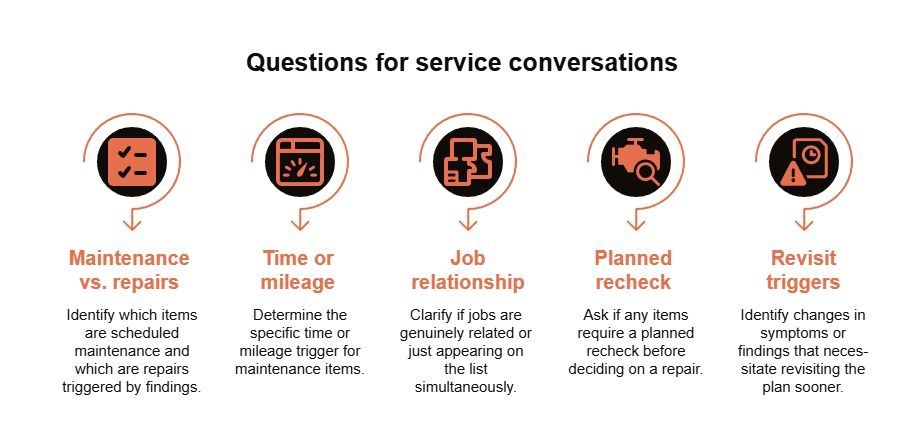
Bring these to your next appointment or phone call. They help translate a list of findings into a household plan.
- Which items on the list are scheduled maintenance, and which are repairs triggered by an actual finding?
- What time or mileage trigger applies to the maintenance items?
- Are any of these jobs genuinely related, or do they simply appear on the list at the same time?
- Does anything need a planned recheck before a repair decision is made?
- What change in symptoms, driving behavior, or inspection findings would mean we need to revisit this plan sooner?
These questions do not replace the shop's judgment about what needs attention. They help you organize the answers into your two-bucket system and plan the household side with more clarity. For a broader repair-decision conversation, see these questions to ask before approving repairs.
Frequently Asked Questions
How much money should I keep in a car repair reserve?
There is no universal figure. The amount depends on your household finances, the vehicle's age and condition, its service history, and your tolerance for risk. While the amount varies, setting aside $50 to $100 per month specifically into the reserve bucket is a common starting point for a well-maintained older vehicle. You can adjust this baseline up or down based on your car's age, parts cost, and your personal financial comfort. The goal is to keep some money separate from scheduled maintenance so that an unexpected finding does not force a rushed decision.
Does combining several services into one appointment always cost less?
Not necessarily. Whether coordination reduces duplicated steps depends on the specific work and whether the jobs are mechanically related. Ask the shop whether the items share evaluation, access, or labor before assuming a single visit is the more economical choice.
How do I decide which repair can wait?
That decision belongs to a repair-priority conversation with the shop, not to the maintenance calendar. Inspection findings, the nature of the issue, and its potential consequences should guide the timing. The household budget plan helps you organize money and scheduling around those decisions, but it is not a substitute for them.
A Better Plan, Not a Perfect Prediction
A good older-car budget does not predict every repair. It separates what the household knows from what it does not yet know, keeps those categories in different planning tracks, and updates the picture as new information arrives. The goal is not to eliminate uncertainty. It is to stop treating foreseeable maintenance and genuine surprises as the same kind of expense.
If you are ready to build your maintenance calendar or want help understanding recent findings on your vehicle, Orange Independent Auto Repair has been helping families in Orange, CA and the surrounding areas with honest, transparent vehicle care since 1971.
Disclaimer: This article is for general informational purposes only. It is not a substitute for advice from a qualified professional, provider, or official source relevant to your situation. Always verify important decisions with the appropriate expert, authority, or service provider.
Our Editorial Process
Our expert team uses AI tools to help organize and structure our initial drafts. Every piece is then extensively rewritten, fact-checked, and enriched with first-hand insights and experiences by expert humans on our Insights Team to ensure accuracy and clarity.
By Orange Independent Auto Repair Insights Team
The Orange Independent Auto Repair Insights Team develops owner-level, evidence-first guidance shaped by decades of hands-on experience serving classic VW and Porsche owners in Orange and the surrounding communities.