
Vehicle Inspection or Immediate Repair? How Orange-Area Families Can Choose the Right First Step
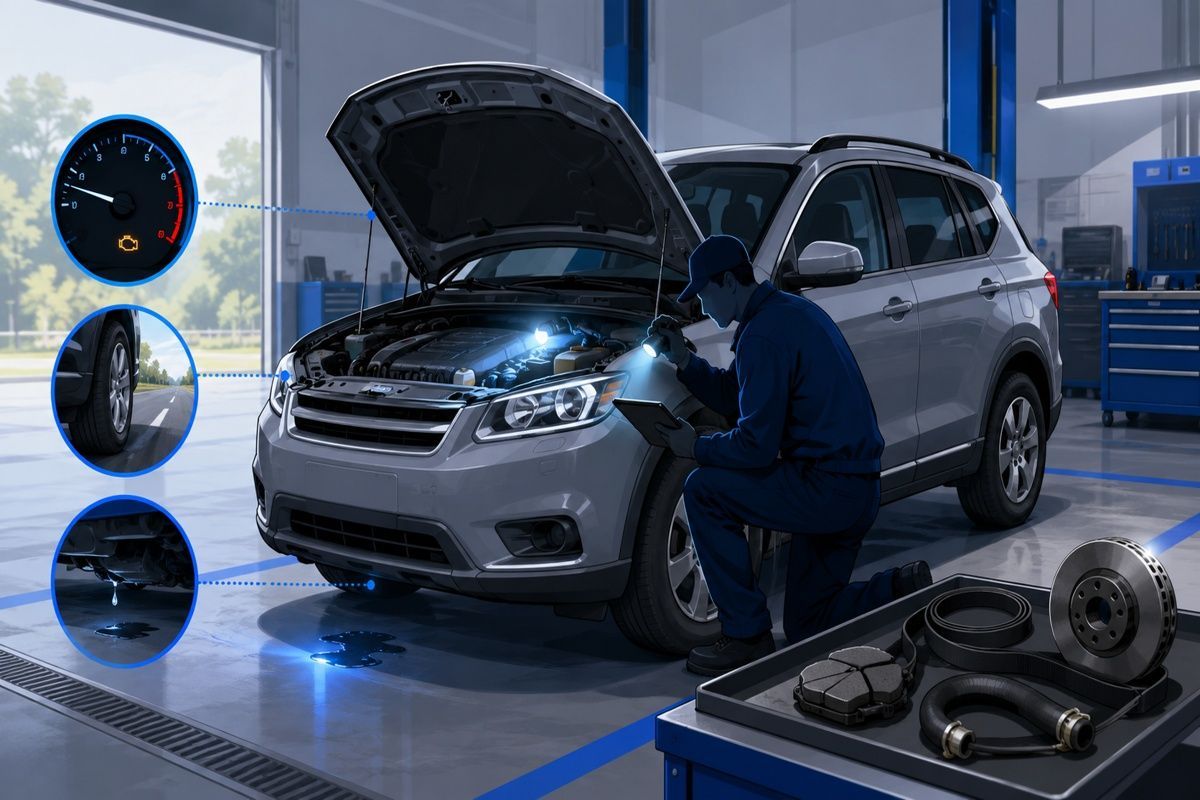
📌 Key Takeaways
When a vehicle problem is unclear, inspect it first so repair decisions follow evidence instead of guesses.
- Inspect Before Repairing: A symptom can justify evaluation without proving which part needs replacement.
- Report What Changed: Tell the shop when symptoms started, when they happen, and what sounds, smells, leaks, or driving changes appeared.
- Ask What Was Confirmed: Before approving work, understand the finding, supporting evidence, affected system, and recommended timing.
- Separate Repair Priorities: Ask which findings need prompt attention, which can be planned, and which can be monitored.
- Set Monitoring Triggers: If repair can wait, define what change should trigger another inspection or call to the shop.
Evidence first, repair approval second.
Orange-area families and commuters will make clearer repair decisions using the inspection and priority questions that follow below.
~ ~ ~ ~ ~ ~ ~ ~ ~ ~ ~ ~ ~ ~ ~ ~ ~ ~
Noticing a warning, smell, sound, leak, gauge change, or difference in how your vehicle behaves tells you that something has changed. It does not necessarily tell you which repair to authorize. When the specific cause has not been established, the first useful decision is usually whether the vehicle needs evaluation, not which part should be replaced.
For Orange-area families and commuters, that distinction matters. A vehicle inspection — an evaluation of the actual vehicle intended to establish useful evidence about the concern, affected systems, and appropriate next steps — gathers the information that supports a repair decision. Repair authorization should follow that evidence, not precede it. This applies whether you are noticing a concern for the first time or you have already received a repair suggestion and want to understand whether the problem was sufficiently evaluated before you say yes.
If a condition is obvious and worsening rapidly (active fluid loss, smoke, loss of braking or steering response, or a manufacturer warning that instructs you to stop), your vehicle's official guidance and professional assessment should take priority over any general article. For everything else, here is what to report, what an inspection should clarify, and what to ask before authorizing work.
An Inspection and a Repair Authorization Are Two Different Decisions
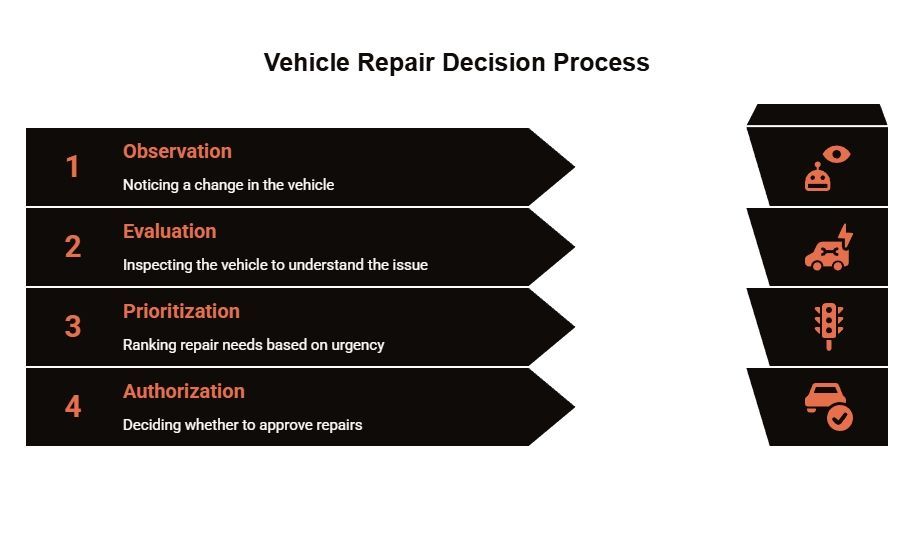
Most vehicle concerns move through a natural sequence, even when the process happens quickly:
- Observation: You noticed a change — a new smell, sound, leak, warning indicator, or shift in how the vehicle drives.
- Evaluation: A vehicle inspection examines the car to clarify what the evidence shows, which systems may be involved, and what remains uncertain.
- Prioritization: The provider separates findings by how urgently each one needs attention. Repair priority simply means the recommended order or timing for addressing findings based on what the inspection supports.
- Authorization: You decide whether to approve a specific proposed repair based on the evidence and explanation.
A symptom can justify evaluation without proving which component needs replacement. The important question is not simply, "What could cause this?" It is, "What has actually been confirmed on this vehicle?" When those steps get compressed into a single moment ("you need this repair"), the driver loses the chance to understand what was found and why the recommendation follows.
If you are wondering whether an inspection is just another expense before the real repair: when the cause is uncertain, evaluation is what supports a more informed repair decision. That does not mean an inspection always saves money. It means the repair you eventually authorize is backed by evidence rather than a plausible guess.
Inspection First or Repair Authorization?
| Question | Why Ask It |
|---|---|
| What has actually been confirmed so far? | Separates evidence from possibility. |
| Is the specific repair already supported by an inspection finding? | Clarifies whether repair authorization is premature. |
| Which findings affect safety or essential vehicle operation? | Establishes priority. |
| Which findings can be scheduled or monitored? | Helps plan timing. |
| If we monitor something, what change should trigger a recheck? | Makes monitoring actionable. |
This framework is a conversation tool, not a remote diagnosis. Its purpose is to help you determine whether the information available is strong enough to support the next decision.
Before the Inspection, Give the Shop a Useful Symptom History
You do not need to guess which part failed. You need to report what you experienced. Before your appointment, think through:
- Timing: When did you first notice the issue? Was it sudden or gradual?
- Recurrence: Does it happen every time you drive, only under certain conditions, or intermittently?
- Smells: Any new fuel, oil, coolant (a sweet odor on water-cooled vehicles), or burning smell?
- Sounds: New clicking, grinding, squealing, knocking, or any unfamiliar noise?
- Leaks: Fresh spots under the vehicle? Where and how much?
- Gauges or indicators: Any change in temperature, oil pressure, charging, or a new dashboard indicator?
- Drivability: Changes in starting, idling, accelerating, shifting, steering, or braking? Drivability means how normally or abnormally the vehicle starts, idles, accelerates, shifts, steers, or otherwise behaves.
- Recent service: Was any work performed recently? A new symptom after recent service is useful context to mention, though a new symptom after service does not automatically prove that the service caused it.
- Conditions: Does the issue appear when cold, warm, under load, at certain speeds, or in specific weather?
If the concern is intermittent, recording these details is especially important. The issue may not reproduce during the visit, but a clear observation history gives the provider a starting point even when the symptom is not active.
For a classic VW or Porsche, observations about smells, sounds, vibrations, leaks, gauge behavior, and drivability changes are especially valuable because these vehicles communicate through physical cues rather than electronic warning systems.
For a modern, OBD-era vehicle, note whether a dashboard indicator is steady, flashing, or intermittent, and whether the vehicle's behavior changed at the same time.
What a Useful Inspection Should Clarify Before You Say Yes to a Repair
An inspection should move the conversation from possibilities toward evidence and give you enough information to make a reasonable decision. Before authorizing work, four questions should be answerable from what the provider explains:
What was found? The provider should describe the specific condition, not just name a part. "The belt shows cracking and reduced tension" tells you more than "you need a new belt."
What does the evidence indicate? Ask whether the finding is confirmed through direct observation, testing, or measurement, or whether it remains a possibility requiring further evaluation. The provider should be able to explain why the finding matters in language you can understand.
What function or system is affected? Knowing whether the issue involves braking, cooling, fuel delivery, electrical charging, or drivetrain helps you gauge how the finding relates to safety and daily use.
What is the recommended timing? Ask whether the item needs prompt attention, can be planned within a reasonable window, or can be monitored with specific recheck conditions.
An inspection may narrow uncertainty considerably, but it does not guarantee absolute certainty in every situation. Some conditions require observation over time or additional testing. What matters is that the provider distinguishes confirmed findings from items that still need observation.
Authorizing an inspection does not mean agreeing to every repair the shop recommends afterward. The inspection produces information; you decide what to authorize based on that information. When scheduling a vehicle inspection, ask the provider to walk you through each finding and its timing before you approve individual repairs.
Ask for Findings to Be Separated by Safety, Timing, and Monitoring
One of the most common frustrations after an inspection is receiving a list of findings that all seem equally urgent. They rarely are. Repair priority — the order in which findings should be addressed based on evidence and consequence — is what turns a long list into a plan. Ask the provider to sort findings into categories:
Prompt attention: The evidence indicates the condition should not be deferred. The provider should explain what function is affected and what could change if the item is postponed.
Plan or schedule: The issue deserves action, but timing allows for planning. Ask when it should be addressed and what would make the priority shift.
Monitor: Current evidence supports observation rather than immediate repair. Monitoring means tracking a known condition against defined recheck triggers, not ignoring it. When a finding is placed in this category, ask:
- What should I watch?
- What change matters?
- When should I contact you again?
- Does my intended vehicle use (a long trip versus short daily commuting, for example) affect the timing recommendation?
Not established yet: More information is needed before a repair can be properly recommended. This is an honest answer, not a failure of the inspection.
This separation matters especially when a family cannot approve every recommendation at once. Imagine receiving five findings after an inspection but being unable to address everything immediately. The useful conversation is not simply, "Which repairs can we afford?" It is, "Which findings deserve prompt attention, which can be planned, and which can be monitored with a clear recheck condition?" Budget matters for planning, but cost alone should not determine how a safety-related finding is treated.
Time pressure matters too. You may need the vehicle for commuting, school runs, errands, or family transportation. That practical need should be part of the conversation, but convenience does not establish that continued operation is appropriate when a finding suggests otherwise.
Placing an item in a later category does not mean it will stay there. If a monitored item worsens, develops new symptoms, or behaves differently from what was described, contact your provider again rather than assuming the earlier recommendation still applies.
For a deeper look at how to evaluate repair priorities, see how to prioritize repair findings.
Classic Symptoms and Modern Warning Lights Need Different Conversations
The way you gather and report information depends on the vehicle.
Since vintage models lack electronic diagnostics, your physical observations serve as the primary diagnostic tool. Report the pattern and the change from normal, not a guessed diagnosis. Avoid turning an observation into a guessed component failure — the useful information is what changed, when, and under what conditions.
Modern, OBD-era vehicles may display dashboard indicators that signal system-level concerns. Report whether the light is steady, flashing, or intermittent, and whether other behavior changed at the same time. A warning indicator tells you a system needs professional attention, but a warning light or trouble code alone should not be treated as proof that a particular component needs replacement. A trouble code narrows the area of concern; the inspection is what determines the specific condition and appropriate response. For example, a P0300 code tells the technician the engine is misfiring, but it takes an inspection to determine if the cause is a faulty spark plug, a vacuum leak, or a failing ignition coil. Your vehicle's owner's manual is the most reliable reference for what a particular indicator means.
A vehicle that feels normal is not automatic proof that nothing needs attention. Some conditions develop gradually or affect systems that do not produce obvious symptoms until the issue progresses. The absence of an obvious drivability change does not replace vehicle-specific guidance or inspection findings.
Whether you drive a classic VW or Porsche or a modern car, the principle is the same: describe what changed, and let the inspection determine what it means.
Six Questions to Ask Before Authorizing the Repair
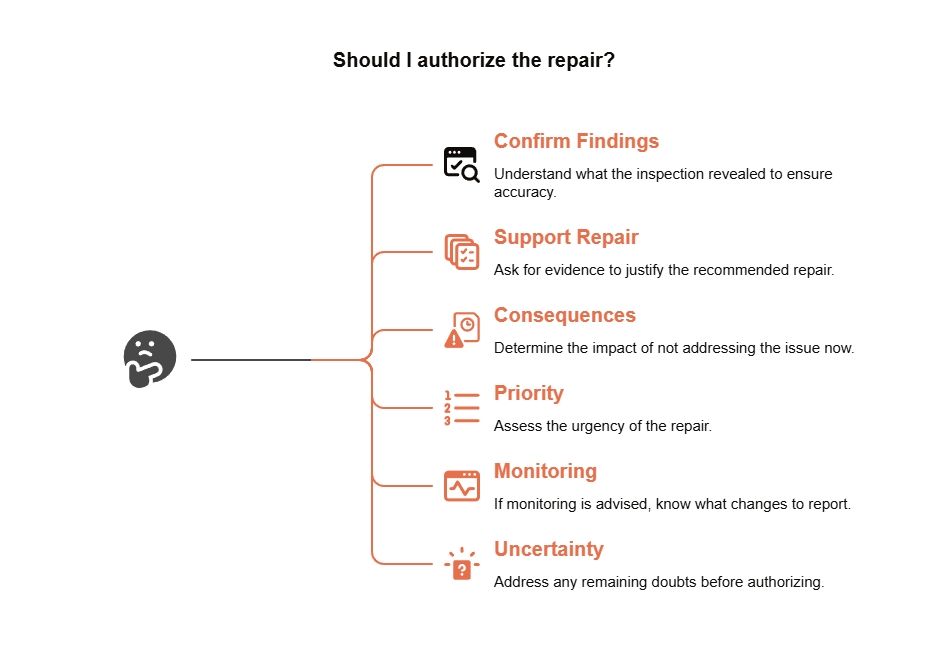
Once the provider has shared findings, these questions can help you make a confident decision:
- What did the inspection confirm?
- What evidence supports this specific repair recommendation?
- What happens if this item is not addressed now?
- Is this a prompt priority, a planned item, or something to monitor?
- If monitoring is reasonable, exactly what change should I report?
- Is there anything still uncertain that needs another check before work is authorized?
These questions are not adversarial. A provider who values transparent communication will welcome them, whether the recommendation came from this inspection or from a previous visit where you want more clarity.
For additional guidance, see questions to ask before approving repairs.
Frequently Asked Questions
Should I approve a repair if the shop has not confirmed what is causing the symptom?
Ask what evidence supports the proposed repair and whether an inspection or additional evaluation would be a more appropriate first step. Some repairs may already be supported by clear findings. When the cause remains uncertain, evaluation is the step that helps establish whether a specific repair is supported in the first place.
What should I tell the repair shop before an inspection?
Describe when the concern started, whether it is steady or intermittent, any new smells or sounds, changes in leaks or gauge readings, drivability differences, and recent service. These details help the inspection focus, even if the symptom does not reproduce during the visit.
What does it mean if a finding can be monitored?
It means the current evidence supports observation rather than immediate repair. Monitoring should include a defined condition to watch, a specific change that matters, a clear trigger for contacting the provider again, and consideration of whether your intended vehicle use affects the recommendation. If the condition changes or worsens, follow up.
Make the Repair Decision After the Information Is Clear
The sequence is worth remembering: observe what changed, have the vehicle evaluated, understand the findings, establish priority, then authorize the appropriate work. That process gives you a clearer basis for deciding what deserves attention now, what can be planned, what may be monitored, and what still needs clarification.
Disclaimer: This article is for general informational purposes only and does not constitute compliance, safety, technical, or professional advice. Requirements, risks, and best practices may vary by context, jurisdiction, system, provider, or use case. Confirm important decisions with the appropriate qualified professional, authority, or technical expert.
Our Editorial Process
Our expert team uses AI tools to help organize and structure our initial drafts. Every piece is then extensively rewritten, fact-checked, and enriched with first-hand insights and experiences by expert humans on our Insights Team to ensure accuracy and clarity.
By Orange Independent Auto Repair Insights Team
The Orange Independent Auto Repair Insights Team develops owner-level, evidence-first guidance shaped by decades of hands-on experience serving classic VW and Porsche owners in Orange and the surrounding communities.