Service History Gaps in an Older Family Car: How Orange-Area Owners Can Build a Maintenance Baseline
📌 Key Takeaways
Build a maintenance baseline from verified records, then use professional review to address gaps without guessing or repeating every service.
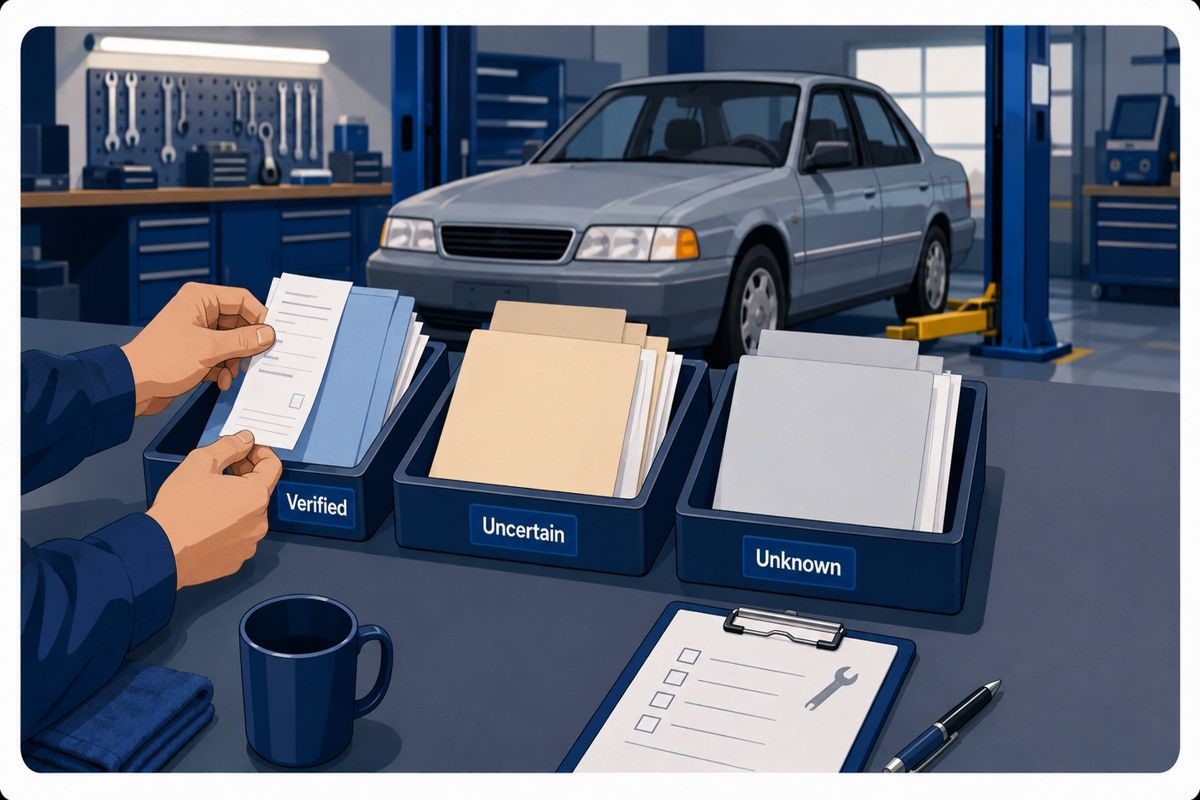
- Treat Gaps as Unknowns: Missing paperwork means a service is unverified, not that someone definitely skipped the work.
- Separate Facts From Guesses: Mark each item verified, uncertain, or unknown so memories and incomplete records never become false facts.
- Preserve Dates and Mileage: Record only supported dates and mileage, because guessing either can create a misleading maintenance schedule.
- Bring Organized Evidence: Give the shop your records, current mileage, unresolved questions, and recent observations so its review can focus efficiently.
- Keep the Baseline Current: Record each future service with its date, mileage, completed work, provider, and invoice.
A trustworthy baseline beats a perfect-looking history.
Owners of older family cars will make better maintenance decisions using this baseline, preparing them for the detailed process below.
~ ~ ~ ~ ~ ~ ~ ~ ~ ~ ~ ~ ~ ~ ~ ~ ~ ~
An older family car can come with years of useful receipts and still leave one uncomfortable gap: nobody can say exactly what happened during the years without paperwork. The glovebox might have invoices from 2018 and 2021, with nothing covering the time in between. Or a family member might be sure the brakes were serviced 'a while back,' even if no one can point to a date or a shop name.
The solution isn't assuming everything was neglected, nor is it repeating every possible service from scratch. A maintenance baseline is a clear record of what you can verify, what remains uncertain, and what is genuinely unknown. Start there, then use a professional review to resolve what paperwork alone cannot answer.
By the end, you will know how to organize an incomplete history, what information to bring into a vehicle inspection or maintenance conversation, and how to keep the record useful going forward.
A Missing Record Is an Unknown, Not Proof a Service Was Skipped
The most common mistake with incomplete records is treating a missing receipt as proof that work was never done. A service may have been completed at a shop that has since closed, by a previous owner who kept separate files, or by a family member who paid cash and never saved the paperwork. Missing documentation means the history is unverified, not that the vehicle was ignored.
A receipt proves someone paid for a service, but if the invoice has no odometer reading or clear description, it leaves its own kind of uncertainty. Even two records covering the same service can contain conflicting dates or mileage figures. When that happens, keep the conflict visible rather than choosing whichever number seems most likely. Invented consistency is less useful than honest ambiguity.
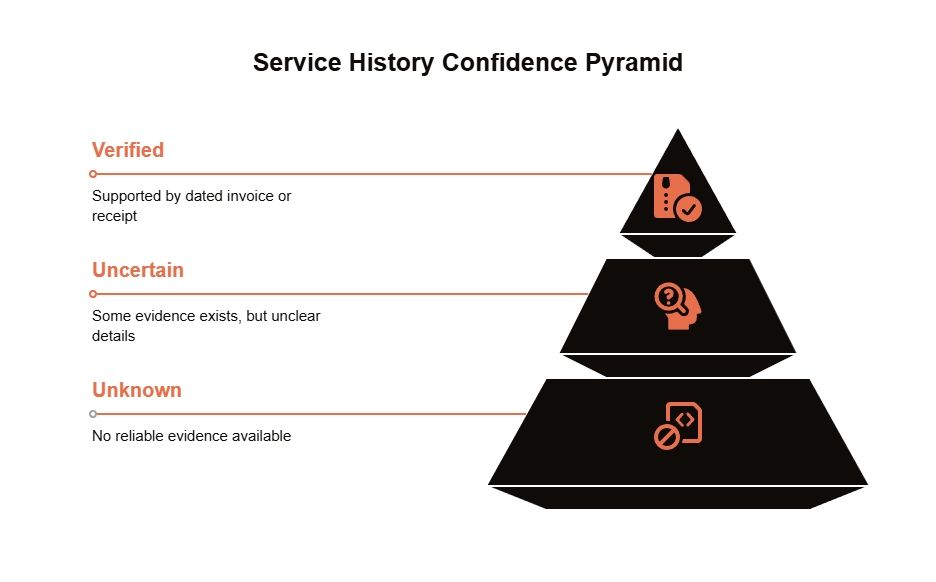
Rather than forcing every item into "done" or "not done," sort your evidence into three confidence categories:
Verified: Supported by a dated invoice, receipt, or service record that identifies the work, the date, and ideally the mileage. Example: an invoice showing an oil change on a specific date at a recorded odometer reading.
Uncertain: Some evidence exists, but the date, mileage, or exact service is unclear. Example: a handwritten note saying "coolant done" with no date or shop name.
Unknown: No reliable evidence is available. Example: no record of any kind for a particular maintenance item.
These labels keep the record honest. An uncertain item still carries useful information, and an unknown item is a question for professional review, not an automatic work order. A family member who remembers "the transmission was serviced a few years ago" is providing something real, even if details cannot be confirmed. Keep that recollection as an uncertain note. Do not discard it, and do not upgrade it to verified history.
Build the Baseline From What You Can Verify
Gather every piece of maintenance documentation you can find: invoices, receipts, service-book stamps, handwritten notes, and any records from previous owners or family members. Beyond physical paperwork, check digital vehicle history reports like Carfax or AutoCheck. Many modern repair shops automatically report mileage and service types to these databases, meaning a missing paper invoice might still exist as a verified digital record. If several repair shops were involved over the years, combine the records before drawing conclusions, and write down the names of previous shops when you know them. Those details may help you organize existing paperwork or explain where particular records came from. Record the current odometer reading, because every future maintenance decision will reference the mileage you start from today.
Work through the records one item at a time. For each service you can identify, note the date and mileage only when the evidence actually provides them. Do not reconstruct missing mileage by estimating annual driving. If the information is not on the paperwork, mark that field as unavailable. When records contain conflicting dates, mileage, or service descriptions, flag the conflict rather than resolving it by guesswork.
Keep lower-confidence information in a separate column rather than converting it into fact. Mark genuinely unknown items as unknown, and list questions that require professional review.
A family member's memory should not be discarded. It may help explain the history. It simply belongs at a lower confidence level until supporting documentation is available.
The baseline is not intended to prove the car is mechanically sound. It is a planning record that shows where your information is strong, where it has gaps, and where a professional can help.
Maintenance Baseline Worksheet
| Maintenance Item / System | Last Verified Date | Mileage at Verified Service | Evidence Source | Confidence | What Remains Unknown | Question for Shop / Next Window |
|---|---|---|---|---|---|---|
| Oil service | MM/YYYY | XX,XXX miles | Invoice from shop | Verified | None about last service | Confirm next planned interval |
| Coolant service | Unknown | Unknown | Handwritten note, no date | Uncertain | Date, mileage, exact work | Review history and current condition |
| Brake service | No record | No record | None | Unknown | Whether prior work occurred | Evaluate during professional review |
| Transmission service | MM/YYYY | Not on receipt | Partial receipt | Uncertain | Mileage at service | Discuss based on current mileage |
Adapt this structure for each system or service you want to track. Blank fields are more useful than invented numbers.
You do not need to understand car mechanics to fill this out. Good preparation means organizing evidence and questions, not diagnosing the vehicle yourself.
Separate Mileage History From Elapsed-Time Uncertainty
An odometer reading tells you how far the car has traveled, but it does not tell you when a specific service was last performed unless the records include that detail. Some old invoices show a date but no mileage. Others show mileage but no date. Either gap matters, because many maintenance items are planned around both distance and elapsed time.
Preserve whichever facts the records support. If an invoice contains a service date but no mileage, keep the date and leave the mileage unknown. If you know the mileage but cannot establish when the work occurred, record the mileage without inventing a date.
For example, a common oil-change guideline is 5,000 miles or 12 months, whichever comes first. If you have an invoice showing an oil change at 87,000 miles but no date, and the car now reads 90,000, the mileage gap looks manageable. However, without a date, you are flying blind on the time requirement; that invoice could easily be three years old, at which point the elapsed time tells a different story.
Low annual mileage does not automatically resolve time-based uncertainty. Fluids, rubber components, and seals can degrade with age regardless of how far the car has driven. The exact requirement varies by vehicle and service item, so the vehicle's owner's manual is the most reliable source for model-specific intervals. A generic maintenance chart should not replace vehicle-specific manufacturer documentation.
A car that "runs fine" may feel normal on your daily commute, but current drivability and documented maintenance history answer different questions. One describes how the vehicle behaves right now; the other describes what care has been confirmed over time. Both matter.
When the underlying last-service date or mileage is unknown, note both gaps in your baseline and bring the question to a professional review rather than guessing at a due date. Do not calculate an exact due date from an uncertain last-service point.
Give the Shop a Clean Evidence Packet, Not a Guess
The quality of information you bring shapes the quality of recommendations you receive. A new shop cannot reconstruct undocumented history with certainty, but organized evidence helps them focus on what matters most. Arriving with three clearly identified unknowns is far more productive than saying, "I have no idea what this car needs."
What to bring:
- Consolidated receipts and invoices, sorted by date if possible
- Your current odometer reading
- Your completed baseline worksheet (or a simple list of verified, uncertain, and unknown items)
- A separate note for family recollections or verbal claims you cannot verify
- Previous repair shop names, when known
- Conflicting or incomplete records, kept visible rather than pre-resolved
- Current observations you want to discuss: noises, smells, leaks, changes in how the car drives, or anything that has appeared recently
When describing those current observations, stick to what you have actually noticed rather than jumping to a conclusion. "I have noticed a new vibration at highway speed" gives the shop something specific to evaluate. "The transmission is failing" makes a diagnosis the available evidence may not support. Describe what changed; let the professional determine why.
Questions worth asking during the review:
- Which maintenance items can the existing records confirm?
- Which items remain unknown from the available documentation?
- Can current condition help clarify any of the uncertain items?
- Which items deserve professional review now, and which can be planned for a future maintenance window?
- What should be documented going forward so the baseline stays useful?
A maintenance window is not a declaration that something is already overdue. It is a future planning point based on the information available at the time, giving you a reasonable target for when to revisit a particular service item.
A vehicle inspection adds current-condition information that paperwork alone cannot provide. It can reveal wear patterns, fluid condition, and observable evidence that may narrow your list of unknowns. What it cannot do is retroactively prove that every undocumented service was or was not performed.
There is a distinct difference between the two: your documentation tells what is verified from the past. An inspection evaluates what can be observed now. They answer different questions, and both contribute to a reliable baseline.
Professional review should also help avoid treating every unknown as equally urgent. For a household working within a maintenance budget, the useful question is what the evidence and current findings support, not how large a service list can be created from missing paperwork.
If you own a classic VW or Porsche, the same baseline method applies, though a shop experienced with these vehicles may look for era-specific concerns (such as fuel system condition, aging seals, or ignition components) that differ from modern vehicle priorities.
Leave With a Baseline You Can Maintain Going Forward
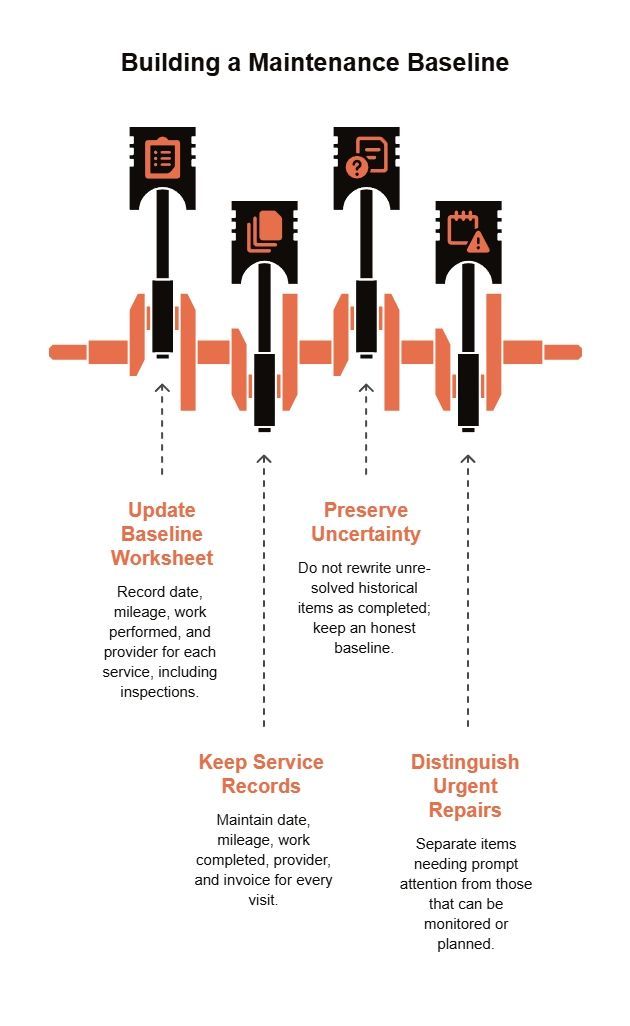
After your professional review, update the baseline worksheet with the findings. Record the date, mileage, work performed, and the provider for each service. If something was inspected and found to be in acceptable condition, note that too, because it becomes part of your verified record.
Going forward, keep four things together for every service visit: the date, the vehicle's mileage, the work completed, and the provider and invoice. When a shop recommends future maintenance, ask for the reasoning and a time or mileage window so you can plan rather than react.
Preserve uncertainty where it still exists. If a historical item was never resolved, do not rewrite it as "completed" simply because time has passed or because newer records are complete. An honest baseline is more useful than a tidy one.
If a professional review produces a longer list of recommendations than expected, the next step is distinguishing items that need prompt attention from those that can be monitored or planned. For guidance on how to separate urgent repairs from items that can be monitored, that conversation is worth having with your provider. Do not try to resolve every finding in a single visit unless the evidence supports it.
The goal is not a perfect history. It is a trustworthy starting point from which future maintenance can be planned with confidence.
Frequently Asked Questions
Should I repeat every maintenance service if I cannot find a record?
Not necessarily. A missing record means the service history is unknown for that item, not that the work was definitely skipped. Treat unverified items as questions for a professional maintenance review rather than automatic work orders. The shop can evaluate current condition and help you decide which items deserve attention now and which can be planned for a future window.
Can a repair shop tell whether an undocumented service was performed?
Sometimes current condition provides useful clues. A technician may observe that fluid appears recently changed or that a component shows minimal wear. But an inspection cannot reliably recreate every historical service event. Separate what the shop can observe today from what remains historically unverified. Some questions may remain unknown even after the vehicle has been evaluated.
Shouldn't a new repair shop already know what maintenance was done?
Not if the previous work was undocumented or those records were never transferred. A new provider can review the paperwork you supply and evaluate the vehicle's current condition, but it cannot know undocumented history with certainty. That is why organizing previous invoices, shop names, mileage, and uncertain recollections before the visit makes the conversation more productive.
What records should I bring when establishing a maintenance baseline?
Bring any receipts, invoices, or dated service records you have, along with your current odometer reading. Include prior-owner notes, family recollections (marked as uncertain), previous mileage entries if available, and a simple list of items you cannot account for. Current observations, such as new noises or fluid spots, are also helpful.
Is mileage or time more important for maintenance on an older car?
It depends on the maintenance item and the vehicle. Some manufacturer schedules use mileage, some use elapsed time, and many use whichever threshold comes first. When records leave both the date and mileage of a prior service unknown, note both gaps and discuss them during a professional review. The vehicle's owner's manual is the best source for the specific requirements that apply to your car.
A Reliable Starting Point, Not a Perfect History
An incomplete service history does not have to become an all-or-nothing maintenance decision. Structure your findings clearly, separate the proven facts from the guesswork, and let an experienced technician fill in the blanks during your next shop visit. Bring your records, your current mileage, and your list of unknowns to your next maintenance conversation.
Orange Independent Auto Repair, a family-owned Orange repair shop since 1971, offers vehicle inspections that can help turn remaining uncertainty into a clear, practical maintenance plan. You can contact Orange Independent Auto Repair to schedule service.
Disclaimer: This article is for general informational purposes only and does not constitute compliance, safety, technical, or professional advice. Requirements, risks, and best practices may vary by context, jurisdiction, system, provider, or use case. Confirm important decisions with the appropriate qualified professional, authority, or technical expert.
Our Editorial Process
Our expert team uses AI tools to help organize and structure our initial drafts. Every piece is then extensively rewritten, fact-checked, and enriched with first-hand insights and experiences by expert humans on our Insights Team to ensure accuracy and clarity.
By Orange Independent Auto Repair Insights Team
The Orange Independent Auto Repair Insights Team develops owner-level, evidence-first guidance shaped by decades of hands-on experience serving classic VW and Porsche owners in Orange and the surrounding communities.