
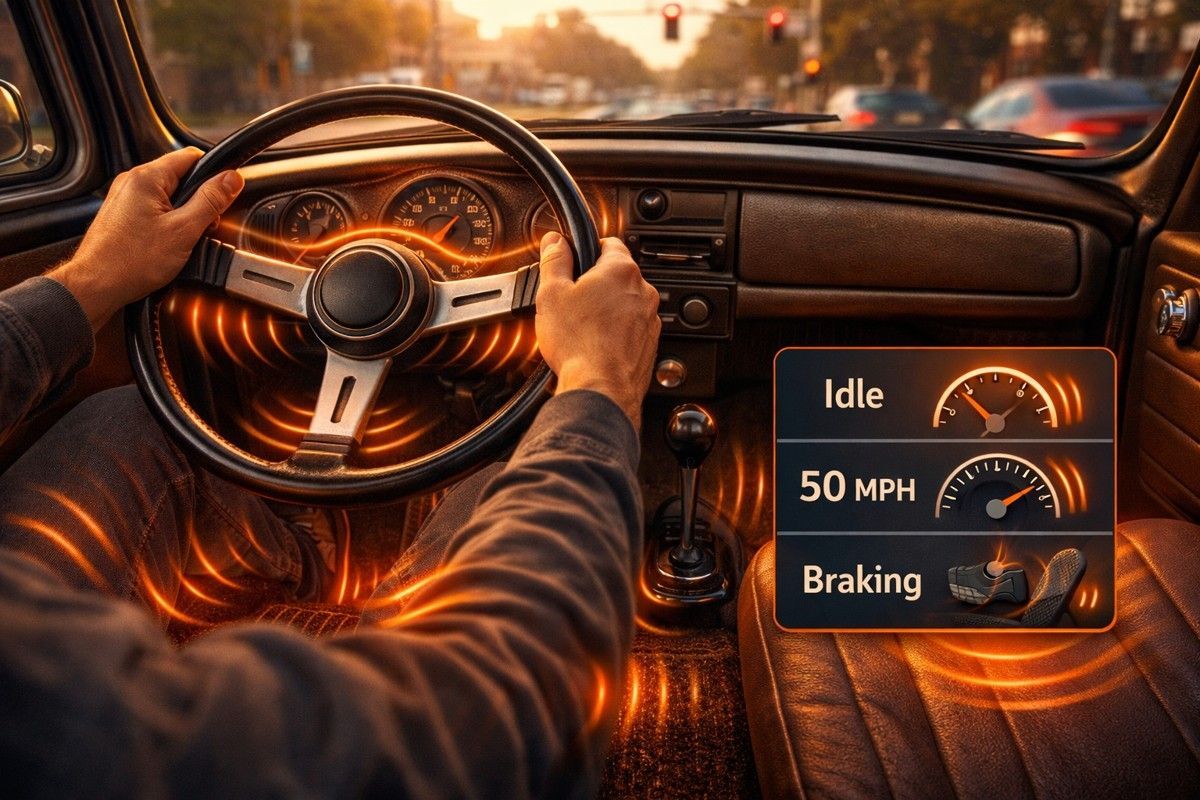
Feeling the Floorboards: What Engine Vibrations Tell You on a Test Drive
📌 Key Takeaways
Test-drive vibrations in classic cars reveal hidden problems—learning to notice patterns helps you negotiate smarter and avoid costly surprises.
- Idle Shakes Point to Mounts: A vibration that only appears when stopped often means worn engine or transmission mounts need inspection.
- Speed-Specific Shakes Suggest Wheels or Suspension: A shimmy that starts around 45–55 mph and fades outside that range usually indicates tire balance or suspension wear.
- Note When, Where, and How Strong: Write down the exact conditions—idle, specific speed, under load—so you can give a specialist clear information later.
- Character vs. Problem: Old cars vibrate naturally, but a shake that's harsh, repeatable, and tied to one condition deserves professional attention before you buy.
- A Short Drive Can't Replace an Inspection: Use test-drive observations to decide whether a pre-purchase inspection is worth booking—it usually is.
What you feel through the floorboards is data—use it before your wallet pays the price.
Buyers considering a classic VW or Porsche will learn how to separate normal vintage-car feel from warning signs, preparing them for the detailed inspection guidance that follows.
~ ~ ~ ~ ~ ~ ~ ~ ~ ~ ~ ~ ~ ~ ~ ~ ~ ~
The light turns red. You ease to a stop, and there it is—a harsh, rattling vibration climbing through the floorboards, traveling up the steering column, and settling into your hands. The seller glances over, casual as ever. "These old cars just have character," he says.
Maybe. But that vibration is telling you something, and you should listen before your wallet does.
Classic VWs and Porsches communicate differently than modern vehicles. There are no warning lights for worn mounts, no dashboard alerts for a tired suspension. Instead, these cars speak through your senses—through what you hear, smell, and especially what you feel. These cars do not hide much. That directness is actually an advantage for a buyer who knows what to look for. Learning to interpret that language during a short test drive can mean the difference between a confident purchase and an expensive regret.
What a Vibration Can Tell You Before the Seller Says a Word
Every classic car vibrates. The question is whether what you're feeling falls within the normal range of vintage machinery or signals something that demands attention—and a professional diagnosis.
The goal during a test drive isn't to diagnose the exact problem. That's what a
pre-purchase inspection is for. Your goal is simpler: notice patterns, note conditions, and know which patterns warrant concern.
Step 1: Separate Normal Classic-Car Feel from a Problem Worth Chasing
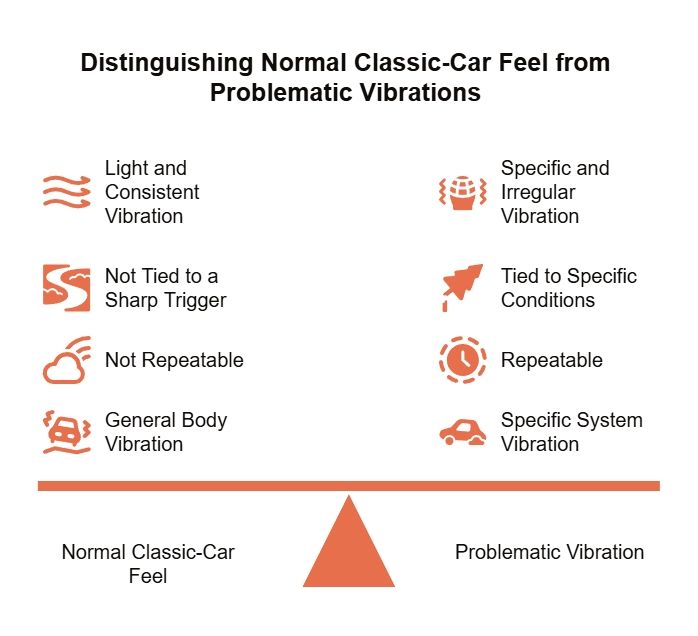
Old cars are not isolation chambers. A certain amount of mechanical presence is expected—the thrum of an air-cooled engine, minor steering wheel feedback on rough pavement, the occasional shimmy at highway speed. None of this necessarily indicates trouble.
A normal old-car feel is usually light, consistent, and not tied to one sharp trigger. A problem pattern is more specific—it appears at one speed, only at idle, or gets stronger when the engine is working harder.
What separates normal character from a warning sign comes down to three factors: pattern, repeatability, and condition.
Pattern means the vibration follows a recognizable behavior. Does it happen every time you stop? Only above 45 mph? Exclusively when accelerating?
Repeatability confirms you're not imagining things. If a shake appears once and never returns, it may have been a road surface anomaly. If it shows up reliably under the same conditions, that's data.
Condition ties the vibration to a specific circumstance. Idle vibrations behave differently than speed-related ones, and the distinction points toward entirely different systems.
The seller may wave off what you're feeling. Your job is to observe without arguing and remember what you noticed. Write the symptom down as soon as you notice it—memory gets fuzzy fast after a ten-minute drive.
Step 2: If It Shakes at Idle, Think Mounts First
A heavy vibration that appears only when the car is stationary—at a stoplight, in a parking lot, during warm-up—often points to failing engine or transmission mounts. These rubber components absorb the natural movement of the powertrain. When they deteriorate, that movement transfers directly into the chassis, the steering column, and your hands.
This matters for negotiation. Mount replacement isn't catastrophic, but it isn't free either. If the steering wheel shakes noticeably while you're sitting still with the engine running, you've just identified a concrete item to direct a specialist toward during a professional evaluation.
Idle removes a lot of variables. The car isn't fighting road speed, tire balance, or suspension movement in the same way. If the shake is obvious while stopped, the problem is closer to how the drivetrain sits in the car rather than how the car rolls down the road.
The classic air-cooled engines in vintage VWs and Porsches generate noticeable vibration by design. But there's a difference between the steady, predictable pulse of a healthy engine and a harsh, irregular shake that rattles through the car. Trust your instincts here. If it feels wrong, it probably warrants a closer look.
Step 3: If It Shows Up Only at Speed, Think Wheels or Suspension
Vibrations that appear only when the car is moving—and especially vibrations that emerge within a specific speed range—suggest an entirely different set of culprits.
A shake that starts around 45-55 mph and fades above or below that window often indicates wheel balance issues. Tires that are out of balance create a harmonic vibration at certain rotational speeds. This is generally the least concerning category because rebalancing is straightforward and inexpensive.
A vibration that worsens progressively with speed, or one that never quite goes away once it appears, may point toward suspension components—worn bushings, tired shocks, or compromised wheel bearings. These carry more significant repair implications.
Pay attention to where you feel the vibration most strongly. Steering wheel shimmy often traces back to front-end components. A shake felt primarily through the seat may originate from the rear suspension or drivetrain. This information helps a specialist narrow down the source more quickly during a proper inspection.
Step 4: Use a Simple Vibration Isolation Matrix During the Drive
During your test drive, mentally run through this decision framework:
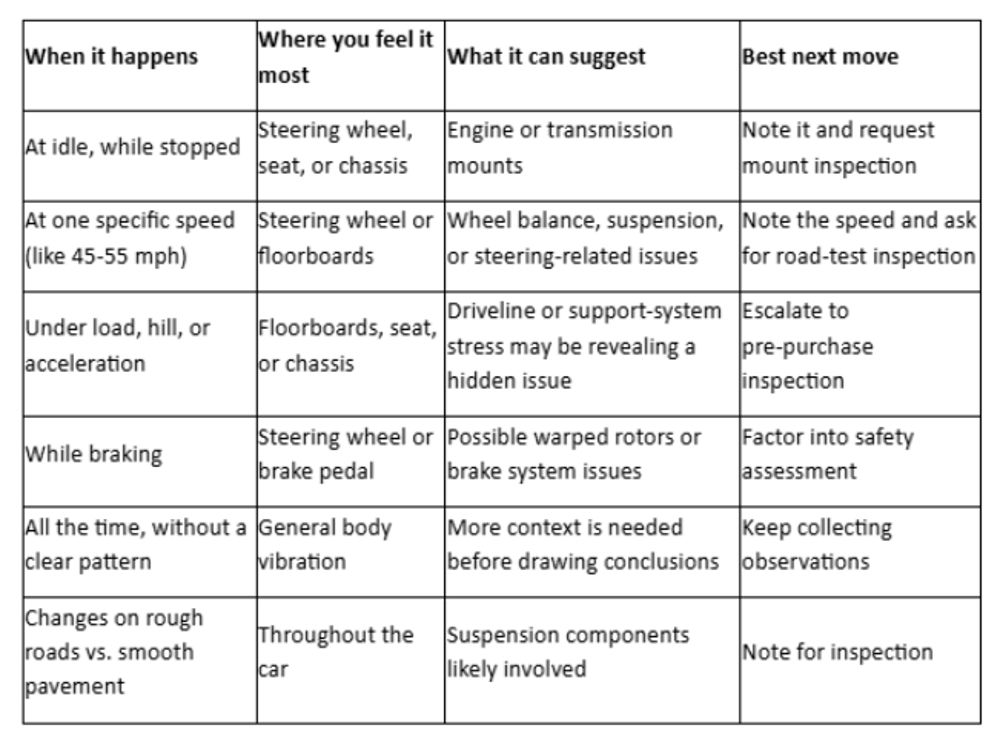
This matrix is not a diagnosis chart. It's a buyer's note-taking tool. Use it that way.
What to Write Down Before You Negotiate or Book an Inspection
Before you leave the test drive, capture four pieces of information:
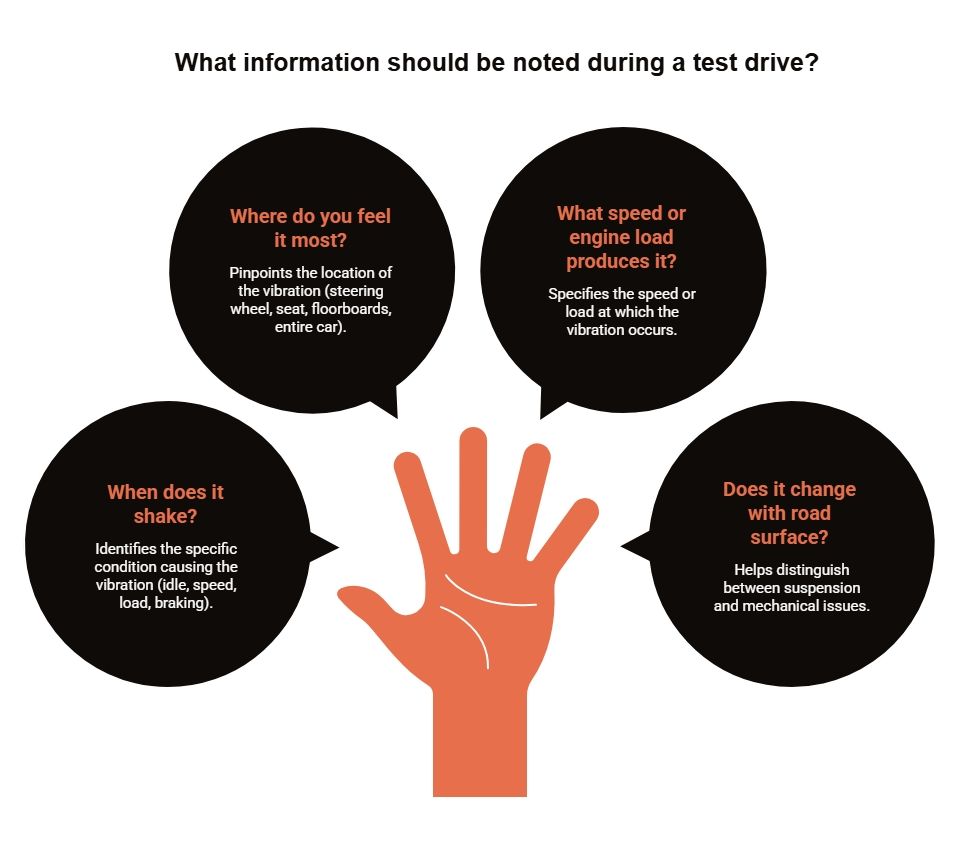
When does it shake? Note the specific condition—idle, a particular speed, under load, or during braking.
Where do you feel it most? Steering wheel, seat, floorboards, or throughout the entire car?
What speed or engine load produces it? Be as specific as possible. "Around 50 mph" is more useful than "at highway speed."
Does it change with road surface? This helps distinguish suspension-related issues from internal mechanical problems.
These notes transform vague impressions into concrete talking points. Instead of saying "it felt weird," you can say "there's a noticeable vibration at idle that I'd like inspected before we finalize anything," or "the car develops a shake around 50 mph that wasn't present at lower speeds."
This positions you as an informed buyer—someone who noticed details and took them seriously. Sellers respond differently to that kind of attentiveness.
When to Stop Guessing and Schedule a Pre-Purchase Inspection
A thoughtful test drive helps you avoid obvious mistakes and identifies patterns worth investigating. But a short drive cannot replace a thorough mechanical evaluation by someone who understands these vehicles.
Orange Independent Auto Repair has specialized in classic car maintenance since 1971. The shop's experience with vintage VWs and Porsches means they understand what normal wear looks like on these vehicles and what signals genuine concern.
"I went here yesterday for a pre purchase inspection and they did an amazing job and they were very competitively priced," notes one customer named Bruce. "Actually they were less than the dealer and they were able to fit me in right away and I was in and out within 2 hours." That kind of evaluation—before money changes hands—can save thousands in unexpected repairs.
For deeper reading before your inspection, consider The Analog Diagnostic Guide: Listening to Your Air-Cooled Engine and Brakes, Steering, and Tires on a Classic Volkswagen: Safety Priorities in a Pre-Purchase Inspection. Both follow the same sensory-first approach to understanding your vehicle.
A few outside resources can also help frame the buying process: the FTC Buyers Guide details your warranty rights and dealer purchasing protections, NHTSA's recall lookup allows you to verify open manufacturer safety recalls, and the California Bureau of Automotive Repair offers repair-transaction guidance.
If your test drive revealed any repeatable vibration pattern, if the seller's explanations felt dismissive, or if you simply want confirmation before committing, a professional inspection is the logical next step. The investment is small compared to the cost of discovering problems after the purchase.
For vintage vehicles in the Orange County area—including Orange, Tustin, Anaheim, Yorba Linda, and Villa Park—you can contact the shop at (714) 633-7161. Hours are Monday through Friday, 7:00 AM to 6:00 PM, with Saturday appointments available by arrangement.
The vibration you felt at that stoplight was information. Now you know what to do with it.
This article is educational and is not a substitute for an in-person inspection. A short test drive can reveal patterns, but it cannot confirm every underlying fault.
Our Editorial Process
Our expert team uses AI tools to help organize and structure our initial drafts. Every piece is then extensively rewritten, fact-checked, and enriched with first-hand insights and experiences by expert humans on our Insights Team to ensure accuracy and clarity.
About the Orange Independent Auto Repair Insights Team
The Orange Independent Auto Repair Insights Team is our dedicated engine for synthesizing complex topics into clear, helpful guides. While our content is thoroughly reviewed for clarity and accuracy, it is for informational purposes and should not replace professional advice.