
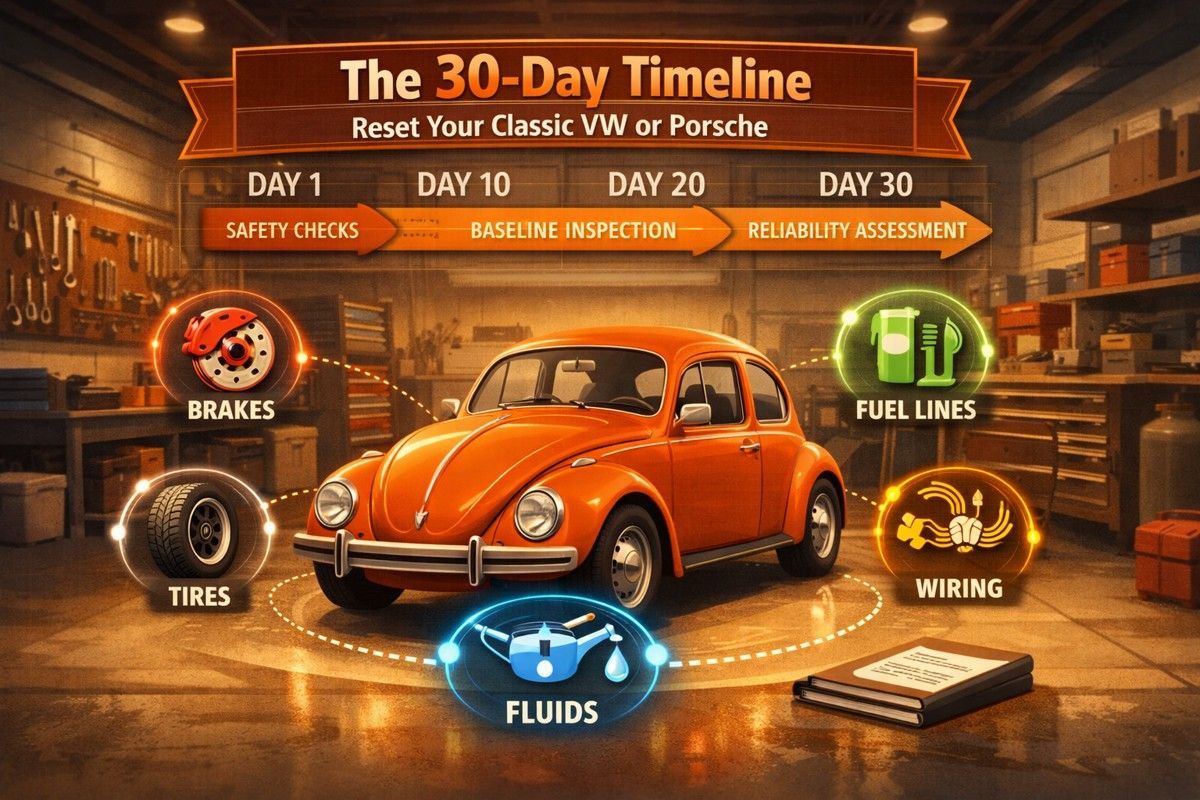
The First 30 Days: How to 'Reset' Your New Classic Car
📌 Key Takeaways
The first 30 days after buying a classic car determine whether you'll enjoy it or regret it—use this window to verify everything the seller claimed.
- Safety First, Always: Check for fuel smells, test your brakes and steering, and verify tire age before driving anywhere meaningful—fire and brake failure are the two worst outcomes to rule out immediately.
- Assume Nothing Was Done Right: "Recently serviced" isn't proof, and "runs great" isn't a maintenance history—treat every seller claim as unverified until a professional inspection confirms it.
- Prioritize Fixes by Category: Handle safety issues (brakes, fuel lines, wiring) immediately, reliability problems (charging, cooling) within 30 days, and save cosmetic upgrades for after the car runs properly.
- Your Senses Are Your Best Tools: Classic cars communicate through smells, sounds, and vibrations—learn what your car sounds like when healthy so you'll notice when something changes.
- Get a Professional Baseline: Schedule a thorough inspection within 30 days to transform "what didn't the seller tell me?" into "I know exactly what my car needs."
Document everything from day one—your maintenance log becomes your proof and your peace of mind.
Classic VW and Porsche owners in Orange County will find a clear 30-day roadmap here, preparing them for the detailed safety and reliability checks that follow.
~ ~ ~ ~ ~ ~ ~ ~ ~ ~ ~ ~ ~ ~ ~ ~ ~ ~ ~ ~ ~ ~ ~ ~ ~ ~ ~ ~ ~ ~ ~ ~ ~ ~ ~ ~ ~ ~ ~ ~ ~ ~ ~ ~ ~ ~ ~ ~ ~ ~ ~ ~
Saturday morning. The garage door rolls up, and there it is—your classic VW or Porsche, finally yours. Then you catch it: a faint whiff of raw fuel hanging in the air. Your chest tightens. Is that normal for a vintage car, or am I about to burn down the garage?
That quiet worry is the price of admission to classic car ownership. On your first drive to cars and coffee, every new rattle makes you reach for the volume knob—because you're listening for clues. You bought the dream, but the dream came with a mystery: what did the last owner not tell you? "The car runs great" is not a maintenance history. "Recently serviced" is not proof. Your classic communicates the old-fashioned way—through smells, sounds, and leaks you have to learn to read.
The first 30 days after purchase determine whether you will enjoy this car or regret buying it. This is your window to hit the reset button on the car's maintenance history, verify what is actually true, and build a roadmap you can trust. A professional baseline service eliminates the hidden risks lurking beneath seller promises, transforming anxiety into confidence before you rack up miles or chase upgrades.
Here is how to approach those first 30 days—safety first, reliability second, cosmetics last.
What a Reset Means (and Why the First 30 Days Matter)
A reset means starting fresh by verifying every system that matters before trusting this car with your safety, your weekends, and your wallet. You are not assuming the previous owner did anything right.
Why does this matter more for a classic VW or Porsche than a modern car? Because classic vehicles communicate through analog signals: the smell of burning oil, a soft brake pedal, a vibration at highway speed, the way the engine stumbles when you blip the throttle. There is no computer storing fault codes or app alerting you to worn brake pads. Your nose and ears are often more accurate than any scanner on a classic car.
If you don't know the history, assume nothing and check everything. The seller said the brakes were "fine." Did they actually inspect the wheel cylinders on a 50-year-old drum brake system, or did they just confirm the pedal felt firm? The seller said the fuel system was "sorted." Did they replace the rubber lines that have been baking in engine heat for a decade, or did they just confirm the car started? The first 30 days are your chance to learn what this specific car sounds like when healthy, smells like when running right, and feels like when everything is working. That baseline becomes your reference point for every mile afterward.
The First 48 Hours: Safety-First Triage
Before you drive this car anywhere meaningful, rule out the two worst outcomes: fire and brake or steering failure. This is not about finding every flaw—it is about confirming the car is safe to drive while you plan a full baseline inspection.
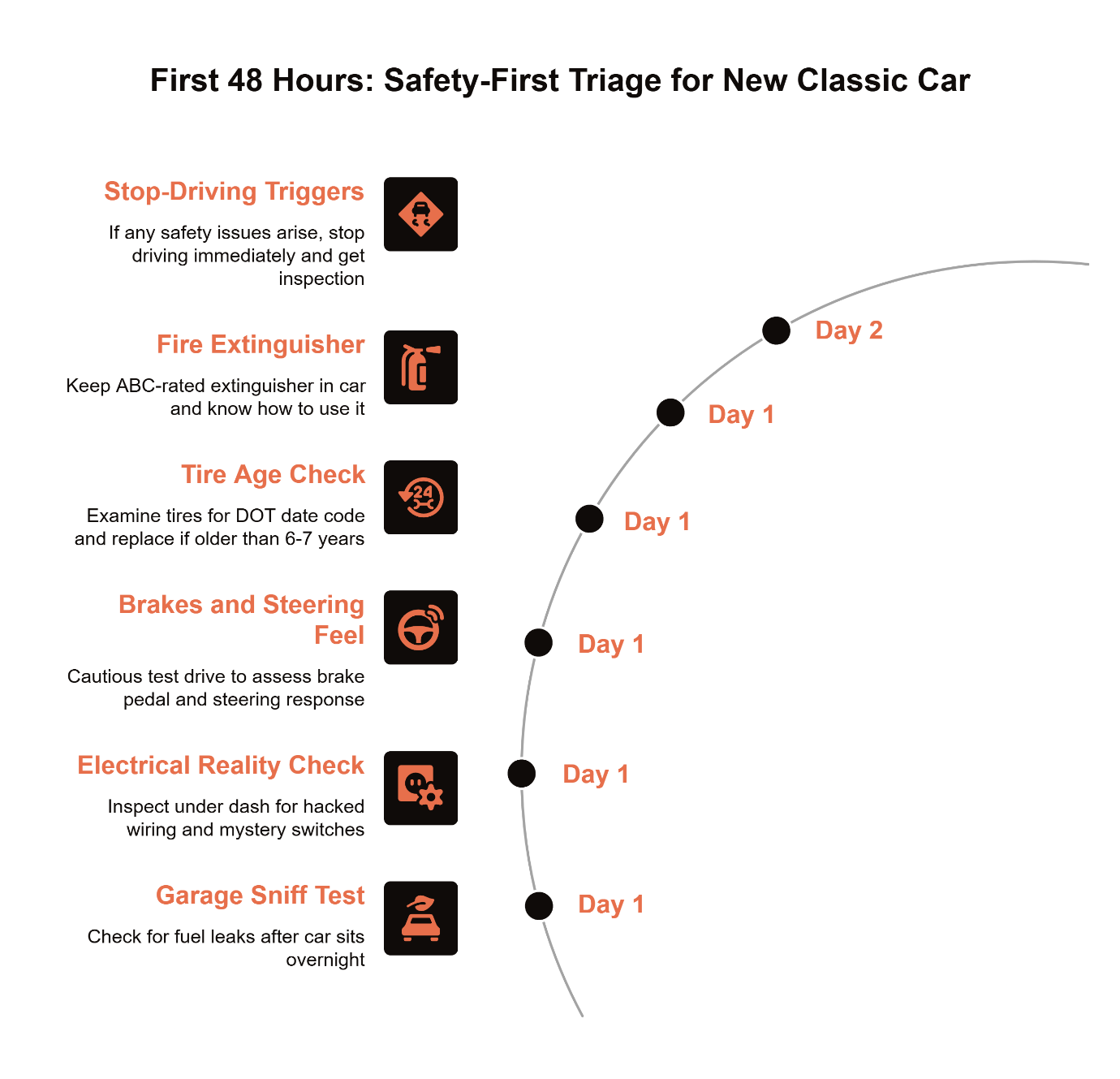
The garage sniff test. After the car sits overnight, open the garage and pay attention before you start the engine. Do you smell raw fuel? Fuel vapor is heavier than air, so it pools near the floor. A faint whiff might be residual from an old carburetor, but visible wetness or a strong gasoline odor means something is actively leaking. Do not start the car until you identify the source.
Electrical reality check. Classic cars accumulate decades of "creative" wiring. Look under the dash for mystery switches, spliced wires wrapped in electrical tape, or accessories that clearly were not factory-installed. These are clues that previous owners made modifications without proper knowledge. Hacked wiring is a leading cause of classic car fires. If you see a rats' nest of non-original wiring, add a wiring audit to your punch list.
Brakes and steering feel. On your first cautious drive—around the block, not to the highway—pay attention to the brake pedal. Does it feel firm and consistent, or does it slowly sink toward the floor when you hold pressure? A sinking pedal often indicates a failing master cylinder or leaking wheel cylinder. Does the car pull hard to one side under braking? Does the steering feel vague, or does the car wander in its lane without input? These are not quirks to live with. They are safety issues to resolve before the car sees real traffic.
Tire age, not just tread. Tires can look perfect and still be dangerous. Rubber degrades over time, regardless of how much tread remains. Every tire manufactured after 2000 has a DOT date code stamped on the sidewall— a four-digit number where the first two digits indicate the week and the last two indicate the year. Tires older than six to seven years should be replaced, even if the tread looks fine. The NHTSA provides a tire labeling guide that explains how to read these codes, and the NTSB has documented how aged tires can fail catastrophically without warning.
Carry a fire extinguisher. This is not paranoia; it is stewardship. Keep a small ABC-rated extinguisher in the car and know how to use it. Classic car fires can escalate quickly, and having the right tool within reach has saved more than a few vintage vehicles.
Stop-Driving Triggers
If you notice any of the following, stop driving immediately and have the car inspected before continuing:
- Raw fuel smell in the cabin or engine bay
- Burning electrical smell (hot plastic or melting insulation)
- Soft or sinking brake pedal that fades under sustained pressure
- Sudden new leak that was not present before (especially if you see fluid pooling rapidly)
- Overheating behavior (For water-cooled models: temperature gauge climbing, steam, coolant smell. For air-cooled models: oil temperature spiking, sluggish performance, or the smell of burning oil—especially in heavy stop-and-go traffic)
- Steering that suddenly feels loose or unresponsive
Week 1: Establish the Baseline
Once you have confirmed the car is safe enough to drive carefully, your first week should focus on verifying what is actually in the car—not what the seller claimed.
Fluids tell the story. Check the oil: is it black and gritty, or reasonably clean? Check the brake fluid: is it clear or dark brown? Check the coolant (if your classic has a water-cooled engine): is it the right color, or does it look like rust? These are not just maintenance items—they are diagnostic clues. Dark, neglected fluids suggest the car has not been maintained to the standard the seller implied.
For oil changes, the standard interval for a classic VW or Porsche is 5,000 miles or 12 months, whichever comes first. If you don't know when the oil was last changed, change it now. This is the single easiest way to start fresh.
Start a simple maintenance log. Write down what you verify and when. Even a notebook in the glovebox works. Record the date, the mileage, and what you checked or changed. This log becomes your proof of ownership stewardship—and your reference when something changes.
Unknown history means assume nothing. The bill of sale might say "engine rebuilt 10,000 miles ago." Do you have documentation? Receipts? Photos? If not, treat that claim as unverified until a professional inspection confirms it. This is not about distrusting people; it is about protecting yourself from expensive surprises.
Weeks 2–4: Reliability Checks That Prevent Breakdowns
With safety confirmed, the next few weeks are about identifying the issues that will leave you stranded—or slowly drain your wallet through neglect.
Charging behavior. Does the car start confidently every time, or does it crank slowly? If your classic has an ammeter or voltmeter gauge, watch it while driving. The gauge should show the system charging, not draining. A weak charging system will leave you stranded at the worst possible moment.
Cooling and overheating behavior. Southern California traffic is brutal on air-cooled engines. Pay attention to how the car behaves in stop-and-go conditions. Does the temperature gauge climb steadily? Do you smell coolant? For air-cooled classics, listen for the cooling fan and watch for oil temperature trends. Overheating is not a minor inconvenience—it causes permanent engine damage.
Drivability symptoms. During your drives, notice how the engine behaves. Does it hesitate when you accelerate? Does it stumble or misfire at idle? Does it stall at stop signs? These symptoms often point to carburetor tuning, ignition timing, or fuel delivery issues. None of them are emergencies, but they all belong on your punch list.
Rubber and hose reality. Here is something many new owners miss: sitting can be harder on a classic than driving. Rubber hoses, seals, and gaskets dry out and crack when a car sits for extended periods. Fuel hoses become brittle. Brake lines develop internal swelling. Vacuum lines crack. If the car was "barn-found" or sat for years before you bought it, every rubber component is suspect until inspected.
Build a Punch List: Fix Now vs. Later
By now, you probably have a mental list of everything that needs attention. The challenge is not identifying issues—it is prioritizing them so you do not go broke fixing everything at once.
Good shops help you pace the spend. They understand that a classic car is a long-term relationship, not a one-time transaction. The goal is to get the car safe and reliable first, then address comfort and cosmetics as your budget allows.
Your Punch-List Triage Matrix
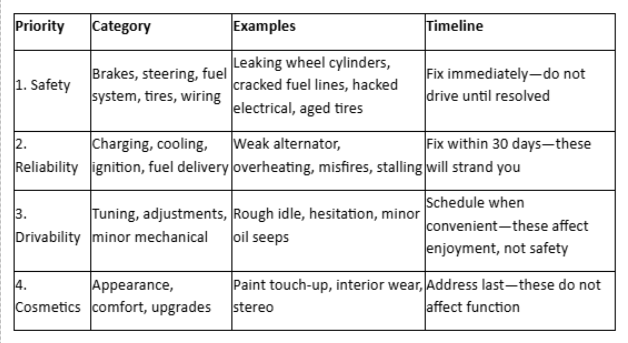
The common mistake is jumping to cosmetics before reliability is sorted. Resist the urge to install new wheels or upgrade the interior until the car is mechanically sound. A beautiful classic that leaves you stranded is not enjoyable to own.
What to Ask for in a Professional Baseline Inspection
At some point in the first 30 days, you should have a qualified shop perform a thorough baseline inspection. This is not a quick oil change—it is a comprehensive evaluation of the car's current condition.
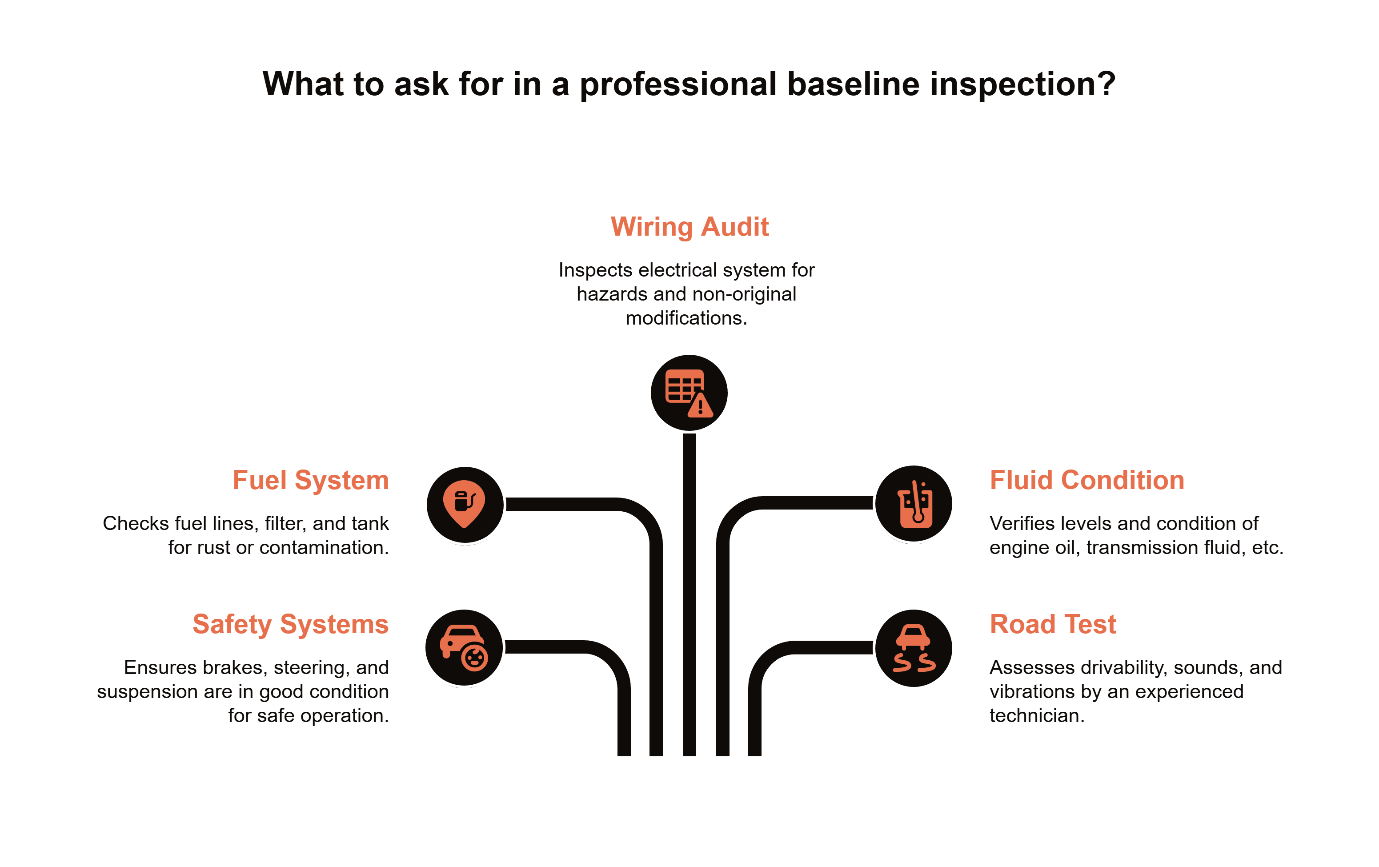
Safety systems. Brakes (including wheel cylinders, brake lines, and pad or shoe condition), steering components (tie rods, ball joints, steering box), and suspension (shocks, bushings, alignment). For a full overview of the services a baseline inspection covers, the shop can walk you through what applies to your specific vehicle.
Fuel system condition. Fuel lines (especially rubber sections near the engine), fuel filter, carburetor or fuel injection condition, and fuel tank for rust or contamination.
Wiring audit. A visual inspection of the electrical system looking for non-original modifications, damaged insulation, improper grounds, and fire hazards.
Fluid condition verification. Engine oil, transmission fluid, brake fluid, and coolant (if applicable)—checking not just levels but condition.
Road test notes. A test drive by an experienced technician who documents sounds, vibrations, and drivability concerns. This is where decades of experience matter. Someone who has worked on classic VWs and Porsches for years will notice things a general mechanic might miss.
When discussing the outcome, ask for a clear, prioritized list—not a scare sheet of everything that could be wrong, but an honest assessment of what needs attention now versus what can wait. Ask for a phased plan if the list is long. A trustworthy shop will tell you what is safe today and what should be scheduled for next month.
California law requires repair shops to provide written estimates before performing work, and the California Bureau of Automotive Repair offers consumer guidance on what to expect from this process. You should never feel pressured to approve repairs on the spot. If a shop cannot explain why something is urgent in plain language, that is a warning sign.
What "classic-quality" service looks like. When evaluating a shop for classic car maintenance, look for signals that match the preservation mindset: period-appropriate repair judgment rather than a replacement reflex, attention to original integrity, careful documentation of what was done and why, and—importantly—honesty about scope. If a shop encounters something outside their expertise, the right response is to refer you to a specialist who can help, not to attempt a repair they are not qualified to perform.
From Anxiety to Confidence: Your 30-Day Reset Roadmap
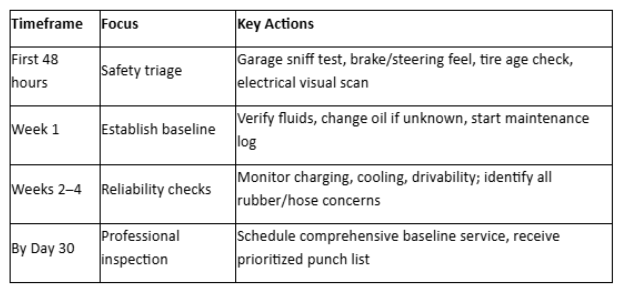
By the end of 30 days, you should know exactly what this car needs. Not guesses. Not seller promises. Verified facts documented in your maintenance log and confirmed by a professional inspection.
That transformation—from "what did the seller not tell me?" to "I know exactly what my car needs"—is the reset. It is the foundation of confident ownership.
Schedule Your 30-Day Reset in Orange County
If you are in Orange, Tustin, Anaheim, Yorba Linda, or Villa Park with a classic VW or Porsche, Orange Independent Auto Repair has been performing exactly this kind of work since 1971. Family-owned, with technicians like Eddie who have over 50 years of hands-on experience with air-cooled VWs, the shop specializes in the sensory diagnostics and baseline verification that classic cars require.
This is not a dealership. There is no fancy waiting room. What you get is honest pricing, a clear explanation of what your car actually needs, and the peace of mind that comes from working with people who understand vintage vehicles. For Porsche owners, the same principles apply—classic-appropriate care with a phased plan that respects both your car and your budget.
If something falls outside the shop's expertise, they will tell you and refer you to someone who can help—because that is how trust is built.
Contact Orange Independent Auto Repair to schedule your baseline inspection. You can also call directly at (714) 633-7161. Hours are Monday through Friday, 7:00 AM to 6:00 PM, with Saturday appointments available by arrangement.
The dream is in your garage. Now make sure it is safe, reliable, and ready for the road.
Frequently Asked Questions
What should I do first after buying a classic car?
Start with a safety-first triage in the first 48 hours. Check for fuel smells or visible leaks, assess brake and steering feel on a cautious test drive, verify tire age using the DOT date code, and visually inspect the wiring for obvious hacks or damage. Do not rack up miles until you have ruled out fire and brake failure risks.
What does a baseline service include for a classic VW or Porsche?
A proper baseline service includes a safety systems check (brakes, steering, suspension), fuel system inspection (lines, filter, carburetor condition), wiring audit for fire hazards, fluid condition verification, and a road test by an experienced technician. The outcome should be a prioritized punch list, not just a generic checklist.
Is it normal for a classic car to smell like gas or oil?
A faint oil smell from an air-cooled engine can be normal—these engines run hot and minor seepage is common. However, a raw fuel smell is never normal and indicates an active leak that needs immediate attention. When in doubt, have it inspected before driving.
How can I tell if my tires are too old?
Find the DOT date code on the tire sidewall—a four-digit number where the first two digits are the week of manufacture and the last two are the year. Tires older than six to seven years should be replaced regardless of tread depth, as rubber degrades and can fail without warning.
Should I drive my new classic right away or have it inspected first?
Drive it carefully and briefly for your initial safety assessment (around the block, not across town). Once you confirm the basics—no fuel leaks, brakes feel solid, steering responds—you can drive it more, but schedule a professional baseline inspection within the first 30 days before trusting the car for longer trips.
How do I prioritize repairs on a classic car?
Use the triage framework: safety first (brakes, steering, fuel system, tires, wiring), reliability second (charging, cooling, ignition), drivability third (tuning, minor mechanical), and cosmetics last. A trustworthy shop will help you phase repairs so you do not have to fix everything at once.
This article provides general guidance for classic car owners and is intended for educational purposes. Specific repair recommendations depend on your vehicle's condition, history, and local regulations. For any safety-related concerns, consult a qualified professional before driving.
Orange Independent Auto Repair 187 S Main St, Orange, CA 92868 (714) 633-7161 | orange.independent@gmail.com Monday–Friday: 7:00 AM – 6:00 PM | Saturday: By appointment only.