Seller-Side Walkaround vs. Shop-Based Inspection for Classic VW Project Cars Around Orange County
📌 Key Takeaways
A seller walkaround can screen a classic VW project car, but bigger risks may need a shop inspection before payment.
- Match Risk To Depth: Use a quick look for first impressions, not major purchase confidence.
- Look Beyond Photos: Completeness, rust, leaks, smells, and seller answers can reveal hidden buying risks.
- Do Not Trust Idle: A car that starts may still have brake, steering, fuel, or drivability problems.
- Slow Down Payment: A shop inspection helps before final payment, especially when rust or repairs are unclear.
- Plan The Logistics: Confirm driving safety, transport needs, timing, costs, and seller approval before arranging inspection.
Quick looks screen the car; deeper questions deserve deeper inspection.
Classic VW project-car buyers in Orange County will make calmer purchase decisions, preparing them for the detailed overview that follows.
~ ~ ~ ~ ~ ~ ~ ~ ~ ~ ~ ~ ~ ~ ~ ~ ~ ~
A classic VW project car can look right in photos and still leave important questions unanswered when you see it in person. The seller may be available for a quick meetup, the car may start, and the body may look complete from a few steps away. That does not always mean the buyer has enough information to commit.
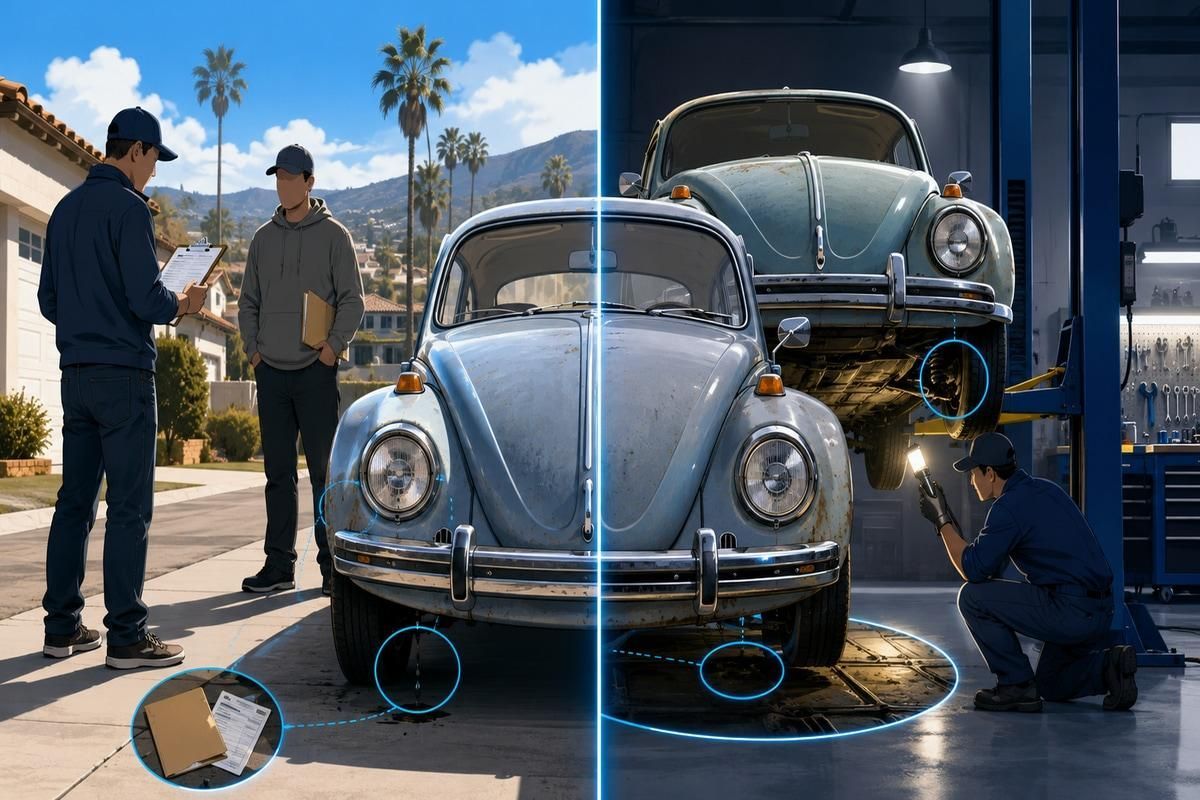
A seller-side walkaround is useful for first impressions. It can help you decide whether the car is worth pursuing, whether the listing seems accurate, and which questions need to be asked next. A shop-based pre-purchase inspection is different. It may be the better next step when rust, prior repairs, underbody condition, drivability, leaks, paperwork, or purchase pressure could affect the decision.
For classic VW buyers around Orange County, including Orange, Tustin, Anaheim, Yorba Linda, and Villa Park, the practical question is not whether every car needs the same process. The better question is: does the risk fit a quick look, or does it call for a deeper inspection before money changes hands?
What a Seller-Side Walkaround Can Actually Tell You
A seller-side walkaround can be a good first screen. It gives you a chance to compare the actual car with the listing and to see whether the seller’s description matches what is in front of you.
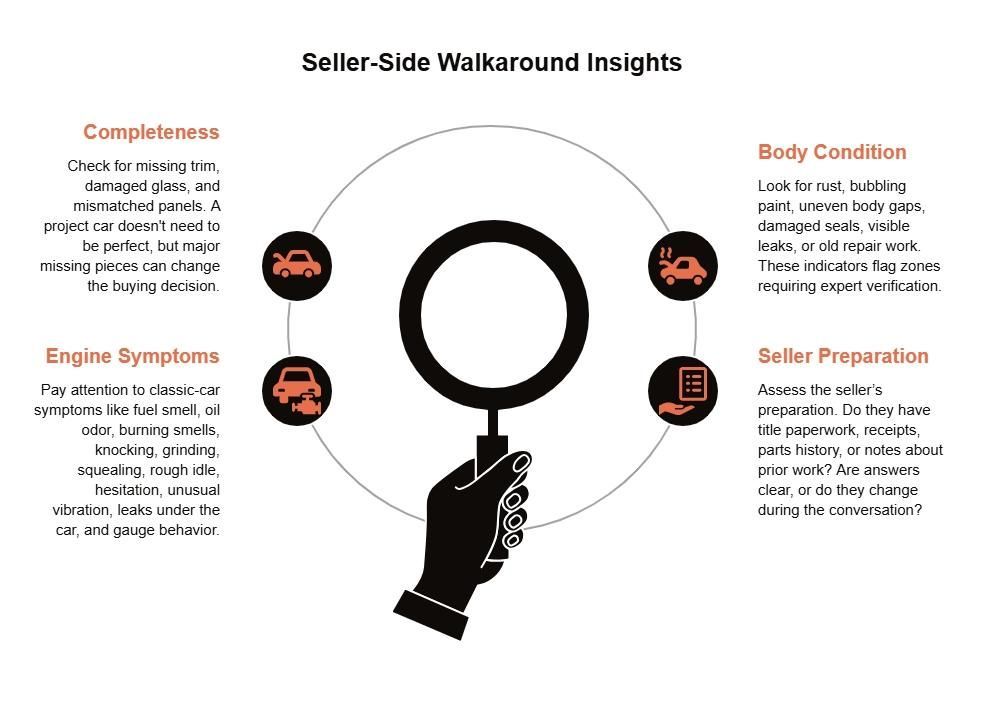
Start with completeness. Look for missing trim, damaged glass, missing interior pieces, mismatched panels, loose wiring, unfinished parts, or signs that the car has been partly assembled from different sources. A project car does not need to be perfect. Still, the difference between “mostly complete” and “missing major pieces” can change the buying decision.
The walkaround can also reveal obvious rust, bubbling paint, uneven body gaps, damaged seals, visible leaks, or old repair work. While not definitive, these indicators flag specific zones requiring expert verification.
If the seller allows the car to start, pay attention to classic-car symptoms rather than modern warning-light habits. On a classic VW, useful clues often come from fuel smell, oil odor, burning smells, knocking, grinding, squealing, rough idle, hesitation, unusual vibration, leaks under the car, and gauge behavior where applicable.
A walkaround is also a chance to assess the seller’s preparation. Does the seller have title paperwork, receipts, parts history, or notes about prior work? Are answers clear, or do they change during the conversation? Seller honesty and vehicle condition are separate issues, but vague history should reduce confidence.
What a Walkaround Can Miss on a Classic VW Project Car
The biggest limitation of a seller-side walkaround is access. In a driveway, parking lot, or storage space, the buyer is usually inspecting from ground level and under time pressure. That can make important areas difficult to evaluate.
Underbody and floor-pan concerns are a good example. A quick look may reveal obvious rust, but it may not show what is under carpets, seals, trim, undercoating, or older patch repairs. General classic-car buying practice treats hidden corrosion and repair quality as issues worth evaluating carefully, especially when the purchase depends on structural condition.
Prior collision work and patch repairs can also be hard to interpret during a short meetup. Fresh paint, seam sealer, uneven gaps, or heavy undercoating may raise questions, but those signs do not always explain how deep the issue goes.
Mechanical concerns may not show during a brief start-up. A car can idle for a few minutes and still have brake, steering, suspension, electrical, fuel-system, engine, or transmission issues that need further evaluation. As a general safety principle, any concern involving braking, steering, fuel smell, or drivability deserves caution before assuming the car can be driven. The National Highway Traffic Safety Administration provides general vehicle safety resources for broader consumer safety context.
Paperwork can be missed or rushed as well. A buyer should not treat title, VIN, registration, or ownership details as an afterthought. For California buyers, the California DMV provides official guidance on registering a vehicle purchased from a private party and title transfers and changes. Those resources should be checked directly because paperwork requirements can depend on the specific transaction.
When a Shop-Based Pre-Purchase Inspection Makes More Sense
A shop-based pre-purchase inspection makes more sense when the unanswered questions are large enough to affect the purchase, transport plan, or repair budget. This does not mean a walkaround is worthless. It means the walkaround has done its job by showing where confidence is still incomplete.
The case for a shop-based inspection is stronger when the car is expensive relative to the buyer’s budget, visible rust or prior repairs are present, the seller cannot clearly explain past work, the car has been sitting, or the buyer cannot safely inspect underneath. It also becomes stronger when the car runs but feels rough, smells like fuel, leaks, hesitates, grinds, or shows questionable gauge behavior.
The same logic applies when a deposit or final payment is imminent. Once money changes hands, the buyer usually has less leverage and fewer options. General due diligence means slowing the process down before the commitment, not trying to understand the car after the decision is already made.
Orange Independent Auto Repair works with classic VW and Porsche vehicles through its classic car maintenance services, and its services page includes vehicle inspections. Those verified business details support mentioning the shop as a relevant option for buyers considering a pre-purchase inspection. They do not support promising exact inspection scope, price, duration, availability, report format, or specific findings.
Questions to Ask Before Money Changes Hands
| What You Can Assess During a Seller Walkaround | What May Need Shop-Based Inspection | Questions to Ask the Seller |
|---|---|---|
| Overall completeness | Underbody and floor-pan condition | Is the car complete, or are parts missing? |
| Obvious rust or bubbling paint | Hidden rust under trim, carpet, seals, or undercoating | What rust repair has been done? |
| Panel fit and visible body damage | Prior collision or patch repair quality | Who performed the body or structural work? |
| Start-up behavior, if allowed | Engine or transmission issues beyond short idle | When was it last driven regularly? |
| Fuel, oil, or burning smells | Fuel-system, leak, and drivability concerns | Has the fuel system been serviced recently? |
| Visible leaks or drips | Brake, steering, and suspension condition | Can the car be safely driven, or does it need transport? |
| Seller’s explanation of prior work | Whether claims match vehicle condition | Are receipts or parts records available? |
| Title or VIN details shared by seller | Paperwork consistency and transfer details | Is the title available and in the seller’s name? |
This table is a practical guide, not a guarantee. A shop-based inspection may provide a better setting for evaluation, but no inspection can promise to find every possible issue on an older project car.
How to Coordinate the Inspection With the Seller
Ask early. A shop visit is easier to coordinate before final payment, before a non-refundable deposit, and before the seller assumes the deal is already complete.
Keep the request neutral. A buyer does not need to accuse the seller of hiding anything. The point is to understand an older vehicle before making a decision.
A simple message can work:
“Thanks for showing the car. It looks promising, and because it is a classic VW project car, a pre-purchase inspection would help clarify the condition before final payment. Are you open to coordinating a shop visit or discussing what would be practical for transport?”
Before setting a time, clarify logistics: vehicle mobility (drivable vs. tow-required), inspection costs, scheduling, and contingency plans for failed inspections.
If the seller refuses, stay measured. A refusal does not automatically prove dishonesty. It does increase uncertainty. The buyer can ask for more documentation, negotiate with that uncertainty in mind, or walk away if the risk no longer fits the budget.
What to Bring to the Walkaround or Inspection
Bring enough information to compare the car with what was advertised. The goal is not to perform repairs at the seller’s location. The goal is to ask better questions and avoid relying only on memory.
Useful items include listing screenshots, seller-provided photos, VIN and title information if available, notes about claimed work, and any receipts or parts lists the seller has shared. Also bring a simple budget note separating must-fix concerns from later-fix concerns. A project car can still be a good purchase, but only if the buyer understands what may need attention soon.
For a hypothetical example, a Beetle with unclear rust history may still be worth pursuing if the price, paperwork, and condition make sense. But if the seller cannot explain prior floor-pan work and the buyer cannot inspect underneath safely, a shop-based inspection may be the more sensible next step.
Another hypothetical example: a VW Bus starts, but there is fuel smell and a rough idle. That does not automatically tell the buyer what is wrong. It does mean the buyer should be cautious about assuming the vehicle is safe to drive or close to road-ready.
Orange County Logistics: Shop Fit, Timing, and Travel
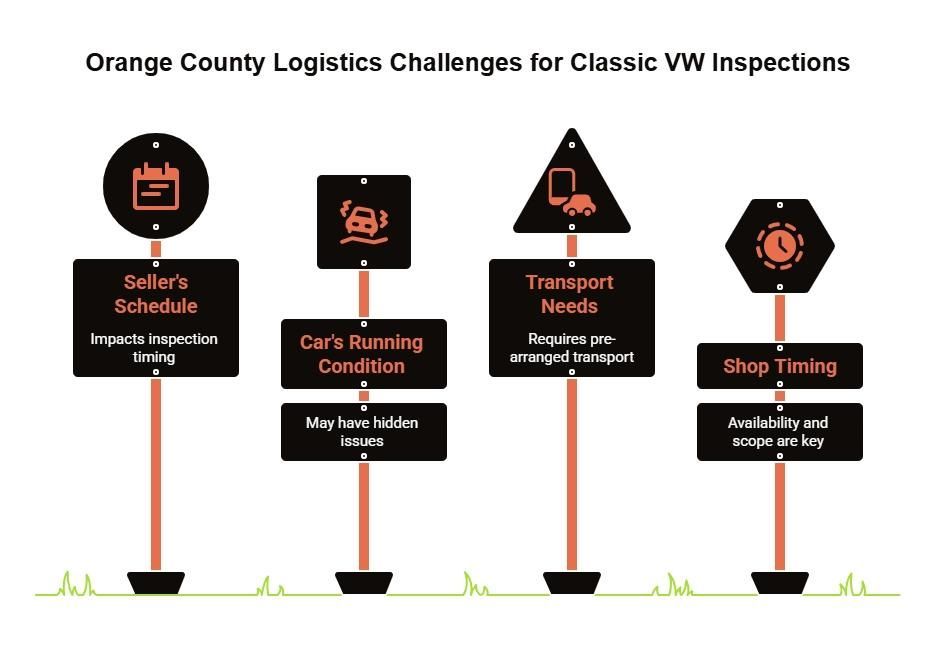
For buyers in Orange, Tustin, Anaheim, Yorba Linda, or Villa Park, logistics can affect the inspection decision. The seller’s schedule, the car’s running condition, transport needs, and shop timing all matter.
Avoid assuming that a project car can be driven just because it starts. A vehicle may idle and move under its own power while still having brake, steering, fuel-system, charging, or drivability concerns. If transport may be needed, discuss that before the meetup turns into a rushed purchase.
Orange Independent Auto Repair is located in Orange, CA. Buyers considering a promising classic VW project car can contact Orange Independent Auto Repair to ask about a pre-purchase inspection before finalizing the purchase. Contact the shop before assuming availability, timing, scope, pricing, or transport arrangements.
Common Questions About Classic VW Walkarounds and Shop Inspections
Is a seller-side walkaround enough for a classic VW project car?
Sometimes it is enough for first-pass screening. It can help a buyer decide whether to continue, pause, negotiate, or walk away. It is less reliable when rust, prior repairs, underbody condition, drivability, or paperwork could affect the decision.
What should be asked before arranging a shop inspection?
Ask whether the car can be driven, whether the seller allows a shop visit, what prior work has been done, how long the car has been sitting, whether title and VIN details are available, and whether records or receipts exist.
Should the inspection happen before or after leaving a deposit?
As a general buying principle, inspection is usually more useful before final payment and before any non-refundable commitment. Deposit terms can vary, so clarify them before money changes hands.
What if the seller refuses a pre-purchase inspection?
Treat the refusal as added uncertainty, not automatic proof of dishonesty. Ask for more documentation, consider whether the price reflects the risk, and be willing to walk away if the unanswered questions are too significant.
Can Orange Independent Auto Repair inspect classic VWs?
Orange Independent Auto Repair’s approved business information supports classic VW and Porsche service relevance and vehicle inspections. Buyers should contact the shop directly to discuss the specific vehicle and avoid assuming exact availability, scope, duration, price, or inspection deliverables.
Do Not Skip the Step That Matches the Risk
A seller-side walkaround is useful when it helps screen the car, compare the listing with reality, and identify the next questions. It becomes less useful when the buyer needs answers about hidden rust, underbody condition, prior repairs, drivability, leaks, paperwork, or transport risk.
The right step depends on the car, the seller, the price, the buyer’s budget, and the uncertainty left after the walkaround. If the car seems promising but the risk feels bigger than a quick look can answer, contact Orange Independent Auto Repair about a pre-purchase inspection before finalizing the purchase.
Disclaimer: This article is for general informational purposes only. It is not a substitute for advice from a qualified automotive professional or service provider familiar with your specific vehicle and situation. Always verify important purchase, paperwork, safety, and repair decisions with the appropriate professional before money changes hands.
Our Editorial Process
Our expert team uses AI tools to help organize and structure our initial drafts. Every piece is then extensively rewritten, fact-checked, and enriched with first-hand insights and experiences by expert humans on our Insights Team to ensure accuracy and clarity.
By Orange Independent Auto Repair Insights Team
The Orange Independent Auto Repair Insights Team develops owner-level, evidence-first guidance shaped by decades of hands-on experience serving classic VW and Porsche owners in Orange and the surrounding communities.