
Mileage, Time, and Vehicle Use: How Orange-Area Owners Can Decide What Maintenance Comes Due Next
📌 Key Takeaways
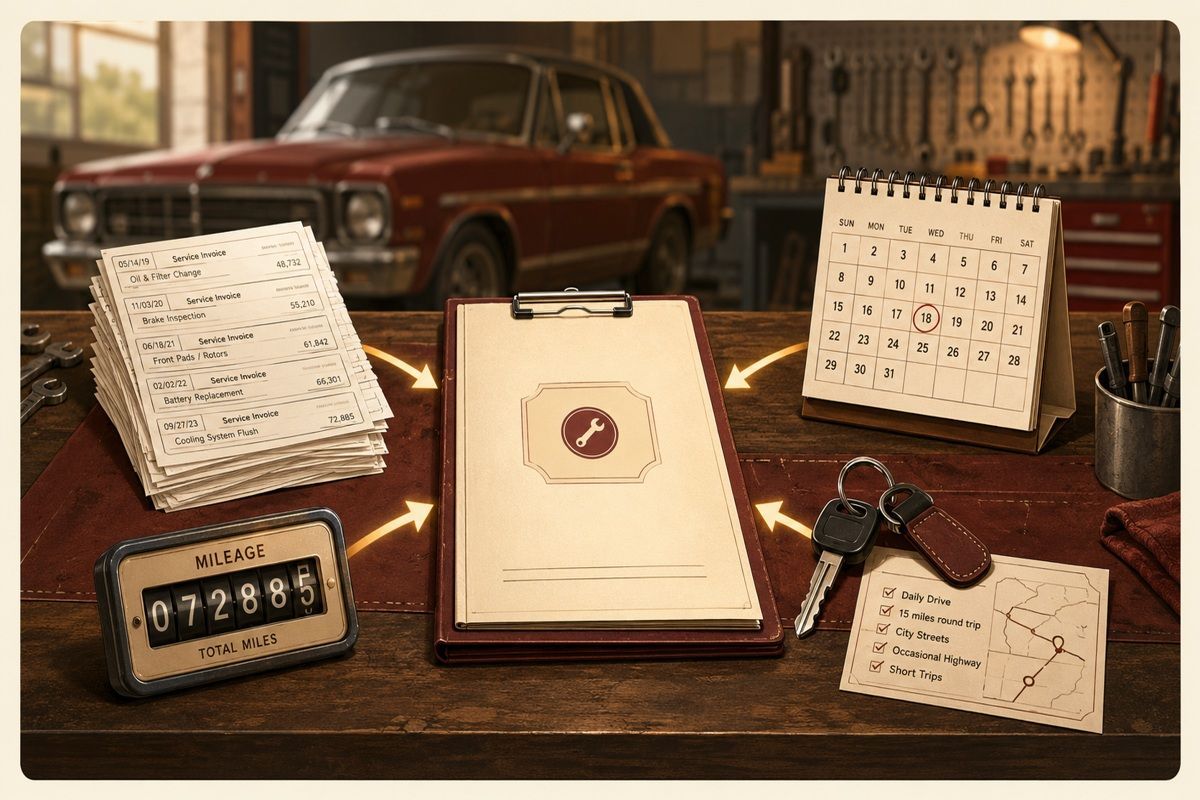
Plan maintenance from documented service history, mileage, elapsed time, and current use, using your vehicle’s official schedule.
- Check Time And Miles: For oil, 5,000 miles or 12 months applies, whichever comes first, so low annual mileage does not stop the clock.
- Use The Official Schedule: Check the owner’s manual or manufacturer schedule because generic charts may not match your exact vehicle.
- Treat Unknowns As Verify: Missing records mean “Verify,” not “overdue,” so confirm the facts before replacing parts or spending money.
- Build One Baseline: Keep confirmed service history, current mileage, upcoming maintenance windows, unknown items, and use changes together.
- Recheck After Use Changes: When driving patterns change, review the official schedule instead of inventing shorter or longer maintenance intervals.
Build the baseline first, then plan maintenance.
Orange-area owners with older vehicles will make clearer maintenance decisions, preparing them for the maintenance planner and questions below.
~ ~ ~ ~ ~ ~ ~ ~ ~ ~ ~ ~ ~ ~ ~ ~ ~ ~
Even if your older car barely moved the odometer this year, it may still need maintenance. The owner who sees a low number and assumes everything can wait is working from only one input. Elapsed time, incomplete records, and a change in how the household uses the vehicle all affect what belongs on the upcoming list.
For Orange-area owners sorting through scattered receipts and a vague sense that "something should probably be done," the practical starting point is not a universal chart. It is a method: match the records you actually have against current mileage, elapsed time, and present vehicle use, then separate what you know from what still needs confirmation. The exact requirement for any given item depends on the vehicle's own official maintenance schedule, not a generic interval found online.
Why Mileage Alone Can Give an Incomplete Maintenance Picture
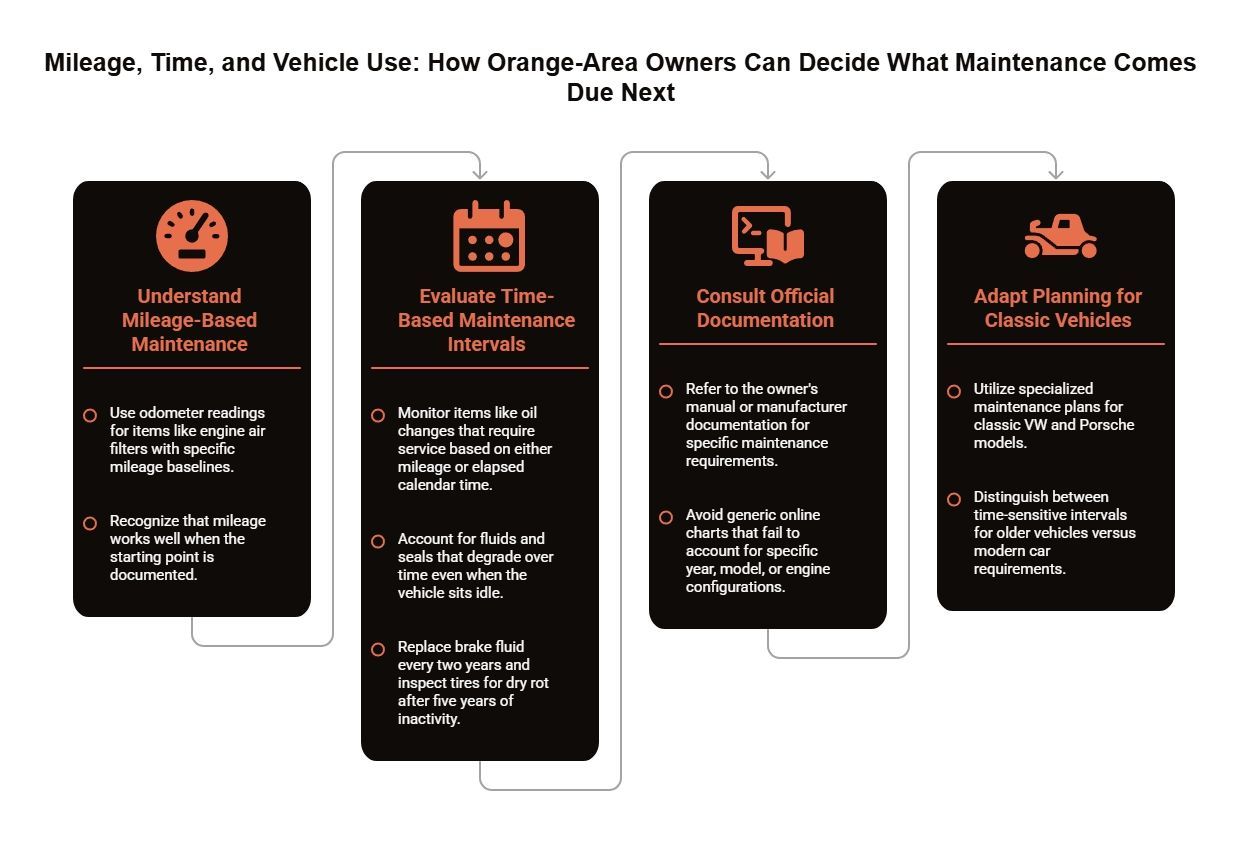
Odometer mileage feels concrete, and for some maintenance items it is the primary planning input. A mileage-based interval — one measured strictly by miles driven — can work well when you know the starting mileage. An engine air filter, for example, has an approved baseline of around 10,000 miles. If the last replacement was documented at 87,000 miles and the odometer now reads 95,000, mileage gives a usable signal.
Other items carry both a mileage threshold and a time-based interval — one measured by elapsed calendar time. Oil is the clearest example: the approved standard is 5,000 miles or 12 months, whichever comes first. A vehicle that traveled only 2,000 miles since its last oil change but had that service 14 months ago has already passed the time limit, even though the mileage number looks comfortable. The calendar caught up before the odometer did.
This distinction matters because low-mileage older vehicles can sit for weeks or months between trips. Fluids age, seals can dry, and certain components respond to elapsed time regardless of whether the wheels turned. For instance, brake fluid absorbs moisture from the air over time and typically requires replacement every two years, regardless of miles driven. Similarly, tires can dry rot and weaken after five years of sitting, and rubber belts can become brittle. The exact items affected and the intervals involved depend on the vehicle's own official maintenance schedule — the owner's manual or manufacturer documentation for that year, model, and engine. Before assuming low mileage means nothing is due, check whether the manufacturer's requirements include a time component for each tracked item. Do not add time limits to filters, fluids, belts, or other components unless the exact schedule supports them.
If you find several online maintenance charts with different numbers, do not choose the one that seems most convenient. For an exact interval, start with the owner's manual or official maintenance schedule for the specific vehicle. If more detail is needed, official manufacturer service information is the next useful source. Generic charts cannot reliably account for the exact year, model, engine, or configuration.
For owners of classic VW and Porsche vehicles, a maintenance plan for classic VWs and Porsches covers time-based preservation considerations specific to those vehicles. The planning logic in this article applies broadly to older vehicles, but classic and modern cars can differ in which components carry time-sensitive intervals and how those intervals are documented.
Build Your Baseline From Four Pieces of Information
A maintenance baseline is a structured snapshot of what you actually know about the vehicle's service history, organized so you can plan forward. It requires four inputs.
What Is Actually Documented?
Pull together every receipt, dated invoice, maintenance log entry, and written record you can find. A receipt with a date, a mileage reading, and a description of the work performed counts as verified service history — a record supported by concrete documentation rather than memory alone. A recollection that "the oil was changed sometime last spring" is not usable until you can pin it to a specific date and mileage.
This step also helps prevent duplicate maintenance. A missing or scattered record should prompt a search for better information before completed work is unnecessarily repeated.
What Was the Mileage When the Work Was Done?
For any item tracked by mileage, you need the odometer reading at the time of service. If a receipt shows the date but not the mileage (or the reverse), record what you have and mark the missing piece. Partial information is still more useful than a guess. If the previous service mileage is missing, do not estimate it simply to complete the worksheet — record the gap instead.
The most useful mileage calculation is the distance traveled since the last known service, not the current odometer reading alone. If a service was documented at 82,000 miles and the vehicle now reads 85,200 miles, then 3,200 miles have accumulated since that service. That number, measured from a known starting point, tells you more than the odometer total by itself.
How Much Time Has Passed?
Where a verified interval includes an elapsed-time component, calculate the gap between the service date and today. This is the input that catches items a low odometer alone would miss. Measure elapsed time only when the applicable maintenance information uses a time criterion — not every item carries one.
How Is the Vehicle Being Used Now?
If the vehicle recently shifted roles — from an occasional second car to a more regularly used household vehicle, or the reverse — record that change. It does not automatically rewrite every interval, but it belongs in the conversation when you review the applicable schedule or discuss the plan with a provider. Keeping current use in the baseline gives you something concrete to discuss without turning driving habits into an unsupported maintenance formula.
Maintenance Baseline Planner
Use a simple table to organize these inputs for each maintenance item you want to track.
| Maintenance Item | Last Service Confirmed? | Date / Mileage Known? | Current Mileage | Time Since Service | Use Changed? | Interval Source | Planning Status |
|---|---|---|---|---|---|---|---|
| Oil change | Yes | 6/2025 at 91,100 mi | 93,100 mi | 14 months | No | 5,000 mi or 12 months, whichever first | Due (time) |
| Engine air filter | Yes | Date only, no mileage | 93,100 mi | Unknown gap | No | Around 10,000 mi baseline | Verify |
| Brake fluid flush | No | — | Record | — | Note if relevant | Check exact vehicle schedule | Verify |
Two rules keep this planner honest. First, only the oil and air-filter rows above use approved baseline intervals. Every other item's interval should come from the exact vehicle's official maintenance schedule. Second, "Verify" is a legitimate planning status. An unknown service date does not mean the item is overdue. It means you need more information before assigning a maintenance window — a future date or mileage point when maintenance is expected to come due.
How to read your planning status:
Known: You have documented service history with a usable date and mileage for this item.
Upcoming: A verified interval, applied to a known starting point, provides an identifiable future maintenance window.
Verify: Missing history or an unconfirmed interval prevents a confident due date. The next step is confirmation, not automatic replacement.
What to Do When the Service History Has Gaps
Gaps in the record are normal, especially for vehicles that have changed hands or been maintained informally. The goal is not to reconstruct a perfect history. It is to separate what can be proven from what cannot and then decide which unknowns actually matter.
Start by writing down every service you can document with a date, mileage, or both. Compare that list against the vehicle's official maintenance schedule. Some gaps will land on items that are not due for thousands of miles regardless. Others will land on items where the time or mileage threshold may have already passed.
For any item you cannot verify, mark it "Verify" in your baseline rather than guessing. Absence of a record is an information gap, not proof of neglect. The previous owner may have completed the service without leaving paperwork you can find. "Unknown" does not automatically mean "overdue," and it does not mean "replace everything."
This distinction is particularly useful when budget matters. An information gap does not need to become an immediate expense. Separate items that are known to be coming due under a verified rule from items that first need confirmation before you commit money to them.
A vehicle inspection can help organize these uncertainties. A provider can assess current condition and help determine which unknown-history items deserve attention now versus which ones can be tracked going forward. That conversation is more productive when you arrive with your documented history and a list of specific gaps rather than a general request to "check everything." If you recently acquired a classic VW or Porsche with unclear records, guidance on how to reset the maintenance baseline on a new-to-you classic covers the first steps in more detail.
When Vehicle Use Changes, Recheck the Plan Instead of Inventing a New Interval
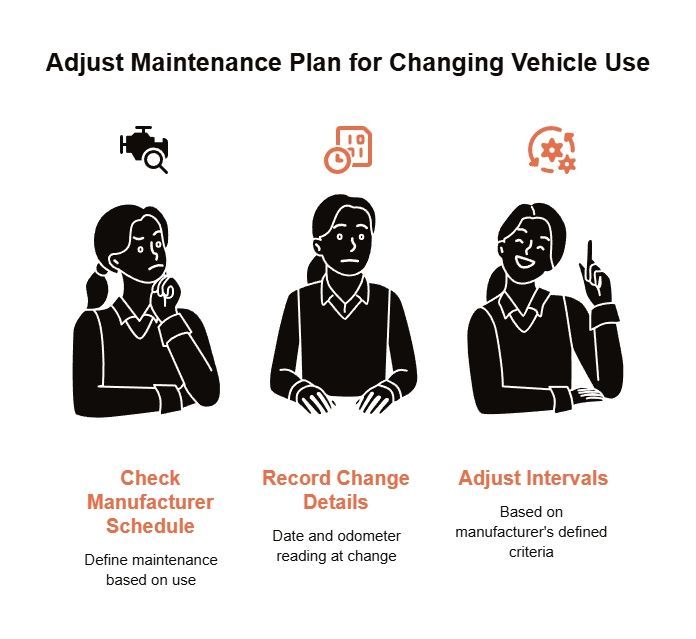
A vehicle that spent two years as an occasional weekend car and now handles regular household trips is accumulating mileage faster than before. That shift matters, but it does not automatically cut every maintenance interval in half.
What a change in use should trigger is a review. Pull up the vehicle's official maintenance schedule and check whether the manufacturer defines different maintenance categories based on operating conditions. Some schedules distinguish between normal and more demanding use patterns, but the specific criteria and adjusted intervals are defined by the manufacturer for that vehicle, not by a general rule.
Record the approximate date when the vehicle's role changed and the odometer reading at that point. This turns a vague feeling that "we are driving it more" into a data point that the next maintenance conversation can use.
A change in the opposite direction works the same way. If the vehicle is driven less than before, time-based intervals (such as the 12-month oil standard) may still arrive before the mileage threshold does.
Turn the Baseline Into an Upcoming Maintenance Calendar
A baseline becomes a calendar when you add forward-looking dates and mileage targets for items with verified intervals.
Consolidate your records in one place, whether that is a notebook, a spreadsheet, or a printed sheet in the glovebox. This is especially useful when several family members drive the same vehicle and information would otherwise be scattered between glove boxes, messages, folders, and individual memories. Your finished one-page baseline should contain:
- Current odometer mileage.
- Documented past maintenance with dates and mileage for known services.
- Verified upcoming maintenance windows.
- Items that still need vehicle-specific confirmation.
- Any meaningful change in how the vehicle is being used.
- Space to record future completed services.
Enter a future due point only when the interval itself is verified. For items still marked "Verify," leave the next-service field open until confirmation is available.
A well-maintained calendar can also make expenses easier to plan. When verified upcoming maintenance is visible in one place, you can distinguish predictable costs from unresolved items that still need information before they become line items.
After any completed service, update the calendar with the new date, mileage, and what was done. When the vehicle's role or annual use changes meaningfully, revisit the applicable schedule rather than continuing on outdated assumptions. A maintenance calendar is a record-and-planning system, not a diagnosis.
Questions to Prepare Before a Maintenance Conversation
If past repair experiences have made you cautious about recommendations, asking for the reasoning behind each item can help rebuild confidence in the process. Before visiting a provider, these questions can keep the conversation organized around evidence rather than assumptions:
- Which maintenance items can you confirm from the records I have?
- Which upcoming items are based on a manufacturer interval, and does my current use pattern affect that interval?
- Which unknown-history items need inspection or confirmation before we assign a maintenance window?
Questions Owners Often Have About Mileage and Time
If my older car only travels a few thousand miles a year, can I wait until the mileage interval?
Not automatically. Oil, for example, is due at 5,000 miles or 12 months, whichever comes first. For other maintenance items, check the exact vehicle's schedule rather than assuming the same time rule applies. A low odometer does not pause every interval.
What if I do not know when a maintenance item was last serviced?
Mark it as unverified, gather whatever records you can find, and compare the gap against the vehicle's maintenance requirements. Do not invent a date, and do not assume the item automatically needs replacement. "Verify" is a valid planning status.
Does driving the vehicle more often change its maintenance schedule?
A change in use is worth recording and may mean you should revisit the applicable schedule or discuss the plan with a provider. Some manufacturers define different categories based on operating conditions, but the specific adjustment comes from the vehicle's own documentation, not a blanket rule. More frequent driving does not automatically shorten every interval.
Can a vehicle inspection help when the maintenance history is incomplete?
A vehicle inspection can provide current-condition information and help structure a maintenance conversation. It does not recreate undocumented history, but it can clarify which unknown items deserve attention now and which can be monitored. It cannot establish with certainty whether undocumented work was completed in the past.
Make the Next Maintenance Decision From a Baseline, Not a Guess
Moving from "I have no idea what is due" to "I know what is documented, what is coming up, and what still needs verification" does not require perfect records. It requires organizing the records you have. Document what you can confirm, separate the unknowns, use the vehicle's own schedule for verified intervals, note how the vehicle is actually being used, and update the plan after every service.
If your baseline reveals gaps that need professional input, Orange Independent Auto Repair is a family-owned shop in Orange that has operated since 1971. Its service approach includes vehicle inspections, maintenance services, owner education, and clear explanations intended to support informed maintenance decisions. Schedule service when you are ready, or learn more about vehicle maintenance and repair services offered.
Disclaimer: This article is for general informational purposes only and does not constitute compliance, safety, technical, or professional advice. Requirements, risks, and best practices may vary by context, jurisdiction, system, provider, or use case. Confirm important decisions with the appropriate qualified professional, authority, or technical expert.
Our Editorial Process
Our expert team uses AI tools to help organize and structure our initial drafts. Every piece is then extensively rewritten, fact-checked, and enriched with first-hand insights and experiences by expert humans on our Insights Team to ensure accuracy and clarity.
By Orange Independent Auto Repair Insights Team
The Orange Independent Auto Repair Insights Team develops owner-level, evidence-first guidance shaped by decades of hands-on experience serving classic VW and Porsche owners in Orange and the surrounding communities.