How to Compare Two Classic VW Project Cars When Rust Risk Is Not Obvious
📌 Key Takeaways
Choose the classic VW with the clearest evidence and best project fit, not the cleanest paint or lowest price.
- Compare Equal Evidence: Ask both sellers for current photos, repair records, and inspection access before judging either car.
- Keep Unknowns Visible: Mark hidden or missing details as unverified rather than assuming the car is probably fine.
- Treat Clues Carefully: Door sag, patches, and fresh coatings justify closer checks, but none proves structural rust or concealment.
- Match Car To Plan: Consider body-work tolerance, intended use, timing, and budget instead of focusing only on purchase price.
- Choose The Next Step: Inspect, renegotiate, pause, or walk away based on evidence gaps and remaining risk.
Better evidence beats better paint and stronger sales stories.
Classic VW buyers will make sounder project choices with these principles, preparing them for the detailed comparison guide that follows.
~ ~ ~ ~ ~ ~ ~ ~ ~ ~ ~ ~ ~ ~ ~ ~ ~ ~
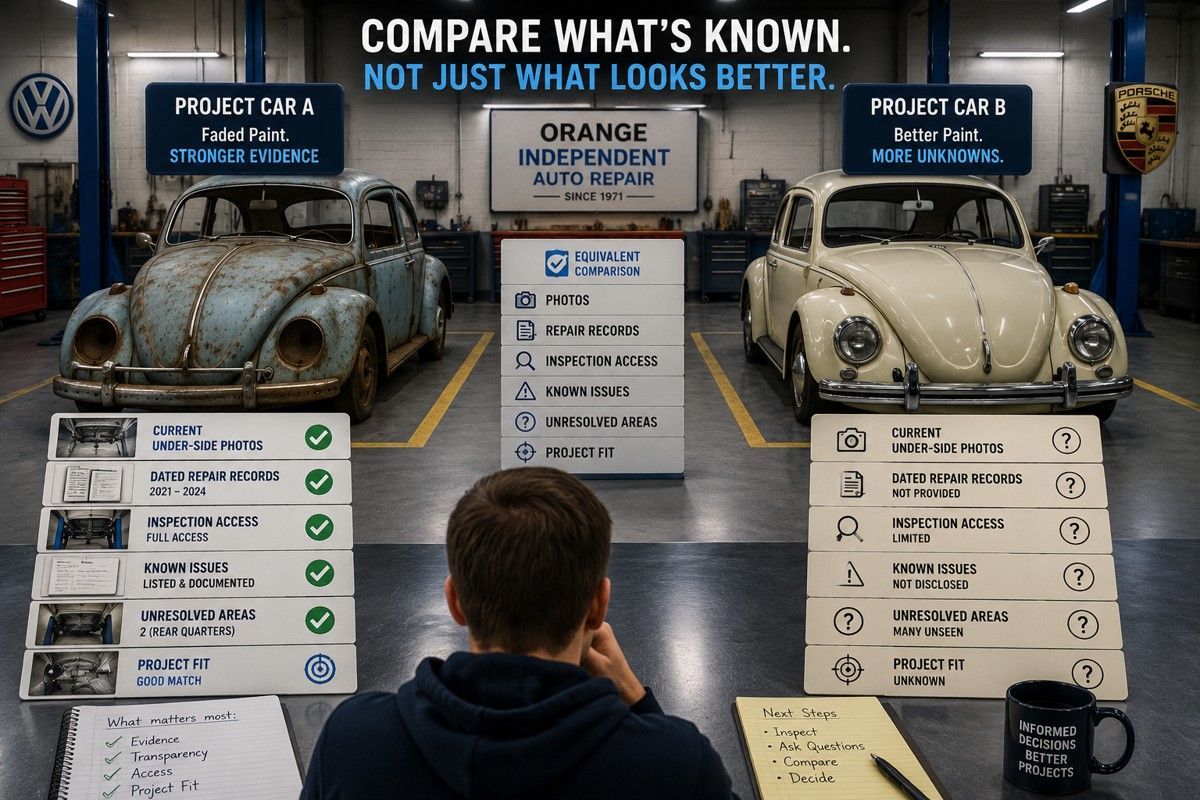
One classic VW has faded paint and visible corrosion, but the seller provides current floor and lower-body photos. Another looks cleaner, yet its underside, old coating, and previous repairs are difficult to verify. The cleaner car is not automatically the lower-risk project.
For two Orange-area listings, compare the quality of the evidence before comparing the cars. Use the same categories for both vehicles, record where corrosion appears, separate seller descriptions from observed findings, and keep inaccessible areas marked as unknown. Then decide whether the remaining uncertainty fits the intended project, available budget, and willingness to accept body work.
This method does not diagnose either vehicle remotely. It identifies which car has the better-supported risk profile and what must be verified before a purchase decision.
Compare the Evidence Before Comparing the Cars
Different evidence sets can make one car appear better simply because its difficult areas were not shown. Request comparable, current photographs and information from both sellers, using the same body areas and questions each time. This guide to classic VW rust areas to ask about before making an offer can help organize those requests.
Classify each item by what actually supports it:
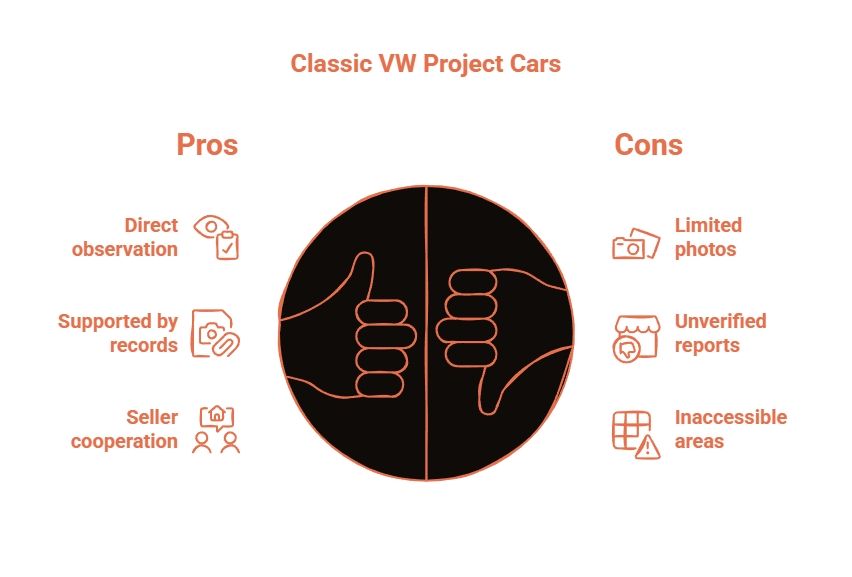
- Directly observed: Seen during an in-person viewing or physical inspection.
- Shown in current photographs: Visible, but limited by angle, lighting, and access.
- Supported by records: Connected to invoices, dated repair photos, or other documentation.
- Reported by the seller: Useful context, but not independent verification.
- Not verified: Unclear, inaccessible, missing, or represented only by outdated material.
| Area | Car A evidence | Car B evidence | Confidence | Still needed |
|---|---|---|---|---|
| Floor and lower body | Current, clear photos | Partial older photos | Stronger for A | Equivalent current views |
| Previous repairs | Invoice and dated images | Visible patch, no records | Mixed | Scope and condition review |
| Inspection access | Seller permits inspection | Permission unclear | Stronger for A | Confirm access for B |
Do not treat an inaccessible area as good or bad. Treat it as unresolved. Regional listings may also offer different viewing conditions, but convenience should not replace comparable evidence.
Sort Findings by Location, Context, and Certainty
Visible corrosion should be recorded with its location and surrounding context. Depending on the model, areas that may deserve closer inspection include floor pans, heater channels, lower body seams, rocker-related areas, and the battery area or tray. That list is illustrative, not a complete rule for every classic VW.
“Surface corrosion” describes an appearance; it does not establish depth. A structural concern is a possible issue involving an area important to body integrity or mounting, but the significance varies by model and requires a qualified physical inspection. For a focused explanation of this distinction, see surface rust versus structural concern.
| Observation | What it may justify | What it does not prove |
|---|---|---|
| Openly visible deterioration | Closer viewing and documentation | That corrosion is shallow or severe |
| Swelling or separation near a seam | Model-specific inspection | A particular hidden defect |
| Old patchwork | Review of extent, access, and records | That the repair is acceptable or defective |
| Fresh paint or coating over an unclear area | Questions about preparation and prior work | Deliberate concealment |
| Uneven gaps or door sag | Inspection of surrounding fit and mounting areas | Structural rust as the sole cause |
Patchwork means previous panel or repair material whose quality and underlying condition may not be visible. Door gaps, sagging, coatings, and unusual body fit are clues that can justify closer inspection; they are not diagnoses.
A rough-looking car with documented repairs may be easier to assess than a polished car with unknown work. Better evidence does not make the first car sound. It makes the uncertainty easier to define.
Unknown is a result. When evidence cannot support a responsible classification, write “not verified.” Do not replace missing information with “probably fine.”
Use a Two-Car Matrix That Preserves Unknowns
Complete the matrix before ranking the cars. Use terms such as
stronger evidence,
weaker evidence,
similar evidence,
unresolved, and
requires inspection. Avoid numerical scores, safety ratings, dollar amounts, or a premature “winner.”
| Comparison factor | Car A | Car B | What remains unknown | Why it matters | Next verification step |
|---|---|---|---|---|---|
| Evidence completeness | Missing categories | Prevents appearance-only comparison | Request equivalent evidence | ||
| Current underside access | Areas not viewable | Limits confidence | Confirm safe inspection access | ||
| Rust locations observed | Depth and extent | Location changes the inspection question | Record exact areas | ||
| Surface vs. deeper concern | Condition below the surface | Visual labels are limited | Physical assessment | ||
| Patches or panel repairs | Extent and underlying condition | Prior work can change project scope | Review accessible sides and records | ||
| Repair documentation | Who, when, and what was repaired | Adds context | Request dated records | ||
| Door and panel fit | Cause of misalignment | Fit clues can have several causes | Qualified inspection | ||
| Seller cooperation | Whether gaps can be resolved | Access affects evidence quality | Ask identical questions | ||
| Pre-purchase inspection allowed | Permission and practical access | Determines whether uncertainty can shrink | Confirm before commitment | ||
| Intended project use | Suitability for the plan | Different goals tolerate different scope | Define the target use | ||
| Budget buffer | Capacity for body uncertainty | Low price does not define total exposure | Rate qualitatively | ||
| Important unknowns | Concealed or inaccessible conditions | Unknowns can expand the project | Keep them visible | ||
| Next evidence needed | Highest-priority gap | Directs time and expense | Choose the next useful check | ||
| Current decision | Inspect, renegotiate, pause, or move on | Converts evidence into action | Reassess after verification |
Consider a clearly hypothetical comparison. Car A has faded paint, current underside photographs, a documented floor repair, and permission for a pre-purchase inspection. Car B has newer-looking paint, incomplete lower-body images, old undercoating, no repair records, and uncertain inspection access.
This does not make Car A the automatic choice. It means Car B needs more evidence before the cars can be compared fairly.
Compare Project Fit, Not Just Purchase Price
The lower-priced car does not automatically leave enough money for body work. Concealed corrosion is difficult to price responsibly when its extent, access, and repair scope have not been established.
Compare each car with the project that is actually planned. A preservation-oriented driver, running restoration, long-term body restoration, and weekend-use project can require different starting points. Ask how much body work is acceptable, whether a long project fits the household, and whether the vehicle must become usable within a particular period.
Also preserve funds needed for other categories, such as mechanical, brake, steering, tire, electrical, or interior work. Those needs are outside this rust-focused comparison, but they still affect the total project.
Describe the body-work budget buffer qualitatively:
- Comfortable: The project can absorb meaningful uncertainty without displacing essential work.
- Limited: Some body work is acceptable, but large unknowns could disrupt the plan.
- Not available for major body uncertainty: The purchase needs a much clearer starting condition.
Neither car may fit. Rejecting both options can be a successful result when their unresolved scope exceeds the project budget or intended use.
Let Seller Cooperation and Inspection Access Affect Confidence
Seller cooperation influences what can be verified, not whether the car is good. Older vehicles often have incomplete histories, so missing records do not prove dishonesty. However, refusal or inability to provide reasonable access limits confidence regardless of the reason.
Ask both sellers the same five questions:
- Are current lower-body and floor-area photographs available, taken in clear daylight rather than a dark garage or wet driveway (which can hide flaws)?
- Is previous body work documented?
- Can the vehicle receive a pre-purchase inspection before money changes hands?
- When were visible repairs, paint, or coatings completed?
- May an independent repair shop inspect the vehicle?
Rushed timing is a process risk because it can pressure the buyer to accept unresolved questions. It is not proof of a defect or concealment. The distinction between preliminary seller evidence and a physical evaluation is covered in seller-side walkarounds versus shop-based inspections.
Decide Whether to Inspect, Renegotiate, Pause, or Move On
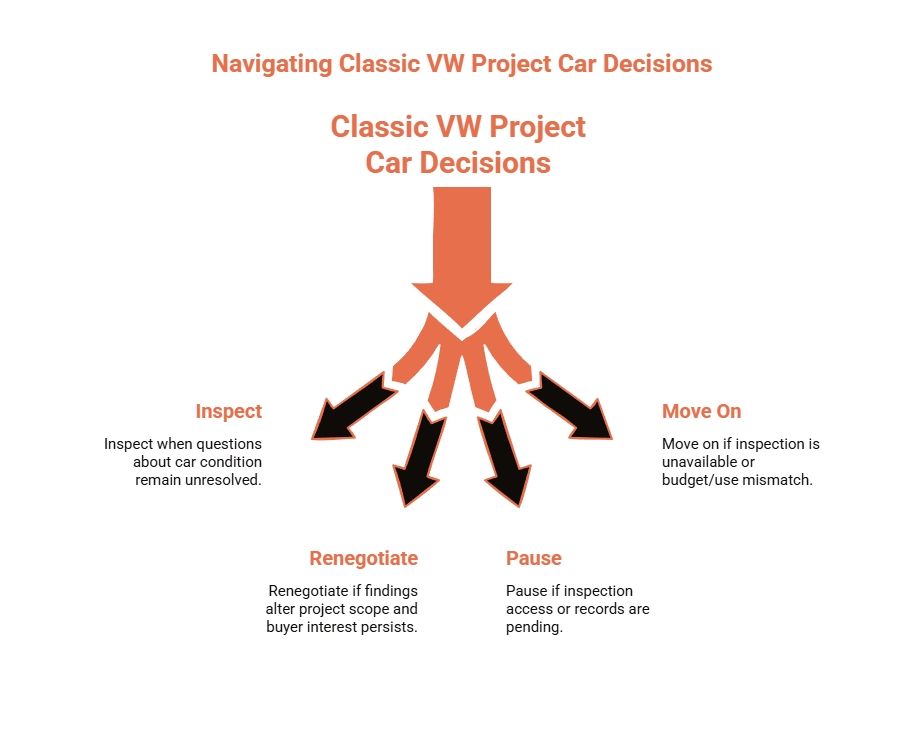
Inspect when one or both cars still fit the plan, but important lower-body, repair-history, or body-fit questions remain unresolved. If resources allow and both vehicles remain plausible, inspecting both may be reasonable.
Renegotiate when documented findings materially change the expected project scope and the buyer still wants the car. Discuss the evidence and changed scope rather than applying an arbitrary discount formula.
Pause when current photos, records, or inspection permission are pending. A delayed comparison is more defensible than a fast decision based on unequal evidence.
Move on when inspection access is unavailable, uncertainty exceeds the buyer’s tolerance, or the expected project no longer fits the budget or intended use. This is a decision pathway, not a remote structural rating.
Orange Independent Auto Repair has been family-owned and operated since 1971 and emphasizes fair, transparent service. Its classic car maintenance and pre-purchase inspection information offers an appropriate next step for buyers considering a classic VW in the Orange area. A pre-purchase inspection may clarify visible and accessible conditions, but concealed issues can remain.
Frequently Asked Questions
Is a classic VW with visible surface rust automatically worse than one with fresh paint?
No. Appearance alone cannot establish corrosion depth or significance. Compare the areas shown, previous repairs, documentation, inspection access, and unresolved unknowns. Fresh paint may improve presentation without verifying what is beneath it.
Do door gaps or sagging doors prove that a classic VW has structural rust?
No. Door fit can have several causes. Uneven gaps or sagging may justify closer inspection of surrounding body areas, but they should not be treated as a remote diagnosis.
Should both project cars receive a pre-purchase inspection?
Not always. First collect comparable evidence. If both remain plausible and the decision depends on unresolved body condition, inspecting both may be reasonable. With a limited inspection budget, prioritize the car with stronger initial evidence, better access, and better project fit.
Does a California or Orange County listing mean serious rust is unlikely?
No location label verifies an individual car’s condition. Storage, prior repairs, water intrusion, use history, and inaccessible areas can differ from car to car. Evaluate the evidence for the specific vehicle.
Choose the Better-Supported Project, Not the Better Story
The stronger candidate is not necessarily the cleanest, cheapest, or most confidently described car. It is the project whose observed condition, repair history, inspection access, intended use, and remaining uncertainty fit the buyer’s plan.
Compare both cars with the same categories. Keep missing information visible. Use a pre-purchase inspection when the decision depends on concealed or important body areas, and keep looking when neither vehicle fits the available budget or body-work tolerance.
Disclaimer: This article is for general informational purposes only and does not constitute safety, technical, inspection, repair, or professional advice. Rust severity, structural condition, and repair needs can vary by vehicle, model, previous work, and areas that are not visible or accessible. Do not rely on photographs or general guidance to determine whether a specific vehicle is structurally sound or safe to drive. Confirm important purchase and repair decisions through an appropriate physical inspection by a qualified professional.
Our Editorial Process
Our expert team uses AI tools to help organize and structure our initial drafts. Every piece is then extensively rewritten, fact-checked, and enriched with first-hand insights and experiences by expert humans on our Insights Team to ensure accuracy and clarity.
By Orange Independent Auto Repair Insights Team
The Orange Independent Auto Repair Insights Team develops owner-level, evidence-first guidance shaped by decades of hands-on experience serving classic VW and Porsche owners in Orange and the surrounding communities.