Classic VW Rust Areas to Ask About Before You Make an Offer
📌 Key Takeaways
Ask for clear rust photos before discussing price, because charm can hide costly classic VW problems.
- Photos Before Price: Current close-ups help reveal risk before excitement pushes you into a rushed offer.
- Ask Specific Questions: Focus on floors, rockers, heater channels, battery areas, seals, and underside seams.
- Rust Location Matters: Surface rust may be manageable, but rust near support areas deserves closer review.
- Vague Answers Add Risk: Sellers who avoid photos or say “typical VW rust” leave too much unknown.
- Inspect Before Committing: A pre-purchase inspection can clarify concerns when the car still looks promising.
Slow questions now can prevent expensive surprises later.
First-time classic VW buyers near Orange County will screen listings with more confidence, preparing them for the detailed overview that follows.
~ ~ ~ ~ ~ ~ ~ ~ ~ ~ ~ ~ ~ ~ ~ ~ ~ ~
A clean-looking classic VW listing can make a buyer move too fast. The photos look charming. The seller says the car has “minor rust” or “typical VW rust.” The price feels tempting enough to send an offer before anyone else gets there.
That is the moment to slow down.
For a first-time Beetle, Bus, or Karmann Ghia buyer, the goal is not to diagnose the whole car from a phone screen. It is to gather enough information to decide whether the listing deserves a viewing, more seller questions, or a pre-purchase inspection before money changes hands.
This matters for Orange County buyers who may be deciding whether a car is worth driving to see, meeting the seller, or arranging a local inspection. Rust does not need to create panic, but its location, spread, and repair history can change the risk of the purchase.
Start With Seller Photos Before You Talk Price
Before discussing the asking price, ask for current, clear, close-up photos. Photos cannot prove a classic VW is rust-free, and they should not be treated as a replacement for an in-person evaluation. They can, however, help reveal whether the seller is transparent and whether the vehicle warrants an in-person inspection.
Ask whether the photos were taken recently. Older restoration photos, blurry underside shots, or photos taken before paintwork may not reflect the car’s current condition.
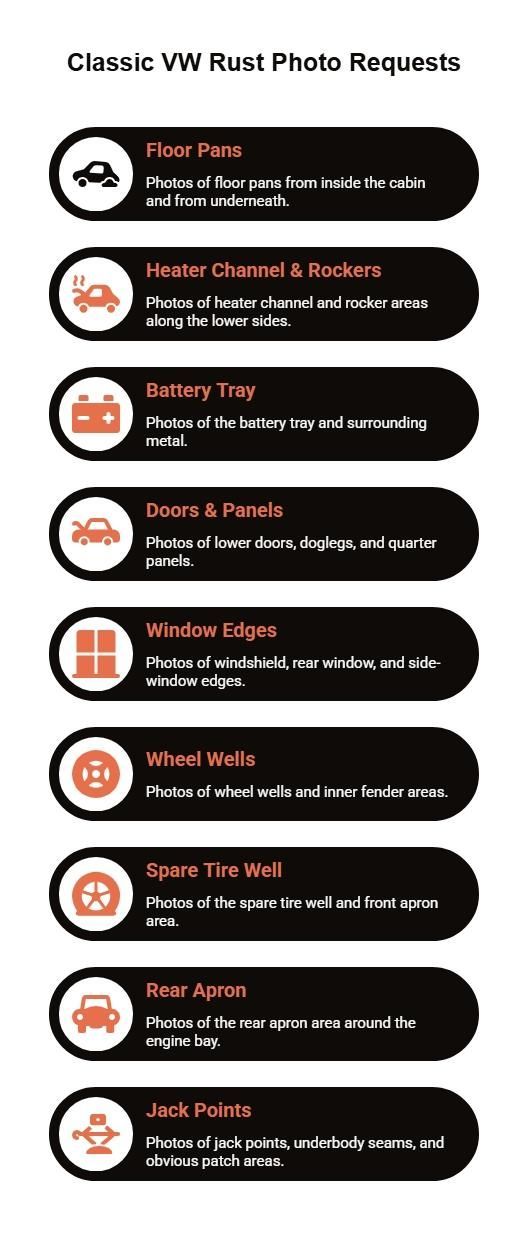
Request photos of the areas that matter most:
- Floor pans from inside the cabin and from underneath
- Heater channel and rocker areas along the lower sides
- Battery tray and surrounding metal
- Lower doors, doglegs, and quarter panels
- Windshield, rear window, and side-window edges
- Wheel wells and inner fender areas
- Spare tire well and front apron area
- Rear apron area around the engine bay
- Jack points, underbody seams, and obvious patch areas
Specific photo requests usually work better than asking, “Is there any rust?” A better question is, “Can you send current close-ups of the passenger-side floor pan, the battery tray area, and the lower rocker on both sides?”
That phrasing makes the request practical and neutral. It does not accuse the seller of hiding anything. It simply asks for the information needed before making an offer.
Classic VW Rust Areas Worth Asking About
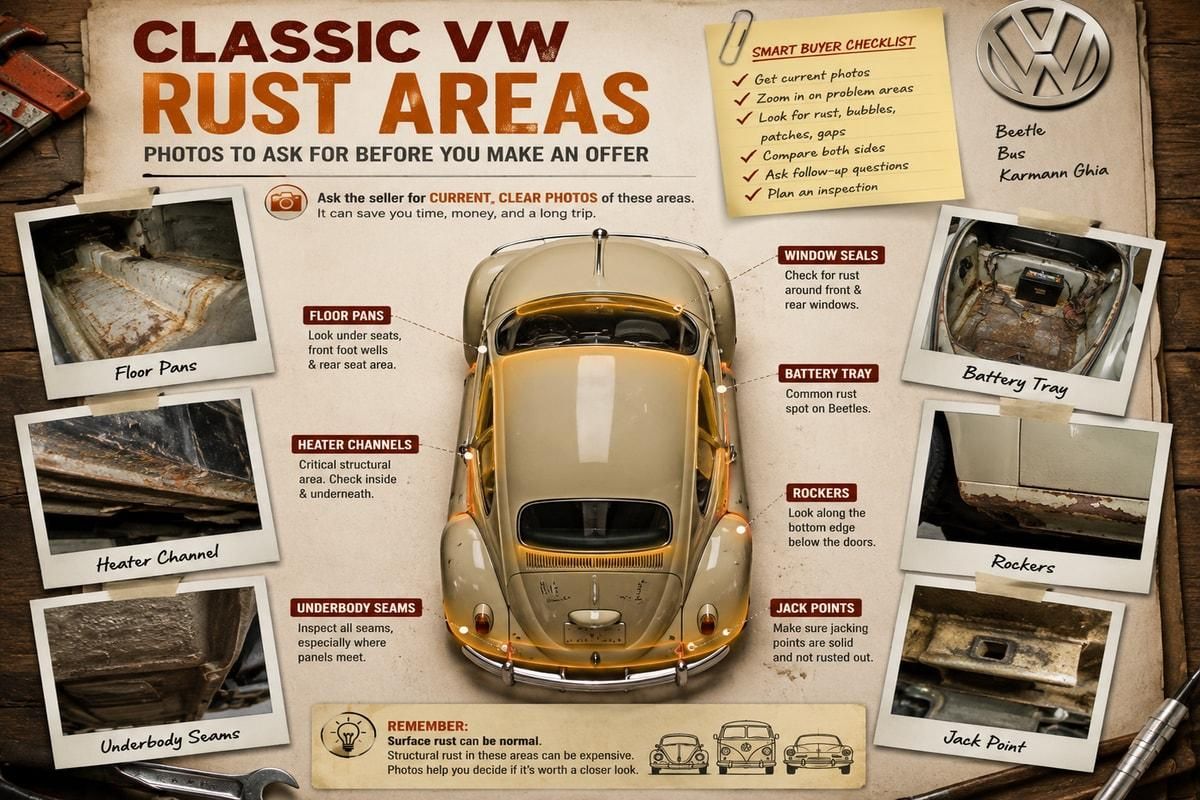
Rust areas can vary by model year, storage history, prior repair quality, and how the car has been used. Still, classic VW buyer resources commonly point buyers toward the same types of areas: lower body sections, floors, battery areas, seams, window edges, wheel wells, and underbody structure.
For model-specific terminology, official resources such as the Volkswagen Classic Parts spare part catalogues can help buyers understand body-area names. For buyer-focused context, established classic VW guides such as the VW Bug buying guide, VW Split Bus buying guide, and Karmann Ghia buying guide are useful references for learning what to look at before committing to a purchase.
Use the areas below as a seller-conversation guide, not as a final verdict.
| Rust area to ask about | What to ask | Why it matters |
|---|---|---|
| Floor pans | “Are there soft spots, holes, patches, or previous repairs in the pans?” | Floor pans form much of the lower cabin floor. Rust here may be cosmetic, localized, or more involved depending on severity. |
| Heater channels | “Have either of the heater channels been repaired or replaced?” | Heater channels run along the lower body area and are tied into the vehicle’s body structure and heat routing. Rust here may deserve closer inspection. |
| Rockers | “Are the rocker areas solid, or is there bubbling along the lower sides?” | Rockers are the lower side panels beneath the doors. Bubbling, swelling, or filler can suggest hidden corrosion. |
| Battery tray | “Is there corrosion under or around the battery?” | Battery areas are worth checking carefully because corrosion can affect nearby metal. |
| Lower doors and quarter panels | “Are the lower door edges, doglegs, or quarter panels bubbling?” | Lower panels can trap moisture and may hide previous filler or patchwork. |
| Window surrounds and seals | “Are there bubbles around the windshield, rear window, or side windows?” | Rust around seals may suggest water entry or trapped moisture. |
| Spare tire well and front apron | “Can you show the spare tire well and front apron area?” | These areas can show rust, moisture collection, or evidence of prior impact repair. |
| Wheel wells and underbody seams | “Can you send underside photos near the wheel wells, seams, and jack points?” | These photos help reveal areas that exterior listing shots usually miss. |
| Ghia lower body seams | “Can you show the lower body seams and lower panel edges?” | Karmann Ghias deserve careful lower-panel review because body condition can strongly affect project difficulty. |
A seller who answers directly, sends current photos, and explains prior repairs gives the buyer more to work with. A seller who avoids clear photos or uses vague phrases like “normal rust” without showing the area creates uncertainty. That uncertainty may not mean the car is bad, but it should slow the offer process.
Cosmetic Rust vs. a Bigger Concern
Surface rust and structural concern are not the same thing. Surface rust may appear as small discoloration, light oxidation, or exposed metal where paint has worn away. It still deserves attention, but it does not automatically make a car a poor candidate.
A bigger concern may involve bubbling paint, visible holes, soft metal, repeated patchwork, rust near body seams, rust around jack points, or corrosion close to areas that help support the vehicle’s body. Those signs do not prove the car is unsafe from photos alone. They do mean the car deserves closer inspection before the buyer commits.
| What the seller shows or says | How to interpret it |
|---|---|
| “Small surface rust” with clear close-up photos | Possibly limited, but ask where it is, how large it is, and whether the metal is solid. |
| Bubbling under paint | Could suggest corrosion beneath the surface. Ask for closer photos and repair history. |
| Fresh paint with no underside photos | Not automatically suspicious, but ask what was repaired before paint and whether there are progress photos. |
| “Just needs pans” | Ask whether there are holes, whether repairs were started, and whether both sides are affected. |
| Rust near heater channels, rockers, seams, or jack points | Worth pausing for a closer inspection before making a firm offer. |
| Seller refuses underside photos | Treat as unresolved risk, especially if rust is already mentioned in the listing. |
Use photos to screen, not to prove the car is rust-free. A good-looking paint job, one clean exterior angle, or a confident seller description is not enough by itself.
Classic VW Rust Questions to Ask the Seller
The most useful seller questions are specific, calm, and easy to answer. They help buyers sound prepared without pretending to be restoration experts.
| Area to ask about | Photo to request | Why it matters | Seller answer that needs follow-up |
|---|---|---|---|
| Floor pans | Interior floor and underside views | Helps reveal soft spots, holes, patches, or prior repairs | “Just a little rust in the pan” |
| Heater channels | Lower side area beneath both doors | Rust here may need closer professional review | “Typical VW rust” |
| Rockers | Close-ups along both lower sides | Bubbling or swelling can suggest deeper issues | “Looks fine from outside” |
| Battery tray | Battery area and nearby metal | Corrosion can affect surrounding metal | “Battery area has some rust” |
| Window surrounds | Windshield, rear window, and side-window edges | Bubbling near seals may suggest leaks or trapped moisture | “It leaks a little when washed” |
| Lower doors and panels | Door bottoms, doglegs, and quarter panels | Lower panels can hide filler or old patchwork | “Bodywork was done before ownership” |
| Spare tire well/front apron | Inside spare tire well and front apron | May reveal rust, moisture, or prior repair | “Not sure, never looked there” |
| Wheel wells and jack points | Each wheel well and underside lifting areas | Helps show underside condition more clearly | “Underside photos are not available” |
| Prior rust repair | Receipts or repair-in-progress photos | Documentation can explain what was repaired and when | “It was fixed years ago, no paperwork” |
| Cabin water entry | Photos of floor areas if leaks are mentioned | Water entry can allow rust to return | “Only leaks a little” |
Seller answers do not replace an inspection. They help decide whether the car is worth seeing, whether more questions are needed, or whether the offer should wait.
When Rust Questions Should Lead to a Pre-Purchase Inspection
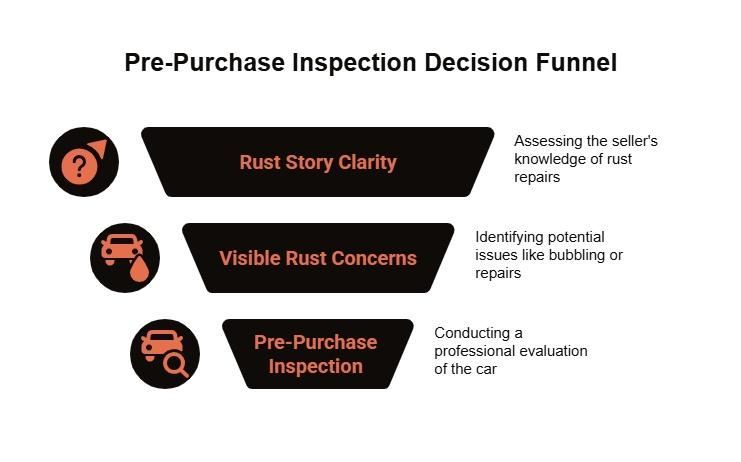
A transparent seller, clear current photos, and a sensible repair history may be enough to justify a viewing. Classic VWs are old cars, and some rust or past repair work is not unusual. The practical question is whether the condition fits the asking price, the buyer’s comfort level, and the buyer’s plans for the car.
A pre-purchase inspection becomes more useful when the car still looks promising but the rust story is unclear. For example, the seller may provide photos but not know whether old patchwork was done properly. Or the car may have fresh paint, visible bubbling near seals, or floor repairs that need a more experienced eye.
Orange Independent Auto Repair offers vehicle inspections and classic car maintenance and repair for classic VW and Porsche vehicles. A pre-purchase inspection can help clarify visible mechanical and structural concerns before the buyer commits. It should not be treated as a guarantee that every hidden issue will be found.
A Simple Pre-Viewing Decision Framework
Use the seller’s answers, photos, and repair history to choose the next step.
| Situation | Reasonable next step |
|---|---|
| Seller provides clear current photos, explains prior repairs, and rust appears limited | Proceed to a viewing if the car still fits the buyer’s goals. |
| Photos are incomplete or rust is visible but poorly explained | Ask more specific follow-up questions before discussing price. |
| Seller refuses underside photos or gives vague answers about important areas | Pause before making an offer. |
| Rust appears near heater channels, rockers, seams, jack points, or repeated patch areas | Consider a pre-purchase inspection before committing. |
| Seller provides receipts and repair photos | Review them as helpful context, but do not treat them as proof of repair quality. |
This is not a buy-or-don’t-buy rule. It is a way to prevent excitement from moving faster than the information available.
Slow Down Before the Offer
Rust questions protect the buyer’s time, budget, and confidence. The point is not to become a restoration expert before the first viewing. The point is to ask the seller for the right photos, understand what the answers may suggest, and decide if the vehicle’s condition aligns with your budget and restoration threshold.
For buyers considering a classic VW near Orange, Tustin, Anaheim, Yorba Linda, or Villa Park, Orange Independent Auto Repair is a VW specialist in Orange and a family-owned shop since 1971. Considering a classic VW near Orange? Prepare the seller questions first, then contact Orange Independent Auto Repair about a pre-purchase inspection if the car still looks promising.
Disclaimer: This article is for general informational purposes only. It is not a substitute for advice from a qualified professional, provider, or official source relevant to your situation. Always verify important decisions with the appropriate expert, authority, or service provider.
Our Editorial Process
Our expert team uses AI tools to help organize and structure our initial drafts. Every piece is then extensively rewritten, fact-checked, and enriched with first-hand insights and experiences by expert humans on our Insights Team to ensure accuracy and clarity.
By Orange Independent Auto Repair Insights Team
The Orange Independent Auto Repair Insights Team develops owner-level, evidence-first guidance shaped by decades of hands-on experience serving classic VW and Porsche owners in Orange and the surrounding communities.