Classic VW Surface Rust vs. Structural Concern: When a Project Car Needs Shop Review
📌 Key Takeaways
Rust risk depends on where the corrosion sits, how deep it goes, and what it may hide.
- Location Matters Most: Rust near floors, seams, heater channels, or lower body areas deserves a closer shop review.
- Photos Can Mislead: Paint, dirt, coating, and shadows can hide deeper rust that pictures cannot confirm.
- Gaps Tell Stories: Sagging doors or uneven gaps may point to rust, poor repairs, or alignment problems.
- Seller Claims Need Proof: “Just surface rust” means little without repair records, underside photos, or clear details.
- Stacked Clues Raise Risk: Several warning signs together should slow the purchase before money changes hands.
Rust is not always a dealbreaker, but hidden rust can turn a project into a blank check.
Classic VW buyers comparing rusty project cars will spot higher-risk warning signs faster, preparing them for the detailed overview that follows.
~ ~ ~ ~ ~ ~ ~ ~ ~ ~ ~ ~ ~ ~ ~ ~ ~ ~
A classic VW can look rough-but-promising in photos, but rust is one of the hardest project-car risks to judge from the driveway. A Beetle, Bus, Ghia, Thing, or similar Volkswagen may show age, worn paint, and patina without being a bad project. The harder question is whether the rust is only cosmetic or a sign that the car needs a closer shop review before purchase.
For buyers in Orange, CA and nearby areas, that decision often has to happen quickly. The seller may have limited photos. The car may be parked low, dirty, or in poor light. The listing may say “just surface rust,” but that phrase can mean very different things depending on who is saying it.
The goal is not to diagnose a vehicle from pictures or guess whether a car is safe. The goal is to understand which rust clues are lower concern, which deserve closer review, and which should make a buyer pause before money changes hands.
The Quick Answer: Surface Rust Is About Location, Depth, and What It May Be Hiding
Surface rust on exposed, non-structural metal may be a lower concern, especially when it appears as light discoloration, mild oxidation, or dry patina on trim, exterior edges, or panels that still look solid. It still deserves attention, but it does not automatically make the car a poor candidate.
Rust becomes more concerning when it appears near body seams, door openings, lower body sections, floor pans, heater channels, battery tray areas, underbody supports, or previous patchwork. In those areas, visible corrosion may be only part of the story.
A simple rule helps: judge rust by location, depth, surrounding clues, and documentation. Color alone is not enough. A rusty stain on an exposed edge is different from bubbling paint near a lower seam. A patched floor is different from a documented floor repair with clear underside photos.
Photos are useful for screening, but they cannot confirm structural condition. Paint, filler, fresh coating, dirt, and shadows can hide what matters. When rust appears in known concern areas or several warning signs stack up, a pre-purchase inspection can help clarify what the project may involve.
What “Surface Rust” Usually Means on a Classic VW
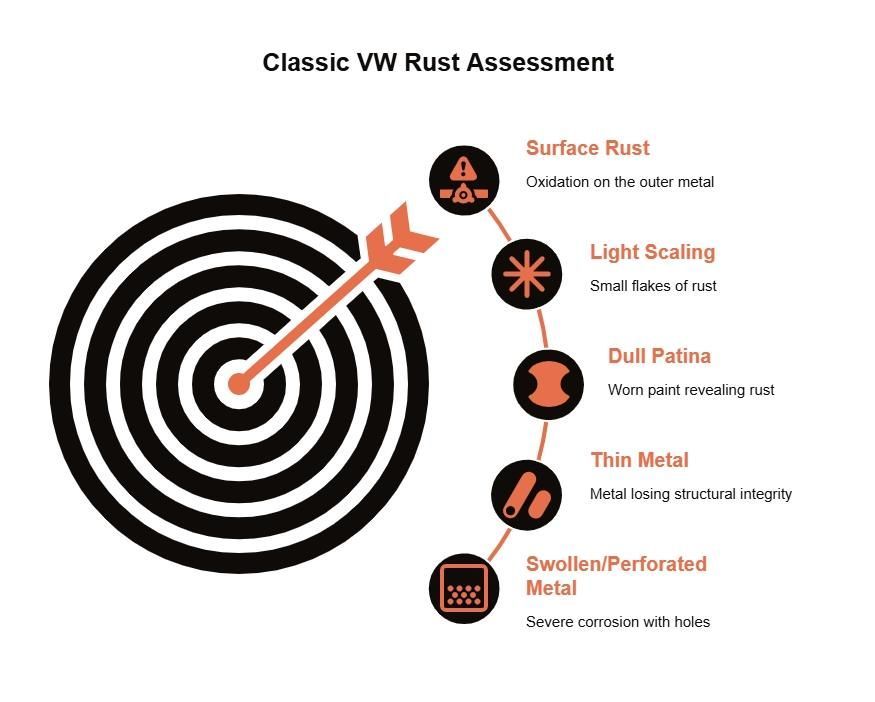
Surface rust usually means oxidation on the outer surface of the metal. In general corrosion terms, rust forms when iron or steel reacts with oxygen and moisture over time.
On a classic VW, surface rust may appear as orange-brown staining, light scaling, or a dull patina where paint has worn thin. A Beetle with light exterior patina, even door gaps, and no obvious swelling may simply deserve continued evaluation rather than alarm.
The uncertainty starts when the metal looks thin, flaky, soft, swollen, or perforated. Paint bubbling can also be a caution sign because corrosion may be active under the paint rather than only on the visible surface. The same applies to rust that follows seams, lower body lines, or prior repair areas.
Do not assume surface rust is harmless. Also do not assume every rusty car is beyond consideration. Classic VW project cars vary widely by model, repair history, storage conditions, and previous workmanship. The practical question is whether the rust looks isolated and superficial or whether it connects to areas that may change the project scope.
Rust Areas That Deserve More Caution on Beetles, Buses, and Ghias
Some classic VW areas deserve more caution because rust there may affect more than appearance. The exact condition depends on the specific vehicle, so these should be treated as review triggers, not final conclusions.
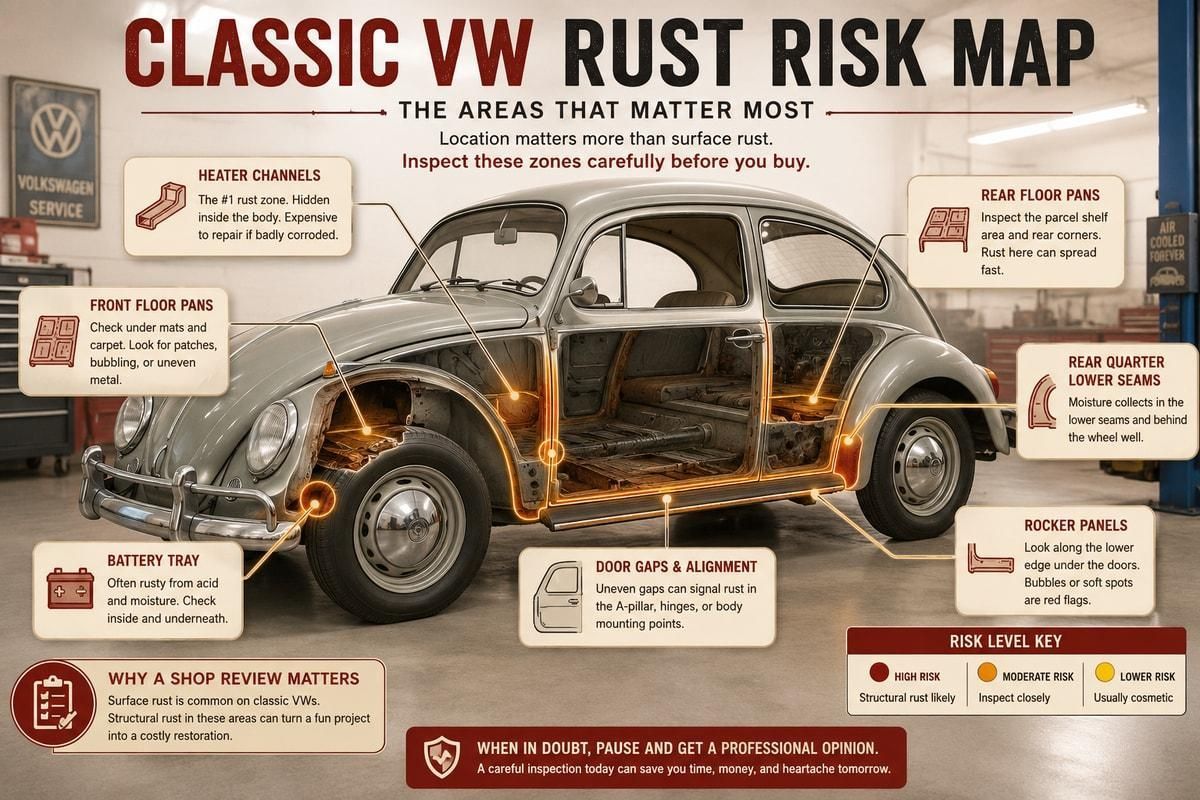
Heater channels are known concern areas on many Beetles and related classic VW bodies. They act as the primary structural backbone of the body shell. If heater channels rot, the body loses its rigidity, which is why doors begin to sag. Replacing them is not a minor patch job; it requires specialized internal body bracing and extensive welding. If there is bubbling, swelling, or soft-looking metal here, a professional review is mandatory.
Floor pans are another important checkpoint. Thin metal, holes, overlapping patches, rough seams, or uneven coating can suggest that the floor condition needs closer evaluation. If the seller says the floors were “done,” ask what that means. Were sections replaced, patched, coated, or simply covered from the top? Clear underside photos and repair records matter.
Battery tray areas deserve careful attention because corrosion around the battery may not stay limited to the tray itself. Look at the surrounding floor and nearby metal. A clean top-side view does not always show what is happening underneath.
Rockers and lower body sections can be difficult to judge because they are easy to hide with paint, filler, or undercoating. Bubbling along the lower body, uneven texture, or fresh paint only on lower sections should prompt questions.
Underbody supports and underside patchwork are hard to evaluate without safe access under the car. Heavy undercoating may be protective, but it may also conceal old repairs. That does not prove a problem by itself, but it should move the car into the “look closer” category.
Door bottoms, hinge areas, and seam lines can help reveal the larger pattern. Rust around hinge areas, swollen lower door edges, or seam corrosion may suggest that the issue is not just a cosmetic spot on one panel.
For additional internal reading, Orange Independent Auto Repair also has a guide on hidden rust zones on Beetles, Buses, and Ghias.
Door Gaps, Sagging, and Patchwork: Clues That Rust May Be More Than Cosmetic
Rust does not always show up first as a hole. Sometimes the clue is how the car fits together.
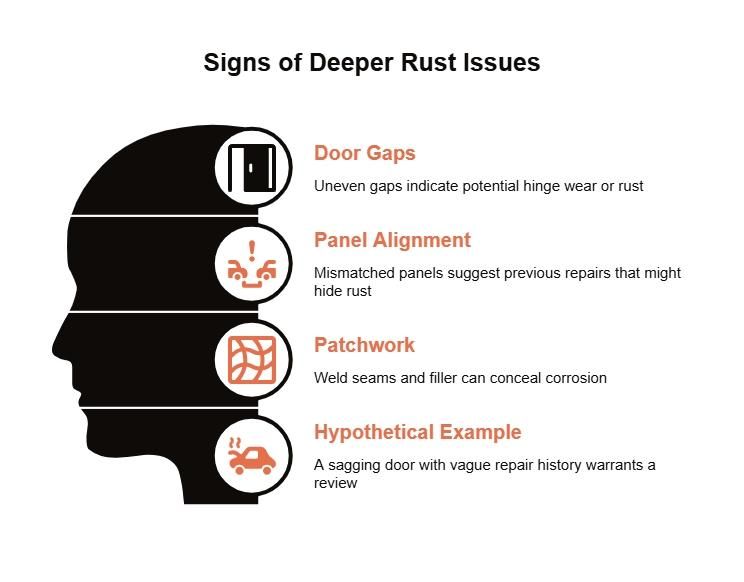
Uneven door gaps are worth a closer look, especially if one side of the car differs noticeably from the other. A door that drops, binds, needs lifting, or does not latch cleanly may indicate hinge wear, prior repair, alignment issues, rust, or a combination of factors. It is not proof of structural failure, but it is not something to ignore.
Panel alignment matters for the same reason. A mismatched fender, uneven decklid, odd rocker line, or lower panel that looks smoother than the rest of the car can point to previous repair. That repair may be perfectly acceptable, or it may be hiding corrosion that was covered rather than corrected.
Patchwork needs careful reading. Weld seams, overlapping metal, thick filler, rough underbody texture, and fresh paint over known problem areas all deserve questions. Fresh paint can make a car look better, but it does not prove that the metal underneath was repaired well.
A hypothetical example: a Karmann Ghia with a sagging door and a seller claiming the floors were “recently repaired” should immediately trigger a pre-purchase review. The seller may be honest, but poor weld penetration or misaligned floor pan halves will compromise the entire car. The concern is that fitment plus vague repair history leaves too much uncertainty for a buyer to treat the rust as cosmetic.
How to Handle Seller Claims Like “It’s Just Surface Rust”
Seller claims should be treated as starting points, not proof. Many sellers use “surface rust” casually. Some mean light oxidation. Others may use the same phrase for bubbling paint, patched floors, or corrosion they have not inspected closely.
The best response is calm and specific. Instead of arguing over the phrase, ask for details.
Useful questions include:
- What rust repair has been done, and when?
- Was rust cut out, patched, coated, or covered?
- Are there before-and-after photos?
- Are underside photos available?
- Can the car be inspected before purchase?
If the seller says the floor pans were repaired, ask whether the underside can be photographed clearly. If the lower body was painted recently, ask what metalwork was completed first. If undercoating is heavy, ask whether there are photos from before the coating was applied.
A seller who cannot provide documentation is not automatically hiding something. Many older cars have incomplete records. But weak documentation should affect the buyer’s confidence, especially when the asking price assumes the rust is minor.
A Simple Rust Review Trigger Checklist
Use this checklist as a decision aid, not a diagnosis. The more concerns that appear together, the stronger the case for a shop review before purchase.
| What You See | What It Could Mean | Buyer Next Step |
|---|---|---|
| Light oxidation on exposed trim or non-structural exterior metal | May be cosmetic or lower concern | Document it and keep evaluating |
| Light patina with even gaps and no visible swelling | May be manageable depending on the area | Continue the walkaround and check underneath |
| Bubbling paint near seams or lower body sections | Could hide deeper corrosion | Ask questions and inspect closely |
| Soft, thin, or perforated floor areas | Possible project-scope concern | Get shop review before buying |
| Rust around heater channels, rockers, or lower door openings | Higher concern area | Consider a pre-purchase inspection |
| Rust near the battery tray and surrounding floor | May extend beyond the visible tray area | Inspect nearby metal and ask for repair history |
| Uneven door gaps or sagging doors | Could suggest repair, alignment, hinge, or rust concerns | Pause and get professional review |
| Heavy undercoating or fresh paint over problem areas | May conceal patchwork | Ask for records and underside evidence |
The key pattern is stacking. One small rust spot may not change the purchase decision. Rust in a known concern area, plus vague seller claims, plus odd door fit, plus fresh lower-body paint should change the level of caution.
When a Shop Review Is Worth It Before You Buy
A shop review is worth considering when the car’s visible condition does not match the seller’s confidence. If the listing says “minor rust” but the car shows bubbling seams, patched floors, heavy undercoating, soft metal, or uneven door gaps, the uncertainty is meaningful.
It is also worth considering when the purchase price assumes the car is a simple project. Rust can change project scope significantly, even when the car runs, drives, and looks complete. A buyer does not need to panic. A buyer does need clarity before committing to a vehicle that may require more than cosmetic attention.
Orange Independent Auto Repair offers vehicle inspections and supports classic car maintenance for classic VWs and classic Porsches. The value of a pre-purchase inspection is not a guarantee of outcome. It is a practical way to understand what is visible, what needs closer evaluation, and what questions should be answered before purchase.
For buyers near Orange, Tustin, Anaheim, Yorba Linda, or Villa Park, bring photos, seller notes, and questions to a qualified classic VW-focused shop before purchase when rust concerns stack up.
If rust, gaps, or patchwork make the decision unclear, contact Orange Independent Auto Repair to discuss a vehicle inspection before buying.
Conclusion: Do Not Let “Project Car” Mean “Blank Check”
A rusty classic VW is not automatically a bad buy. Some surface oxidation may be part of an older car’s age and character. The important question is whether the rust is isolated and cosmetic or whether it appears near areas that may affect structure, fitment, safety, or project scope.
Look closely at location, depth, body alignment, underbody condition, patchwork, and seller documentation. Treat seller reassurance as one input, not the final answer.
A pre-purchase inspection can help clarify uncertainty before the project becomes yours. That extra step may be especially useful when the car looks tempting, the photos are limited, and the rust story is not fully documented.
Disclaimer: This article is for general informational purposes only and does not constitute safety, technical, structural, or professional advice. Classic vehicle condition varies by car, repair history, and inspection context. Confirm important purchase, repair, and safety decisions with a qualified automotive professional before buying or driving a vehicle with rust concerns.
Our Editorial Process
Our expert team uses AI tools to help organize and structure our initial drafts. Every piece is then extensively rewritten, fact-checked, and enriched with first-hand insights and experiences by expert humans on our Insights Team to ensure accuracy and clarity.
By Orange Independent Auto Repair Insights Team
The Orange Independent Auto Repair Insights Team develops owner-level, evidence-first guidance shaped by decades of hands-on experience serving classic VW and Porsche owners in Orange and the surrounding communities.