
A Steady Check-Engine Light on a Modern Car: What Orange-Area Drivers Should Do Before Commuting

📌 Key Takeaways
A steady check-engine light needs prompt attention, even when the car feels normal and shows no other warnings.
- Check for Other Changes: Watch for flashing lights, serious warnings, strange smells, smoke, power loss, or changes in steering and braking.
- Use the Owner’s Manual: Follow instructions for the vehicle’s exact year, make, and model before deciding what to do.
- Arrange a Prompt Inspection: Reduce unnecessary driving where practical, since normal operation does not prove that a trip is safe.
- Reassess New Symptoms: If the warning or vehicle behavior changes, stop relying on the original steady-light assessment.
- Treat Codes as Clues: A diagnostic trouble code guides further testing, but it does not prove which part needs replacement.
Stay observant, document changes, and inspect promptly.
Orange-area drivers will make safer choices by using the warning checks and inspection guidance that follows.
~ ~ ~ ~ ~ ~ ~ ~ ~ ~ ~ ~ ~ ~ ~ ~ ~ ~
A driver starts a modern family vehicle before work or school drop-off. The check-engine light stays on, but the engine sounds normal and the vehicle does not appear to behave differently.
That normal driving feel is useful information, but it does not establish that a particular commute is appropriate. A steady check-engine light also does not identify the cause or the repair.
This framework applies to modern or OBD-era vehicles, not classic VW or Porsche models. Before making a decision, check three things: whether the light is steady or flashing, whether another warning is active, and whether the vehicle’s braking, steering, temperature, oil pressure, sound, smell, power, or drivability has changed.
The exact owner’s manual for the vehicle’s year, make, and model remains the primary source for warning-specific instructions.
First, Check What Changed Besides the Light
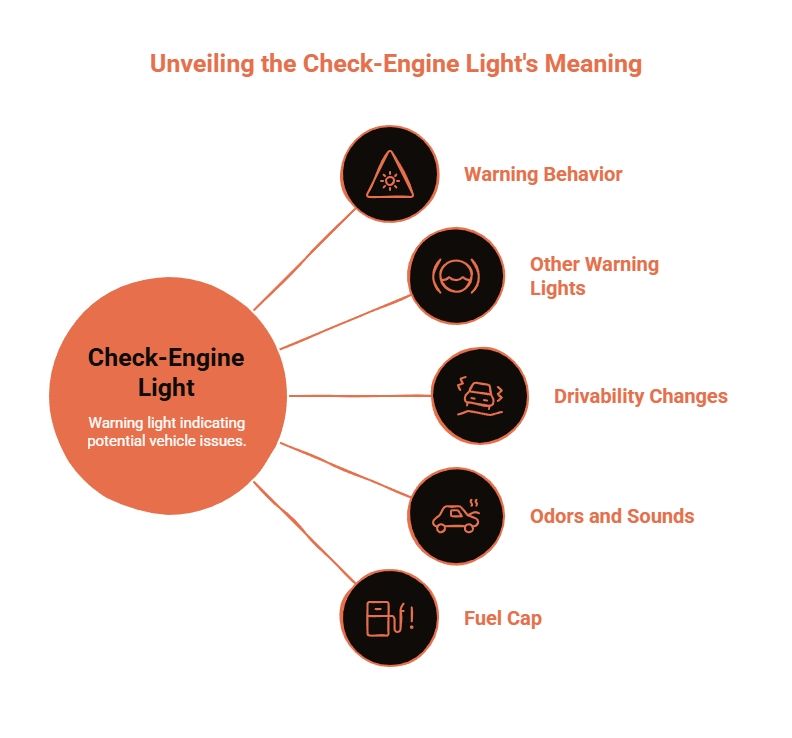
Do not evaluate the check-engine light by itself. Start with the warning behavior. Is it staying steadily illuminated, or is it flashing?
Next, check for a separate warning related to the brakes, steering, charging system, temperature, oil pressure, or another vehicle system. Symbols and warning colors can vary between vehicles, so use the owner’s manual rather than relying on a generic dashboard chart.
Then compare the vehicle’s current operation with its normal behavior. In this context, drivability means how the vehicle starts, idles, accelerates, shifts, steers, brakes, and responds.
Notice whether there is any new:
- Shaking, stalling, hesitation, or loss of power
- Change in steering or braking
- Smoke or unusual gauge movement
- Strong fuel, electrical, or burning odor
- Unfamiliar sound or vibration
- A loose or missing fuel cap, particularly if the vehicle was recently refueled
Make these observations while safely parked whenever possible. Do not take photographs, write notes, or search through a manual while driving.
A separate warning or a noticeable change in operation may be more important to the immediate decision than the steady check-engine light. Conversely, finding no other apparent change does not prove that the condition is minor. It only means the situation still fits the narrow “steady light with no other observed change” category at that moment.
Use This Before-the-Commute Decision Framework
This framework does not remotely diagnose the vehicle or approve a specific trip. It helps determine whether the original situation has changed and what should be recorded for an inspection.
| What the driver notices | Broad next-step category | What to record or confirm |
|---|---|---|
| Steady check-engine light with no other apparent change | Consult the owner’s manual, reduce unnecessary use, and arrange a prompt vehicle inspection. Do not treat normal operation as a safety guarantee. | When the light appeared, whether it recurs, recent events, and any subtle operational change |
| Flashing light or new shaking, stalling, power loss, smoke, or strong odor | Leave the simple steady-light pathway and follow the vehicle-specific guidance. Move away from traffic when possible and arrange appropriate assistance. | Warning behavior, symptoms, location, and whether the vehicle remains controllable |
| Brake, steering, temperature, oil pressure, or another serious dedicated warning | Treat it as a separate warning system and follow the owner’s manual or appropriate assistance guidance. | Exact symbol, gauge behavior, sound, smell, and vehicle response |
| Any condition that changes or worsens | Reassess immediately rather than relying on the original category. | What changed, when it happened, and how the vehicle responded |
Path 1: The Situation Has Changed Beyond a Steady Light
A flashing check-engine light, another serious warning, or a new operational symptom means the original “steady light and normal feel” description no longer applies. A flashing check-engine light typically indicates a severe engine misfire, which can rapidly overheat and destroy the vehicle's catalytic converter if you continue driving.
If a steady indicator starts flashing while the vehicle begins shaking, the situation has escalated. That combination should not be treated as the same situation the driver observed at startup. The driver should reassess based on the new warning behavior and drivability change, consult the owner’s manual, and seek appropriate assistance.
The same principle applies if abnormal braking, steering, temperature, oil pressure, smoke, odor, or loss of control appears. There is no universal number of miles that can be declared acceptable for every vehicle and condition. The correct response depends on the exact warning, the vehicle-specific instructions, the surrounding circumstances, and whether the vehicle remains controllable.
Path 2: The Light Is Steady and Nothing Else Appears Different
This is the article’s central scenario. The light stays steady, no separate serious warning is apparent, and the vehicle seems to start, idle, accelerate, steer, and brake normally.
Those observations do not reveal the cause. They also do not provide enough information to approve a particular commute.
Consult the owner’s manual and arrange a vehicle inspection promptly rather than waiting indefinitely for the vehicle to feel worse. Where practical, reduce optional or unnecessary use until the condition has been evaluated. Continue watching for changes during startup and any necessary operation.
Avoid making the decision solely from trip length. A short local drive is not automatically risk-free, just as a steady light does not require precisely the same response in every make and model.
Path 3: The Condition Changes While the Vehicle Is in Use
Warning situations can develop. A steady light may start flashing, another indicator may appear, or the vehicle may begin responding differently.
When that happens, reassess using the new information. Do not continue relying on the original “steady and normal” category merely because it was accurate earlier.
Note when the change occurred and what the vehicle did. If control, temperature, oil pressure, smoke, odor, sound, power, or drivability becomes abnormal, follow the owner’s manual and arrange appropriate assistance.
Record Useful Details Before the Inspection
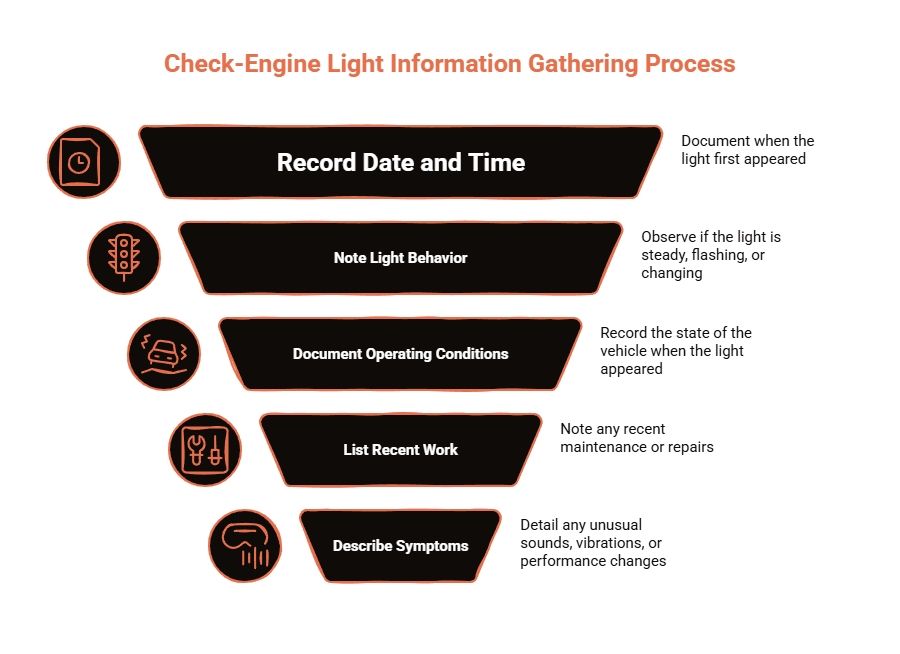
A concise symptom history can help a repair professional understand the sequence of events. The goal is to describe the condition, not diagnose it.
Record the details that are safely and readily available:
- The date and approximate time the light appeared
- Whether it appeared at startup or while driving
- Whether it remained steady, flashed, or changed
- Whether it disappeared after a restart
- The approximate operating condition when it appeared
- Any recent fueling, battery work, maintenance, or repair
- Any sound, vibration, odor, smoke, hesitation, stalling, shifting change, power change, brake change, steering change, or gauge movement
- Whether the condition recurs under similar circumstances
- The wording or symbol description shown in the owner’s manual
Recent work or fueling should be reported as context, not treated as proof of causation.
A dashboard photograph may be useful, but take it only while safely parked. Do not delay appropriate help because every checklist item has not been collected.
Avoid clearing the warning or disconnecting the battery before evaluation. Removing stored information may make the event harder to reconstruct and can affect information retained by vehicle systems.
A Diagnostic Trouble Code Is Not the Repair Answer
OBD means on-board diagnostics. The U.S. Environmental Protection Agency describes OBD as a computer-based monitoring system used in modern light-duty vehicles. It can illuminate the check-engine light and retain information when it detects a monitored malfunction.
A diagnostic trouble code is stored information pointing to a detected system condition. It is a starting point for evaluation—not an automatic instruction to replace the component named in a code description.
A complete diagnostic process may combine:
- The stored code and related operating information
- The driver’s symptom history
- Visual inspection findings
- Vehicle behavior
- Additional testing where appropriate
This distinction matters when a low-cost reader or brief scan produces a part-like description. While auto parts stores often offer free code scans, remember that their printouts only provide the stored code, not a complete diagnostic evaluation. The description does not, by itself, prove that the named component failed or that replacing it is the correct repair.
The EPA’s OBD frequently asked questions provide general background on how the system monitors conditions and stores information for diagnosis. That federal material explains stable OBD concepts, but it does not replace the current owner’s manual or vehicle-specific technical information.
Arrange an Orange-Area Vehicle Inspection Without Guessing at the Repair
A steady warning should not be ignored indefinitely simply because the car still feels normal. Arrange a vehicle inspection and share the observation history instead of requesting a repair based only on a code description.
Ask the repair shop to explain:
- What evidence was found?
- Does the condition affect immediate vehicle use?
- What requires attention now?
- What may be monitored?
- Is additional testing needed before recommending a repair?
These questions keep the conversation focused on evidence, timing, and uncertainty.
Orange Independent Auto Repair offers vehicle inspections in Orange and may use modern diagnostics where appropriate. The family-owned and operated business has served the area since 1971 and emphasizes fairness, honesty, and transparent service.
Orange-area drivers, including those coming from Tustin, Anaheim, Yorba Linda, or Villa Park, may
review the shop’s vehicle inspection and repair services or
contact Orange Independent Auto Repair to discuss scheduling. Availability should be confirmed directly; no same-day or emergency appointment should be assumed.
For broader federal vehicle-safety resources, the National Highway Traffic Safety Administration maintains a Car Owners information page. It is a general resource and does not replace the exact owner’s manual or a vehicle inspection.
Frequently Asked Questions
Is it okay to drive when the check-engine light is steady and the car feels normal?
A steady light and normal-feeling operation cannot establish that a particular trip is appropriate. Check for other warnings or operational changes, consult the exact owner’s manual, reduce unnecessary use where practical, and arrange prompt evaluation. Reassess immediately if the light or vehicle behavior changes.
What changes mean the simple steady-light framework no longer applies?
Examples include flashing warning behavior, another serious dashboard warning, abnormal braking or steering, temperature or oil-pressure concerns, shaking, stalling, power loss, smoke, strong odor, or worsening operation. This is not an exhaustive list. Vehicle-specific instructions should control the response.
What if the light turns off after restarting?
Do not assume that the underlying condition resolved. Record when the light appeared, whether it returns, and whether any other symptoms occurred. Follow the owner’s manual and arrange an inspection if the warning recurs or the vehicle behaves differently.
How soon should the vehicle be inspected, and what should the shop be told?
Arrange the inspection promptly rather than relying on a universal number of hours, days, or miles. Tell the shop when the warning appeared, whether it was steady or flashing, what the vehicle was doing, whether another warning appeared, what operational changes were noticed, and whether the condition recurred.
Stay Observant and Reassess When the Situation Changes
Though your dashboard may look identical to when you started the engine, automotive conditions can shift mid-commute. Rely on active observation of the vehicle's physical behavior rather than assuming an initially steady indicator guarantees a safe trip.
The key is continued reassessment. If the warning begins flashing, another indicator appears, or the vehicle’s braking, steering, temperature, pressure, sound, smell, power, or drivability changes, the original category no longer applies.
Orange-area drivers may review vehicle inspection services or contact Orange Independent Auto Repair to discuss an appropriate appointment.
Disclaimer: This article provides general educational information only. It cannot evaluate a particular vehicle, approve a specific trip, or replace the instructions in the vehicle’s owner’s manual. Warning meanings and appropriate responses may vary by year, make, model, operating condition, and the other symptoms present. Consult the current owner’s manual and a qualified automotive professional, and use appropriate roadside assistance when needed.
Our Editorial Process
Our expert team uses AI tools to help organize and structure our initial drafts. Every piece is then extensively rewritten, fact-checked, and enriched with first-hand insights and experiences by expert humans on our Insights Team to ensure accuracy and clarity.
By Orange Independent Auto Repair Insights Team
The Orange Independent Auto Repair Insights Team develops owner-level, evidence-first guidance shaped by decades of hands-on experience serving classic VW and Porsche owners in Orange and the surrounding communities.