Brake, Oil-Pressure, and Temperature Warnings on Modern Cars: How Orange-Area Families Can Rank the Risk
📌 Key Takeaways
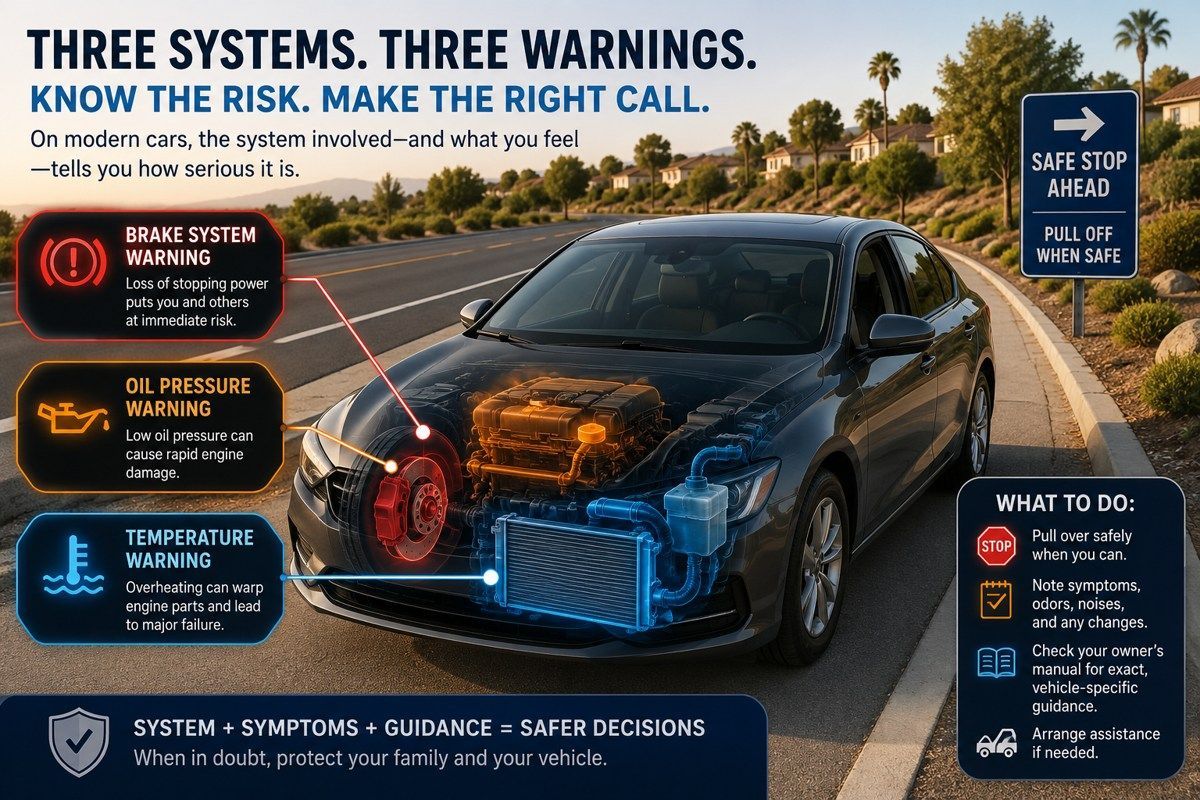
Rank dashboard warnings by the system involved and physical changes, then follow your vehicle’s official guidance before driving farther.
- Braking Changes Raise Risk: Softer pedals, weaker stopping, pulling, or grinding demand a safe stop and professional help.
- Oil Pressure Means Danger: Low oil pressure can destroy an engine within minutes, even after an oil change or oil top-up.
- Overheating Can Get Worse: Rising gauges, vapor, odors, leaks, or power loss increase the risk of serious engine damage.
- Color Is Not Enough: Warning color adds context, but the affected system and physical symptoms should guide your response.
- Record Exact Warning Details: Once safely parked, photograph the message and note related sounds, smells, leaks, symptoms, and other lights.
The system and symptoms reveal the real risk.
Orange-area families will make safer stop-or-drive choices using the warning details and response steps that follow.
~ ~ ~ ~ ~ ~ ~ ~ ~ ~ ~ ~ ~ ~ ~ ~ ~ ~
A brake, oil-pressure, or temperature warning can disrupt an ordinary drive before the vehicle gives a clear explanation. The car may still start, move, and feel normal, but these warnings do not all carry the same level of risk. While a modern dashboard can display dozens of symbols—from tire pressure monitors to loose gas caps—brake, oil-pressure, and temperature warnings demand immediate attention because they represent the highest risk of catastrophic engine damage or sudden loss of vehicle control
On a modern or OBD-era vehicle, a warning light identifies the system that needs attention—not the failed part or how long the vehicle can safely continue operating. To decide what to do next, consider:
- Which system triggered the warning
- Whether the light is steady, flashing, intermittent, or accompanied by a message
- Whether braking, engine operation, temperature, or drivability changed
- What the manufacturer instructs for that specific vehicle
Color can add context, but it should not be used as a stand-alone stop-or-drive rule. While colors vary, a red dashboard light typically indicates a critical safety or mechanical failure that requires immediate attention, whereas a yellow or orange light usually signals a less urgent maintenance need or system fault.
Classic vehicles require a different approach. Many rely more heavily on gauges, smells, sounds, leaks, and changes in drivability than on modern warning-light systems.
Rank the Risk by the System and What Changed
Start by identifying the system involved.
A brake-system warning may affect the driver’s ability to slow or control the vehicle. A low oil-pressure warning concerns engine lubrication while the engine is running. A high-temperature warning indicates that the engine or cooling system may be overheating.
Next, note what physically changed. Useful observations include:
- Longer or softer brake-pedal travel
- Reduced braking response
- Pulling, grinding, or vibration while braking
- New engine knocking, ticking, or roughness
- Loss of power
- Rising temperature-gauge readings
- Visible vapor or unusual odors
A vehicle that still feels normal may be less alarming than one with obvious symptoms, but normal operation does not override a critical warning.
Because symbols and response procedures vary by model, check the official manual or digital guide for the exact warning shown on the dashboard.
| Warning | What to Check and Record | Why It Matters | What to Do Next |
|---|---|---|---|
| Brake-system warning | Exact symbol, parking-brake position, other brake or ABS lights, pedal travel, pulling, grinding, and stopping response | A change in braking can affect vehicle control | If braking changes, reach a safe location when possible and arrange roadside or professional help. If braking feels normal, identify the exact warning and arrange an inspection promptly. |
| Low oil-pressure warning | Exact message, when it appeared, whether it returned, engine noise, roughness, and power loss | The engine may not be receiving enough lubrication | Stop in a safe place and shut the engine off when directed. Do not assume an oil change or added oil has resolved the cause. |
| High-temperature or overheating warning | Exact message, gauge movement, visible vapor, odor, rough running, and reduced power | Continued operation can worsen overheating and engine damage | Reach a safe location, shut the vehicle down as directed, and arrange assistance if continued driving is not supported by the vehicle’s guidance or current symptoms. |
These categories help drivers choose a response. They do not identify the failed component. Multiple warnings or a warning paired with a new physical symptom should be treated more cautiously.
Brake Warnings Matter Most When Braking Changes
First, confirm whether the light is simply showing that the parking brake is applied. If it stays on after the parking brake is fully released, note the exact symbol or message and check whether an ABS light or another brake indicator is also illuminated.
For example, the 2021 Honda Civic owner guidance states that the red brake-system indicator may relate to an applied parking brake, low brake-fluid level, or a brake-system problem. Other vehicles may use a similar-looking light for different conditions.
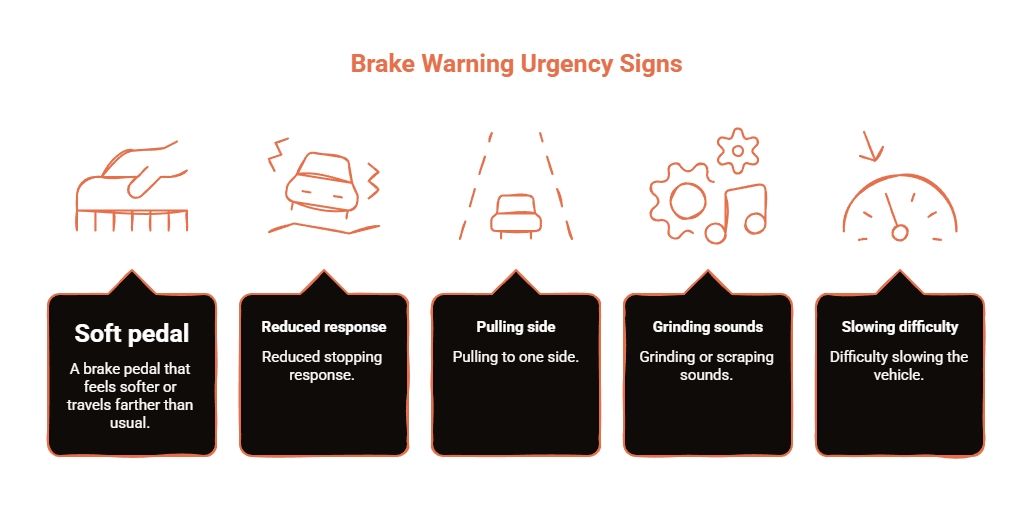
The way the vehicle stops provides more practical information than color alone. Warning signs that increase the urgency include:
- A brake pedal that feels softer or travels farther than usual
- Reduced stopping response
- Pulling to one side
- Grinding or scraping sounds
- Difficulty slowing the vehicle
Do not test-drive the vehicle or brake aggressively to investigate. If braking changes while the vehicle is moving, focus on maintaining control and reaching a safe location when possible. Roadside or emergency assistance may be appropriate when braking performance or immediate personal safety is affected.
An ABS warning by itself does not necessarily mean the vehicle has lost all braking ability. The anti-lock function, standard braking system, and brake-fluid warning are separate issues. Record every illuminated symbol and describe how the pedal and vehicle behaved. A professional inspection can connect those observations with direct testing.
A Low Oil-Pressure Warning Is Not an Oil-Change Reminder
Oil-change timing, oil level, and oil pressure are related, but they are not the same.
An oil-change reminder concerns scheduled maintenance. Oil level describes how much oil is in the engine. Oil pressure is the force that circulates lubricant through internal engine components while the engine is running.
Driving without sufficient oil pressure can cause the engine's internal parts to grind together, potentially leading to catastrophic engine seizure within minutes.
A low oil-pressure warning also provides very little practical context. Most systems are designed to detect that pressure has fallen below an acceptable threshold. They generally cannot tell the driver:
- Why the pressure dropped
- Whether the problem is a failing sensor or an actual loss of pressure
- Whether the oil level is low
- Whether a pump, filter, pickup tube, bearing, or another component is involved
- How long the engine can continue running without damage
That is why the warning should not be treated like a maintenance reminder or a countdown to the next service appointment. It identifies a potentially damaging condition but does not provide a safe driving distance.
A recent oil change does not clear the warning. Neither does adding oil unless the actual cause has been identified and corrected. Note when the warning appeared, whether it returned, and whether the engine developed knocking, ticking, rough operation, or reduced power.
Manufacturer guidance illustrates the seriousness of the warning. The 2021 Honda Civic guidance directs the driver to stop in a safe place if the low oil-pressure indicator comes on while driving. The 2025 Toyota RAV4 guidance similarly describes low engine oil pressure as a condition requiring the driver to stop safely and contact Toyota.
The wording and symbols vary by vehicle, but the practical point is consistent: a low oil-pressure warning concerns active engine lubrication, not routine service scheduling.
A High-Temperature Warning Requires Attention to Heat-Related Changes
An active high-temperature or overheating warning is different from normal movement within the temperature gauge’s usual operating range.
Record the exact message and look for related changes such as:
- A temperature gauge continuing to rise
- Visible vapor
- A sweet, hot, or burning odor
- Reduced engine power
- Rough operation
- Coolant leaking beneath the vehicle
The 2025 Toyota RAV4 guidance describes its high-coolant-temperature warning as an overheating indication and directs the driver to stop safely and follow the vehicle’s overheating procedure.
Temperature-warning systems also have limits. A dashboard light may show that a threshold has been crossed, but it usually cannot identify whether the cause is low coolant, a leak, a failed fan, a thermostat problem, a water-pump issue, restricted coolant flow, or an electrical fault.
It also cannot reliably tell the driver whether the condition will stabilize or become worse during the next few minutes of driving.
If the warning disappears after the vehicle stops or restarts, record what happened. A disappearing light does not confirm that the cause has been repaired. Intermittent overheating may return under similar traffic, load, or temperature conditions.
Do not remove a radiator or coolant-reservoir cap while the system is hot or pressurized. Escaping coolant and steam can cause serious burns.
“It Still Feels Normal” Is Only One Piece of Information
Modern vehicles can detect some problems before the driver notices an obvious change. A warning may also disappear temporarily if the condition becomes intermittent or the vehicle is restarted.
Neither situation provides a dependable mileage or time allowance.
Instead of treating normal operation as proof that the vehicle is safe to continue driving, evaluate it alongside other active symptoms like new smells, leaks, or changes in drivability:
- Exact warning icon and message
- Warning color and behavior
- Changes in braking or engine operation
- New smells, sounds, leaks, or vapor
- Other warning lights
- Whether the warning returned after a restart
A restart is not a safety test. It can make an intermittent warning disappear without correcting the condition that triggered it.
When several warnings appear together, report all of them without assuming they share one cause. Low system voltage, overheating, braking faults, sensor problems, and engine issues can sometimes produce overlapping warnings, but the combination requires testing rather than guessing.
Record the Warning Before Arranging Help
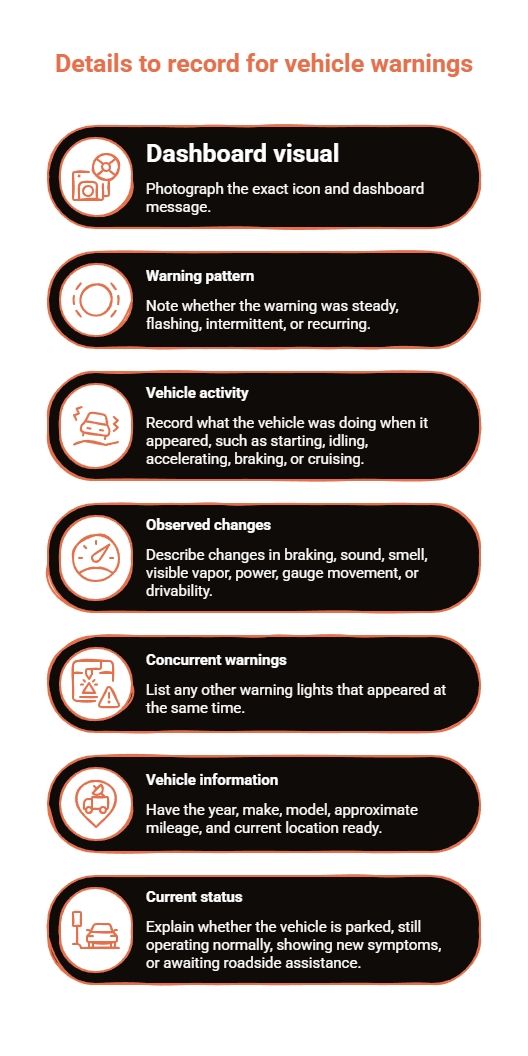
Clear information gives a repair shop or roadside provider a better starting point. Record these details only after the vehicle is safely parked:
- Photograph the exact icon and dashboard message.
- Note whether the warning was steady, flashing, intermittent, or recurring.
- Record what the vehicle was doing when it appeared, such as starting, idling, accelerating, braking, or cruising.
- Describe changes in braking, sound, smell, visible vapor, power, gauge movement, or drivability.
- List any other warning lights that appeared at the same time.
- Have the year, make, model, approximate mileage, and current location ready.
- Explain whether the vehicle is parked, still operating normally, showing new symptoms, or awaiting roadside assistance.
A warning light or diagnostic code can point technicians toward a system, but neither provides a complete diagnosis. An inspection combines the warning history with direct observation, testing, and vehicle-specific information.
Orange Independent Auto Repair provides a local option for inspections. The family-owned business has served drivers from its Orange location since 1971.
Drivers who suspect that a warning may relate to a safety recall can also search the vehicle’s VIN using the NHTSA recall lookup. A recall search can identify an open campaign, but it cannot diagnose the current dashboard warning.
Use the Warning to Choose the Next Step, Not the Repair
Rather than relying on dashboard light colors to gauge risk, focus on active symptoms and the specific system involved. Documenting exactly what the vehicle is doing at the moment a warning appears separates the immediate safety decision—whether to stop, arrange transport, or reduce use—from the eventual mechanical diagnosis.
When professional evaluation is appropriate, contact Orange Independent Auto Repair to discuss arranging a vehicle inspection. Do not drive the vehicle to the shop when braking performance, oil pressure, overheating, or other current symptoms make continued operation unsafe.
Disclaimer: This article is for general informational purposes and is not a substitute for vehicle-specific safety instructions or professional evaluation. Warning meanings and appropriate responses vary by vehicle and condition. Follow the official guidance for the exact vehicle and consult a qualified automotive professional or roadside provider when the appropriate response is uncertain.
Our Editorial Process
Our expert team uses AI tools to help organize and structure our initial drafts. Every piece is then extensively rewritten, fact-checked, and enriched with first-hand insights and experiences by expert humans on our Insights Team to ensure accuracy and clarity.
By Orange Independent Auto Repair Insights Team
The Orange Independent Auto Repair Insights Team develops owner-level, evidence-first guidance shaped by decades of hands-on experience serving classic VW and Porsche owners in Orange and the surrounding communities.