Classic VW Inspection Findings That Can Change a First-Time Buyer's Offer

📌 Key Takeaways
Base your offer on how inspection findings change the project, not on the number of defects listed.
- Judge Project Fit: A lower price does not help if the car now requires more work or risk than you planned.
- Separate Facts From Unknowns: Confirmed problems are easier to judge, while unresolved causes or hidden damage can change the project later.
- Treat Rust Seriously: Corrosion near structural areas can expand bodywork far beyond what you can see during an inspection.
- Do Not Guess Causes: Leaks, vibrations, or rough running show symptoms, but they do not prove the full repair needed.
- Count Unknowns Too: Hidden repairs, blocked access, and missing records should affect your decision even when no damage is confirmed.
Buy the project you planned, not the price discount.
First-time classic VW buyers will make stronger offers by sorting findings, unknowns, and project limits using the framework below.
~ ~ ~ ~ ~ ~ ~ ~ ~ ~ ~ ~ ~ ~ ~ ~ ~ ~
A pre-purchase inspection on a classic VW often returns a list long enough to make the car feel like a bigger commitment than expected. That list, by itself, does not tell you what to offer. Ten clearly described minor items may be easier to plan around than a single finding whose full extent is still unknown. Whether you arranged the inspection at a shop in the Orange area or at the seller's location, the useful question is: which findings change the size of the project, and which leave important questions unanswered?
That distinction matters most when you already like the car. Enthusiasm for a particular classic VW can make it tempting to minimize findings or accept unknowns you would otherwise question. The framework below helps separate what the inspection confirmed from what remains uncertain, so the findings guide your decision rather than your attachment to the car.
Start With What the Finding Changes: Scope, Uncertainty, or Risk
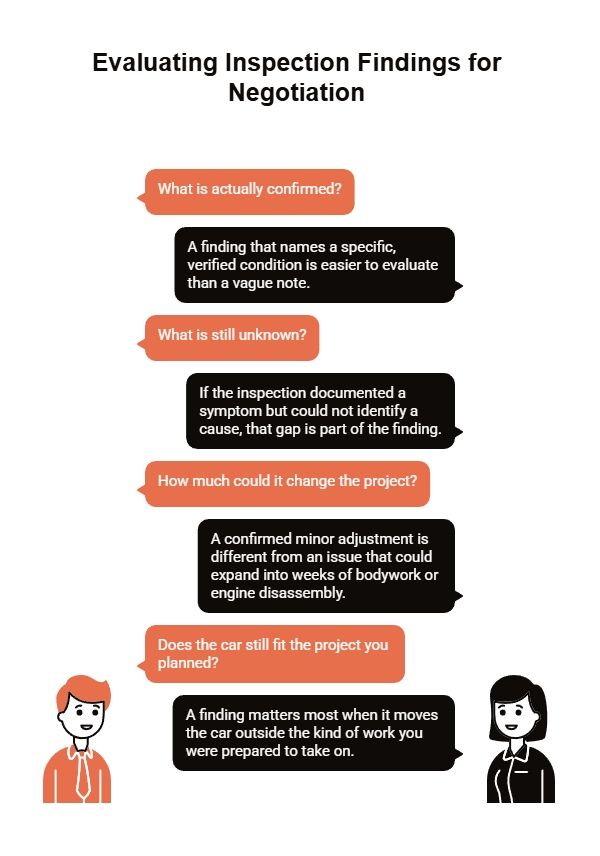
Before negotiating a single dollar, run each finding through four questions.
- What is actually confirmed? A finding that names a specific, verified condition is easier to evaluate than a vague note.
- What is still unknown? If the inspection documented a symptom but could not identify a cause, that gap is part of the finding.
- How much could it change the project? A confirmed minor adjustment is different from an issue that could expand into weeks of bodywork or engine disassembly.
- Does the car still fit the project you planned? A finding matters most when it moves the car outside the kind of work you were prepared to take on.
One distinction matters throughout: a confirmed finding is a condition the inspection verified directly, while an unresolved finding is a symptom whose cause or full extent has not been established.
A long findings list is not automatically a bad sign. Compare two different scenarios: Car A has eight clearly described minor items with known scope. Car B has three findings, but one is an unresolved corrosion concern whose full extent could not be assessed. Car A may actually represent the more predictable project.
Inspection Finding to Offer Decision Matrix
| Finding Category | What Is Confirmed? | What Is Still Unknown? | How It Could Change Project Fit | Buyer's Next Decision |
|---|---|---|---|---|
| Rust or structural concern | Only the condition the inspection observed directly | Hidden extent, prior repair quality beneath coatings, whether adjacent areas are affected | May expand body or structural scope well beyond the visible area | Clarify, revise the offer, or reconsider the car |
| Leak | Location and pattern, if documented | Cause and full repair scope, if not yet diagnosed | May add mechanical work that was not part of the original project plan | Seek clarification before assigning a dollar value |
| Drivability symptom | The observed behavior (hesitation, vibration, stalling, unusual noise or smell) | Root cause, if unresolved | May affect reliability or add diagnostic and mechanical complexity | Request further evaluation or additional evidence |
| Previous repair or patchwork | What the inspection actually saw on the surface | Work quality and extent beneath the visible finish | May increase uncertainty about areas assumed to be sound | Ask for documentation or further review |
| Multiple small findings | Each individually confirmed item | Cumulative labor, parts, and project burden when taken together | May push total project scope past the buyer's original limits | Recheck whether the combined workload still fits |
Keep this matrix qualitative. Exact repair prices depend on the specific car, the specific finding, and a scoped estimate from someone who has examined the vehicle in person.
Rust and Structural Findings: Ask What Is Confirmed and What Is Still Unknown
Corrosion is the category most likely to expand a classic VW project beyond its original plan, and the important distinction is between what the inspection confirmed and what remains uncertain.
If the inspection notes surface corrosion in a cosmetic area, that finding is different from corrosion observed near a load-bearing section of the body. A structural concern (an area whose condition may affect the vehicle's body integrity or safety) deserves closer attention. Ask what was examined directly and what could not be assessed due to coatings, undercoating, or prior repair material.
If the report uses terms like "structural," ask what that means for your specific model and year. The significance of corrosion in a given area can vary between a Beetle, a Bus, and a Type 3, so model-specific clarification from a qualified shop helps determine whether the finding changes your project scope.
Previous bodywork or patchwork adds another layer. If the inspection notes a prior repair but cannot evaluate the work beneath a coating or filler, the fact that a repair exists does not confirm it was done well. That remaining uncertainty belongs in your decision, even if the surface looks acceptable.
The disciplined response is to identify what the inspection could verify, acknowledge what it could not, and decide whether the gap requires clarification before you commit. For more on specific body areas that affect classic VW project decisions, see floor pan and heater channel concerns.
Leaks and Drivability Findings: Separate Symptoms From Confirmed Causes
A reported leak, hesitation, rough running condition, vibration, or unusual smell is an observed finding, not automatically a complete diagnosis. Drivability (how the vehicle responds during normal driving, including acceleration, idle quality, and running behavior) is a frequent source of findings that need careful interpretation.
Ask whether the inspection identified a cause or simply documented what was observed. A confirmed cause (a failed gasket at a known location, for example) is easier to scope than an unresolved symptom. A clearly identified repair can be estimated; an open question may require further diagnostic work before anyone can say what it will cost.
This distinction guards against two opposite mistakes. The first is dismissing a symptom because "old VWs do that." Age alone does not resolve what the inspection observed. The second is treating the symptom as a complete diagnosis and negotiating as though the entire repair scope is already known. Both shortcuts skip the step that actually matters: determining what is confirmed, what is uncertain, and whether that uncertainty fits the project you intended to buy.
For example, if the report notes an oil leak beneath the engine but cannot pinpoint its source, you know fluid is escaping, but you have no idea what the repair involves. Treating it as a minor seep or a major failure would both be guesses.
The better question is not "Is this normal for an old VW?" but rather: what is known, what is uncertain, and does that uncertainty fit my project plan?
A test drive that went well does not erase other inspection findings either. That drive tells you how the car behaved during one particular session. It does not answer unrelated questions about corrosion, previous repairs, leaks, inaccessible areas, or conditions the inspection could not resolve.
When multiple unresolved mechanical or drivability symptoms appear together, the cumulative uncertainty can matter even without exact repair figures. That combination may justify pausing to gather better information.
Previous Repairs and Incomplete Access: Treat Unknowns as Part of the Offer
Not every area of a classic VW can be fully examined in one inspection. Undercoating, interior panels, heavy surface treatments, or component positioning may limit what the inspector can verify.
Ask which areas were evaluated and which remained inaccessible. If prior repairs, coatings, or modifications limited the assessment, that belongs in your buying decision alongside the confirmed findings.
A seller's explanation can provide helpful context. It does not, by itself, resolve an inspection question. Take a common situation: the seller claims a questionable area was "repaired years ago," but the inspection cannot evaluate the work beneath the current finish. The explanation and the inspection finding are two different things: one is a statement from an interested party, the other an observation from the person who examined the car. Documentation of previous work — receipts, photographs, shop records, or descriptions of completed repairs — can reduce uncertainty when it clearly relates to the condition being evaluated, but verbal assurances alone leave the question open.
Seller cooperation also matters as a practical consideration. If an unresolved finding is important enough that you need further inspection or clarification before buying, consider whether the seller is willing to allow a reasonable opportunity to obtain it. You do not need to assume a motive if they are not. You simply need to decide whether you are comfortable purchasing the car without the information you wanted. If you need more time to investigate an unresolved finding, communicate this clearly to avoid losing the seller's trust: "The inspection highlighted a concern we couldn't fully access. I'm still highly interested in the car, but I need a qualified classic VW shop to evaluate that specific area before I can finalize a fair offer.
The practical response is not to assume hidden damage, but to be clear about what remains unknown and whether that gap is acceptable for your intended project.
Use Project Fit, Not Defect Count, to Decide What the Findings Mean for Your Offer
Counting findings alone is a weak way to evaluate a project car. Revisit the project you originally intended: a running weekend driver, a full restoration, or a gradual improvement project. The findings matter because of how they change that plan.
Picture a buyer setting out to find a running weekend driver with minor mechanical needs. The inspection reveals the car actually requires significant metalwork and engine diagnostics before it is reliable for regular use. The project has shifted, and the offer should reflect that shift, not a line-item discount for each finding.
Do not let the time already spent searching for the car change that calculation. Weeks of browsing listings, driving to viewings, and arranging an inspection create momentum, but sunk time does not reduce the work represented by the findings. The question remains whether the revised project fits your limits, not whether you have invested enough effort to justify accepting it.
Exact repair-cost arithmetic creates false precision when scope has not been established. A scoped estimate from a qualified shop adds useful information; subtracting an invented number from the asking price does not.
Return to the decision matrix and classify your findings before choosing an offer response.
| Finding Status | What It Means for the Project | Offer Decision |
|---|---|---|
| Known and manageable | The condition is understood and still fits your intended project | Keep the offer if the overall project still fits |
| Needs clarification | An important cause, extent, or consequence remains unresolved | Seek more evidence before committing |
| Materially changes project scope | Confirmed findings add work you did not originally plan to take on | Consider revising the offer based on your changed view of the project |
| Exceeds current project tolerance | The workload or uncertainty no longer fits your limits | Consider continuing the search |
A lower price is not automatically a better project. The useful comparison is between the revised project and the project you actually want to own.
Revise the Offer, Ask for More Evidence, or Keep Looking
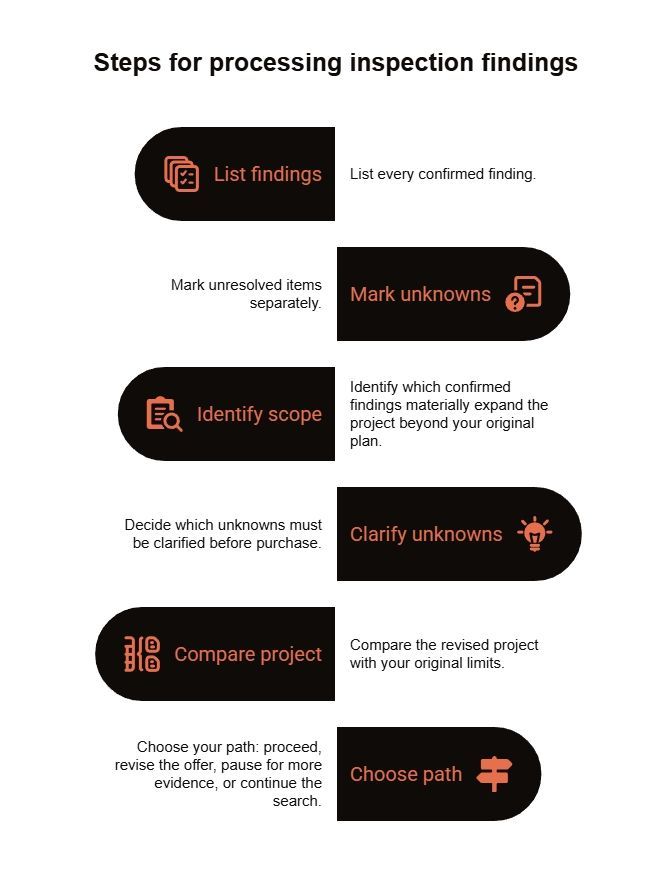
Once you have mapped your findings against the matrix, work through these steps.
- List every confirmed finding.
- Mark unresolved items separately.
- Identify which confirmed findings materially expand the project beyond your original plan.
- Decide which unknowns must be clarified before purchase.
- Compare the revised project (not just the revised price) with your original limits.
- Choose your path: proceed, revise the offer, pause for more evidence, or continue the search.
If clarification requires a shop-based evaluation, account for the practical step of getting the vehicle to the right provider before the sale is finalized. A buyer in the Orange area can explore shops experienced with classic VWs for that review.
If you continue the search, comparing cars on evidence quality and project fit (not just asking price) will serve you better. For guidance, see how to compare two classic VW project cars. To understand what a thorough evaluation covers, learn more about classic car maintenance and pre-purchase inspections.
Frequently Asked Questions
Does every classic VW inspection finding justify a lower offer?
No. A finding justifies reconsidering the offer when it materially changes project scope, introduces significant uncertainty, or shifts the car outside the kind of work you planned. Clearly scoped items within your expectations may not change the decision at all.
Should I get an exact repair estimate before changing my offer?
A scoped estimate from a qualified shop can add useful information when the finding is clearly identified. For unresolved findings, the cause may need clarification before an estimate is meaningful. There is no universal dollar or percentage formula for revising an offer, so avoid assigning a dollar figure to an unresolved finding.
What if the seller says the rust or leak is normal for an old VW?
Treat the seller's comment as context, not as a substitute for what the inspection documented. Ask what the inspection actually confirmed, what it could not access, and whether the finding was described as stable or progressing. You do not need to accuse the seller of being wrong to decide that you need more information before committing.
Can a pre-purchase inspection find every hidden problem?
Not necessarily. Ask what areas were inspected, what was accessible, and what remained uncertain. Coatings, prior repairs, and limited access can leave some conditions unverified, so factor those limitations into your decision.
Making the Findings Work for Your Decision
A professional evaluation translates mechanical conditions into a business reality. Once you map the required metalwork, engine diagnostics, and missing history against your actual budget and skill level, the right offer usually becomes obvious. If the math no longer supports your build strategy, let the data give you the confidence to walk away and find a better starting point.
Learn more about classic car maintenance and pre-purchase inspections at Orange Independent Auto Repair, a family-owned shop in Orange, CA since 1971. You can also contact Orange Independent Auto Repair to schedule service.
Disclaimer: This article is for general informational purposes only. It is not a substitute for advice from a qualified professional, provider, or official source relevant to your situation. Always verify important decisions with the appropriate expert, authority, or service provider.
Our Editorial Process
Our expert team uses AI tools to help organize and structure our initial drafts. Every piece is then extensively rewritten, fact-checked, and enriched with first-hand insights and experiences by expert humans on our Insights Team to ensure accuracy and clarity.
By Orange Independent Auto Repair Insights Team
The Orange Independent Auto Repair Insights Team develops owner-level, evidence-first guidance shaped by decades of hands-on experience serving classic VW and Porsche owners in Orange and the surrounding communities.