
Classic VW Door Gaps, Sagging, and Patchwork: Buyer Clues That Deserve Inspection
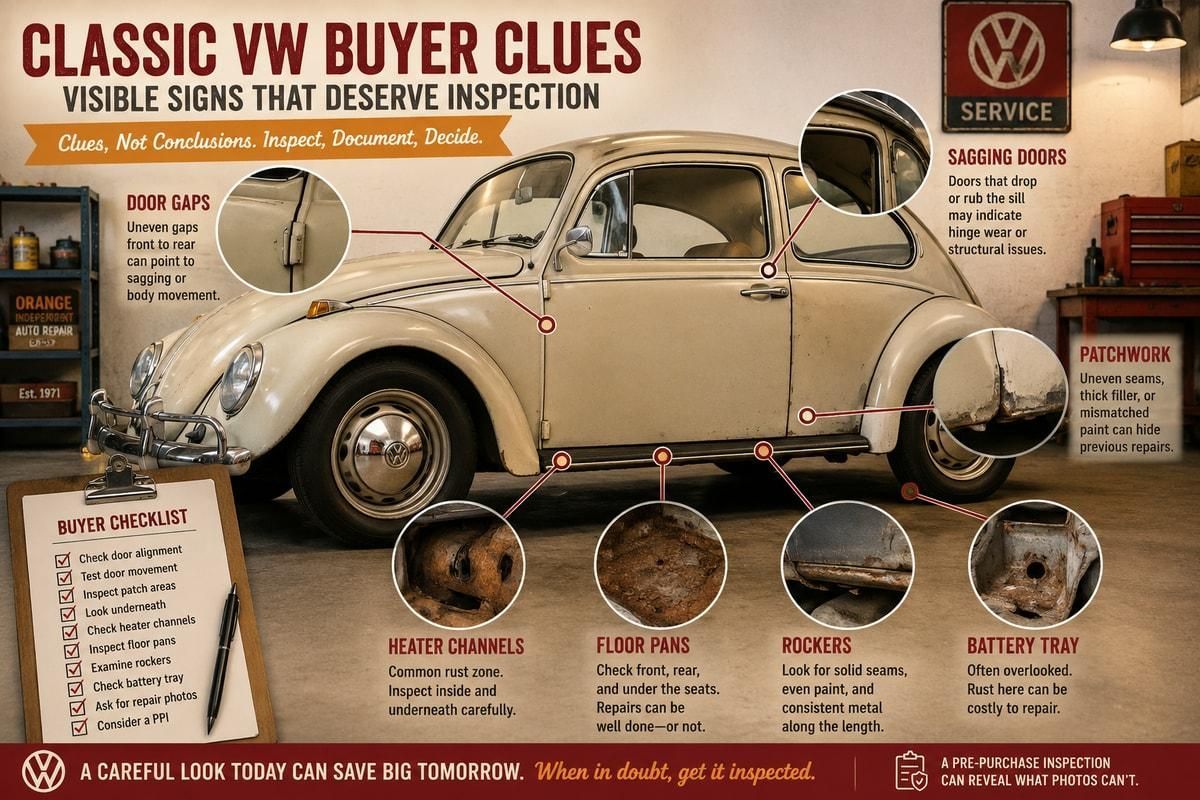
📌 Key Takeaways
Visible door gaps, sagging doors, and old patchwork are not proof of damage, but they are clear signs to inspect before buying.
- Inspect Stacked Clues: One flaw may be minor, but grouped issues near the same area deserve closer review.
- Watch Door Movement: A door that drops, binds, or needs lifting may point to wear or hidden body issues.
- Question Old Repairs: Patch panels can be fine, but vague repair stories need photos, receipts, or better proof.
- Check Lower Areas: Heater channels, floors, rockers, and battery areas can reveal problems fresh paint may hide.
- Use Expert Eyes: A pre-purchase inspection can reduce guesswork when visible clues and seller claims do not line up.
Clues do not decide the purchase; better inspection does.
Classic VW buyers comparing charming cars with uncertain repair histories will gain sharper inspection focus here, preparing them for the detailed overview that follows.
~ ~ ~ ~ ~ ~ ~ ~ ~ ~ ~ ~ ~ ~ ~ ~ ~ ~
A classic VW can look charming from ten feet away and still leave questions up close. Maybe the paint looks fresh, the price feels tempting, and the seller says the car is “solid.” Then the driver’s door drops when opened, the gap pinches near the latch, or an old patch sits along a lower seam with no repair photos to back up the story.
Those clues do not automatically mean the car has structural damage. Classic VWs are old vehicles, and age, prior repairs, hinge wear, paintwork, and adjustment history can all affect how panels fit. Still, visible body-fit issues are worth taking seriously because they can show where a buyer should look more carefully before committing.
The goal is not to diagnose a car from a driveway viewing. The goal is to separate a harmless imperfection from a clue that deserves documentation, seller questions, and possibly a pre-purchase inspection.
Why Door Gaps and Patchwork Matter on a Classic VW
Door gaps, sagging doors, bubbling paint, and old patchwork matter because they help a buyer decide where to slow down. A slightly uneven gap may be cosmetic. A sagging door may come from hinge wear. A patch panel may be part of a reasonable repair history.
The concern increases when clues stack up in the same area. For example, a sagging door, bubbling paint along the lower opening, and rough patchwork near the rocker or heater channel area deserve closer inspection together than any one clue would on its own.
A useful way to think about certainty is this:
- A visible clue can show where to inspect.
- A seller explanation can guide what to ask next.
- Documentation can support the repair story.
- A professional inspection can help clarify what is not visible.
What a visible clue cannot do is prove the hidden condition of the car by itself. That distinction helps buyers stay practical instead of either panicking or ignoring a real concern.
| What You Notice | Could Be Cosmetic When… | Deserves Inspection When… |
|---|---|---|
| Slight uneven door gap | The door opens and closes smoothly, and nearby metal looks clean | The gap changes sharply, the door drops, or surrounding metal shows cracking, rust, or bubbling |
| Sagging door | Hinge wear seems likely, and the opening looks consistent | The opening looks distorted, or nearby lower metal looks rusty, soft, swollen, or patched |
| Old patch | The repair is documented, and the seams look clean | The seam is lumpy, paint is bubbling, or the underside does not match the outside appearance |
| Fresh paint near lower panels | The seller can explain what bodywork was done | Paint covers rough seams, patch edges, or areas with no repair history |
| Rust near floor or battery areas | The visible area appears minor and isolated | Metal looks weak, moisture is present, or older repairs are hidden under mats or coatings |
Door Gaps: What to Look For Before Assuming the Worst
Uneven door gaps are one of the easiest clues to spot, but they are also easy to overinterpret. A classic VW may have some imperfect panel fit because of age, adjustment, prior paintwork, or old repairs. The key is to compare patterns.
Look at both sides of the car. A small difference may not mean much. A sharp change from one side to the other deserves more attention, especially if the door also moves strangely.
During the viewing, check whether:
- The gap widens at one end and pinches at the other.
- The door drops when the handle is pulled or the door opens.
- The door needs lifting, slamming, or extra force to latch.
- Paint is cracked near the hinge area, latch area, or lower door opening.
- Rust, bubbling, or patch edges appear near the same area as the uneven gap.
This is a general inspection principle, not a model-specific diagnosis. Panel fit and door movement can point a buyer toward areas that need closer review. They should not be treated as proof that the car is unsafe or structurally compromised without qualified inspection.
For general body-repair education, I-CAR offers collision-repair training resources that can help buyers understand why panel fit, repair quality, and visible finish are not always the same thing.
Sagging Doors: Hinge Wear, Body Movement, or Rust Nearby?
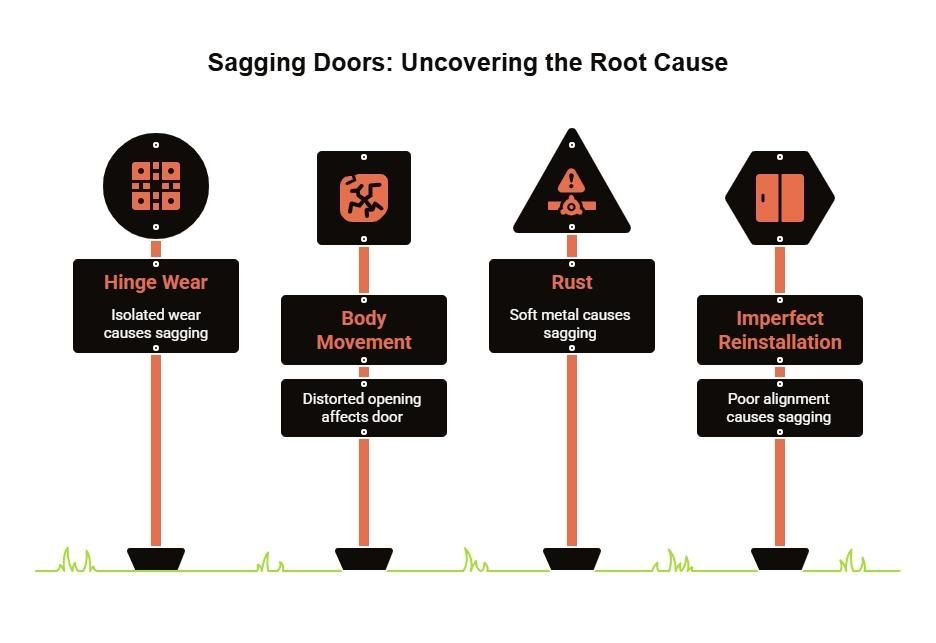
A sagging classic VW door may have a simple explanation. Hinges wear. Latches get adjusted. Doors may have been removed during paint or bodywork and reinstalled imperfectly. A door that drops slightly is not automatically a reason to walk away.
The important question is what appears around the sagging door.
For example, if a driver’s door drops slightly when opened—but the hinge area is clean, the lower opening is solid, and it closes without binding—the issue is likely isolated wear. That is still worth noting, but it is different from a door that drops, binds at the latch, and sits above bubbling paint along the lower opening.
Sagging deserves more attention when it appears with rusty or soft-looking lower metal, cracked paint near the hinge or latch area, patchwork around the rocker or heater channel area, or a door opening that looks distorted.
A door that still closes is one useful clue. It is not a complete assessment. The buyer should look around the whole opening, not only at the hinge.
Old Patchwork: Why “Already Fixed” Still Needs Questions
Patch panels are not automatically bad. Many classic VWs have had rust repair, floor work, paintwork, or lower-body repairs during their life. A documented repair can be part of a reasonable ownership story.
The risk comes from vague patchwork. “It was repaired” does not explain what was repaired, whether rusty metal was removed, whether replacement panels were used, or whether the repair was mostly cosmetic.
Picture a hypothetical Bus with smooth paint on the outside and rough seams underneath. The seller says the rust was handled years ago but has no photos or receipts. That does not prove the repair is poor. It does mean the buyer should ask more specific questions before relying on the claim.
Useful seller questions include:
| Seller Claim | Helpful Follow-Up Question |
|---|---|
| “The rust was repaired.” | What area was repaired, and when? |
| “The floors are solid.” | Can the mats be lifted, or are underside photos available? |
| “It has new pans.” | Are there receipts or photos from the repair? |
| “It was just painted.” | What bodywork was done before paint? |
| “It is only surface rust.” | Has a specialist inspected the surrounding metal? |
These questions are designed to verify the repair history, not to accuse the seller of deception.
Rust Zones That Should Slow a Buyer Down
With classic VWs, rust location matters more than the simple question of whether rust exists. Some visible corrosion may be cosmetic. Rust or rough repairs near lower body openings, floors, seams, or battery areas can affect the scope of the project and should be checked more carefully.
Because model details vary, avoid making a final judgment from a quick viewing. Treat the following areas as general inspection priorities:
Heater channels: These lower-body areas near the door opening are worth checking when door gaps, sagging, or lower-body bubbling appear nearby.
Floor pans: Lift mats only if the seller allows it and no disassembly is needed. Look for moisture, soft spots, patch edges, heavy corrosion, or repairs that do not match the seller’s explanation.
Battery tray area: If accessible, check for corrosion, weak-looking metal, or signs that old damage may have been covered.
Rocker and lower door areas: These areas can help explain why a door gap or sagging door deserves closer attention.
Underbody seams and patch edges: Rough seams, heavy coatings, and lumpy repairs do not prove a problem by themselves, but they can make the car harder to evaluate without inspection.
A clean paint job does not verify the underside. Good door gaps do not prove the car is structurally sound. Poor gaps do not prove the opposite. The safest conclusion is narrower: visible clues help identify where a buyer should inspect closer.
For a related buyer-focused resource, see this air-cooled walkaround checklist. For more rust-specific reading, see this guide to hidden rust zones on Beetles, Buses, and Ghias.
Seller Claims to Treat Carefully
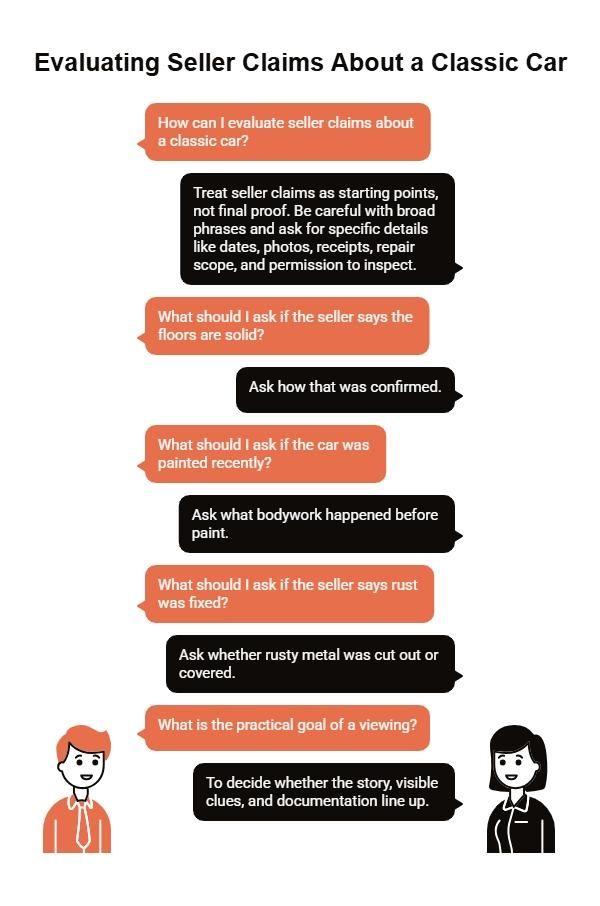
Most sellers are not trying to provide a technical body-structure report. Many are repeating what a previous owner told them. That is why seller claims should be treated as starting points, not final proof.
Be careful with broad phrases such as “solid car,” “rust repaired,” “just surface rust,” “new pans,” and “painted recently.” These statements may be true, partly true, or too incomplete to guide a buying decision.
A stronger explanation includes dates, photos, receipts, repair scope, and permission to inspect visible areas. A weaker explanation asks the buyer to ignore mismatched clues.
If a seller says the floors are solid, ask how that was confirmed. If the car was painted recently, ask what bodywork happened before paint. If the seller says rust was fixed, ask whether rusty metal was cut out or covered.
A buyer does not need to become a restoration expert during a viewing. The practical goal is to decide whether the story, the visible clues, and the documentation line up.
When to Pause and Get a Pre-Purchase Inspection
One minor clue may not be decisive. A slightly uneven gap on an otherwise consistent car may simply be something to note.
Multiple clues in the same area deserve more caution. A sagging door, bubbling lower paint, rough patchwork, and limited repair history together create a stronger reason to pause. That still does not mean the car is a bad purchase. It means the buyer needs better information before deciding.
A pre-purchase inspection can help clarify whether the car fits the buyer’s budget, tolerance for project work, and intended use. It cannot guarantee that every hidden issue will be found, but it can reduce guesswork before money changes hands.
Orange Independent Auto Repair is a family-owned shop in Orange, CA that works with classic VW and Porsche vehicles. Its classic car maintenance services include pre-purchase inspections, and its site also lists vehicle inspections among available services. Buyers near Orange, Tustin, Anaheim, Yorba Linda, or Villa Park can contact Orange Independent Auto Repair to ask whether a pre-purchase inspection makes sense before committing to a classic VW.
For broader vehicle-safety context, buyers of 1981 and newer models can use the official NHTSA VIN lookup as one general check, though the tool will reject the shorter VINs found on older classic VWs. For vintage models, discussing historical safety bulletins with a specialist should instead be part of a careful used-vehicle review.
Quick Buyer Checklist Before You Decide
Use this checklist during or immediately after the viewing:
- Open and close both doors. Note whether either door drops, binds, or needs lifting.
- Compare left-side and right-side door gaps.
- Look for bubbling paint near lower door openings, rockers, heater channels, and patch edges.
- Check floor areas if mats or carpets can be lifted without disassembly.
- Look at the battery tray area if it is accessible.
- Inspect underbody seams for rough patches, heavy corrosion, or mismatched repairs.
- Photograph questionable areas for later review.
- Write down exact seller claims about rust, floors, patch panels, and paintwork.
- Ask for repair photos, receipts, and prior inspection notes.
- Consider a pre-purchase inspection before committing if several clues stack up.
FAQs
Should a buyer walk away from a classic VW with patch panels?
Not automatically. Patch panels can be part of a reasonable repair history. Ask what was repaired, how it was repaired, and whether documentation exists. Poorly blended or undocumented patchwork deserves closer inspection.
What rust areas should a classic VW buyer check first?
Start with heater channels, floor pans, battery tray areas, lower door or rocker zones, and underbody seams. Treat these as general inspection priorities, not automatic proof of structural trouble.
Is a pre-purchase inspection worth it for a rough project car?
Often, yes, especially when visible clues stack up. The purpose is not to make the car perfect. It is to understand the risk before buying, so the project matches the buyer’s budget, time, and comfort level.
Final Thoughts
Classic VWs often come with age, repairs, and imperfections. A door gap, sagging door, or old patch does not automatically mean disaster. Those clues should help a buyer slow down, document what is visible, and ask better questions.
The strongest buying decision is made with clear notes, realistic expectations, and enough inspection information to understand the risk. If visible body-fit clues raise more questions than the seller can answer, a pre-purchase inspection is a practical next step before committing.
Disclaimer: This article is for general informational purposes only. It is not a substitute for advice from a qualified professional, provider, or official source relevant to your situation. Always verify important decisions with the appropriate expert, authority, or service provider.
Our Editorial Process
Our expert team uses AI tools to help organize and structure our initial drafts. Every piece is then extensively rewritten, fact-checked, and enriched with first-hand insights and experiences by expert humans on our Insights Team to ensure accuracy and clarity.
By Orange Independent Auto Repair Insights Team
The Orange Independent Auto Repair Insights Team develops owner-level, evidence-first guidance shaped by decades of hands-on experience serving classic VW and Porsche owners in Orange and the surrounding communities.