Warning-Light Colors in European Cars: Red, Amber, Flashing—What Each Means for Safety and Cost
📌 Key Takeaways
A lit dashboard doesn't have to mean panic—understanding what each color signals puts you back in control of both safety and repair costs.
- Color Is Your First Clue: Red means stop safely and often tow, amber means caution with time to plan, and flashing elevates urgency beyond a steady light of the same color.
- Symptoms Override Color: Any warning light paired with burning smells, smoke, shaking, or unusual noises should be treated as urgent, regardless of whether it's red or amber.
- Flashing Demands Immediate Action: A blinking check-engine light signals active damage occurring—continuing to drive, especially at highway speeds, can turn a minor repair into catalytic converter replacement.
- Early Response Protects Your Budget: Most amber lights represent small problems that grow expensive when ignored, like misfires that eventually destroy catalytic converters or low tire pressure that ruins an entire set of tires.
- Proper Diagnostics Prevent Repeat Repairs: A Now/Soon/Later priority plan based on actual root-cause testing keeps you from guessing at parts or paying twice for the same issue.
Know the color, read the symptoms, act accordingly—that's the formula for keeping your European car safe and your repair bills predictable.
Budget-conscious European car owners in Orange County will find a clear decision-making framework here, preparing them for the detailed color-by-color breakdown that follows.
You're backing out of the driveway in Orange or Anaheim, coffee in hand, when something catches your eye. A light on the dashboard just came on. Is it serious? Can you still make it to work, or should you call for help?
This moment of uncertainty is familiar to many European car owners. Warning-light diagnostics exists to answer exactly this question. It retrieves fault codes and performs guided tests to isolate the root cause—essentially the lab work before treatment. Once the severity is clear, you'll know whether to drive or tow, then move into a prioritized estimate to approve the right work at the right time.
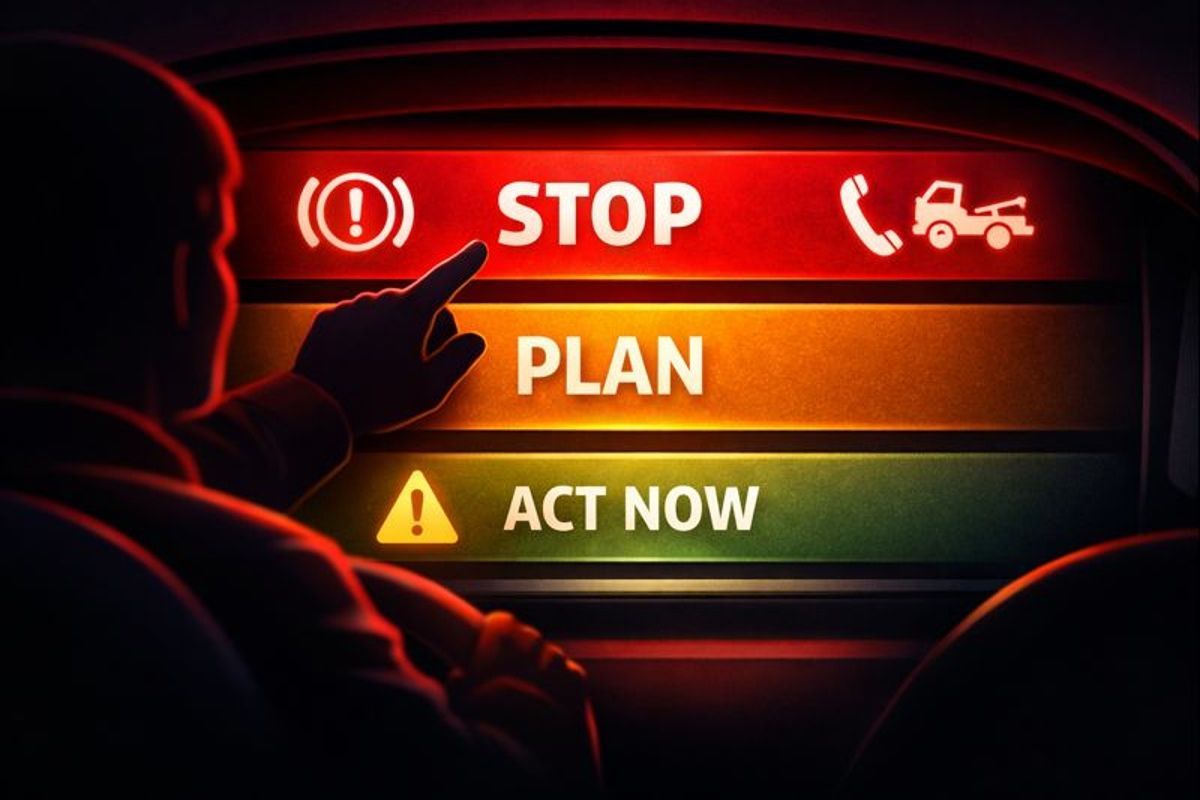
The good news: your dashboard is actually trying to help you. Warning-light colors follow a logical system. Red signals something safety-critical or damage-risking. Amber means caution and attention soon. Flashing elevates urgency beyond a steady light. Understanding this simple framework transforms panic into a clear next step, protecting both your family's safety and your repair budget.
Quick guide: what red, amber, and flashing really mean
If you're standing in a parking lot in Tustin or sitting in your driveway in Yorba Linda staring at a lit dash, this is your 10-second answer.
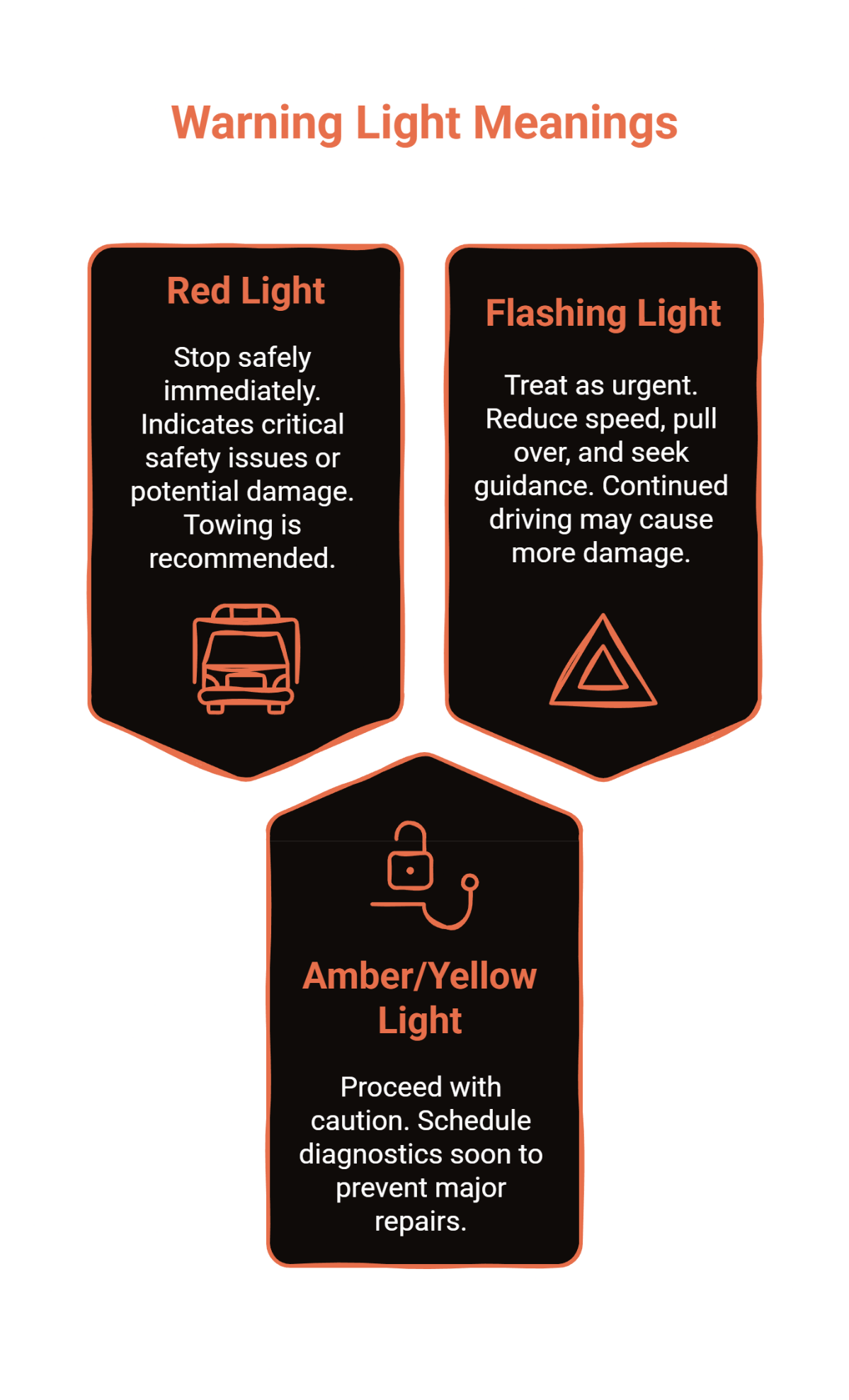
Warning-light colors and behaviors provide immediate clues about severity. Most European manufacturers follow similar conventions, though specific symbols vary by brand. Here's the essential framework:
- Red: Stop safely as soon as possible. These warnings indicate safety-critical systems or conditions that risk immediate damage. Towing is often the safest choice rather than continuing to drive.
- Amber/Yellow: Proceed with caution. The car may be drivable if it feels, sounds, and smells normal, but schedule diagnostics soon. Delaying can turn minor issues into major repairs.
- Flashing (any color): Treat as urgent. A blinking light signals escalating severity compared to a steady one. Reduce speed, pull over safely, and call for guidance—continued driving often causes additional damage.
One important caveat: always follow your owner's manual and trust your instincts. If the car feels wrong, smells strange, or sounds unusual, treat any warning light as urgent regardless of color.
If you're near Orange, Tustin, Anaheim, Yorba Linda, or Villa Park and unsure whether it's safe to drive, you can always call (714) 633-7161 for a quick warning-light triage.
Why European car warning lights feel so confusing
European vehicles—VW, Audi, BMW, Mercedes, MINI, Volvo, and others—contain dozens of electronic modules, each capable of triggering its own warning symbols. Different manufacturers use slightly different icons for similar functions. A Volkswagen's symbol for one system might look different from a BMW's or Mercedes-Benz's version of the same warning.
Adding to the confusion, similar-looking icons can mean very different things. The parking brake indicator looks remarkably like the main brake system warning on some models. Engine-related and emissions-related symbols can appear nearly identical. Tire, steering, or traction icons change color or behavior depending on severity. Even experienced drivers mix them up.
You shouldn't need an engineering degree to understand what your own car is telling you. At Orange Independent Auto Repair, the team helps local drivers in Orange, Villa Park, and beyond decode these lights every week, turning that initial confusion into a simple priority plan. The shop has served the Orange County community since 1971 as a family-owned business, specializing in classic VW and Porsche as well as modern European, Asian, and American vehicles.
Red warning lights: stop safely, protect the car, protect your budget
When does a red light mean stop immediately instead of "get to work first and deal with it later"?
What red usually means on a European dashboard
Red warnings indicate your car is alerting you to a safety-critical system or a condition that risks immediate mechanical damage. These aren't suggestions to address when convenient—they're closer to a medical emergency than a routine checkup.
Systems that commonly trigger red warnings include brakes, steering assist, airbags and seat belt systems, engine temperature, oil pressure, and charging systems. When these illuminate red, the car is communicating that something fundamental to safe operation needs immediate attention.
Common red warning examples
While specific symbols vary by manufacturer, several archetypal red warnings appear across European makes:
The oil can or oil pressure warning indicates dangerously low or absent oil pressure—the engine may not be getting enough lubrication. The coolant temperature gauge in the red zone signals overheating. A red brake system warning (distinct from the parking brake indicator) suggests potential brake failure, low brake fluid, or worn components. Red steering or charging system icons indicate loss of power assist or electrical charging failure.
This list isn't exhaustive. Your owner's manual provides the definitive guide for your specific vehicle.
Safety and cost implications of ignoring red lights
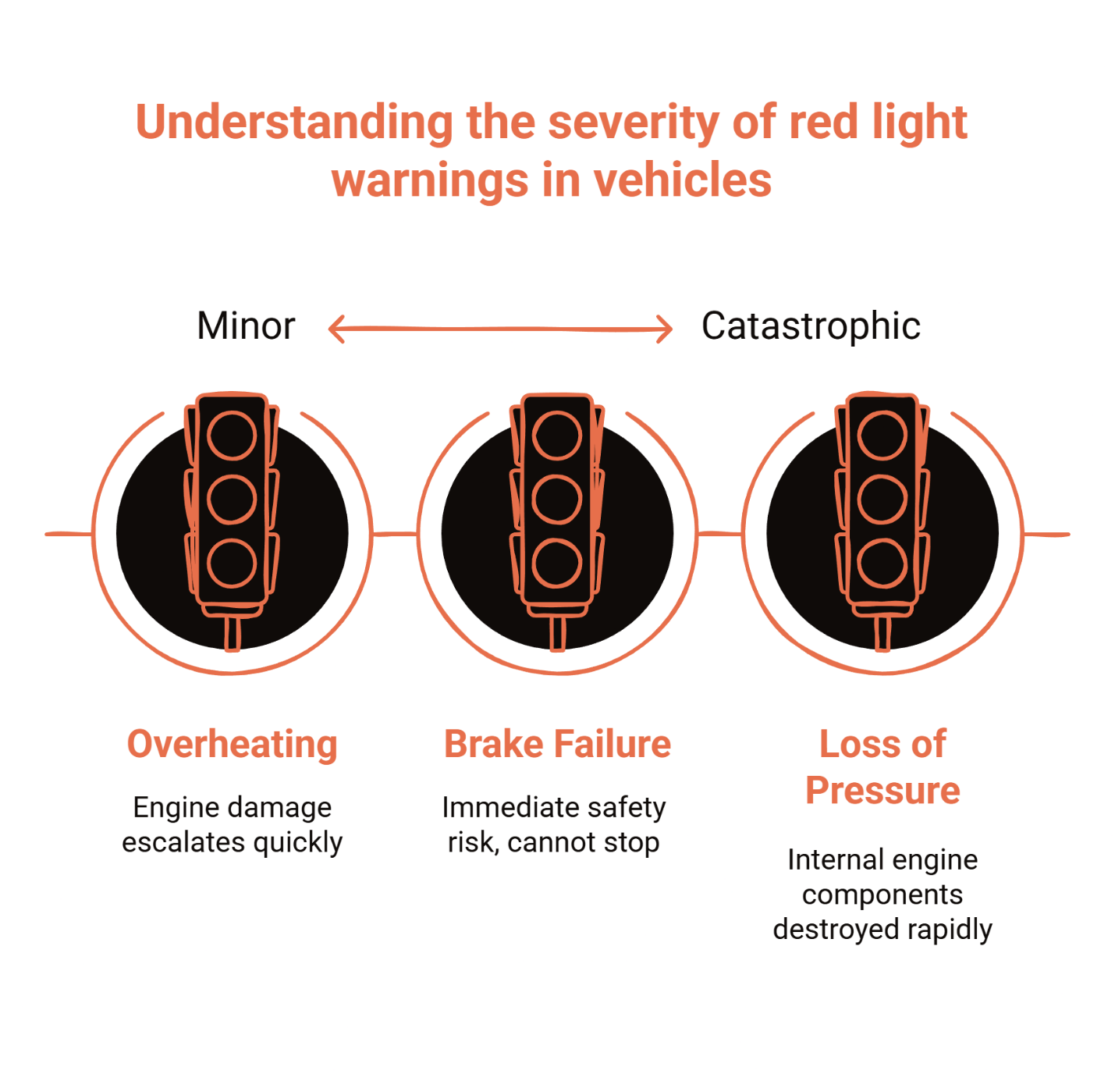
Minutes can matter with red warnings. Consider this scenario: you're heading up the 55 freeway when the temperature gauge climbs into the red and the car starts to smell hot. Continuing to drive even a few more miles risks warping the cylinder head or destroying the engine entirely—turning a thermostat or water pump repair into a multi-thousand-dollar engine replacement.
Similar escalation applies to other red warnings. Loss of oil pressure can destroy internal engine components within minutes. A red brake warning might mean you cannot stop safely when needed.
The guidance is straightforward: pull over as soon as it's safe to do so. If oil pressure or overheating is suspected, turn off the engine immediately. Call a professional. Many red-light situations should be towed rather than driven, even short distances, to prevent catastrophic damage.
Amber/yellow lights: drive with care and book diagnostics soon
Which lights give you some time to respond—but not forever?
What amber usually means
Amber or yellow warnings signal caution. Something isn't operating correctly, but the car may still be safe to drive if it otherwise feels normal. These lights are your vehicle giving you advance notice to address an issue before it becomes urgent.
Common amber warnings include the check-engine light (often emissions or sensor-related), traction or stability control indicators, tire-pressure monitoring system (TPMS) warnings, and service reminder lights. Each indicates a system that needs attention but isn't immediately compromising your safety.
When amber can still turn serious
Not all amber lights stay in the "caution" category. An amber check-engine light that starts flashing represents escalated urgency, especially if accompanied by rough running, shaking, loss of power, or vibration. The flashing indicates active damage may be occurring.
Similarly, any amber light paired with symptoms demands more immediate attention. Burning smells, smoke from under the hood, harsh mechanical noises, or significant changes in how the car drives all elevate an amber warning toward red-light urgency.
The practical guidance: if the car feels completely normal otherwise, drive gently to a trusted shop. If something feels off, reduce use or stop and call for advice before driving further.
How amber lights affect long-term cost
Here's a scenario many parents experience: you're driving from Yorba Linda to a school event when the amber tire icon appears. The car feels normal. It's usually safe to drive at moderate speed to a nearby shop or service station to check and adjust pressures the same day rather than waiting weeks and ruining a set of tires.
Left unaddressed, amber issues often grow into significantly larger repairs. A minor misfire that could have been fixed with a spark plug or coil replacement eventually damages the catalytic converter—an expensive part on European cars. Low tire pressure causes uneven tire wear and compromised braking, requiring premature tire replacement.
The key message: most amber lights represent your car giving you a chance to fix a small problem before it becomes a big repair. Acting promptly typically saves money.
Flashing lights: why blinking means "pay attention now"
A flashing warning light communicates escalating urgency beyond its steady counterpart. Think of it as the difference between a nurse walking toward you with information versus running toward you with concern. The core message has intensified.
The most common example is a flashing check-engine light, which typically signals an active misfire. During a misfire, unburned fuel enters the exhaust system where it can overheat and damage the catalytic converter—often within minutes of continued driving. Some European vehicles also use flashing red icons for critical warnings requiring immediate attention.
Picture this scenario: you're on the 91 freeway when the check-engine light starts blinking and the engine begins shaking. Continuing to drive at highway speeds dramatically increases the likelihood of expensive catalytic converter damage. The safest move is to ease off the gas, move right, pull off safely, and call for guidance.
The simple rule: flashing red means stop safely and arrange towing. Flashing amber, particularly with symptoms like rough running, burning smells, or unusual noises, means reduce power immediately, pull over safely, and call for guidance. Flashing indicators are not something to monitor for weeks.
From color to action: Drive, reduce use, or tow?
Use this legend as your quick-reference guide:
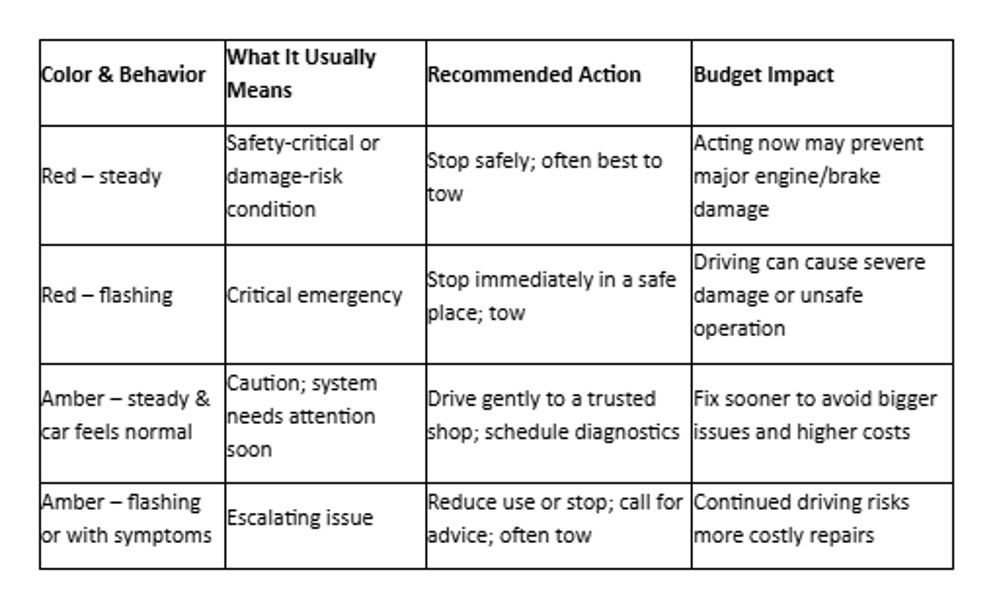
Think of it this way:
Red (especially with symptoms): Pull over safely; usually tow. Risk includes severe engine or brake damage, loss of control, or safety compromise.
Steady amber and car feels normal: Drive gently to a shop you trust; book diagnostics soon. Risk is that problems grow over time into bigger repairs.
Flashing (red or amber), or any color plus harsh symptoms: Treat as urgent—slow down, pull over safely, and call; usually better to tow. Risk includes rapid damage, breakdown, or unsafe driving.
Using a proper diagnostic process and a Now/Soon/Later priority plan keeps you from guessing at solutions or paying for the same issue twice.
What happens when you bring a lit dash to Orange Independent
Here's exactly what to expect once you decide to contact the shop for help with a warning light:
- Safety triage first. When you call, the team uses the same color-and-behavior framework to help determine: can you drive it in, should you reduce use, or should we arrange towing? This guidance costs nothing and takes just a few minutes.
- Warning-light diagnostics beyond a code read. Technicians retrieve fault codes, then perform guided tests to isolate the actual root cause. This matters because a single code can have multiple possible causes. The shop doesn't just read codes and guess at parts—they verify what's actually failing using modern diagnostics where appropriate.
- Thorough vehicle inspection. Once diagnostics identify the issue, the team inspects related systems to ensure nothing else needs attention. They'll explain exactly what they found and why it matters, so you understand the full picture before approving any work.
- Now/Soon/Later priority plan. Not everything needs fixing today. The team categorizes findings into three buckets: "Now" items affect safety or risk imminent failure. "Soon" items prevent spreading damage if addressed within weeks. "Later" items can be scheduled around your life and budget. This approach gives you control over decisions rather than facing an all-or-nothing estimate.
- Written warranty. Recommended repairs are backed in writing, reducing the risk of unexpected issues after you leave.
When to call us right away about a warning light
Call right away if you experience:
- Red oil pressure or temperature warning light
- Red brake system warning (not just the parking brake)
- Any warning light that starts flashing, especially with rough running, burning smells, smoke, or loud mechanical noises
- Any warning light combined with significant changes in steering feel, braking response, or acceleration
- Multiple warning lights illuminating simultaneously
You can call (714) 633-7161 just to ask questions about what you're seeing—the goal is helping you make a safe, confident decision. If you're reading this outside business hours, the contact page provides additional ways to reach the team.
You don't have to guess alone. Even a quick phone conversation can help you decide whether to drive in, wait, or arrange a tow.
About the Orange Independent Auto Repair Insights Team.
The Orange Independent Auto Repair Insights Team is our dedicated engine for synthesizing complex topics into clear, helpful guides. While our content is thoroughly reviewed for clarity and accuracy, it is for informational purposes and should not replace professional advice.
Disclaimer: Every vehicle is different. This article is a general guide to help you think about warning-light colors and urgency, but it isn't a substitute for your owner's manual or professional advice. Always follow your vehicle's specific instructions and consult a qualified technician before making driving or repair decisions.