
The Sweet Smell of Trouble: Identifying Coolant and Fuel Leaks by Scent
📌 Key Takeaways
Your nose detects fuel, coolant, and oil leaks faster than any dashboard light—knowing what each smell means tells you whether to keep driving or call a tow truck.
- Raw Fuel Smell Means Stop Now: A strong gasoline odor is a fire hazard—pull over, shut off the engine, and arrange a tow immediately.
- Sweet Smell Needs Context: That syrupy scent usually signals coolant leaks, but air-cooled VWs and classic Porsches don't use liquid coolant at all.
- Burning Oil Varies in Urgency: A faint oil smell after driving is often normal; sudden, strong odor with smoke means get it checked right away.
- Describe, Don't Diagnose: Tell the shop when the smell appeared, where it was strongest, and what else was happening to speed up the fix.
- Test Drives Hide Problems: Intermittent smells during a test drive don't mean the issue disappeared—a pre-purchase inspection catches what your nose might miss.
Trust your nose first, then trust a specialist.
Classic VW and Porsche owners evaluating a purchase or noticing new smells will gain confidence in making safe decisions, preparing them for the detailed guidance that follows.
~ ~ ~ ~ ~ ~ ~ ~ ~ ~ ~ ~ ~ ~ ~ ~ ~ ~
You are halfway through a test drive when a sharp, unmistakable smell fills the cabin. Raw gasoline. Strong enough to make your eyes water. The seller keeps talking, but your attention has already shifted to one question: Is it safe to keep driving?
Your nose just gave you an answer. Now the question is whether you know how to read it.
Think of it like smelling smoke in your house. You do not wait to see flames before acting. Classic VWs and Porsches communicate problems through sensory clues—smells, sounds, vibrations, leaks, and drivability changes—long before anything else signals trouble. Understanding what your nose is telling you can mean the difference between a minor repair and a catastrophic failure.
Why Smell Matters So Much on Classic VW and Porsche Vehicles
Classic VWs and Porsches speak through analog feedback: engine sounds under load, steering feel at speed, oil pooling beneath the car overnight, and the behavior of gauges like oil pressure and temperature. These vehicles reward attentive owners who learn to read sensory signals.
Smell belongs in this diagnostic toolkit alongside noise and drivability changes. When something goes wrong with fuel delivery, the cooling system, or oil containment, the nose often picks it up first. That matters even more on a test drive, when the real question is not "What part failed exactly?" but "Is it safe to keep driving or buying this car?"
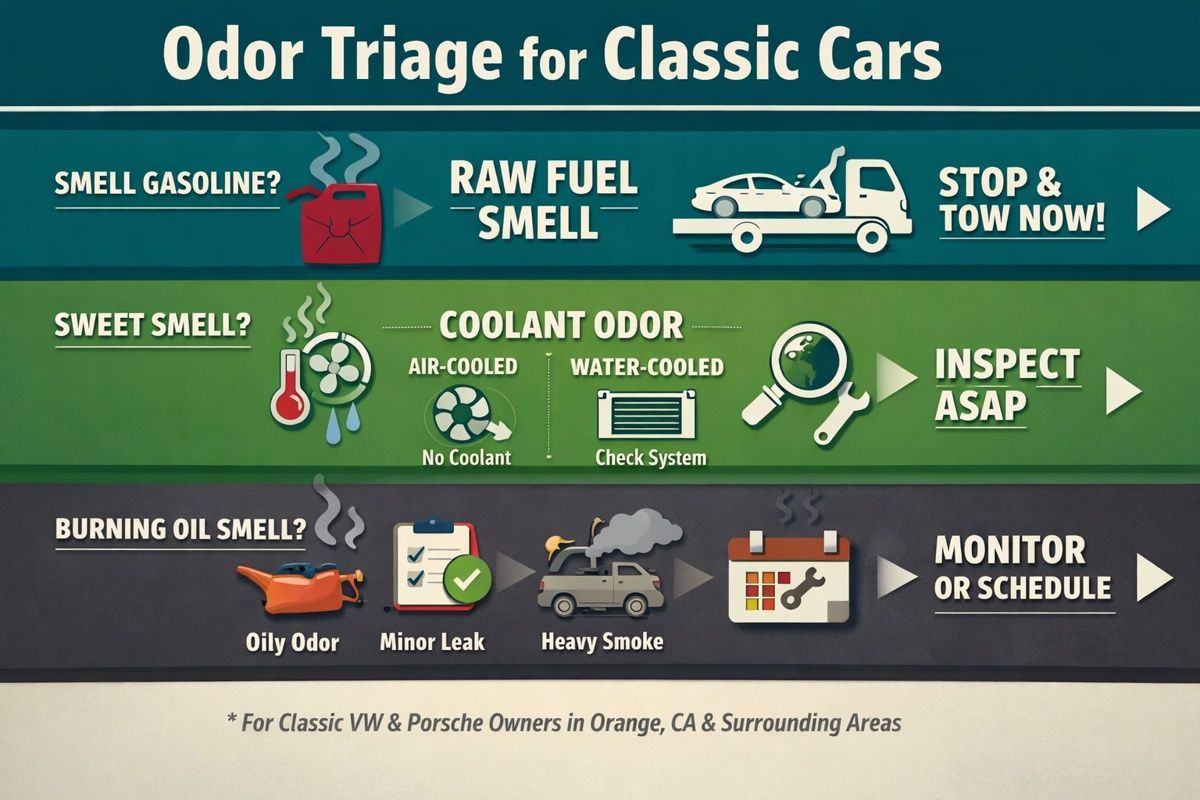
Raw Fuel Smell: When the Answer Is Stop, Shut It Off, and Tow
A raw fuel smell is the most urgent category. Strong gasoline odor in a classic VW or Porsche is not a quirk to overlook. It is an immediate fire hazard.
Gasoline vapors are highly flammable. According to the National Fire Protection Association, vehicle fires cause hundreds of deaths annually, and fuel system failures are among the leading causes. In a classic car with aging rubber fuel lines, brittle connections, or a seeping carburetor, the risk is real. The NFPA's car fire safety guidance advises immediate response when a vehicle shows smoke, flames, or other fire-warning signs.
Beyond fire risk, gasoline exposure carries health consequences. EPA materials note that gasoline-related air toxics include benzene, and benzene exposure can irritate the eyes, skin, and respiratory tract in the short term.
If raw fuel smell becomes noticeable during a drive or test drive:
- Pull over safely and shut off the engine immediately.
- Do not restart the vehicle.
- Arrange for a tow to a qualified shop.
The fact that the car "still runs fine" is not a safety defense. Fuel leaks often worsen quickly, and the ignition source needed to start a fire could be as simple as a hot exhaust manifold.
Sweet Smell: When It Points to Coolant—and When That Does Not Apply
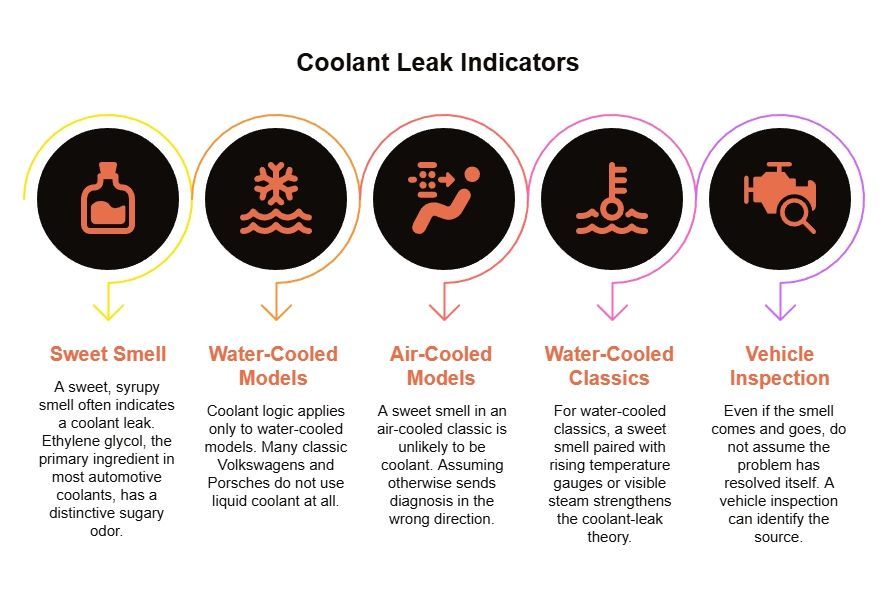
A sweet, syrupy smell often indicates a coolant leak. Ethylene glycol, the primary ingredient in most automotive coolants, has a distinctive sugary odor. When coolant escapes from a hose, radiator, or heater core, that smell can reach the cabin—especially through the ventilation system.
This diagnosis comes with an important caveat: coolant logic applies only to water-cooled models.
Many classic Volkswagens— including air-cooled Beetles, Buses, and Karmann Ghias, alongside classic Porsches like the 356 and early 911s—do not use liquid coolant at all. These engines rely on air passing over external fins to dissipate heat. A sweet smell in an air-cooled classic is unlikely to be coolant, and assuming otherwise sends diagnosis in the wrong direction.
For water-cooled classics, a sweet smell paired with rising temperature gauges or visible steam strengthens the coolant-leak theory. Even if the smell comes and goes, do not assume the problem has resolved itself. A vehicle inspection can identify the source before a small seep becomes a roadside breakdown.
Burning Oil Smell: What It Usually Tells You on a Classic
Burning oil has a heavy, acrid quality that differs sharply from both fuel and coolant odors. On a classic vehicle, this smell often means oil is landing on hot exhaust components—typically from a leaking valve cover gasket, oil cooler seal, or pushrod tube.
The smell may intensify after longer drives or during stop-and-go traffic. It can also become more noticeable after parking, as residual oil burns off hot surfaces.
Not every faint oil smell signals an emergency. Small seeps are common on older engines. But if the smell is strong, appears suddenly, or accompanies visible smoke, the leak likely requires prompt attention.
Drive or Tow? A Simple Scent-Based Triage Framework
When a smell appears, the immediate question is what to do next:
Tow Now: Strong raw fuel smell, especially inside the cabin. Any smell accompanied by visible smoke. Sweet coolant smell with rapid temperature rise or steam.
Stop Driving and Inspect Promptly: Burning oil smell that intensifies or appears suddenly. Sweet smell in a water-cooled vehicle with no other symptoms yet.
Bring It In Soon: Faint, intermittent smells that do not worsen. Any odor noticed during a pre-purchase test drive.
When in doubt, err on the side of caution. A tow bill is far cheaper than an engine fire.
What to Tell the Shop So the Smell Clue Actually Speeds Up Diagnosis
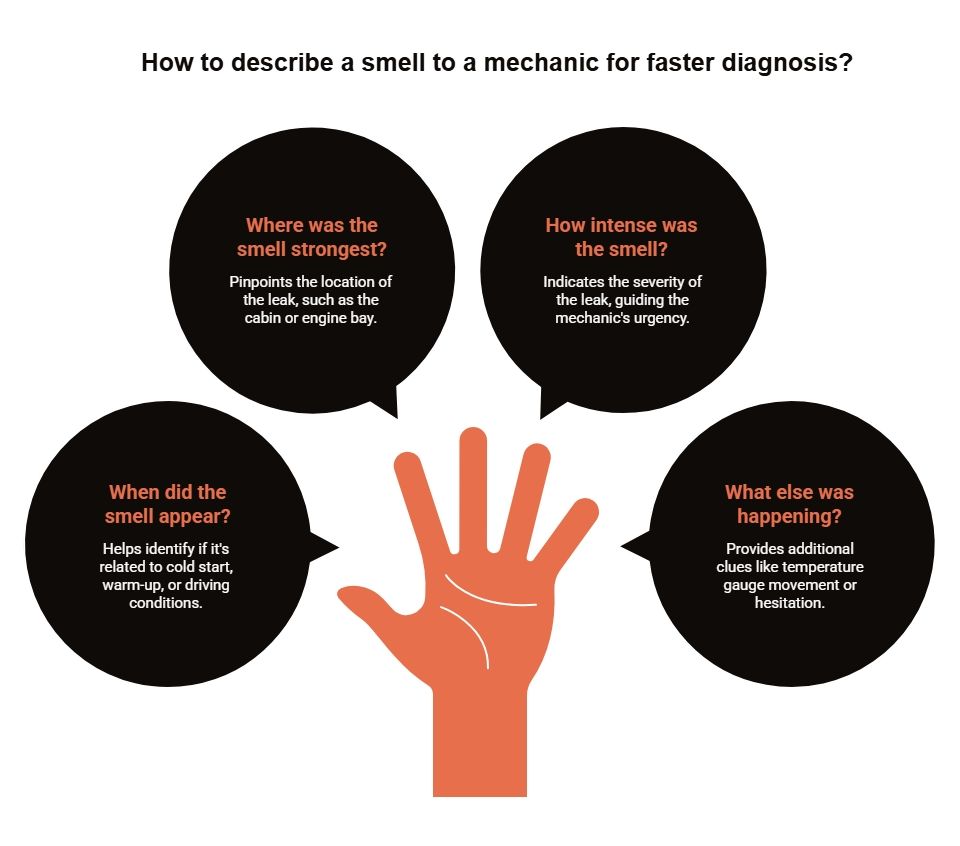
A good handoff makes diagnosis faster. Before calling or arriving at the shop, note:
- When the smell appeared (cold start, after warming up, under acceleration)
- Where it seemed strongest (cabin, engine bay, rear of vehicle)
- How intense it was
- What else was happening (temperature gauge movement, hesitation, smoke)
These details help technicians narrow down the source without guesswork, reducing diagnostic time and cost.
Why a Pre-Purchase Inspection Still Matters Even If the Smell Comes and Goes
An intermittent smell during a test drive does not mean the problem has disappeared. Leaks can be position-dependent, temperature-dependent, or pressure-dependent. A fuel line that seeps only when the tank is full may seem fine during a short drive but fail later.
This is why a pre-purchase inspection matters. A qualified technician can pressurize systems, inspect connections under load, and identify wear that a casual test drive would never reveal.
As one longtime customer shared after bringing in a 1963 Bug with a surprise fuel leak: "My car was serviced and repaired within one day and runs great." Another noted after a fuel system diagnosis: "They were able to locate the problem and give me a very reasonable fix without giving me the run around."
Trust Your Nose—Then Trust a Specialist
Your nose is one of the best diagnostic tools for a vintage vehicle. A sharp fuel smell, a sweet coolant odor, or a burning-oil scent each tells a story about what is happening inside the car.
But sensory triage is only the first step. When a smell raises concern—especially during a test drive—the safest next move is a professional evaluation.
Orange Independent Auto Repair has served classic VW and Porsche owners in Orange, Tustin, Anaheim, Yorba Linda, and Villa Park since 1971. The family-owned shop is located at 187 S Main St, Orange, CA 92868, and is open Monday through Friday, 7:00 AM to 6:00 PM, with Saturday by appointment only. The shop offers free estimates and honest guidance. Porsche owners can also visit the dedicated Porsche services page for model-specific information.
Request your free estimate today by calling (714) 633-7161 or visiting the contact page. Public trust references are also available through the shop's Better Business Bureau profile.
Our Editorial Process
Our expert team uses AI tools to help organize and structure our initial drafts. Every piece is then extensively rewritten, fact-checked, and enriched with first-hand insights and experiences by expert humans on our Insights Team to ensure accuracy and clarity.
By Orange Independent Auto Repair Insights Team
The Orange Independent Auto Repair Insights Team develops owner-level, evidence-first guidance shaped by decades of hands-on experience serving classic VW and Porsche owners in Orange and the surrounding communities.