The Fix-Now List: How a Shop Should Explain Repairs That Need Prompt Attention
📌 Key Takeaways
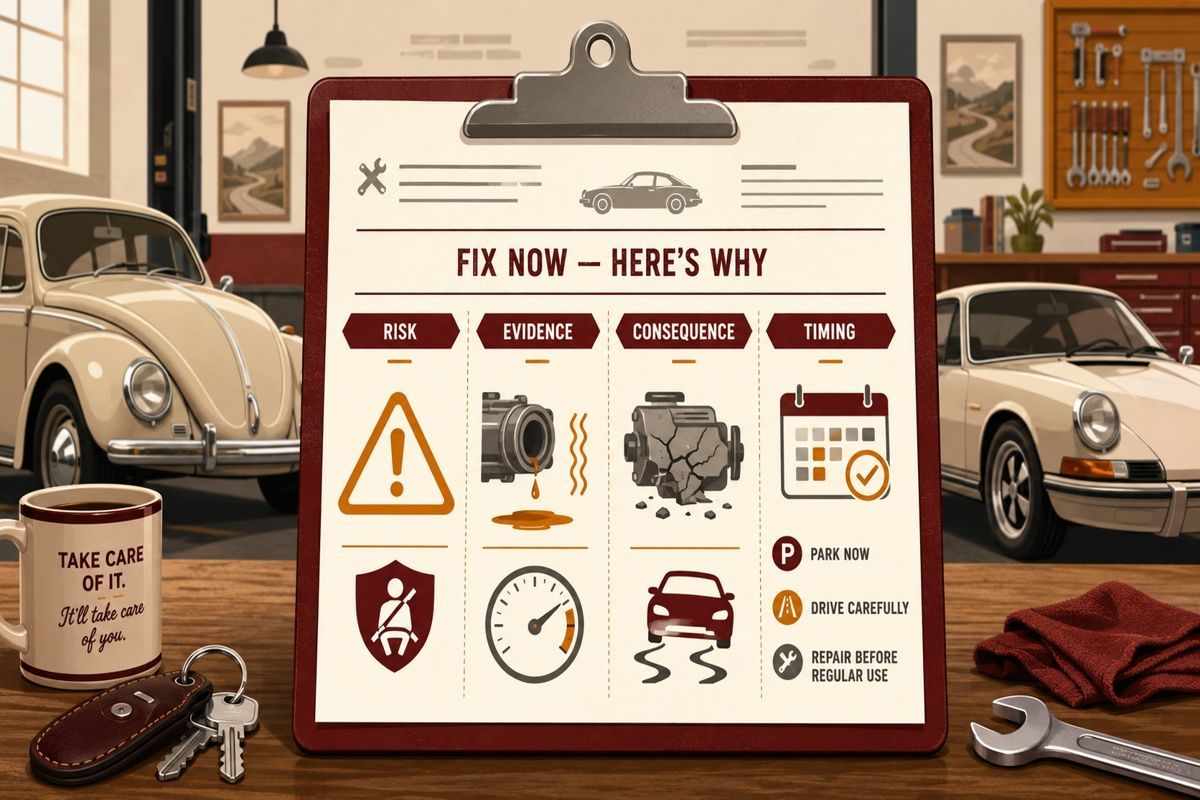
A repair marked “fix now” should explain the risk, proof, likely consequence, and safe timing before approval.
- Priority Needs Proof: A shop should explain what it found before asking you to approve urgent work.
- Symptoms Matter Most: Older VW and Porsche vehicles often show problems through smells, leaks, sounds, or gauge changes.
- Urgent Is Not Panic: Prompt attention can mean stop driving, drive home carefully, or repair before regular use.
- Ask Clear Questions: Good questions help separate safety repairs from items that can wait or be watched.
- Trust Needs Clarity: Honest shops explain what matters first, what can wait, and why.
Clear repair advice turns “you shouldn’t wait” into a safer, calmer decision.
Classic VW and Porsche owners facing repair estimates will gain clearer decision-making tools here, preparing them for the detailed overview that follows.
~ ~ ~ ~ ~ ~ ~ ~ ~ ~ ~ ~ ~ ~ ~ ~ ~ ~
“You shouldn’t wait on this.”
That sentence can make any repair estimate feel heavier. The paper is on the counter. The total is staring back. The car may even feel normal on the drive in, which makes the recommendation harder to judge.
For classic VW and Porsche owners, the uncertainty can feel even sharper. Older vehicles do not always communicate problems the way modern cars do. There may be no clear dashboard warning telling you what system needs attention. Instead, the clues may come from a fuel smell, a new vibration, a fresh drip on the driveway, a changing gauge needle, or the way the car hesitates under load.
A fix-now recommendation can be completely valid. Some issues deserve prompt attention because they affect safety, reliability, drivability, or the risk of further damage. But urgency should still be explained. A good shop should be able to tell you what was found, why it matters, what could happen if you wait, and what step makes sense next.
That is the difference between pressure and priority.
A Fix-Now Repair Should Come With a Clear Reason
A fix-now repair is a repair that should not be treated as routine or optional because delaying it may create a safety issue, leave the vehicle unreliable, make the problem worse, or increase the chance of more expensive damage.
That does not mean every recommendation belongs in the same category. Some items need prompt attention. Some can wait. Some should be monitored. Some may not be needed yet.
The shop’s job is to separate those categories clearly.
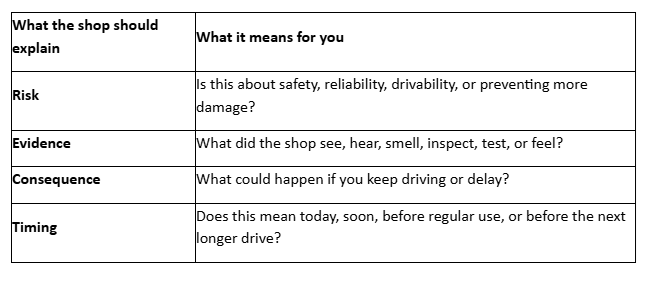
For an owner, the most useful explanation usually answers four questions:
The Federal Trade Commission’s auto repair guidance encourages vehicle owners to understand repair questions and shop communication before authorizing work. That principle matters here. You do not need to become a technician. You do need enough information to make a confident decision.
For Classic VW and Porsche, Symptoms Matter More Than Warning Lights
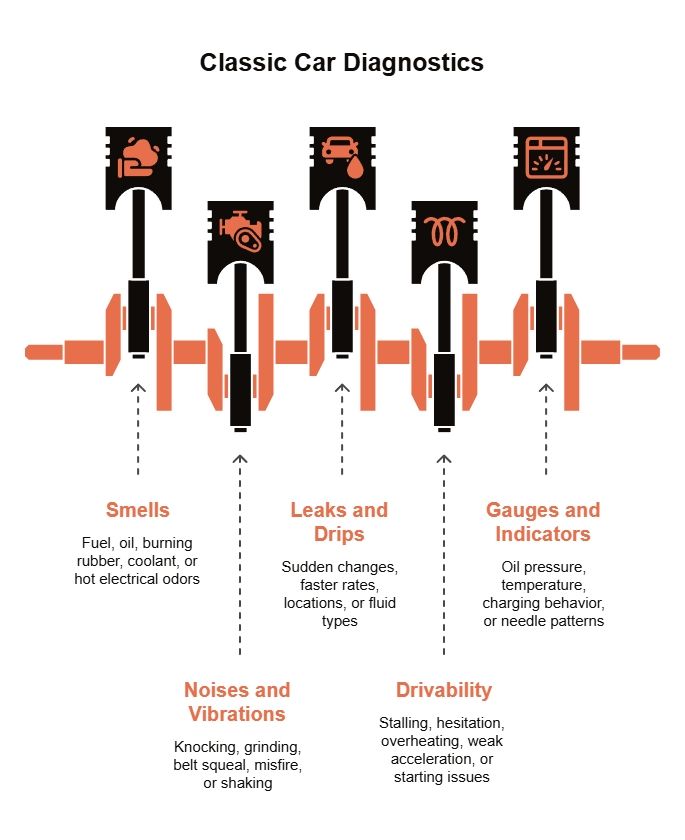
Classic vehicles often speak through physical symptoms.
A classic VW or Porsche may tell you something is wrong through smell, sound, feel, leaks, temperature behavior, or charging behavior. That is why a warning-light-centered explanation may not fit an older vehicle. Many classics simply do not have the same warning-light systems found on modern OBD-era cars.
For classic triage, a shop should pay close attention to clues like these:
- Smells: fuel, oil, burning rubber, coolant on applicable water-cooled models, or hot electrical odors
- Noises and vibrations: knocking, grinding, belt squeal, misfire feel, or a new shake under load
- Leaks and drips: sudden changes, faster leak rate, location, or fluid type
- Drivability: stalling, hesitation, overheating behavior, weak acceleration, or trouble starting
- Gauges and analog indicators: oil pressure, temperature, charging behavior, or a needle pattern that changes from normal
These examples are general principles. A specific car still needs a professional inspection before anyone can say what is safe, urgent, or repairable.
If your classic has a sharp fuel smell, a major leak, brake trouble, severe overheating behavior, or a new sound that changes quickly, the safest move is to stop driving and ask a qualified shop what to do next. Guessing is not the same as diagnosing.
For owners maintaining older vehicles, Orange Independent Auto Repair’s Classic Car Maintenance page is the most relevant internal resource. The shop also provides information for Porsche services, with the right focus on practical care rather than late-model feature claims.
For Modern OBD-Era Vehicles, Warning Lights Need Context
Modern vehicles are different.
On OBD-era cars, dashboard warning lights and scan information can help point the shop toward the affected system. But even then, a warning light is not the whole diagnosis. It is a starting point.
A good modern-vehicle explanation should still translate the finding into plain language:
“The warning light points us toward this system. Here is what we tested. Here is what the result suggests. Here is why we think it should be handled soon.”
That is much more useful than, “The light is on, so you need the repair.”
The California Bureau of Automotive Repair provides consumer information about auto repairs, maintenance, warranties, safety recalls, and repair-shop expectations. For safety-related concerns and recall information, the National Highway Traffic Safety Administration is also a high-authority source.
The practical rule is the same for classic and modern vehicles: the shop should translate the symptom or test result into a repair priority you can understand.
What a Calm Fix-Now Explanation Should Sound Like
A strong fix-now explanation should not sound dramatic. It should sound specific.
Here is a clear version:
“We found a fuel smell near the engine area, and that raises a safety concern. Because this is a classic vehicle, we do not want to treat that as a normal old-car smell. The next step is to inspect the source before you continue driving it regularly.”
That explanation works because it connects the symptom to the risk. It also explains why the issue belongs on the prompt-attention list.
Here is another owner-friendly example:
“The leak itself is small, but its location matters. It is close to a component where continued driving could make the problem worse. This is not a panic situation, but it should be handled before the car goes back into normal use.”
That is the tone you want. Calm. Direct. Useful.
A poor explanation sounds different:
“You need this right now.”
That may be true, but it is incomplete. It does not tell you what system is affected. It does not explain what the shop found. It does not tell you what could happen if you wait.
A fix-now recommendation should make the decision clearer, not more confusing.
When “Fix Now” Does Not Mean “Panic”
Prompt attention does not always mean immediate panic.
Sometimes it means the car should not be driven until the issue is inspected. Sometimes it means the repair should happen before the next longer drive. Sometimes it means the vehicle can be driven home carefully but should not return to normal use until the problem is addressed.
The exact timing varies by symptom, vehicle, inspection finding, and risk level. That is why the shop should avoid vague urgency. “Soon” is not specific enough when you are deciding whether to drive home, call for a tow, schedule service, or pause regular use.
A better explanation gives you practical direction:
- Is the vehicle safe to drive home?
- Should it stay parked?
- Can it be used locally until the appointment?
- Should the repair happen before the next freeway drive?
- If several repairs are listed, which one protects safety or reliability first?
Those are not aggressive questions. They are responsible questions.
Warning Signs That Urgency Is Being Explained Poorly
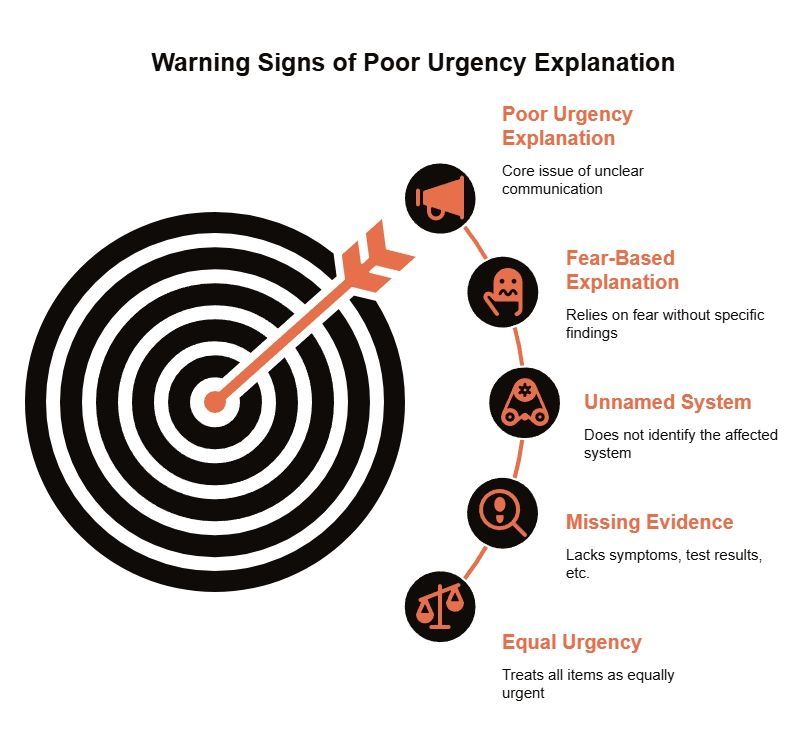
Not every unclear explanation means the recommendation is wrong. Sometimes the shop simply has not translated the finding well enough.
Still, you should slow down and ask for clarification when:
- The explanation relies on fear but gives no specific finding.
- The shop does not name the affected system.
- No symptom, inspection result, test result, sound, smell, leak, or drivability change is mentioned.
- Every item on the estimate is treated as equally urgent.
- You are told to approve work before the priority is explained.
- You ask what happens if you wait and do not get a clear answer.
A fair shop should be able to explain the difference between “fix now,” “plan soon,” and “monitor.” That distinction matters because it protects your car and your budget.
It also builds trust.
Questions to Ask Before Authorizing a Prompt Repair
You do not need a technical script. You need practical questions that force clarity.
Ask:
- “What makes this a fix-now item?”
- “What did you see, hear, smell, inspect, or test?”
- “Is this about safety, reliability, drivability, or preventing more damage?”
- “What could happen if the repair waits?”
- “Is the car safe to drive home?”
- “Can it be driven locally, or should it stay parked?”
- “If there are several repairs, what should be done first?”
- “What can wait, and what should be monitored?”
The California Bureau of Automotive Repair’s Write It Right resource explains repair authorization and documentation expectations for repair businesses in California. That does not mean every repair conversation needs to become legal or formal. It does mean clear estimates and clear authorization matter.
For a professional inspection or service conversation, Orange Independent Auto Repair lists its auto repair services in Orange, CA, including vehicle inspections and repair services.
How Priority-First Communication Builds Trust
Trust is not built by making every repair sound urgent. It is built by explaining priority honestly.
Orange Independent Auto Repair is a family-owned shop that has served Orange, CA and nearby communities since 1971. Its service-area references include Orange, Tustin, Anaheim, Yorba Linda, and Villa Park. The shop’s public materials emphasize fair, transparent service and practical owner education.
That matters because the best repair conversation is not just “Here is what is wrong.” It is “Here is what matters first, here is what can wait, and here is why.”
For classic VW and Porsche owners, that kind of communication is especially important. Older cars may have quirks, smells, sounds, and analog behavior that need context. A shop that understands those vehicles should be able to separate normal character from warning signs that deserve prompt attention.
The goal is not to scare you into saying yes.
The goal is to help you make a safer, clearer decision.
The Right Fix-Now Explanation Should Reduce Confusion
The words “you shouldn’t wait on this” should never stand alone.
They should be followed by a reason. A real fix-now explanation names the risk, points to the evidence, explains the consequence of waiting, and gives you practical timing.
That is true whether you drive a classic VW, an older Porsche, or a modern OBD-era car. The clues may differ, but the standard for communication should not.
You deserve repair guidance that is clear enough to act on and honest enough to trust.
If you are unsure whether a recommendation belongs on the fix-now list, contact Orange Independent Auto Repair or call (714) 633-7161 to ask about scheduling service at 187 S Main St, Orange, CA 92868.
Disclaimer: This article is for general owner education only. It is not a substitute for a professional vehicle inspection. If your vehicle smells strongly of fuel, has brake or steering concerns, overheats severely, leaks rapidly, or feels unsafe to drive, stop driving and contact a qualified repair professional.
Our Editorial Process
Our expert team uses AI tools to help organize and structure our initial drafts. Every piece is then extensively rewritten, fact-checked, and enriched with first-hand insights and experiences by expert humans on our Insights Team to ensure accuracy and clarity.
By Orange Independent Auto Repair Insights Team
The Orange Independent Auto Repair Insights Team develops owner-level, evidence-first guidance shaped by decades of hands-on experience serving classic VW and Porsche owners in Orange and the surrounding communities.