The Classic VW and Porsche Decision Check: Is This Symptom Urgent, Watchable, or Routine?
📌 Key Takeaways
Classic VW and Porsche symptoms become easier to handle when you sort them before guessing parts.
- Sort Risk First: Classify each symptom as urgent, watchable, or routine before deciding what to do next.
- Treat Danger Seriously: Strong fuel smell, smoke, overheating, brake changes, or fast leaks need quick professional guidance.
- Track Small Changes: Mild ticks, seeping, hesitation, or vibration deserve notes when they repeat or get worse.
- Plan Routine Care: Oil service, belts, hoses, fuel lines, brakes, and tires stay safer with regular checks.
- Explain Symptoms Clearly: Shops can help faster when you describe timing, smell, sound, leaks, and driving conditions.
The car’s clues matter most when you slow down, notice patterns, and choose the right next step.
Classic VW and Porsche owners will feel more confident sorting symptoms, preparing them for the detailed overview that follows.
~ ~ ~ ~ ~ ~ ~ ~ ~ ~ ~ ~ ~ ~ ~ ~ ~ ~
The car tells you before it fails.
Sometimes it is a fuel smell after the engine warms up. Sometimes it is a new tick, a drip on the cardboard under the car, a belt squeal at startup, or a gauge needle that sits somewhere it did not sit last week.
That moment can feel uncomfortable because classic VW and Porsche ownership asks more from the driver. Many classic vehicles do not explain themselves through modern warning lights. They speak through smell, sound, vibration, leaks, drivability, and analog gauges.
The first job is not to diagnose the part. The first job is to decide what kind of next step the symptom deserves.
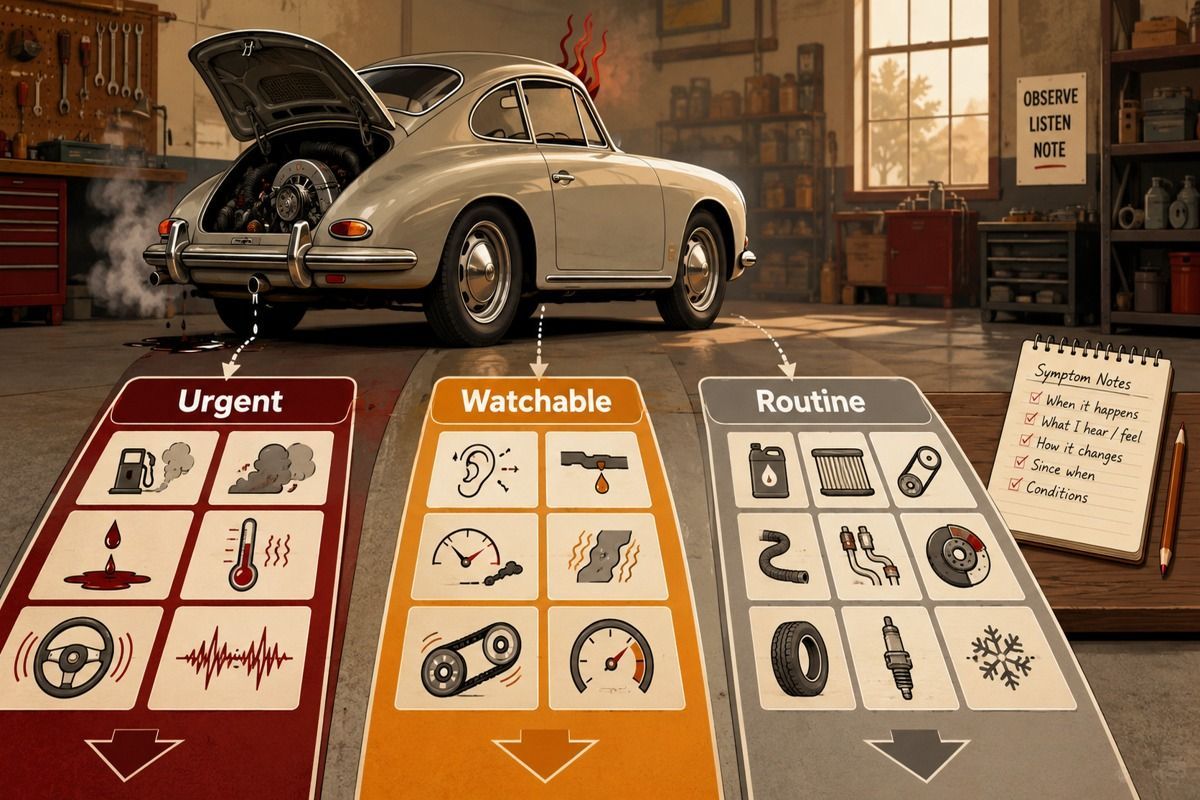
For classic VW and Porsche owners, most symptoms fall into one of three practical categories: urgent, watchable, or routine. Urgent means safety or damage risk may be present. Watchable means the symptom is not clearly dangerous right now, but it needs notes and a planned inspection. Routine means it belongs in normal maintenance planning.
This article is not a substitute for a professional inspection. It is a calm way to organize what you noticed before you call a shop.
Classic vs. Modern: Start With the Right Diagnostic Lens
A classic VW and Porsche symptom should not be treated the same way as a modern OBD-era warning-light problem.
That distinction matters. A modern vehicle may alert the driver through a check engine light, brake warning, temperature warning, or stored diagnostic code. Classic models rely entirely on physical feedback: unusual odors, erratic charging, running hot, or sluggish acceleration.
Use the right lens first.
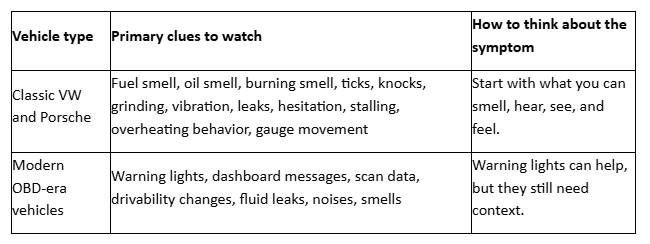
For classic vehicles, warning lights should not be the center of the decision. If a light exists, note it. Then come back to the more useful classic clues: smell, noise, leaks, gauges, and drivability.
Urgent Symptoms: Stop, Reduce Driving, or Call the Shop
Urgent symptoms are the ones that suggest safety risk, fire risk, overheating, loss of control, or fast mechanical damage.
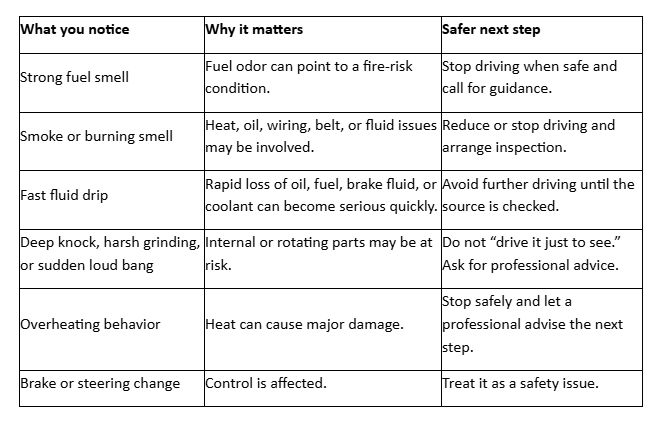
With a classic VW and Porsche, a strong fuel smell deserves immediate attention. So does smoke, fast dripping, sudden oil pressure concern, overheating behavior, hard brake pedal changes, a new grinding sound, a deep knock, or a belt squeal paired with charging trouble.
A classic car that still starts is not automatically safe to keep driving. That is the trap.
Treat these as urgent patterns:
General safety resources from the National Highway Traffic Safety Administration can help owners understand broader vehicle safety concerns, recalls, and reporting options. For repair-process questions in California, the California Bureau of Automotive Repair explains consumer repair expectations, estimates, authorizations, and records.
When a symptom affects safety, fire risk, overheating, or control, do not turn it into a driveway guessing game.
Watchable Symptoms: Take Notes Before They Become Vague Memories
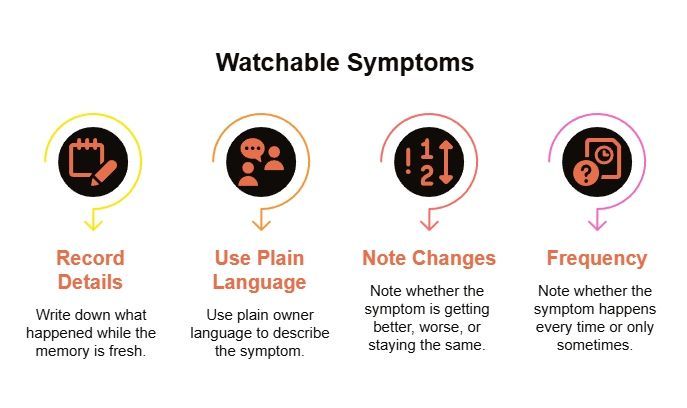
Watchable does not mean harmless.
It means the symptom is not clearly unsafe at this moment, but it has earned attention. Classic VW and Porsche owners know this category well. A faint tick, occasional hesitation, small oil spot, brief belt squeal, light vibration, or slightly different gauge behavior may not require panic. It does require a clear record.
Write down what happened while the memory is fresh.
Use plain owner language:
- when the symptom started
- whether the engine was cold or warm
- whether it happened at idle, under acceleration, while braking, while turning, or after a longer drive
- whether you noticed a fuel smell, oil smell, burning smell, leak, smoke, vibration, or gauge change
- whether it is getting better, worse, or staying the same
- whether it happens every time or only sometimes
A symptom that happens once may be watchable. A symptom that repeats, worsens, or combines with another clue deserves inspection.
For example, a light tick at idle may not carry the same concern as a new tick that becomes louder when warm and appears with an oil smell. A small old seep is different from a fresh wet spot that appears after every drive. A brief hesitation is different from repeated stalling.
Pattern changes the decision.
Orange Independent Auto Repair offers vehicle inspections and classic-focused service support for owners who want a clear explanation before authorizing work. The goal is not to sell every possible repair. The goal is to sort what matters now from what can be monitored.
Routine Symptoms: Plan Maintenance Without Turning It Into a Crisis
Routine maintenance keeps classic vehicles enjoyable.
Routine does not mean ignore it. It means plan it before it becomes stressful.
For classic VW and Porsche owners, routine planning often includes oil service, filters, belts, hoses, fuel lines, brake checks, tire condition, charging behavior, and seasonal tuning. These cars can be sensitive to age, storage, weather changes, and how often they are driven.
Use these general maintenance baselines as planning references:
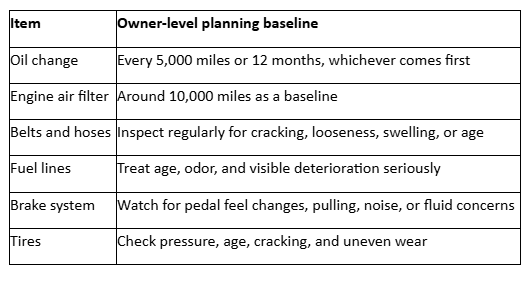
These are general planning principles. Exact needs can vary by vehicle, use, age, storage conditions, and prior maintenance history.
For broader service context, Orange Independent Auto Repair lists auto repair services including inspections, suspension service, transmission repair, engine repair, starters and alternators, and oil changes. For vintage owners, the shop’s classic car maintenance page explains its focus on classic vehicles, including classic VW and Porsche care.
Maintenance is less stressful when it has a plan.
The Classic VW and Porsche Decision Check
Use this table before deciding whether to stop driving, keep notes, or schedule routine service.
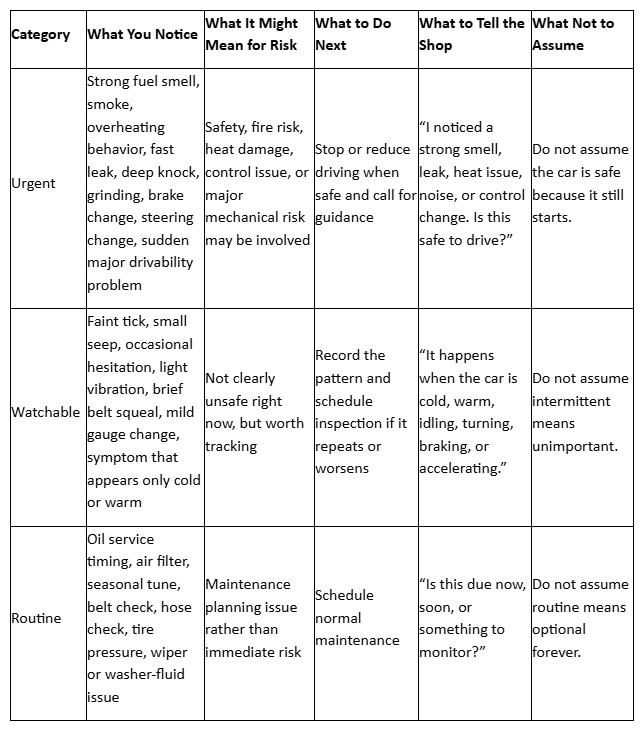
On modern OBD-era vehicles, warning lights can add useful context. On classic VW and Porsche vehicles, the more useful first clues are often physical: smell, sound, leak rate, drivability, and gauges.
What to Say When You Call the Shop
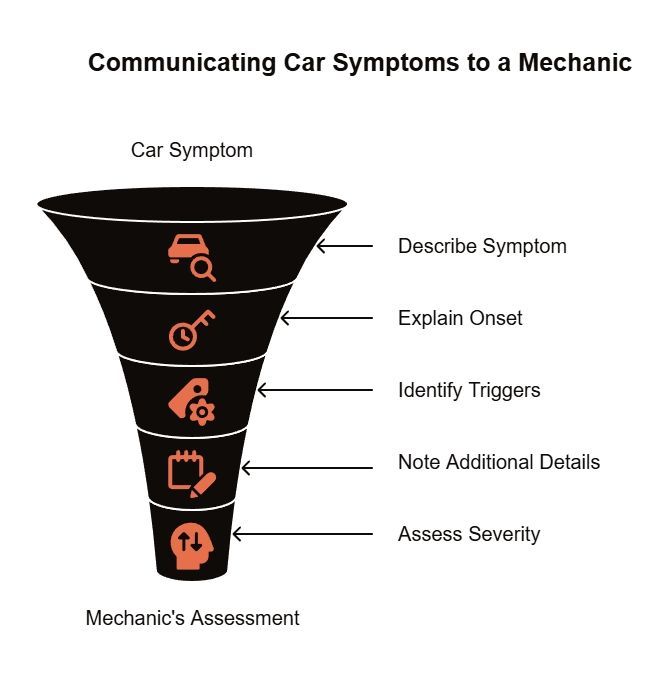
You do not need technical vocabulary.
A clear symptom story is more useful than a guessed diagnosis. Use a simple structure:
“I noticed ___. It started ___. It happens when ___. I also noticed ___. It is getting better, worse, or staying the same. Can you help me understand whether this is urgent, watchable, or routine?”
Here is what that can sound like:
“My classic VW has a fuel smell after it warms up. It started this week, and it is stronger after a short drive. I do not see a large drip, but the smell is new. Should it be driven, or should it be inspected first?”
Or:
“My Porsche has a light vibration at idle after sitting for several days. It smooths out once warm, and there is no fuel smell or visible leak. Is this something to monitor, or should it be looked at?”
That kind of detail helps the conversation start clearly. It also helps the shop separate safety concerns from routine planning.
The FTC’s Auto Repair Basics is a useful general consumer resource for asking questions, understanding repair discussions, and choosing a repair shop.
Why Orange Independent Auto Repair Fits This Kind of Conversation
Classic vehicles reward patience and honest communication.
Orange Independent Auto Repair is a family-owned shop serving Orange, Tustin, Anaheim, Yorba Linda, and Villa Park. The business has been family-owned since 1971, and its positioning emphasizes fair, transparent service for classic and modern vehicles.
That matters because classic VW and Porsche service is not just about replacing parts. It is about understanding the vehicle’s behavior, sorting priorities, and explaining what should happen next.
Sometimes the right answer is “fix this now.” Sometimes it is “watch this and come back if it changes.” Sometimes it is “plan this during routine maintenance.” A helpful shop should be able to explain the difference.
For more about the shop, visit the About page. Classic Porsche owners can also review the Porsche services page for related service information.
When You Are Not Sure, Choose Clarity
Uncertainty is not a failure. It is a reason to slow the decision down.
If the symptom involves fuel smell, smoke, overheating behavior, fast leaks, braking, steering, or a major drivability change, choose the safer next step. If the symptom is mild but repeating, write down the pattern and schedule a vehicle inspection. If it is routine maintenance, plan it before it becomes a problem.
Classic VW and Porsche ownership is easier when every symptom does not feel like a crisis.
Categorize the symptom, take precise notes, and make the call with a clear head.
To ask about a symptom or schedule service, contact Orange Independent Auto Repair.
Our Editorial Process
Our expert team uses AI tools to help organize and structure our initial drafts. Every piece is then extensively rewritten, fact-checked, and enriched with first-hand insights and experiences by expert humans on our Insights Team to ensure accuracy and clarity.
By Orange Independent Auto Repair Insights Team
The Orange Independent Auto Repair Insights Team develops owner-level, evidence-first guidance shaped by decades of hands-on experience serving classic VW and Porsche owners in Orange and the surrounding communities.