From Estimate Anxiety to Repair Confidence: How to Compare Recommendations by Priority
📌 Key Takeaways
Clear repair decisions start with priority, evidence, and a next step, not price alone.
- Start With Priority: Sort each recommendation into fix now, can wait, monitor, or not needed yet.
- Match The Evidence: Classic VW and Porsche issues often show up as smells, leaks, noises, or driving changes.
- Ask What Supports It: A clear repair recommendation explains what was found before asking for approval.
- Separate Fear From Risk: Urgent repairs should connect to safety, reliability, drivability, or possible added damage.
- Look For Restraint: A trustworthy shop can explain what does not need repair yet.
Priority first = calmer decisions and clearer repair conversations.
Classic VW and Porsche owners comparing repair estimates will gain a simple decision filter here, preparing them for the detailed overview that follows.
~ ~ ~ ~ ~ ~ ~ ~ ~ ~ ~ ~ ~ ~ ~ ~ ~ ~
Every estimate feels different.
You have two or three repair recommendations open on your phone. One sounds urgent. One is cheaper. One includes a longer list of work. The words blur together, and the real question sits underneath everything: What actually needs attention first?
For owners of a vintage air-cooled vehicles, determining priority can feel even more challenging. Older vehicles do not always communicate problems the way modern OBD-era cars do. A classic may speak through a fuel smell, a new vibration, a drip on the garage floor, a hot-running pattern, or a gauge that starts behaving differently.
You do not need to become a mechanic to make a better repair decision. You need a clear way to compare each recommendation by evidence, urgency, and next step.
That turns an estimate from a pressure moment into a practical conversation.
Start With Priority, Not Price
Price matters. A fair estimate should respect your budget.
Still, price alone does not tell you whether the recommendation is clear. A low number can leave out important context. A higher number can look intimidating before you understand what is urgent and what can wait.
Start with priority instead.
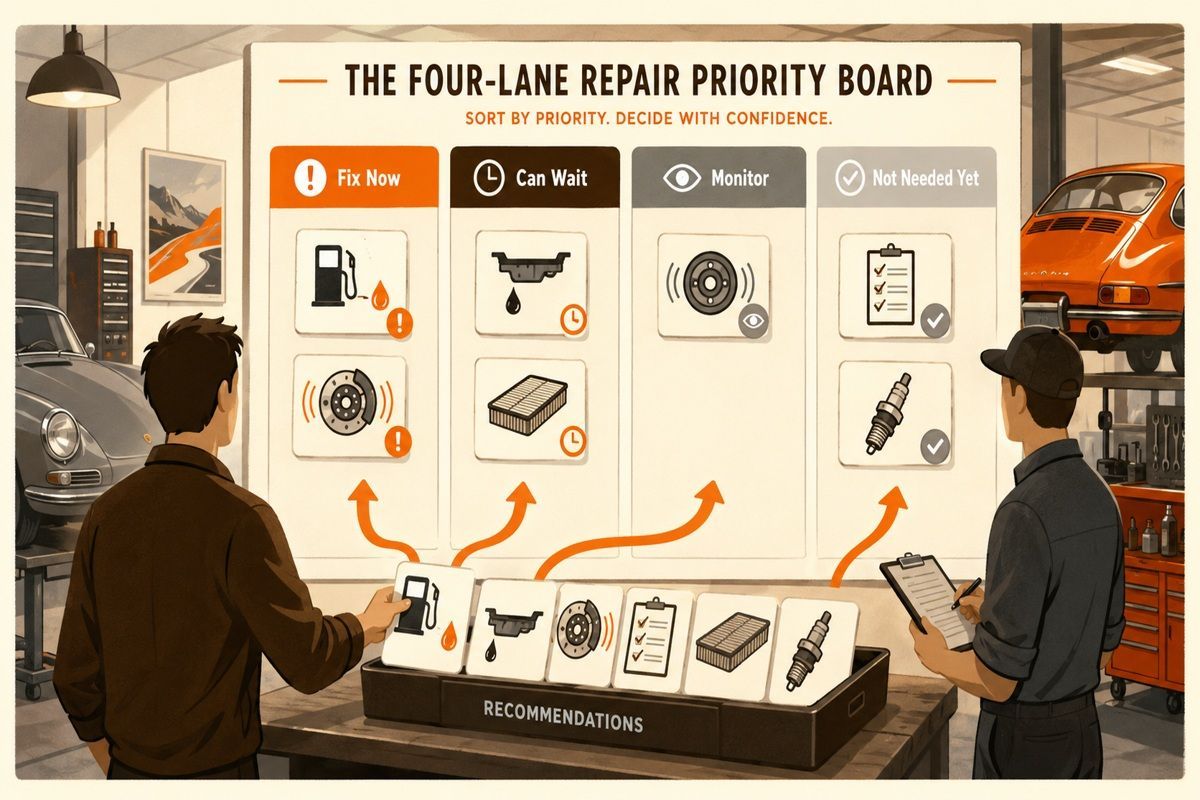
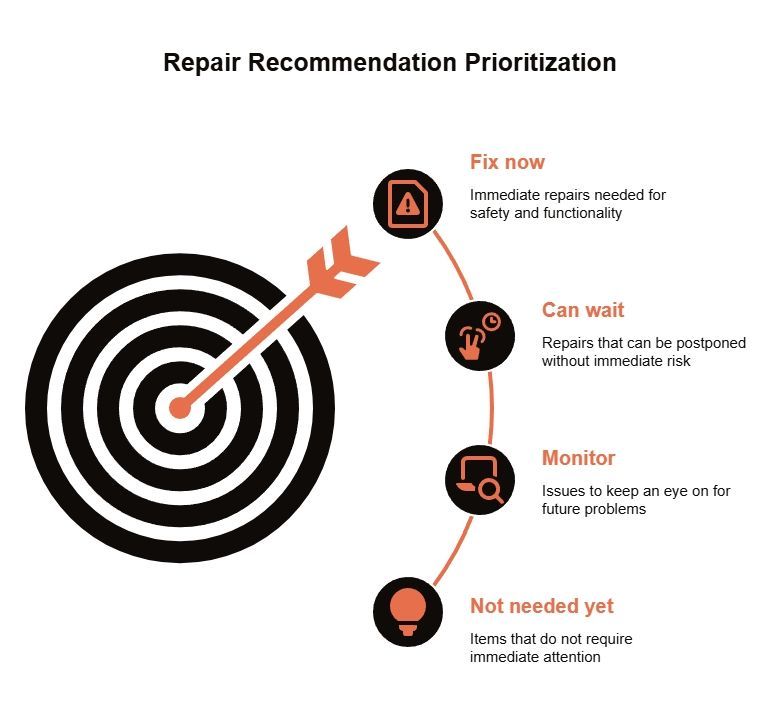
A helpful recommendation should sort the work into simple categories:
- Fix now
- Can wait
- Monitor
- Not needed yet
That last category matters. A trustworthy repair conversation is not only about what gets fixed. It is also about what does not need to be sold prematurely.
For classic VW and Porsche vehicles, this can be especially useful because symptoms may not come with a simple warning-light message. A recommendation should explain what the technician observed and why it matters for safety, reliability, drivability, or preservation.
A good repair recommendation makes the decision smaller. Smaller decisions are easier to make well.
Classic vs. Modern: The Evidence Should Match the Vehicle
Classic and modern vehicles often need different diagnostic framing.
For a classic VW and Porsche, the strongest evidence often comes from physical symptoms. That may include a fuel smell after parking, oil spots that appear suddenly, a grinding noise, a belt squeal, hesitation under load, stalling, overheating behavior, charging irregularities, or analog gauge changes where the vehicle has those gauges.
Modern OBD-era vehicles can also provide warning lights, scan data, and electronic fault information. That information can be useful, but it should not be generalized to older vehicles that were not built around modern onboard diagnostics.
A clear shop should explain the evidence in a way that matches the car.
For example, a recommendation for a classic VW should not rely on vague language like “the system shows a warning.” A better explanation would connect the concern to what was seen, smelled, heard, felt, inspected, or tested.
For a modern OBD-era vehicle, a warning light or fault code may be part of the evidence. Even then, the recommendation should still explain what the code means, what was confirmed, and what the next step should be.
Evidence is not just data. Evidence is the reason behind the recommendation.
The Four Things Every Clear Recommendation Should Explain
A repair recommendation becomes easier to compare when it answers four questions.
1. What is the issue in plain language?
A useful explanation should be understandable without a technical dictionary.
“Your car has a fuel delivery concern” may be accurate, but it may not be enough. A clearer explanation might say, “There is a fuel smell near the engine area after running, so the vehicle should not be driven until the source is inspected.”
That tells you what was noticed and why it matters.
2. What evidence supports it?
Ask what the shop found.
For classic VW and Porsche vehicles, evidence may come from:
- a smell, such as fuel, oil, coolant, or burning material
- a noise, such as knocking, grinding, squealing, or misfire-like behavior
- a leak or drip, including its location and rate
- drivability changes, such as hesitation, stalling, overheating, or loss of power
- gauge behavior, where applicable
For modern OBD-era cars, evidence may also include warning lights, stored diagnostic codes, or electronic test results. The key is that the recommendation should not rest on a label alone.
The Federal Trade Commission’s Auto Repair Basics encourages consumers to ask questions and understand repair recommendations before authorizing work. That principle applies whether the vehicle is vintage or modern.
3. How urgent is it?
Not every recommendation belongs in the same category.
A fuel smell on a classic VW or Porsche may be treated very differently from a minor seep that has not changed. A sudden grinding noise may deserve faster action than a maintenance item that can be planned for the next visit.
A good recommendation should tell you whether the issue is:
Fix now: The concern may affect safety, reliability, or further damage if ignored.
Can wait: The issue is real, but it can be planned.
Monitor: The condition should be watched because changes may raise the priority.
Not needed yet: The item does not currently justify repair.
These categories are general decision tools. They do not replace a professional inspection, and the correct priority can vary by vehicle condition, use, and symptom severity.
4. What is the next step?
A recommendation should end with a clear action.
That action might be approving the repair, scheduling a follow-up, watching for a change, planning maintenance, or getting a more detailed vehicle inspection. If the answer is vague, keep asking until you know what to do next.
A Simple Repair Priority Matrix
Use this matrix when you are comparing recommendations and trying to decide what deserves attention first.
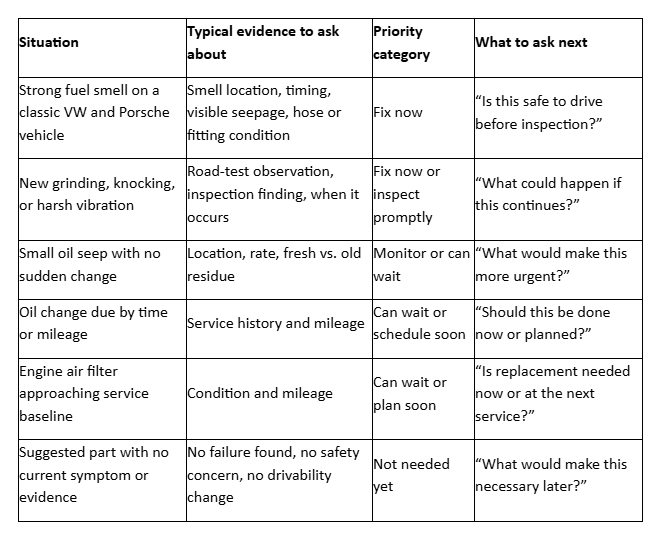
If oil-change timing comes up, use 5,000 miles or 12 months, whichever comes first, as the standard baseline. For an engine air filter, around 10,000 miles is a reasonable baseline unless the vehicle’s condition, use, or service history points to a different need.
The matrix is not a diagnosis. It is a way to ask better questions.
If the vehicle smells strongly of fuel, overheats, loses braking confidence, changes suddenly, leaks heavily, or feels unsafe, stop treating the issue as a paperwork decision. Ask a qualified repair professional whether the vehicle should be driven.
How to Compare Recommendations Without Quote Shopping
Comparing repair recommendations is not the same as chasing the lowest number.
A better comparison asks which recommendation gives the clearest explanation. Look for the shop that can explain the issue, the evidence, the priority, and the next step without making every item sound equally urgent.
Use calm language when you compare:
“Can you explain why this is urgent?”
“What did you see during the inspection?”
“Is this a safety issue, a reliability issue, a maintenance item, or something to monitor?”
“What happens if this waits?”
“Is anything on this list not needed yet?”
These questions keep the conversation fair. They also protect you from two common mistakes: approving everything out of fear or delaying a real concern because the estimate felt overwhelming.
The goal is not to argue. The goal is to understand.
What a Clear Explanation Sounds Like
A weak recommendation makes you feel cornered.
A stronger recommendation gives you a path.
For a classic VW and Porsche owner, “You need this fixed” is not enough. A clearer explanation might sound like this:
“There is a fresh fuel smell after the engine has been running. Because fuel-related concerns can affect safety, this should be inspected before normal driving continues.”
Or:
“The oil seep is minor right now and does not appear to be changing quickly. It should be monitored, and if the drip becomes fresh, larger, or starts reaching hot components, the priority changes.”
That kind of language does not pressure you. It helps you decide.
Where Orange Independent Auto Repair Fits
Orange Independent Auto Repair is a family-owned shop serving Orange, Tustin, Anaheim, Yorba Linda, and Villa Park. The business has been family-owned since 1971, and its service approach centers on fair, transparent repair conversations.
The shop specializes in vintage Volkswagen and Porsche models, while also providing comprehensive service for modern European, Asian, and domestic vehicles. Owners looking for classic-focused service can review the shop’s Classic Car Maintenance page, and Porsche owners can also visit the Porsche Services page.
For broader repair needs, Orange Independent Auto Repair lists its official Services, including vehicle inspections, suspension service, transmission repair, engine repair, oil changes, starters, and alternators.
The most useful trust signal is not a claim about being the loudest or cheapest option. It is a shop's willingness to clearly differentiate immediate safety risks from baseline preventative maintenance.
That is how a repair shop earns confidence.
Questions to Ask Before Authorizing Work
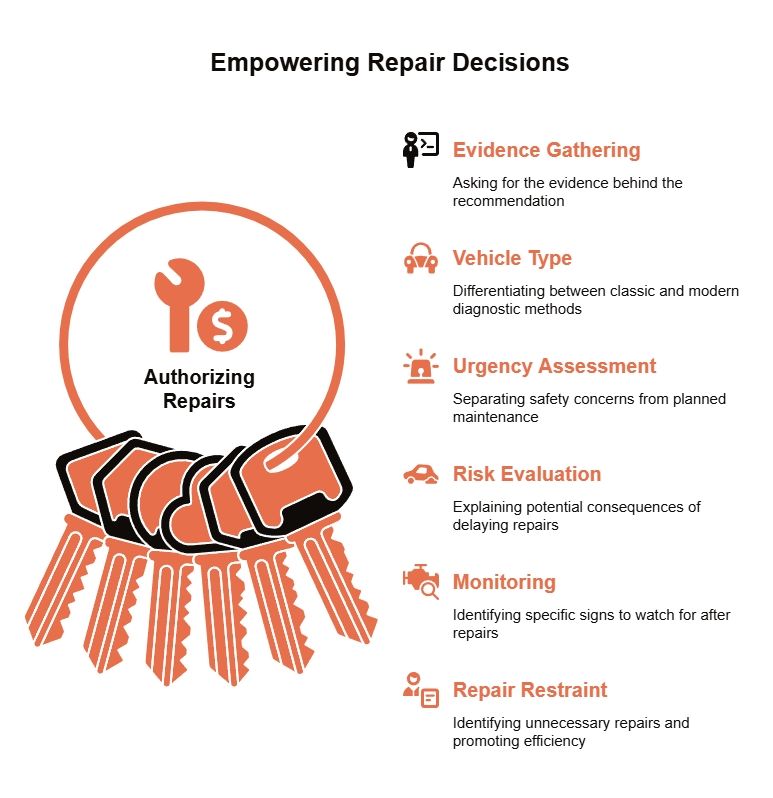
Before approving a repair, ask questions that reveal priority.
- What did you find?
Ask for the evidence behind the recommendation. - Is this classic or modern diagnostic evidence?
For classic VW and Porsche vehicles, ask about smells, noises, leaks, drivability, and gauge behavior. For modern OBD-era vehicles, warning lights and scan data may also matter. - What makes this urgent or not urgent?
This helps separate safety concerns from planned maintenance. - What happens if this waits?
A clear answer should explain likely risk without fear-based pressure. - What should be monitored?
Monitoring should come with specific signs to watch for. - Is anything not needed yet?
This question helps identify repair restraint, which is often a sign of a fair recommendation.
California’s Bureau of Automotive Repair provides consumer information on estimates, authorization, and repair records through its Maintenance and Repairs resource. Its Write It Right resource also explains documentation and authorization standards in repair transactions.
Frequently Asked Questions
Should classic VW and Porsche owners compare estimates by price?
Price matters, but it should not be the only comparison point. Compare how clearly each recommendation explains the symptom, evidence, priority, and next step. Once those pieces are clear, price becomes easier to judge fairly.
Are warning lights useful for classic VW and Porsche diagnostics?
Not as the main trigger. Many classic vehicles do not use warning-light systems the way modern OBD-era vehicles do. Classic triage should focus on smell, sound, leaks, drivability, and gauges where applicable.
What does “monitor” mean on a repair recommendation?
“Monitor” means the condition is not necessarily urgent today, but it should be watched. A good recommendation should tell you what change would make it more serious.
What does “not needed yet” mean?
It means the item does not currently justify repair based on the evidence available. That can be a strong trust signal when the shop also explains what would make it necessary later.
When should a repair move into “fix now”?
A repair may become “fix now” when it affects safety, reliability, drivability, or the risk of additional damage. The exact answer varies by vehicle and symptom, so ask what evidence supports the priority.
Ready for a Clearer Repair Conversation?
The next time an estimate feels confusing, do not start with the scariest wording or the lowest price.
Start with priority.
Ask what was found. Ask whether the evidence fits a classic VW and Porsche vehicle or a modern OBD-era diagnostic process. Ask what is urgent, what can wait, what should be monitored, and what is not needed yet.
If you want help making sense of a recommendation, Orange Independent Auto Repair offers owner-level explanations, vehicle inspections, and repair guidance for drivers in Orange and nearby communities. You can learn more about the shop on the About page or contact the team through the official Contact page.
Our Editorial Process
Our expert team uses AI tools to help organize and structure our initial drafts. Every piece is then extensively rewritten, fact-checked, and enriched with first-hand insights and experiences by expert humans on our Insights Team to ensure accuracy and clarity.
By Orange Independent Auto Repair Insights Team
The Orange Independent Auto Repair Insights Team develops owner-level, evidence-first guidance shaped by decades of hands-on experience serving classic VW and Porsche owners in Orange and the surrounding communities.