Check-Engine Light Diagnostics: Drive, Reduce Use, or Tow? A Simple Decision Tree for European Cars
📌 Key Takeaways
A warning light demands a clear safety decision in seconds, not guesswork or delay.
- Color and Behavior Form Your First Filter: Red or flashing lights paired with overheating, brake issues, heavy steering, or severe shaking mean stop and tow immediately—driving risks catastrophic damage.
- Amber with Normal Feel Signals Reduce Use: When the light is steady amber and the car drives normally, short gentle trips directly to a qualified shop protect both safety and your budget without the cost of an unnecessary tow.
- Codes Point to Systems, Not Failed Parts: Reading a trouble code from a free scanner or app identifies which system complained, but guided tests using smoke machines, meters, and scopes reveal the actual root cause and prevent expensive parts-darting.
- Diagnostics Builds a Priority Plan, Not Just a Repair List: Professional check-engine light diagnostics transforms fault codes into a documented inspection with photos, then sorts repairs into Now, Soon, and Later categories backed by a written warranty so you approve only what matters most.
Triage protects your engine; diagnostics protects your budget.
European car owners in Orange, Tustin, Anaheim, Yorba Linda, and Villa Park will get immediate clarity here, preparing them for the detailed triage framework that follows.
The light just appeared.
You're sitting in your car, maybe in a parking lot or at a stoplight, and an amber or red warning light has just illuminated on your dashboard. Your mind races through questions: Can I drive home? Should I pull over right now? Do I need a tow truck?
This article solves that exact moment of uncertainty. When a check-engine or warning light appears on your European car—whether it's an older Audi, BMW, Mercedes, or a classic VW or Porsche—you need clear guidance on whether it's safe to drive, whether you should reduce use and head straight to a shop, or whether you need to call for a tow immediately. The answer depends on the light's color, its behavior, and what else your car is telling you through sounds, smells, or how it's performing.
Here's what proper Check-Engine Light Diagnostics actually involves: It's more than reading trouble codes. Professional diagnostics use appropriate tools and guided tests to understand what the light is really telling you about your engine and related systems. At European car repair services in Orange, CA, this process turns panic into a clear plan.
Use the decision framework on this page to make an immediate safety decision. Then, once you safely arrive at a qualified shop, diagnostics feeds into a documented vehicle inspection with photos, followed by a Now/Soon/Later priority plan backed by a written warranty. You'll know exactly what needs attention right away, what can wait, and what the real cost will be before any work begins.
First Things First: Is It Safe to Drive Right Now?
Taking 30 seconds to assess the situation protects your engine, your safety, and your budget. Driving on certain warning lights can turn a small problem into thousands of dollars in damage. Other lights signal immediate safety risks that put you and other drivers in danger.
This article focuses on European cars, including older models and classics, but the safety logic aligns with common manufacturer conventions. Remember that nothing here overrides your owner's manual or any "Stop vehicle" message on your dash. When in doubt, the safest choice is always to stop, turn off the engine, and call for help.
Quick Color & Behavior Guide
Think of each warning light as part of a traffic light system:
Red (steady or flashing) signals high risk. This usually means stop driving and arrange a tow.
Amber or yellow (steady) signals caution. Reduce your use of the car and get to a shop soon.
Flashing (any color) signals elevated urgency. When paired with bad symptoms, this often means tow immediately.
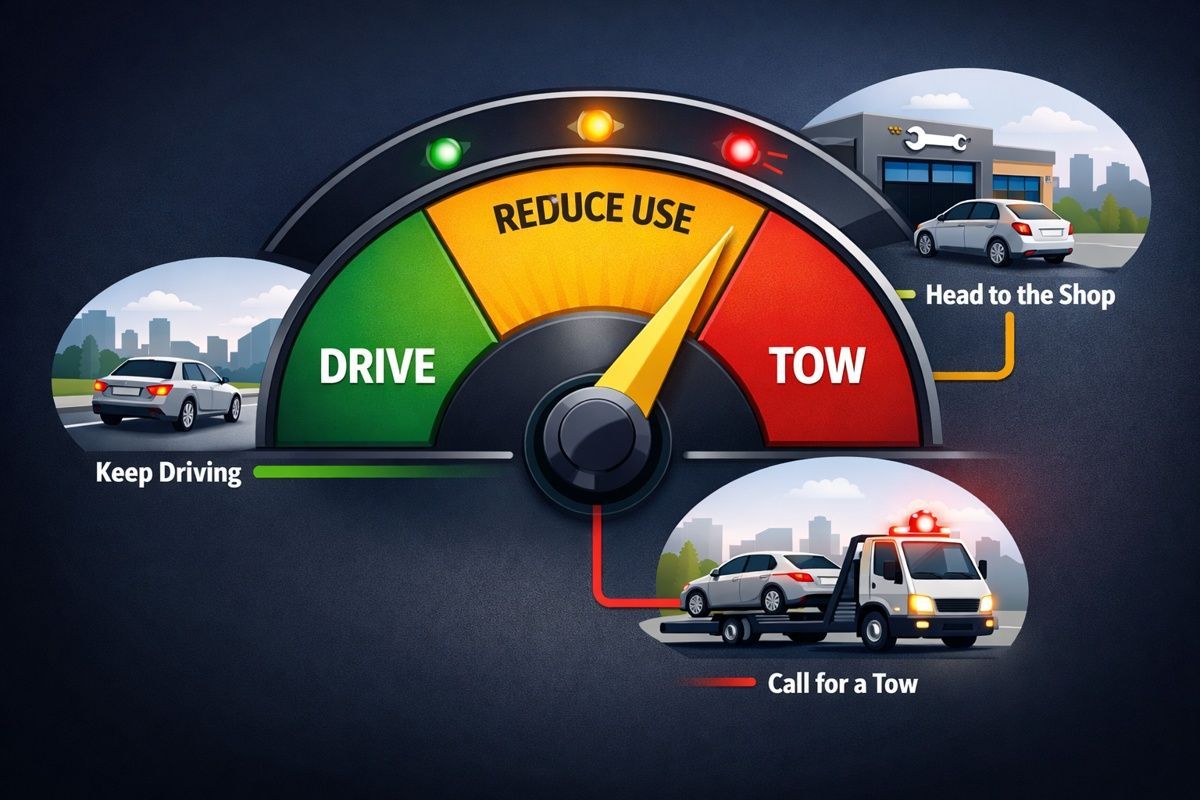
The Three Possible Answers: Drive, Reduce Use, or Tow
Drive means it's generally safe to drive normally for now, but you should schedule diagnostics soon. The light is telling you something needs attention before it becomes urgent.
Reduce Use means take short, gentle trips directly to a qualified shop. No highway speeds, no heavy loads, no detours. The car can move under its own power, but continuing to drive normally risks making the problem worse.
Tow means do not drive the vehicle at all. Arrange for a tow truck immediately. The risk of catastrophic damage or a safety failure is too high to take any chances.
When You Must Tow Immediately (Never Drive Cases)
The highest-risk systems are oil pressure, overheating, brakes, steering, and severe engine misfire. When these systems fail or warn you of imminent failure, the safe answer is always to tow. These examples aren't exhaustive, and your owner's manual or any "Stop vehicle" message always takes priority.
Top 5 "Tow Now" Triggers
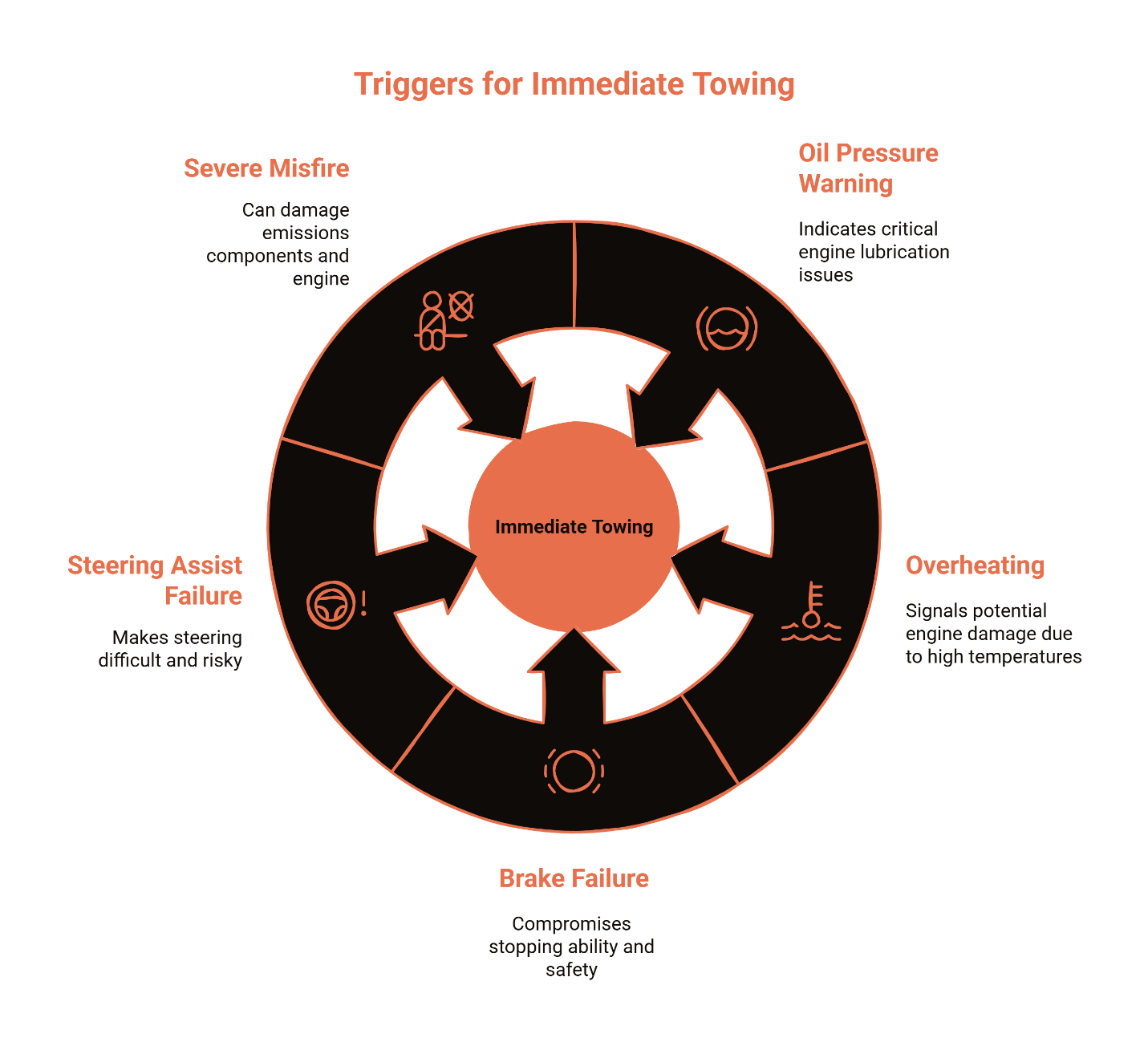
- Flashing red oil can or red oil-pressure message. Oil pressure keeps your engine's moving parts from grinding against each other. Without it, an engine can seize in minutes. Any red oil warning means stop immediately and call for a tow.
- Temperature gauge in the red or red overheating warning. An overheating engine risks warping the cylinder head or blowing the head gasket. Continuing to drive can turn a cooling system repair into an engine replacement.
- Brake warning combined with a soft or sinking pedal. If your brake pedal feels different and a warning light is on, your ability to stop safely is compromised. This is not a situation where you "limp" to the shop.
- Steering assist failure with very heavy steering feel. Modern European cars rely on power steering. If the system fails, the steering wheel can become nearly impossible to turn, especially at low speeds or when parking. Tow the car rather than risk losing control.
- Severe shaking or misfire with a flashing check-engine light. A flashing check-engine light means the engine is misfiring badly enough to damage the catalytic converter. The shaking signals unburned fuel entering the exhaust system, where it can overheat and destroy expensive emissions components.
"If a red oil can is flashing, your engine is asking you to stop—listen."
These are examples based on common safety conventions. Always defer to any "Stop vehicle" message, your owner's manual, or a qualified technician's advice.
When You Can Reduce Use and Drive Gently to a Shop
Reduce Use applies to situations where the light is steady amber, the car feels normal, and there are no obvious safety or performance issues. You can drive short distances at moderate speeds, but the goal is to get the car to a qualified shop as soon as possible.
Examples of "Reduce Use" Situations
An amber check-engine light appears, but the car accelerates normally, sounds normal, and shows no smoke or unusual smells. This might indicate an emissions or sensor issue, but it still needs diagnostics soon.
An emissions-related warning comes on without any misfire or overheating symptoms. Generic emissions messages or mild system faults often fall into this category.
AdBlue or diesel exhaust fluid range warnings where the car is still operating normally. Many diesel European cars will eventually limit power or prevent restarting if DEF runs out, so addressing this promptly matters even when the car feels fine.
Even in these cases, avoid delaying for days or weeks. What starts as a small issue can escalate. Reduce Use means you're choosing to drive gently and briefly to get proper Check-Engine Light Diagnostics rather than ignoring the warning.
When It's Generally Okay to Drive (But Still Schedule Diagnostics)
Some situations are lower urgency. For example, if you recently had a repair done and the light came back on due to a loose connection, or if you know you left the gas cap loose after refueling, the immediate risk may be minimal.
That said, this guidance must remain conservative. If your owner's manual says otherwise, or if you have any doubt about the light's meaning, choose the safer path. Even low-urgency lights deserve professional attention to confirm the issue and prevent it from becoming urgent.
Why "Just Clearing Codes" Isn't Enough
A common misconception is that reading a trouble code tells you exactly which part failed. In reality, codes point to systems or circuits, not guaranteed failed components. A code for an oxygen sensor might actually be caused by a vacuum leak, an exhaust leak, or fuel pressure issue. Simply replacing the sensor without testing wastes money and often doesn't fix the problem.
This is where Check-Engine Light Diagnostics becomes essential. Guided tests using smoke machines, voltage meters, and oscilloscopes help technicians narrow down the root cause. The result is accurate repairs the first time, not parts-darting and repeat visits.
The Simple Decision Tree: From Dash Light to Safe Next Step
An effective triage process starts with the light's appearance and follows a simple logic path:
Check the color. Red almost always means stop or tow. Amber usually means caution and schedule service soon. Flashing means the urgency is higher than steady.
Check the behavior. Steady lights indicate a problem that's present but stable. Flashing lights, especially on the check-engine light, signal active damage happening right now.
Check for symptoms. Is the engine overheating? Is the brake pedal soft? Is the steering heavy? Are there strong smells or visible smoke? Is the engine shaking violently? These physical symptoms elevate urgency and often point to a "Tow Now" situation.
Follow the path to your answer. Based on color, behavior, and symptoms, the tree leads to one of three outcomes: Drive, Reduce Use, or Tow.
Decision Tree Summary
If the light is red or the car is overheating, losing brakes, losing steering assist, or shaking badly with a flashing check-engine light, choose Tow. If the light is amber and the car feels normal, reduce use and drive gently straight to a qualified shop soon. If symptoms are mild or previously known and the car feels normal, driving may be okay for a short time, but proper Check-Engine Light Diagnostics is still needed to confirm safety and build a plan.
How Orange Independent Uses Your Triage Once You Arrive
Once you safely bring your car to the shop, a technician confirms your symptoms and uses professional diagnostic equipment appropriate for European vehicles. These tools help run guided tests to isolate the root cause.
This sequence—diagnostics → inspection → Now/Soon/Later plan—demonstrates how Check-Engine Light Diagnostics turns a warning light into a prioritized, visual, and budget-friendly plan. It's the professional follow-through after your safe triage decision.
If you're still unsure whether you should drive or tow, call (714) 633-7161 and our team can help you think through the decision in real time based on what you're seeing and feeling from your car.
Common Pitfalls When Deciding to Drive, Reduce Use, or Tow
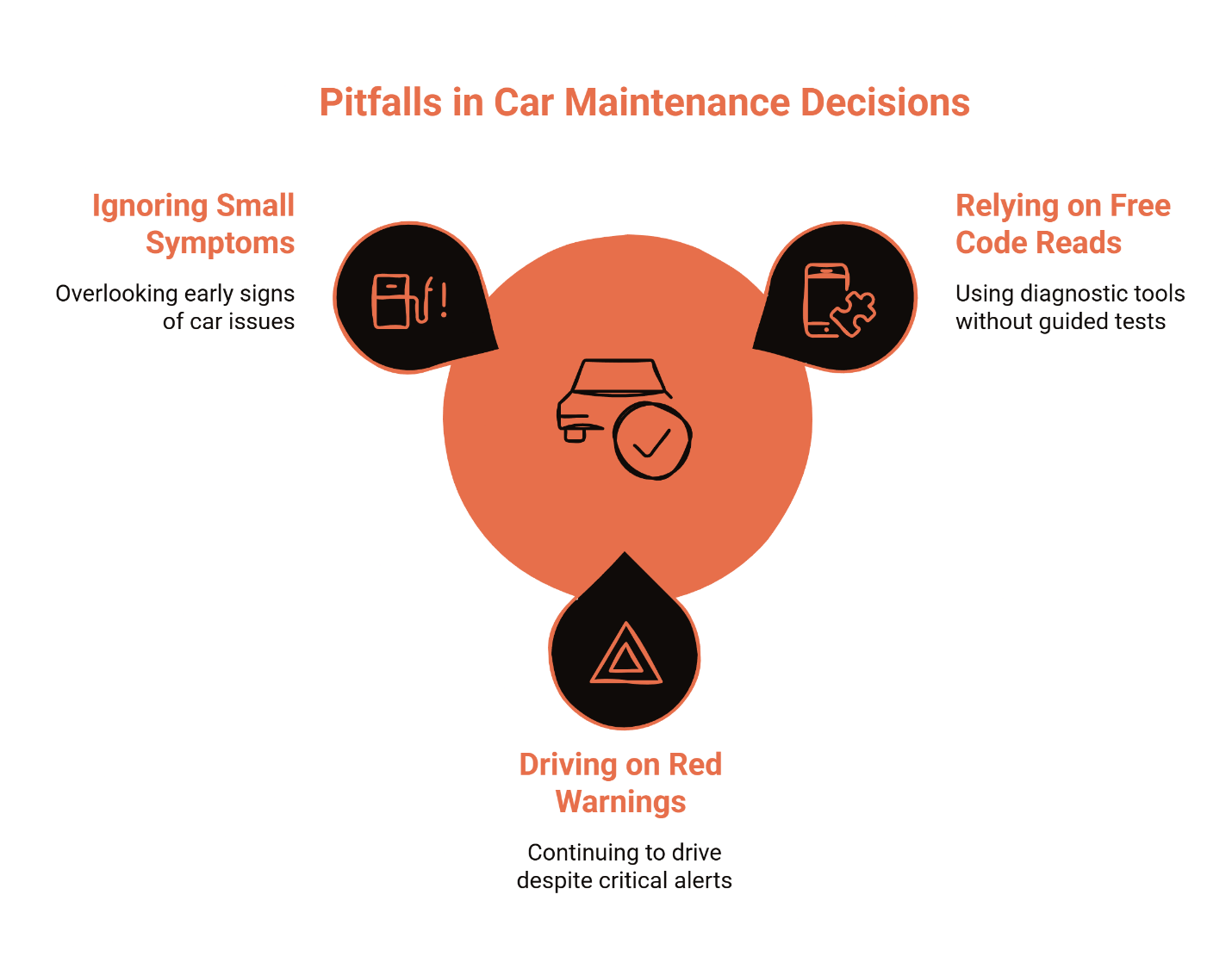
Relying Only on a Free Code Read or App
Many auto parts stores offer free code reads, and smartphone apps can connect to your car's diagnostic port. These tools have value for pulling codes, but they don't perform the guided tests needed to confirm the root cause. A code is a starting point, not a diagnosis. Making a Drive or Tow decision based only on a code number can lead you astray.
Driving on Red or Flashing Warnings "Just This Once"
The temptation to push a car "just a few more miles" on a red or flashing light is understandable, especially if you're close to home or work. But those few miles can cause catastrophic damage. An engine that loses oil pressure or overheats can fail completely in a matter of minutes, turning a repair into a replacement.
Ignoring "Small" Symptoms Because the Car Still Moves
A subtle misfire, a faint burning smell, or a minor vibration paired with a warning light may not feel urgent. But these symptoms often signal a problem in its early stage. Ignoring them allows the issue to escalate, often into more expensive and dangerous territory.
What Happens After Diagnostics: From Codes to a Priority Plan
After the technician retrieves fault codes and completes guided tests, the next step is organizing the findings into a clear plan. The vehicle inspection documents everything with photos, creating a visual record you can review from your phone.
Items are sorted into Now, Soon, and Later categories. "Now" means the repair is urgent for safety or to prevent immediate damage. "Soon" means it should be addressed in the next few weeks or months. "Later" means it's something to watch but not urgent.
This planning process aligns repairs with your safety and budget, and the written warranty ensures promises are kept. It's the logical conclusion of proper Check-Engine Light Diagnostics: from warning light to clear decision to prioritized action.
When to Call, When to Tow, and How We Help
Three takeaways guide your next step when a warning light appears:
- Red or flashing lights paired with safety or performance issues mean tow right away. The risk of damage or danger is too high to drive.
- Amber, steady lights with normal drivability mean reduce use and drive gently to a qualified shop soon. Don't delay for weeks.
- Once you arrive, diagnostics → inspection → Now/Soon/Later plan backed by a written warranty gives you a clear path forward.
Orange Independent Auto Repair provides calm, neighborly guidance and visual proof every step of the way. Whether you need immediate help assessing a warning light or full classic VW and Porsche services, our team serves European car owners near Orange, Tustin, Anaheim, Yorba Linda, and Villa Park.
Call (714) 633-7161 for Expert Automotive Care or contact us today to schedule your car repair service. We're ready to turn that warning light into a clear, safe, and budget-friendly plan.
Our Editorial Process
Our expert team uses AI tools to help organize and structure our initial drafts. Every piece is then extensively rewritten, fact-checked, and enriched with first-hand insights and experiences by expert humans on our Insights Team to ensure accuracy and clarity.
About the Orange Independent Auto Repair Insights Team
The Orange Independent Auto Repair Insights Team is our dedicated engine for synthesizing complex topics into clear, helpful guides. While our content is thoroughly reviewed for clarity and accuracy, it is for informational purposes and should not replace professional advice.